Congress Advances CBDC Ban Until 2030 Through Major Housing Reform Bill

TheNewsCryptoPubblicato 2026-06-17Pubblicato ultima volta 2026-06-17

Introduzione

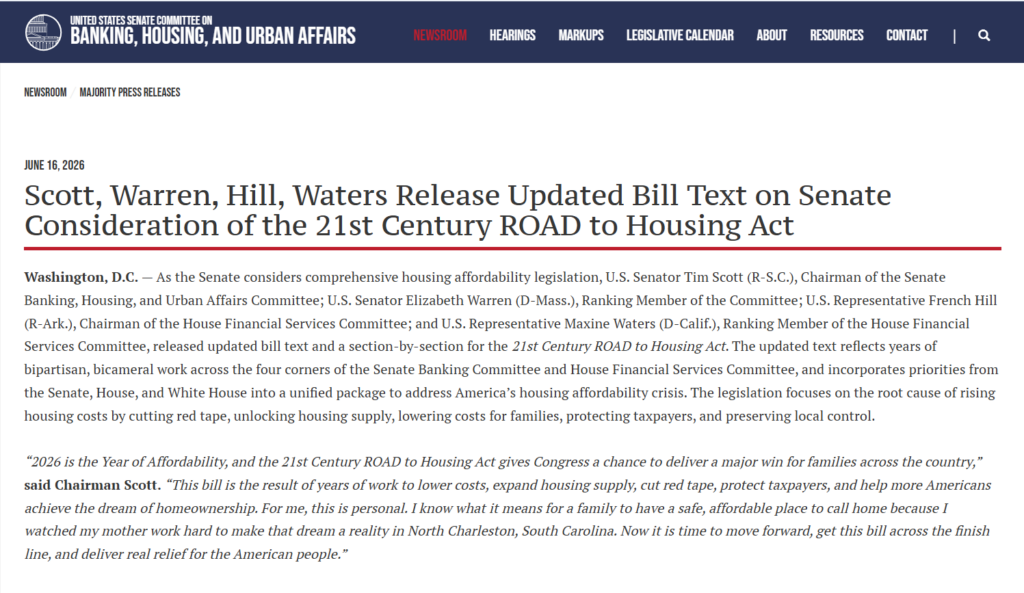
Congress has passed the 21st Century Road to Housing Act, a bipartisan bill primarily focused on housing reform to improve affordability and supply. Included within it is a significant provision that bans the Federal Reserve from issuing a central bank digital currency (CBDC) or "digital dollar" before December 31, 2030. The measure defines a CBDC as a dollar-denominated digital asset, a direct liability of the Fed, accessible to all Americans. Proponents argue the ban allows more time to study a digital dollar's impacts and addresses concerns about privacy, financial surveillance, and government overreach in digital payments. The provision specifically targets a retail CBDC but does not restrict permissionless blockchain networks. This crypto-related language, embedded in broader housing legislation, has drawn considerable attention for its potential to shape the future of digital assets and payments in the U.S. The bill's final passage will determine if the ban takes effect for the next decade.

Legislators have passed a bill aimed at pushing housing reforms that feature a temporary ban on a Federal Reserve CBDC. The ban forms one of the many proposals included in the bipartisan bill, the 21st Century Road to Housing Act. The bill seeks to improve affordable housing, boost the supply of houses, and bring about various reforms.

A proposal in the bill bans the Federal Reserve from creating a digital dollar before December 31, 2030. Lawmakers inserted the provision into the broader housing bill rather than introducing it as a standalone crypto-related measure. Under the proposal, lawmakers classify a CBDC as a dollar-denominated digital asset. This serves as a direct liability of the Federal Reserve and remains accessible to all Americans.
Supporters of the provision argue that it gives policymakers additional time to evaluate the potential impacts of a digital dollar. The ban also reflects concerns that some lawmakers have raised about privacy, financial surveillance, and government involvement in digital payment systems. On the other hand, this proposal does not impose restrictions on permissionless blockchain networks.

Focus on Crypto Policy in Housing Legislation

Lawmakers designed the housing legislation to address housing supply challenges through permitting reforms, regulatory changes, and expanded financing opportunities. Nevertheless, it is the CBDC policy language that caught much attention in the cryptocurrency community. Since it impacts the issuance of the digital dollar in the future. The language was adopted in Congress in light of further discussions. This was regarding the place of digital assets in the country’s financial system.

In accordance with the language, the ban applies to the efforts of the Federal Reserve to issue a retail CBDC regardless of whether it will be issued directly by the institution or by means of intermediaries. In addition, there are some drafts of the bill that have an exception in the case when private digital dollars retain privacy traits comparable to those of physical dollars.

The market analysts are continuing to watch the developments since the legislation could affect further discussions about digital payments and cryptocurrencies. Although the housing bill is what lawmakers are concentrating on, the clause regarding CBDCs can be seen as an important factor in terms of the cryptocurrency sector. The next few steps in the legislation process will decide whether or not the ban will be enforced within the next decade.

Highlighted Crypto News:

Ethereum Advances Glamsterdam Upgrade Ahead of Planned 2026 Launch

TagsBlockchainCBDCcrypto legislationFederal ReserveU.S Congress

Crypto di tendenza

Domande pertinenti

QWhat is the main purpose of the 21st Century Road to Housing Act as mentioned in the article?

AThe main purpose of the 21st Century Road to Housing Act is to improve affordable housing, boost the supply of houses, and bring about various reforms.

QWhat specific restriction does the bill place on the Federal Reserve regarding a Central Bank Digital Currency (CBDC)?

AThe bill bans the Federal Reserve from creating a digital dollar, or retail CBDC, before December 31, 2030.

QWhy did supporters of the CBDC provision include it in the bill according to the text?

ASupporters argue the provision gives policymakers additional time to evaluate the potential impacts of a digital dollar and reflects concerns about privacy, financial surveillance, and government involvement in digital payment systems.

QHow does the article describe the focus of the housing legislation versus the attention it received?

AWhile the housing legislation is designed to address housing supply challenges, it was the CBDC policy language within the bill that caught much attention in the cryptocurrency community.

QAccording to the bill's language, does the CBDC ban apply to private, permissionless blockchain networks?

ANo, the proposal does not impose restrictions on permissionless blockchain networks. Some drafts of the bill even have an exception for private digital dollars that retain privacy traits comparable to physical dollars.

Letture associate

Bitcoin Withdrawals Continue: 8 Years of Storage in a Coldcard Cold Wallet Ended in Zero

Coldcard Hardware Wallet Hacked: Losses Mount Due to Vulnerable Seed Generation A critical vulnerability in Coldcard hardware wallets has led to a continued wave of fund thefts. According to Galaxy Research, the total stolen has reached 1,367.05 BTC (approx. $88.6 million) from 4,585 addresses, a significant increase from the initial 594.5 BTC reported on July 30, 2026. Most of the stolen funds remain on the attackers' addresses. The issue is not with the current firmware, which Coinkite has updated, but with seed phrases generated on vulnerable devices between March 2021 and the release of fixed firmware versions. Due to a programmer error, devices switched from using a hardware random number generator to the software-based Yasmarang generator, which was initialized with publicly accessible data like the chip's serial number. This made the seed phrases predictable through offline brute-force attacks, meaning wallets remain at risk until funds are moved to a new wallet generated with the patched firmware. Affected devices include Mk2/Mk3 with firmware 4.0.1–4.1.9 (and up to 5.0.3), Mk4/Mk5 up to version 5.6.0, and Q models up to 1.5.0Q. The only exceptions are seeds created with a high-entropy method like at least 50 independent dice rolls or a strong unique BIP-39 passphrase. All other owners must generate a new seed on the fixed firmware and transfer their assets. A case highlighting the human impact involves a 39-year-old long-term investor who lost 2 BTC (approx. $130,000) in minutes. He had accumulated the Bitcoin over eight years through physical labor, viewing it as a financial lifeline and a retirement plan in a country suffering from hyperinflation. His story underscores that even conservative "buy and hold in cold storage" strategies can be compromised by such underlying technical flaws. From a technical perspective, this incident echoes historical failures where weak random number generators undermined cryptographic security, challenging the assumption that offline storage is automatically foolproof.

cryptonews.ru39 min fa

Bitcoin Withdrawals Continue: 8 Years of Storage in a Coldcard Cold Wallet Ended in Zero

cryptonews.ru39 min fa

Trading

Spot

Articoli Popolari

Come comprare BAN

Benvenuto in HTX.com! Abbiamo reso l'acquisto di Comedian (BAN) semplice e conveniente. Segui la nostra guida passo passo per intraprendere il tuo viaggio nel mondo delle criptovalute.Step 1: Crea il tuo Account HTXUsa la tua email o numero di telefono per registrarti il tuo account gratuito su HTX. Vivi un'esperienza facile e sblocca tutte le funzionalità,Crea il mio accountStep 2: Vai in Acquista crypto e seleziona il tuo metodo di pagamentoCarta di credito/debito: utilizza la tua Visa o Mastercard per acquistare immediatamente ComedianBAN.Bilancio: Usa i fondi dal bilancio del tuo account HTX per fare trading senza problemi.Terze parti: abbiamo aggiunto metodi di pagamento molto utilizzati come Google Pay e Apple Pay per maggiore comodità.P2P: Fai trading direttamente con altri utenti HTX.Over-the-Counter (OTC): Offriamo servizi su misura e tassi di cambio competitivi per i trader.Step 3: Conserva Comedian (BAN)Dopo aver acquistato Comedian (BAN), conserva nel tuo account HTX. In alternativa, puoi inviare tramite trasferimento blockchain o scambiare per altre criptovalute.Step 4: Scambia Comedian (BAN)Scambia facilmente Comedian (BAN) nel mercato spot di HTX. Accedi al tuo account, seleziona la tua coppia di trading, esegui le tue operazioni e monitora in tempo reale. Offriamo un'esperienza user-friendly sia per chi ha appena iniziato che per i trader più esperti.

605 Totale visualizzazioniPubblicato il 2024.12.11Aggiornato il 2026.06.02

Come comprare BAN

Discussioni

Benvenuto nella Community HTX. Qui puoi rimanere informato sugli ultimi sviluppi della piattaforma e accedere ad approfondimenti esperti sul mercato. Le opinioni degli utenti sul prezzo di BAN BAN sono presentate come di seguito.

活动图片













