Compliant Stablecoin Competition Heats Up as Tether Launches USAT to Enter the US Market

Odaily星球日报Pubblicato 2026-01-28Pubblicato ultima volta 2026-01-28

Introduzione

Tether, the dominant stablecoin issuer, has launched a new regulated dollar-pegged stablecoin called USAT, specifically designed for the U.S. market under the GENIUS Act framework. USAT is issued through the federally chartered Anchorage Digital Bank, with Cantor Fitzgerald serving as the custodian and primary dealer. Initially launched on Ethereum with a supply of $20 million, it is supported by exchanges including Bybit, Crypto.com, Kraken, OKX, and MoonPay—notably excluding Binance and Coinbase, which have ties to competing stablecoins. Tether will pursue a dual-track strategy: USAT will focus on compliant competition within the U.S., while USDT continues to serve as the global liquidity benchmark in offshore markets. USAT enters a highly competitive landscape, challenging incumbents like Circle’s USDC, World Liberty Financial’s USD1 (backed by the Trump family), PayPal’s PYUSD, and BlackRock’s USDtb. While Tether has substantial financial resources, it remains uncertain whether it will adopt aggressive incentive strategies to spur adoption, as the company has historically opposed yield-bearing models. The success of USAT will depend on Tether’s ability to compete as a regulated latecomer in a crowded market.

Original | Odaily Planet Daily (@OdailyChina)

Author | Azuma (@azuma_eth)
On January 27, stablecoin giant Tether officially announced that its new USD stablecoin, USAT, designed specifically for the US market and tailored to the GENIUS regulatory framework, has officially launched.

The promotion of USAT has been in the works for a long time. As early as when the GENIUS bill was being pushed through last year, Tether had already decided to launch a new USD stablecoin alongside USDT to compete directly with other stablecoins in the US market under a compliant system. Subsequently, Tether disclosed the development progress and design details of USAT several times. It was previously rumored to launch before the end of 2025 but was officially released in January this year.

USAT: A More Compliant USDT

With the official launch of USAT, the veil has been completely lifted on this new stablecoin.

According to Tether's official statement, USAT is tailor-made for the US market, and its design will fully comply with the new federal stablecoin regulatory framework established by the GENIUS bill (you can simply think of it as a compliant version of USDT). Specifically, Tether will issue USAT through the US federal chartered bank Anchorage Digital Bank, with Cantor Fitzgerald designated as the custodian of USAT's reserve funds and the preferred primary dealer. Bo Hines, former executive director of the White House Cryptocurrency Committee, will serve as CEO to directly oversee USAT's operations.

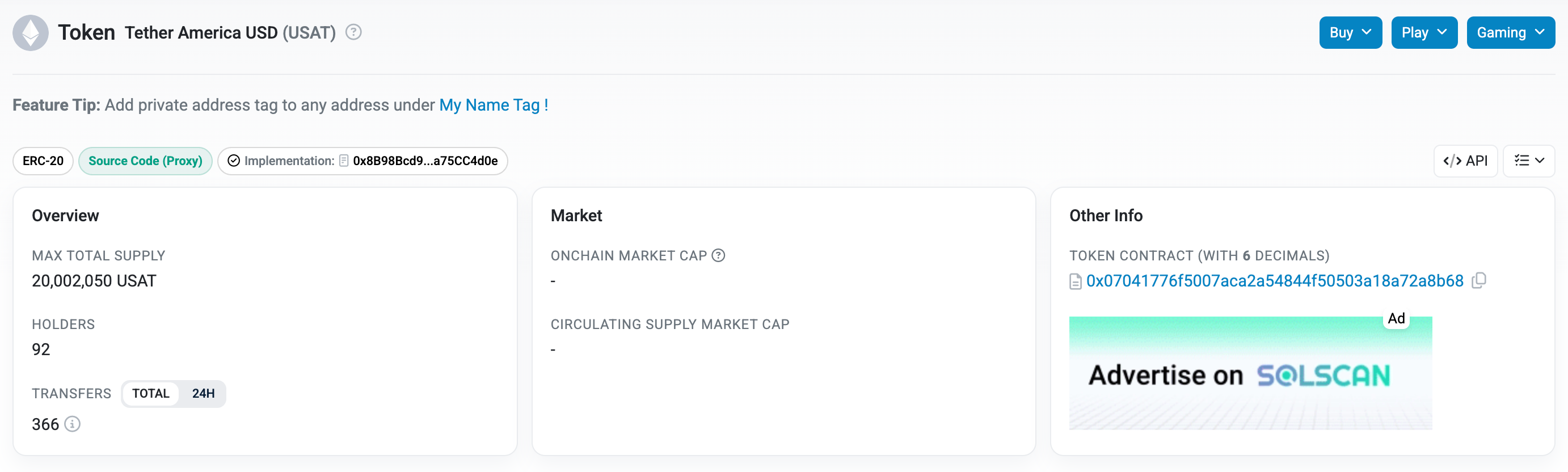
At the initial stage, USAT will only be issued on the Ethereum mainnet, with an initial issuance size of $20 million. The official contract address is 0x07041776f5007aca2a54844f50503a18a72a8b68.
In terms of distribution, Bybit, Crypto.com, Kraken, OKX, and Moonpay will become the first platforms to support USAT, with each platform having successively announced the launch of USAT. It is worth noting that Binance and Coinbase are not among the first batch of platforms. The former is currently flirting with World Liberty Financial (USD1), while the latter has long had interests tied to Circle (USDC). Choosing not to support USAT for now may involve certain strategic considerations.

Tether's Future: Dual-Track Parallel Development

The launch of USAT does not mean that USDT's position will be replaced.

In fact, Tether has repeatedly stated its stance on USDT and USAT, emphasizing that it will adopt a development model of two stablecoins operating in parallel in the future —— USAT will focus on the US market, competing directly with rivals like USDC within the compliant system to capture institutional clients in the traditional financial market; USDT will focus on offshore markets, continuing to serve as the liquidity cornerstone of the cryptocurrency market.

In yesterday's announcement about the issuance of USAT, Tether also mentioned USDT's gradual compliance strategy again: "USDT will continue to operate globally and lead the market as the most widely adopted stablecoin, while gradually moving towards compliance with the GENIUS bill."

In the short term, USDT will still be Tether's main business focus. It will be difficult for USAT to replace the former in terms of scale, but it is expected that Tether will allocate certain resources to USAT to boost the early growth of this stablecoin.

From First Mover to Latecomer, How Will Tether Break Through This Time?

After USAT enters the market, the competitive landscape of the stablecoin market in the US is destined to heat up again.

Considering the current development trends, Circle's (USDC) temporary leading position is not secure. The king of the global stablecoin market, Tether (USAT), World Liberty Financial (USD1) backed by the Trump family, internet giant representative Paypal (PYUSD), BlackRock-backed USDtb... various competitors are launching fierce attacks.

A typical case is that since Binance and USD1 launched a joint subsidy activity (including the ended current account financial management and the ongoing airdrop subsidies) on December 24 last year, USD1's supply scale has grown by more than $2 billion, while USDC's supply scale has shrunk by over $5 billion during the same period —— there is likely some correlation in this ebb and flow.
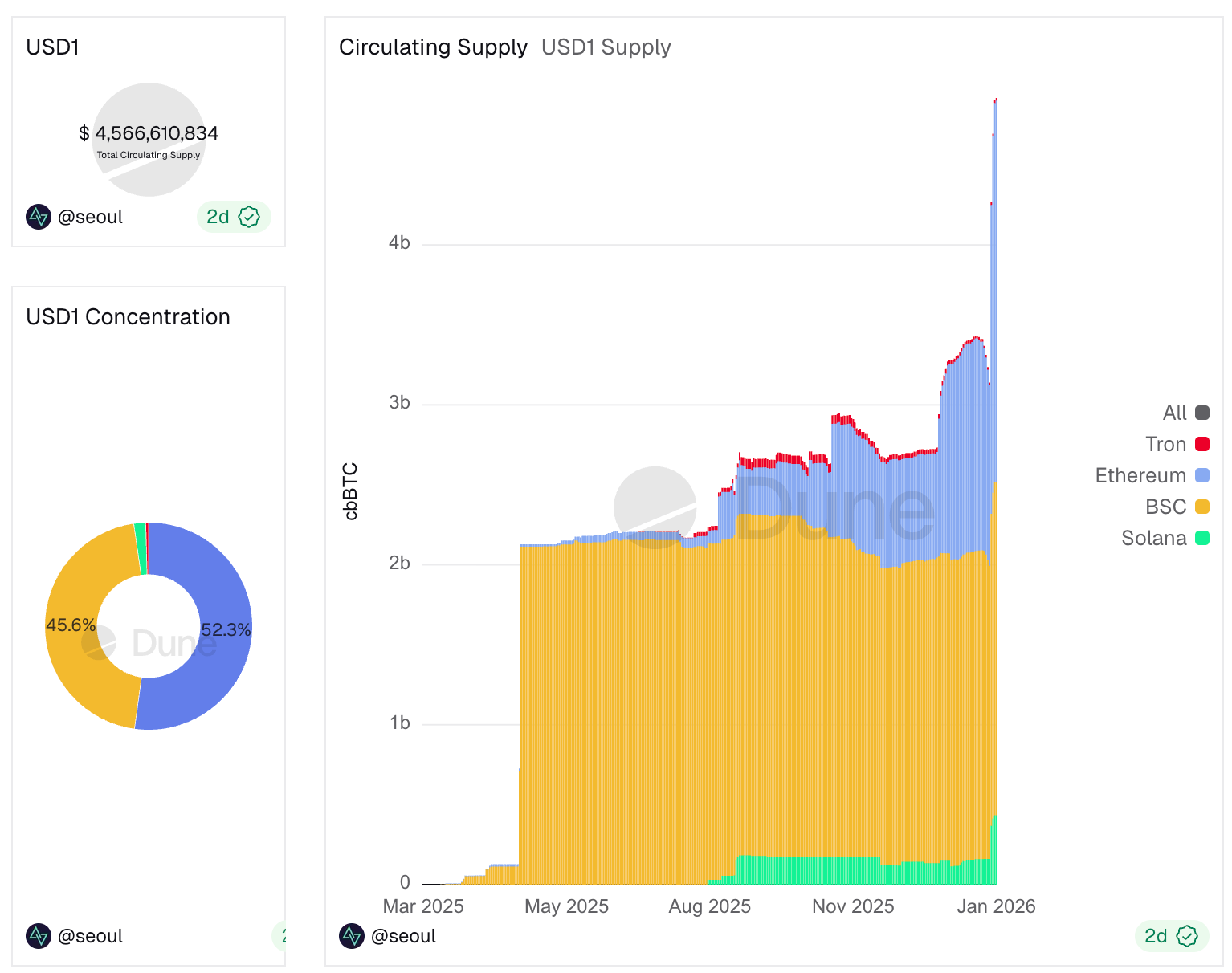
A similar case could also happen with USAT. As a latecomer stablecoin, if Tether wants to stimulate the growth of its supply, subsidies would obviously be the most efficient measure. As ordinary users, we naturally hope to see major stablecoins engage in incentive wars.

Tether's financial strength is undeniable. In 2025, Tether achieved profits of tens of billions of dollars in just three quarters. However, the problem here is that Tether has long been opposed to profit subsidies. Tether CEO Paolo Ardoino clearly expressed his disdain last year for the industry's pursuit of interest-bearing stablecoins, bluntly stating it was a "bad idea." Therefore, it remains unknown whether Tether will adopt a growth strategy similar to USD1 for USAT in the future.

This is an unresolved question for Tether —— in the development history of stablecoins, Tether used USDT to fully exploit first-mover advantages. This time, as a latecomer chasing the competition, Tether's strategy to break through is worth anticipating.


Domande pertinenti

QWhat is the name of the new stablecoin launched by Tether for the US market, and what regulatory framework is it designed to comply with?

AThe new stablecoin is called USAT, and it is designed to comply with the GENIUS regulatory framework.

QWhich institutions are involved in the issuance and custody of USAT's reserve funds?

AUSAT is issued through the US federal chartered bank Anchorage Digital Bank, and Cantor Fitzgerald is the designated custodian of the reserve funds and the preferred primary dealer.

QWhich major cryptocurrency exchanges are notably absent from the first batch of platforms supporting USAT, and what are their potential strategic reasons?

ABinance and Coinbase are notably absent from the first batch. Binance is reportedly involved with World Liberty Financial (USD1), and Coinbase has long-term interests tied to Circle (USDC), which are likely strategic reasons for not initially supporting USAT.

QHow does Tether plan to position USAT and USDT in the market moving forward?

ATether plans a dual-track development model: USAT will focus on the US market and compete with other stablecoins within the compliant system, while USDT will focus on offshore markets and continue to serve as the liquidity cornerstone of the cryptocurrency market.

QWhat challenge does Tether face as a latecomer with USAT in the competitive US stablecoin market, according to the article?

AThe challenge is whether Tether will adopt subsidy strategies, similar to its competitors like USD1, to stimulate the growth of USAT's supply, given that Tether's CEO has historically been opposed to the idea of yield-bearing subsidies for stablecoins.

Letture associate

Within Strategy's Framework, STRC's Dividend Yield Remains at 12% as Share Price Stays Below Par Value

Michael Saylor, Executive Chairman of Strategy (MSTR), confirmed that the dividend rate for its STRC perpetual preferred shares will remain at 12.00% through August 2026. The rate has increased from 9% at its July 2025 launch to the current high via a "ratchet" mechanism, which permanently raises the rate by 0.5% whenever the share price falls below $95. This mechanism is intended to push the price back toward its $100 par value and support Strategy's "at-the-market" (ATM) program for issuing new shares to fund Bitcoin purchases. However, the mechanism has not worked as intended. STRC shares closed at $89.46 on July 31, remaining about 10-11% below par value despite the record-high dividend. Competition from rival Strive's higher-yielding SATA securities has pressured demand. The persistent discount has forced Strategy to suspend new STRC issuances via its ATM program, limiting this funding channel for Bitcoin acquisitions. STRC's struggles reflect Bitcoin's own volatility, as the preferred shares historically move in tandem. Analysts have warned the ratchet structure carries long-term, one-way risk. A law firm is investigating Strategy's ability to maintain dividend payments if Bitcoin's price stays low. Retail investors own roughly 83% of outstanding STRC shares, a group seen as prone to panic selling during downturns. In response, Strategy has established financial reserves, including a liquidity cushion covering about 26 months of dividend/interest obligations, and a $2 billion share buyback program alongside a Bitcoin monetization framework, though the company emphasized it is not obligated to sell any Bitcoin.

cryptonews.ru24 min fa

Within Strategy's Framework, STRC's Dividend Yield Remains at 12% as Share Price Stays Below Par Value

cryptonews.ru24 min fa

Analyst: Bitcoin's Price Will Drop to $60k in August, Then Rebound to $70k

Financial analyst Andrey Poroshin has provided a new forecast for Bitcoin's price dynamics in August. Poroshin, an analyst at the Bitbanker exchange, expects the cryptocurrency market to experience a downturn this month, with prices retesting the $60,000 level due to a lack of supportive macroeconomic catalysts. He noted that the recent US Federal Reserve decision to hold interest rates did not significantly impact the market, while inflation remains above the 2% target. Poroshin stated that Bitcoin is ending July under pressure from moderate volatility and a lack of new macroeconomic stimuli, leading to continued market caution. According to his base scenario, Bitcoin will drop to a range of $60,000 to $62,000 before recovering to $70,000. He pointed out that even $70,000 remains below the cost of mining in the US, which has prompted some miners to shift towards AI data center operations. Poroshin cited the winding down of BitMEX's operations as a potential catalyst for a price rebound, suggesting the exit of weaker players often coincides with market reversals and reduced short-term selling pressure. He believes Bitcoin is currently less susceptible to geopolitical shocks, such as the Iran-US conflict, and does not expect significant market changes in August related to the pending CLARITY Act. Looking ahead, Poroshin forecasts that September will bring more active price fluctuations driven by potential Fed rate decisions and possible discussions or approval of the CLARITY Act.

cryptonews.ru24 min fa

Analyst: Bitcoin's Price Will Drop to $60k in August, Then Rebound to $70k

cryptonews.ru24 min fa

Trading

Spot
活动图片




