Researchers are ecstatic!!
Less than a week after Anthropic's Claude Science launched, the open-source community has presented its own answer.
An AI research team incubated by YC, has delivered 'the open-source alternative to Claude Science' — OpenScience.
It's also a full-process AI research workbench covering literature search, hypothesis generation, code experiments to paper writing, but it is not tied to any single model provider.
DeepSeek, GLM, Claude, GPT... regardless of domestic or international, use whichever one you want.
Moreover, the project adopts the developer-friendly Apache 2.0 license and can be installed with just one command.
Once the news broke, the project directly trended on X. People bluntly stated:
This is what scientific AI should look like. (Anthropic: Just say my name.)

Claude Science is powerful, but it's unusable...
About 5 days ago, Anthropic officially launched Claude Science at a closed-door event by MIT Technology Review.
This is an AI workbench specifically for scientists, providing various tools and software packages most commonly used by researchers.
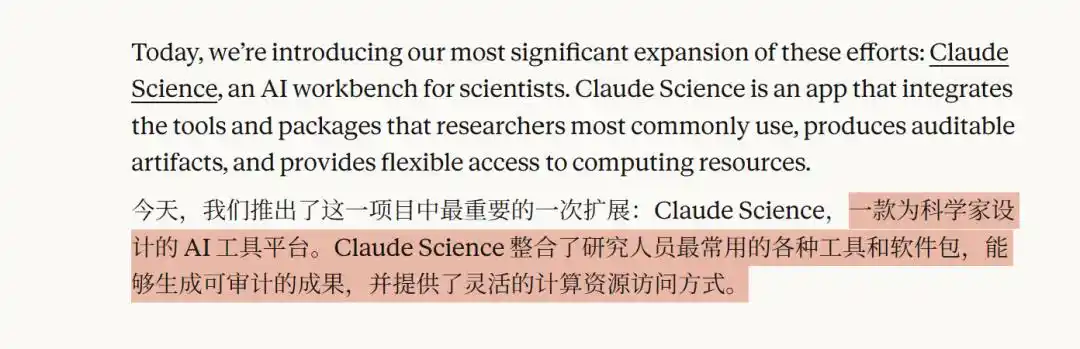
For example, previously, a researcher completing a study had to search literature on PubMed, write code in Jupyter, run statistics in R, connect to a cluster via SSH to submit tasks, and then use various tools to create charts and write papers.
Switching between a dozen windows, the mere 'transitions' between tools consumed a huge amount of energy.
What Claude Science aims to do is bundle all of this into the same workbench.
Specifically, it achieves several key integrations:
At the database and toolchain level, it comes with built-in connectors to over 60 scientific databases and pre-configured skill packages, covering common research fields like genomics, single-cell analysis, proteomics, structural biology, chemoinformatics, etc.
You ask in natural language, and specialized Agents automatically perform cross-database queries — no need to manually search databases like UniProt, PDB, Ensembl, ChEMBL, GEO one by one.
It also integrates with NVIDIA's BioNeMo Agent Toolkit, allowing direct connection to life science models like Evo 2, Boltz-2, OpenFold3.
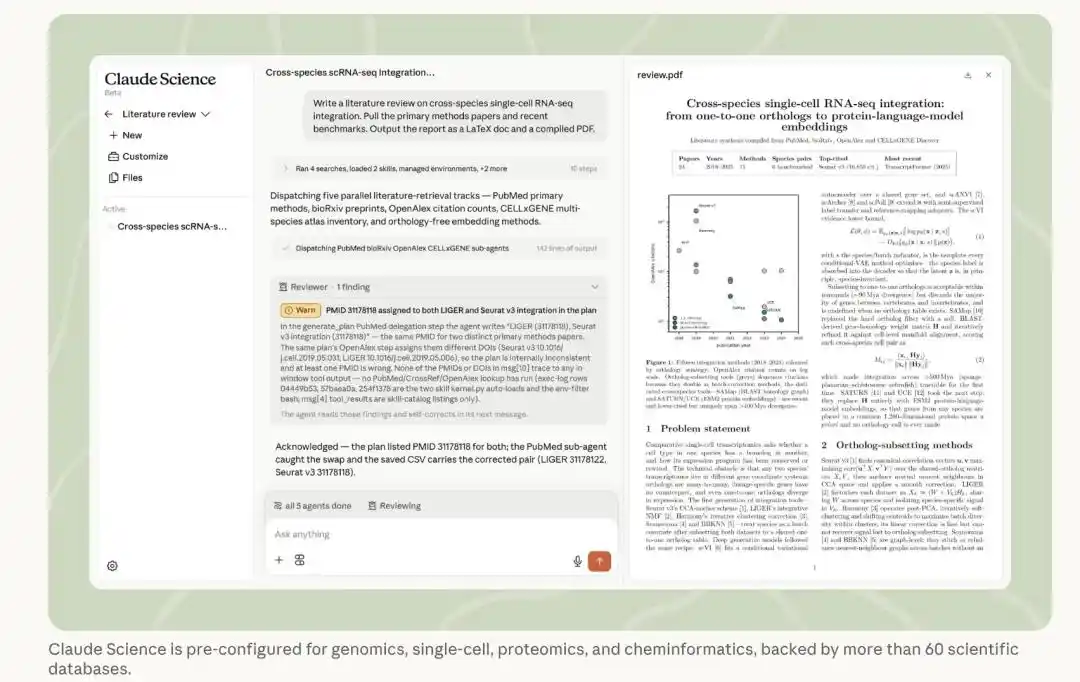
At the execution level, it introduces a multi-agent architecture.
The main Agent handles overall planning, sub-agents process different tasks in parallel, and there is a Reviewer Agent specifically responsible for fact-checking, such as verifying citations, validating calculation results, and flagging potential errors.
The generated output is not just text. It can natively render content like 3D protein structures, genome browser tracks, chemical structure formulas.
Moreover, each chart retains the generation code, runtime environment, natural language description, and complete conversation history.
In some scenarios, scientists can even modify charts with a single sentence, and the system automatically rewrites the underlying code.
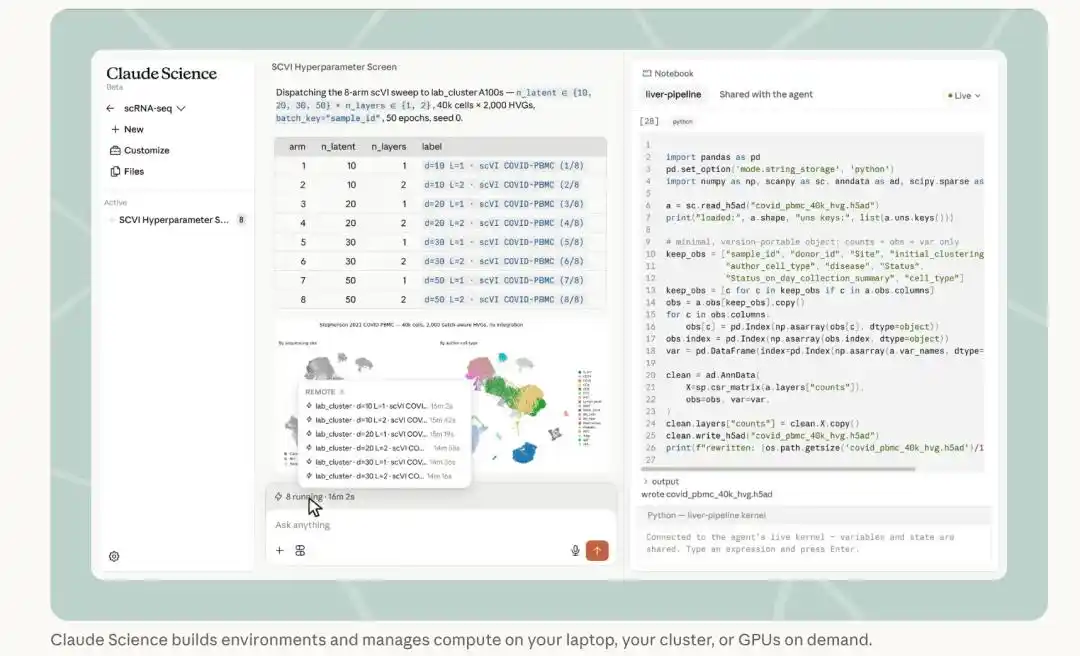
At the computing power level, Claude Science can directly interface with your lab's existing infrastructure.
Be it notebooks, Linux servers, or HPC cluster login nodes, it can connect via SSH or use a Modal account to call cloud GPUs on demand, scaling from a single GPU to hundreds.
Large-scale datasets only need to be loaded once; sensitive data never leaves your own system. Only the context needed for each step of analysis is sent to Claude.
Early beta users have already produced some practical cases.
Jerome Lecoq, a neuroscientist at the Allen Institute, used it to build a multi-agent 'computational review template' containing about 20 custom skills, letting sub-agents read thousands of papers, extract core viewpoints and quantitative data, and then generate review chapters one by one.
To put it simply, writing a review used to take two years; now he has about 10 drafts in hand —
Many exceed 100 pages, and all citations have been verified by the Reviewer Agent.
Stephen Francis from the UCSF Brain Tumor Center used it for molecular epidemiological studies of glioma, running germline variant analysis.
He said Claude Science compressed the previously required time to one-tenth, and his team independently validated the results, confirming the analysis was both fast and reliable.

Combined with the evaluation of AI research capabilities by Harvard physicist Matthew Schwartz this past March, Claude's current level is roughly equivalent to a second-year graduate student.
He published a guest post titled "Vibe Physics: The AI Grad Student" on the Anthropic official blog, documenting his entire process of using Claude Opus 4.5 to complete a theoretical physics paper.
His conclusion at the time was:
Current AI research capability is roughly equivalent to a second-year grad student — can work, doesn't complain about being tired, but needs a supervisor to monitor every step.
This assessment was later incorporated by Anthropic into the Claude Science technical documentation as a calibration point for the product's positioning.
However, Claude Science currently has several hard limitations:
Only supports macOS and Linux
Only available to Pro/Max/Team/Enterprise paying users
Only Claude's own models can be used on the platform
These thresholds stacked together, especially for domestic research teams in China, make Claude Science something "visible but out of reach."
Good News: An Open-Source Alternative is Here
Targeting the above limitations, the open-source project OpenScience emerged.
The team behind it is called Synthetic Sciences, founded in San Francisco in 2025, and just graduated from the YC Winter 2026 batch this year.
The founding team's ambition is not small: to build a platform that lets scientists directly delegate complex research tasks to "AI co-scientists," enabling AI to autonomously run the entire chain from literature review to hypothesis generation to experiment execution to paper writing.
They have an internal core belief:
Scientific foundation models need to possess genuine 'research taste,' and this taste cannot be achieved by simply scaling parameters. It must be a two-pronged approach: product and model. Use the product to collect high-quality scientific process data, then use this data to train models with taste.
OpenScience is the first product landing on this path.
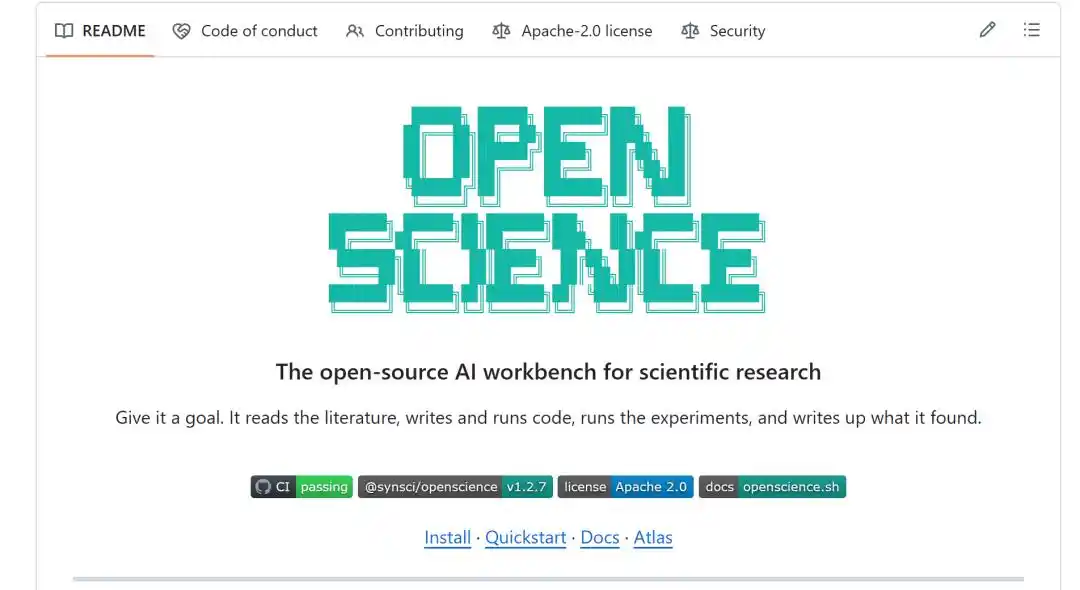
Although OpenScience's mission is the same as Claude Science's, they have a fundamental difference:
Model-agnostic.
In Synthetic Sciences' own words:
Scientific AI should be open. The tools humans use for exploration and discovery should not be monopolized by one company, nor should that company decide who is qualified to use them.
Therefore, on this platform, Anthropic, OpenAI, Google, DeepSeek, GLM... as long as you have an API Key, you can connect directly.
You can even run local models, deploy via Ollama, without a single byte of your data leaving your machine.
Your Key stays locally, requests go directly to the model provider, not passing through any intermediate server.
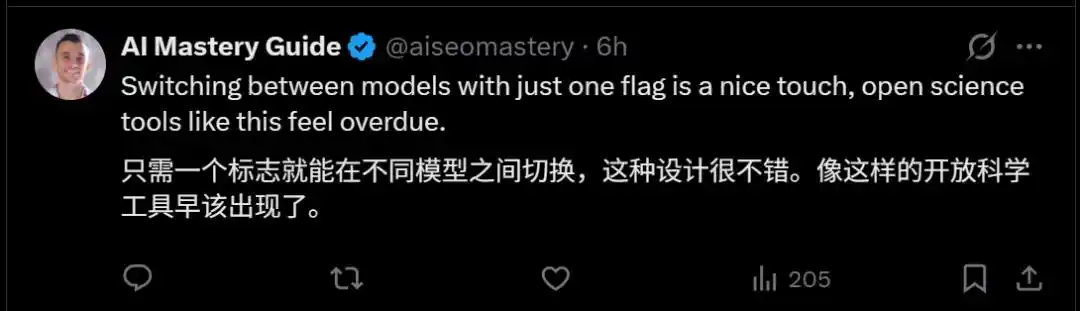
Moreover, OpenScience supports switching models per request.
Within the same workbench, you can use Claude for this step, then switch to DeepSeek for the next, without changing any configuration.
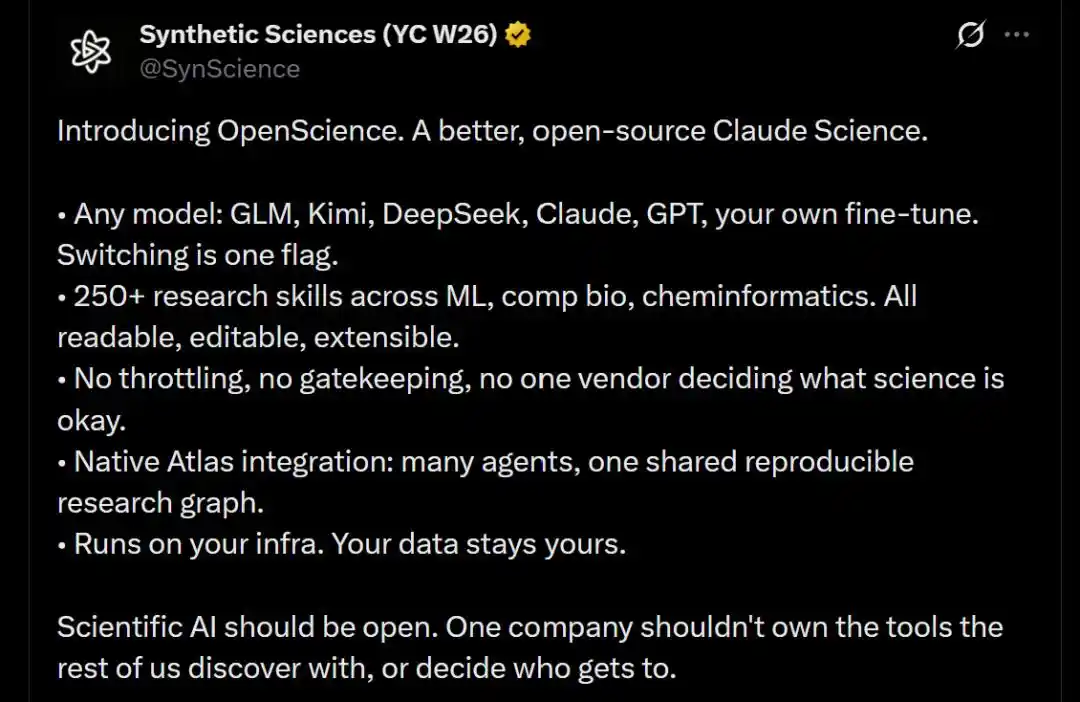
Feature-wise, OpenScience is even more aggressive than Claude Science —
Built-in with over 250 research skill packages, more than 4 times that of Claude Science, covering ML, computational biology, chemoinformatics, etc., and all are readable, editable, and extensible.
Installation is also simple, just one command in the terminal:

Open and use immediately, the workbench automatically pops up in the browser. On first run, select a model source, fill in the API Key, and you can start working.
You can also install it globally:

If configuring Keys is troublesome, the team also provides a hosted platform called Atlas —
Top up a wallet to directly call various cutting-edge models without configuring Keys one by one, plus persistent research graphs and cloud computing power.
But Atlas is not mandatory. You can use OpenScience fully for free with your own Keys, no barrier.
One More Thing
Interestingly, if you scroll to the very bottom of OpenScience's GitHub page, you'll see a statement added specifically:
OpenScience is an independent project. It is not affiliated with, endorsed by, or sponsored by Anthropic. “Claude” is a trademark of Anthropic, PBC, used here only to describe compatibility.
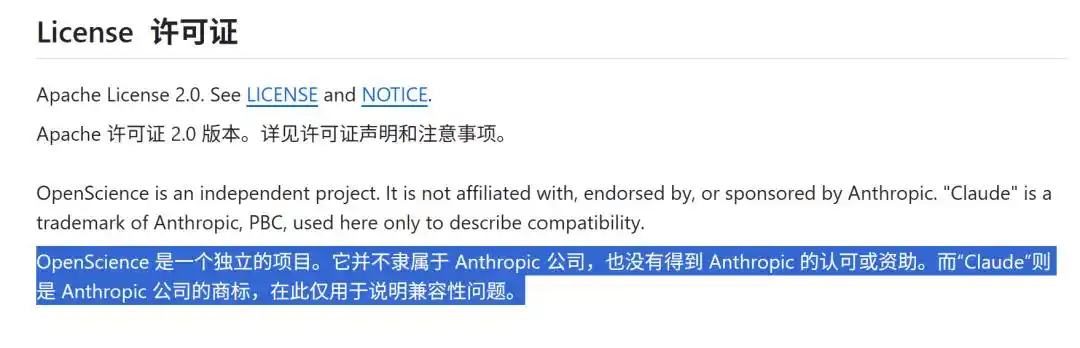
Translation: We are an independent project, with no relation to Anthropic whatsoever. Mentioning "Claude" is purely about describing compatibility, don't read too much into it.
It seems the impression left by the "lobster" incident on the entire open-source community is still too profound.
With OpenClaw changing names several times before, OpenScience this time directly welded the disclaimer onto the first version of the README.
Nothing else — survive first, then talk about being an alternative (doge).
Open-source address:
https://x.com/i/trending/2073904804829741364?s=20
Reference links:
[1]https://x.com/SynScience/status/2073829478393086311?s=20
[2]https://x.com/i/trending/2073904804829741364?s=20
[3]https://www.openscience.sh/
[4]https://www.anthropic.com/news/claude-science-ai-workbench
This article is from WeChat official account "QbitAI", author: Yi Shui