Commodities Surge, Equities Steady, Crypto Falls Behind In 2025 Market Showdown

bitcoinistPubblicato 2025-12-22Pubblicato ultima volta 2025-12-22

Introduzione

The investment landscape of 2025 has delivered an unexpected outcome, with traditional commodities emerging as the clear winners while cryptocurrencies fell to the bottom of performance rankings. Data reveals a strong divergence between asset classes: silver leads with a 130% year-to-date gain, followed by gold (65%) and copper (35%). Equity indices like the Nasdaq and S&P 500 also posted positive returns. In stark contrast, the crypto market is the worst-performing asset class. Bitcoin is down 6%, Ethereum has declined 12%, and altcoins (excluding Ethereum) have plummeted approximately 42%. This marks a dramatic reversal from the mid-year rally, where Bitcoin, Ethereum, and XRP reached new all-time highs. The downturn began with a flash crash in October, leading to Bitcoin's worst Q4 performance in seven years, ultimately erasing earlier gains and cementing crypto's position at the bottom of the 2025 market.

The investment landscape in 2025 has delivered an unusual outcome that few would have anticipated at the start of the year. Assets traditionally viewed as slow movers have risen as the clear winners, while the cryptocurrency market has quietly slipped to the bottom of the performance rankings.

As the year draws to a close, data from across commodities, equities, and digital assets shows an imbalance in returns, revealing that cryptocurrencies now sit behind every major asset class in year-to-date performance.

Clear Split Between Traditional Assets And Crypto

The performance data for 2025 reveals a strong divergence between traditional markets and digital assets, with the gap widening as the year progressed. According to the figures revealed on the social media platform X by ‘Bull Theory,’ silver is the top-performing asset for 2025, posting gains of about 130% year-to-date. Gold is the second-best-performing asset of 2025, with an increase of about 65%, while copper has climbed close to 35%. These numbers reflect sustained strength across the commodities sector.

Equity markets are also currently trading in positive territory. The Nasdaq is up around 20% on the year, the S&P 500 has gained approximately 16%, and the Russell 2000 is higher by about 13%.

The only negative numbers are from the crypto industry. In contrast, the crypto market sits at the bottom of the performance rankings. Bitcoin is currently down by about 6% from its 2025 opening price, Ethereum has declined around 12%, and the entire altcoin market (removing Ethereum) has suffered a much deeper drawdown of about 42%. Therefore, the crypto market is now officially the worst-performing asset class in 2025.
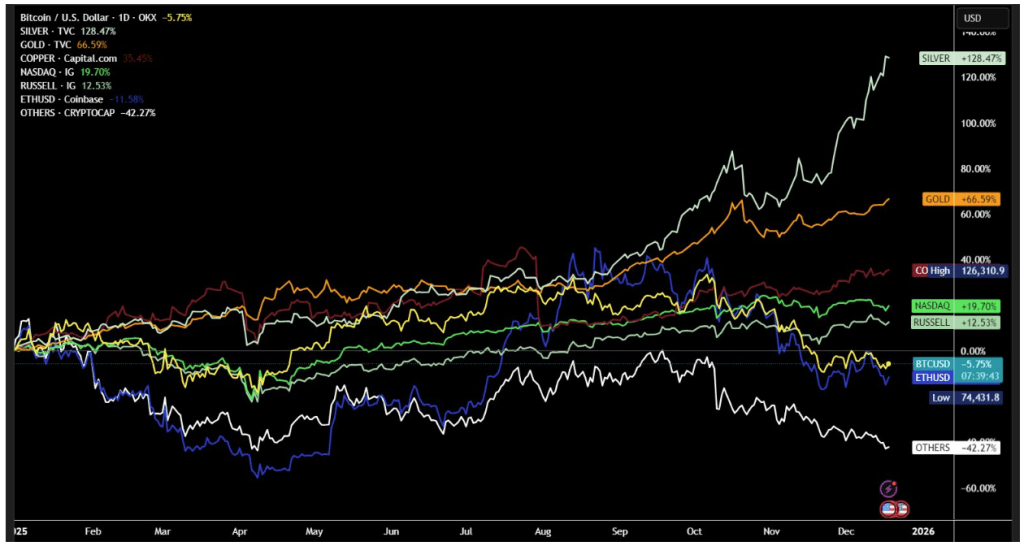
Chart Image From X. Source: @BullTheoryio

From Mid-Year Rally To Q4 Breakdown

The current weakness of the crypto market is very different from the optimism that dominated the beginning and middle of 2025. During that period, the crypto market experienced a powerful recovery that reignited bullish sentiment across the board. Bitcoin, Ethereum, XRP, and several large-cap tokens pushed to new all-time highs.

Bitcoin’s rally peaked in October, when it set its standing record of $126,000 after months of steady accumulation and strong momentum. Ethereum, on the other hand, registered a new all-time high of $4,946 in August, while XRP’s all-time high came earlier in July. XRP’s record price of $3.65 was the most notable, as it was its first time breaking into a new all-time high since 2018.

Total crypto market cap currently at $2.98 trillion. Chart: TradingView

That bullish trend began to unravel as the fourth quarter got underway, starting with the crypto market flash crash on October 10. The decline has extended since then, and Bitcoin and the broader crypto market have now fallen into negative territory from their 2025 opening levels.

Quarterly returns data shows that Bitcoin just recorded its worst fourth-quarter performance in seven years. The result is a year in which digital assets, despite a powerful mid-year rally, are closing out as the worst-performing major asset class.
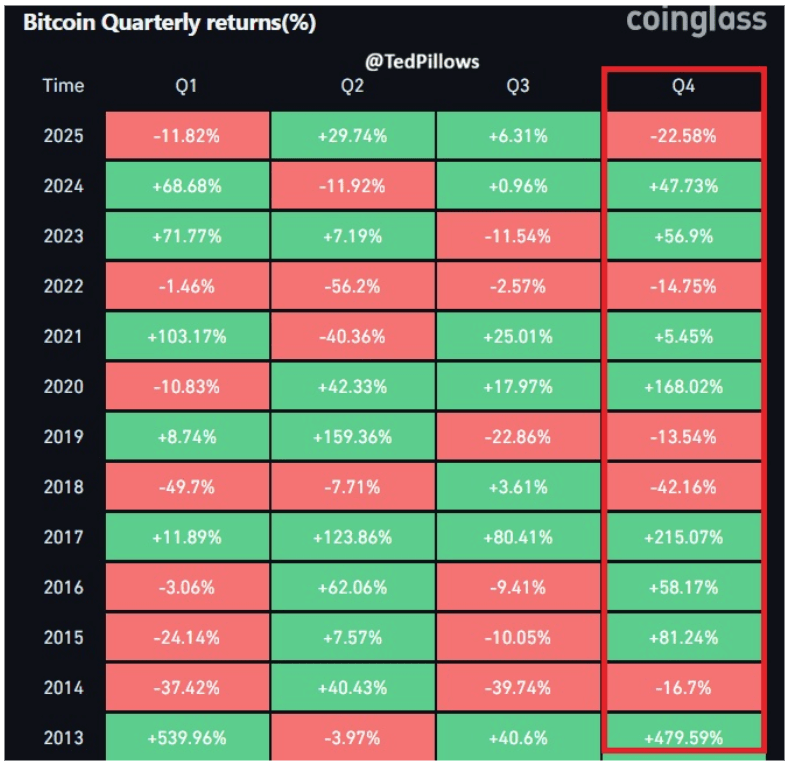
Bitcoin Quarterly Returns. Source: @TedPillows On X

Featured image from Unsplash, chart from TradingView

Domande pertinenti

QWhich asset class was the top performer in 2025 according to the data from 'Bull Theory'?

ACommodities, specifically silver, was the top-performing asset, posting gains of about 130% year-to-date.

QWhat are the year-to-date performance figures for Bitcoin and Ethereum in 2025 as described in the article?

ABitcoin is down by about 6% from its 2025 opening price, and Ethereum has declined around 12%.

QWhat significant event on October 10, 2025, contributed to the crypto market's decline in Q4?

AThe crypto market experienced a flash crash on October 10, which marked the beginning of the extended decline into negative territory for the year.

QWhat were the peak prices reached by Bitcoin and Ethereum during their 2025 rallies?

ABitcoin reached a peak of $126,000 in October, and Ethereum reached a new all-time high of $4,946 in August.

QHow does the performance of the entire altcoin market (excluding Ethereum) compare to the major cryptocurrencies in 2025?

AThe entire altcoin market (removing Ethereum) suffered a much deeper drawdown of about 42%, performing worse than both Bitcoin and Ethereum.

Letture associate

Expect news tomorrow: this time the Bank of Japan will announce its interest rate decision! What impact will this have on Bitcoin?

A day before the Bank of Japan's (BOJ) interest rate decision announcement, the Japanese yen surged nearly 3% against the US dollar. The sharp move in the currency market fueled speculation that the Japanese government may have intervened again to support the yen. The USD/JPY pair fell over 400 pips to 158.5, its steepest daily drop since Japan's currency intervention earlier this year. Market participants suspect the rapid, strong yen appreciation could be due to direct foreign currency sales by Japanese authorities, though the Ministry of Finance has made no official statement. The yen had previously fallen to its weakest level against the dollar in nearly 40 years. In late April and May, the government intervened with roughly 9.6 trillion yen to prevent the USD/JPY from rising sustainably above 160, but the yen faced renewed selling pressure afterward. Investors are now focused on the BOJ's rate decision and its signals on future monetary policy. Potential hawkish signals from the BOJ are seen as a factor that could support further yen strength. A sharp yen appreciation could create short-term selling pressure on Bitcoin by increasing the risk of unwinding carry trades, where investors borrow low-yielding yen to invest in Bitcoin and other risky assets. This pressure could intensify if the BOJ takes a hawkish stance or raises interest rates.

cryptonews.ru14 min fa

Expect news tomorrow: this time the Bank of Japan will announce its interest rate decision! What impact will this have on Bitcoin?

cryptonews.ru14 min fa

Bernstein Reveals Details of Core Scientific's $14 Billion Deal with AMD

Analysts from Bernstein revealed details of a deal between Core Scientific and AMD with a potential total value of over $14 billion. According to the report, initial contracts for 530 MW of capacity could generate this revenue over 15 years, with AMD acting as a credit guarantor for part of the bitcoin miner's infrastructure. The partnership, announced on July 28, has the potential to allocate up to 2.5 GW of data center capacity for AI. Bernstein broke down the 530 MW into 377 MW of direct triple-net lease for AMD and 152 MW for an unnamed cloud provider backed by AMD's credit. This structure is seen as lowering financing costs and counterparty risk. AMD also received warrants to buy 30 million Core Scientific shares at $23.47 each, which vest upon reaching the 2.5 GW target. Average annual revenue from the deal is estimated at around $0.9 billion, or about $1.8 million per megawatt, which is 5-25% below recent AI hosting deals by other miners. However, the 377 MW triple-net lease for AMD carries a margin close to 100%. Core Scientific expects capital expenditures for the deal to be $11-12 million per MW, totaling about $6 billion. Bernstein views this partnership as a new phase in the transformation of former bitcoin miners into AI infrastructure operators, with AI chipmakers like AMD now acting as direct anchor tenants. Recent similar deals include Hut 8 allocating 704 MW to a tenant believed to be Nvidia, and AMD reserving 200 MW with Riot Platforms. Core Scientific also paid Block $41.9 million to terminate a mining chip supply contract as part of its accelerated diversification into AI.

cryptonews.ru1 h fa

Bernstein Reveals Details of Core Scientific's $14 Billion Deal with AMD

cryptonews.ru1 h fa

Trading

Spot
活动图片