Commerce Ministry's Latest Export Controls Target 10 US Companies: Three Market-Moving Threads Explained

marsbitPubblicato 2026-06-22Pubblicato ultima volta 2026-06-22

Introduzione

China's Ministry of Commerce placed 10 U.S. entities, including MP Materials, USA Rare Earth, Red Cat Holdings, and Teal Drones, on an export control list, banning the export of dual-use items. This move is seen as part of an ongoing countermeasure in the rare earth sector. The analysis suggests the primary impact is on U.S. companies within the **military, drone, and rare earth** sectors, aiming to restrict their access to critical Chinese materials and technology. For the Chinese market, the event is interpreted as reinforcing the **strategic value and pricing power** of domestic rare earth suppliers. However, the potential stock market reactions are nuanced: 1. **Chinese Rare Earth Upstream:** Companies like Northern Rare Earth are near yearly highs, indicating this event's "beneficiary" logic is largely priced in. It may confirm the trend but is unlikely to be a new major catalyst. 2. **Chinese Rare Earth Mid/Downstream & Drones:** Sectors like magnetic materials (e.g., Da Di Bear, Zhenghai Magnetic) and military drones (e.g., China Aerospace) are relatively undervalued. While the drone listing highlights sectoral competition, it doesn't directly translate to new orders for Chinese firms. 3. **Impact on Listed U.S. Companies:** The effect on stocks like MP Materials is ambiguous. While Chinese restrictions pose a challenge, these companies are also core to U.S. supply chain security efforts and may receive increased government support, potentially offsetting negative...

Author: David, Chao Xiang Research

On June 22nd, the Ministry of Commerce issued Announcement No. 23 of 2026, adding 10 U.S. entities including Ivex, Red Cat Holdings, and MP Materials to the export control list, prohibiting the export of dual-use items to them; on the same day, an additional 46 U.S. companies were added to the government procurement restriction list.

(Author's note: Dual-use items refer to goods, technologies, and services that have both civilian and military applications or can enhance military potential.)

This marks another round in the normalization of China's rare earth countermeasures since October 2025. The 10 targeted U.S. companies are primarily concentrated in three sectors: defense, drones, and rare earths.

The two most prominent names on the list are MP Materials and USA Rare Earth, both flagships of the U.S. rare earth industry. China's action against them prompted the market's initial reaction to favor the A-share rare earth sector: with competitors being restricted, domestic players gain greater scarcity and value.

The question is, the rare earth sector has been rising from last October until now, with leading upstream companies already near their year-to-date highs. Is it too late to react now?

If it is late, where might the money go?

The Commerce Ministry's control list involves more than just the rare earth thread. The fully appreciated rare earth sector might still have further catalysts ahead, and overlooked, less popular threads might still be under the radar.

We attempt to outline the potentially affected threads and place them on a price coordinate for reference.

Key Conclusions

1 The upstream A-share rare earth sector is fully priced-in; this control measure is not a new catalyst.

Northern Rare Earth's current price of 52.9 yuan is only about 20% away from its one-year high of 63.6 yuan; Guangdong Rising Nonferrous Metals at 115 yuan and Shenghe Resources at 33.6 yuan are both close to their one-year highs. These upstream resource stocks have been trending upward since October last year, and the logic of "benefiting from rare earth countermeasures" has largely been priced in. For the upstream rare earth industry, this control measure is more of a reconfirmation of the trend rather than a new starting point for a rally.

2 The relatively underpriced segments are the mid-to-downstream rare earth magnet materials and the drone industry chain.

Within the same rare earth chain, valuations in the midstream and downstream are significantly lower than upstream:

Magnet sector players like Earth-Panda (30.7 yuan) and Sinomag (13.7 yuan) are still near the lower end of their one-year ranges, their gains notably lagging behind upstream resource stocks. The drone sector corresponding to Red Cat and Teal Drones on the control list is even quieter, with Avic UAS near its one-year low and receiving limited market attention. The pricing progress of various segments is not uniform under the same event.

3 The targeted U.S. stocks do not necessarily constitute a one-sided negative; the open market needs to verify.

MP Materials and USA Rare Earth are core players in the U.S. domestic rare earth supply chain, with MP having background investment from the U.S. Department of Defense.

For such companies, China's export controls and U.S. policy support are two coexisting forces, and their impact directions may not align. All three mentioned stocks were not at low levels before the announcement. The announcement was made on Monday before U.S. markets opened, so their true pricing reaction awaits the market's verdict.

Investors holding related positions should pay close attention to the post-open price action.

Why Do Export Controls Benefit Domestic Rare Earths?

Many find it counterintuitive at first glance: banning exports means Chinese businesses do less trade, so how is that a positive?

The key lies in the direction of the control. This ban prevents China from selling rare earth-related items to those 10 U.S. companies, cutting off the supply sources for these American firms, not the raw material procurement for Chinese manufacturers.

China's rare earth industry, from mining, smelting, and separation to magnet manufacturing, is the world's most complete chain, self-sufficient and not reliant on sourcing from the U.S. In other words, this announcement does not affect Chinese suppliers' upstream operations; they can produce and export as usual.

It's the U.S. side that is truly pinched.

Companies like MP Materials and USA Rare Earth want to build a self-reliant supply chain bypassing China, yet they still depend on China for separation technology, equipment, and some intermediate materials. Restricting competitors' access conversely enhances the scarcity and bargaining power of Chinese companies within the global rare earth landscape, which is the real reason the market interprets this as positive for A-share rare earths.

Rare Earth Upstream is Fully Priced; Money Hasn't Flowed Downstream

First, clarify the chain. Rare earths are mined, then smelted and separated into materials like praseodymium-neodymium oxide; this is the upstream, handled by companies like Northern Rare Earth, Guangdong Rising Nonferrous Metals, and Shenghe Resources.

These raw materials are further processed into NdFeB permanent magnet materials and installed into various motors; this is the midstream and downstream, where JL Mag, Sinomag, and Earth-Panda operate.

The upstream sells raw materials; the downstream sells magnet materials.

In this round of market movement, money primarily surged into the upstream. Northern Rare Earth at 52.9 yuan, Guangdong Rising Nonferrous Metals at 115 yuan, and Shenghe Resources at 33.6 yuan are all near their one-year highs. The logic is straightforward: every time rare earths' strategic importance is emphasized, the first beneficiaries are the upstream players with mines and smelting capacity, whose scarcity is tangible.

In my view, this control event is a positive in the same direction for the upstream, but the price has already digested this expectation. Entering now is more like taking over at high levels, offering less favorable risk-reward.
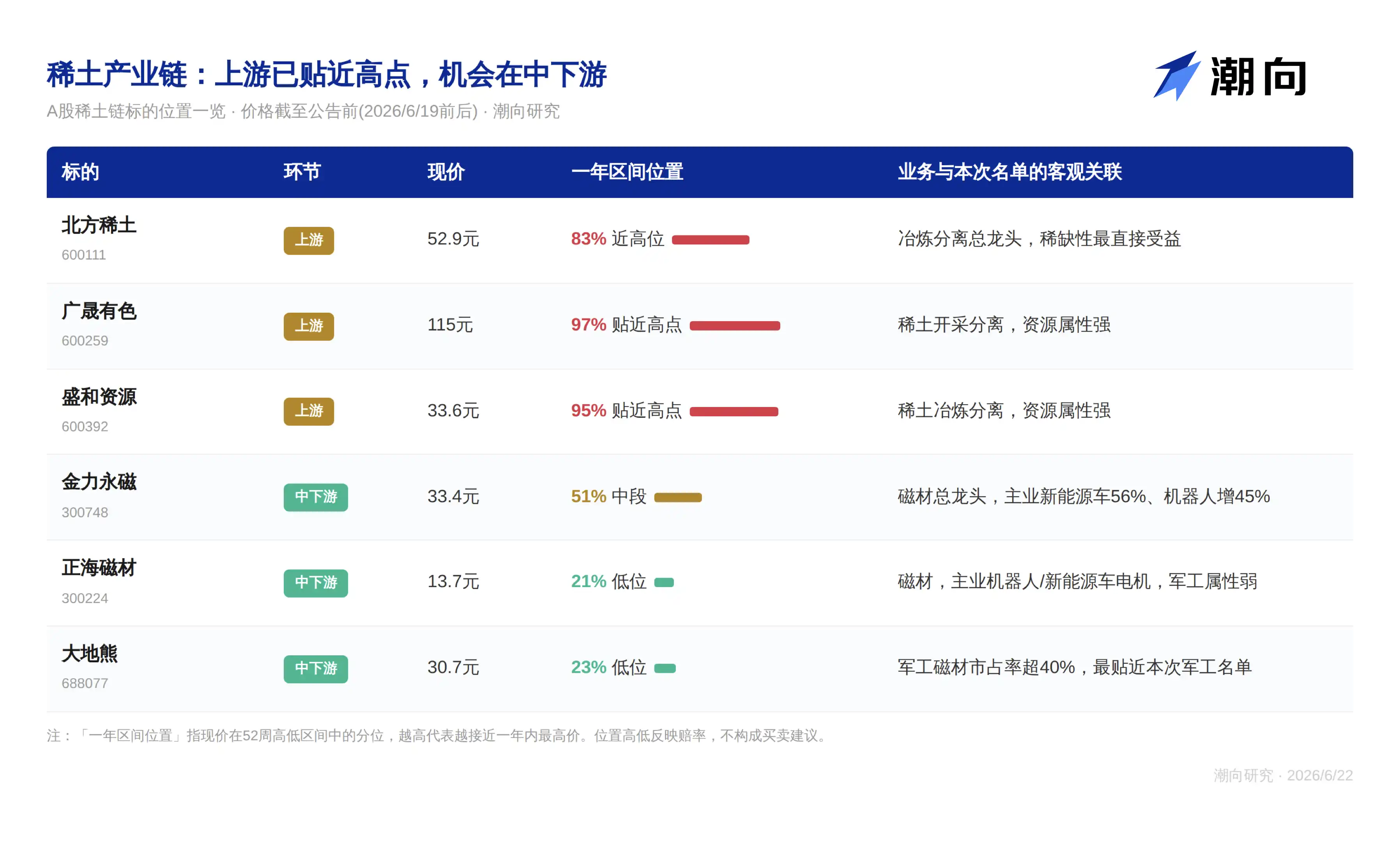
Moving downstream to magnet materials, the pricing progress is noticeably slower.

Among the three magnet leaders, JL Mag, with 7.7 billion yuan in revenue and doubled net profit, saw its 2025 stock price rise over 90%, placing it at a high level. However, Sinomag and Earth-Panda are still pressed near the lower end of their one-year price ranges, not catching up with the upstream gains.

There is a background detail easily overlooked:

Since the second half of 2025, China has opened up exports to U.S. magnet manufacturers. For instance, JL Mag's U.S. sales reached 500 million yuan for the full year, up 40%; Sinomag and Earth-Panda also obtained U.S. export licenses. China's addition of 10 companies to the control list this time is a precise move under the framework of "allowing ordinary commercial customers while cutting off specific defense entities," not a comprehensive embargo.

Therefore, the impact of this logic on magnet companies' financial statements is actually limited.

The 10 restricted U.S. companies were not among their major clients to begin with. The real revenue for JL Mag and Sinomag comes from new energy vehicle and robot motors, largely unrelated to defense exports to the U.S.

This control measure is more of a sentiment boost for the magnet stock sector, unlikely to translate into tangible orders. However, regarding the rare earth downstream, what's truly noteworthy might be which company's business aligns more closely with the defense theme of this list.
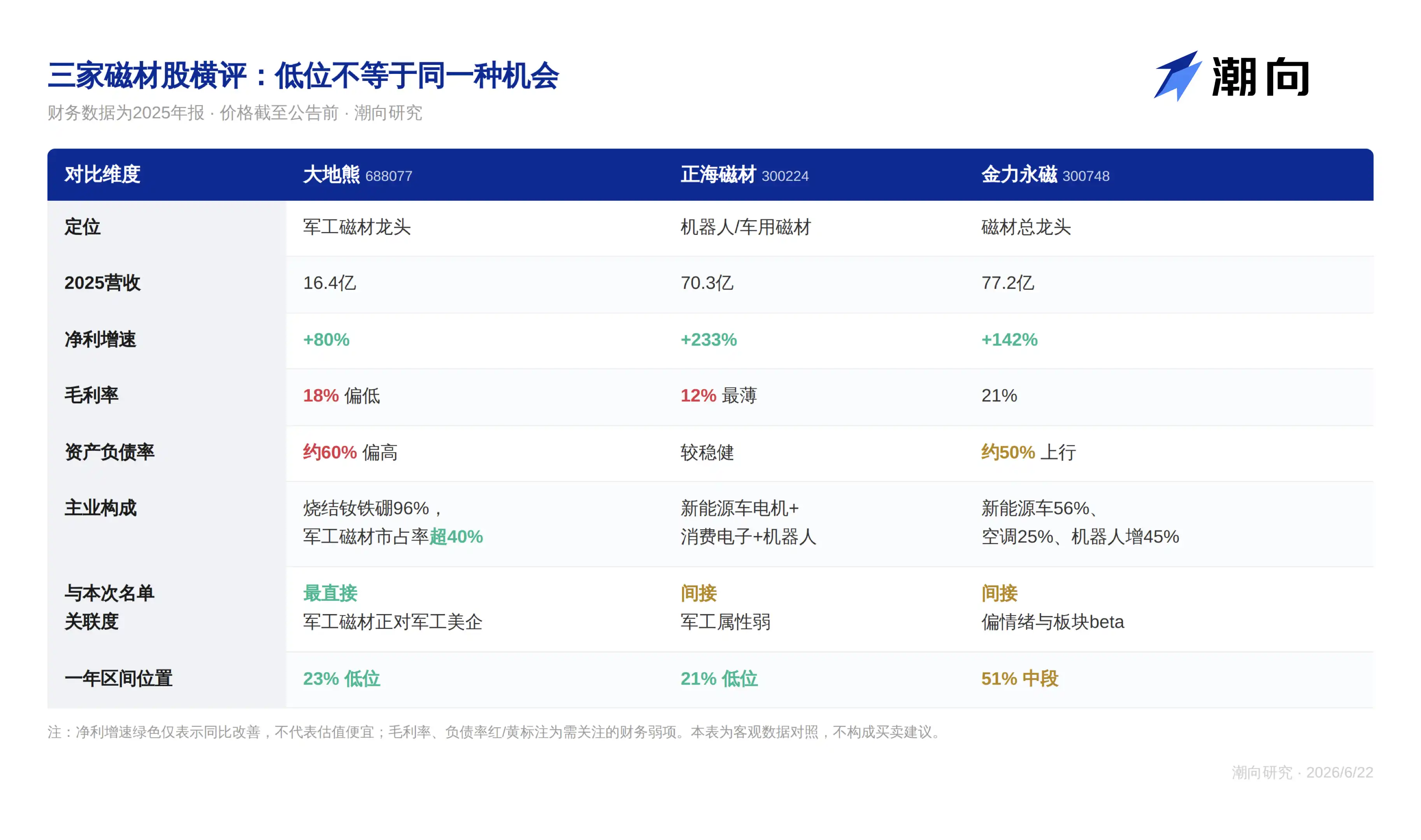
On this point, Earth-Panda aligns better than the other two.

Earth-Panda has a small market cap, with 2025 revenue of 1.6 billion yuan and net profit of 57.4 million yuan. However, it is a major domestic supplier of defense magnet materials, with publicly available data showing over 40% market share in this segment. Its products are used in equipment like aero engines and missiles, directly corresponding to the targeted defense and drone U.S. companies on the control list. This is its most direct narrative link to the event.

However, narrative alignment doesn't equal stability: financially, its gross margin is only 18%, and its debt ratio is nearing 60%, indicating weaker profitability and financial safety compared to peers. Combined with its small market cap, its stock price can bounce up quickly but also plummet sharply.

It suits those who can tolerate volatility and prioritize "purest theme," not as a cornerstone holding.

Sinomag represents another type. Its 2025 net profit more than tripled, a reversal much stronger than Earth-Panda's, but driven by humanoid robots and new energy vehicle motors, largely unrelated to this defense list. Its low price is more due to the robotics story not being fully priced in by the market yet.

Therefore, reading the rare earth thread reveals two different situations upstream and downstream.

Upstream holds resources with the most tangible scarcity, but prices have already reflected the positives; it's now a high-level handoff. Downstream magnet materials are still at low levels. Earth-Panda aligns more with the defense list, at the cost of a small market cap and weak finances. Sinomag is cheap but has weak relevance.

Drones: The List Points to This Thread, But No Direct Positive

Red Cat Holdings and its subsidiary Teal Drones on the control list produce military reconnaissance and strike drones in the U.S., exactly the type of military drone suppliers the U.S. aims to support to replace Chinese products.

The market naturally associates this with the A-share military drone sector, but the positive logic here is likely not the same as for rare earths. This won't directly bring orders to any specific Chinese drone company. It's more about bringing "Sino-U.S. competition in military drones" to the forefront, prompting the market to refocus on the strategic value and military export competitiveness of domestic military drones.

Following this thread to find corresponding A-share targets, the most business-aligned company is Avic UAS.

Avic UAS is a leader in large domestic military drones. Its core product is the Wing Loong series of reconnaissance-strike integrated drones, with drone systems accounting for over 90% of its main revenue. It primarily exports through military trade, being a main force in China's military drone exports.

In terms of business alignment, it indeed competes in the same arena as the targeted U.S. drone companies, making it the highest relevance play on this thread.

Its current price is 44 yuan, at the lower end of its one-year range. However, this position formed after a decline from highs, not from a lack of movement.

Its 2025 financial report shows significant performance growth with military trade orders, with revenue in the first three quarters more than tripling year-on-year, and the stock price once reached 48 yuan. The current pullback is more akin to cooling off after realization.

It's important to note that military trade revenue heavily depends on single large orders. Revenue fell nearly 70% year-on-year in 2024, turning to a loss, then rebounded strongly in 2025. This boom-bust characteristic means judging its cheapness based on price position is unreliable. The real variable is the signing and delivery rhythm of subsequent military trade orders. Valuation-wise, the company's P/E ratio has long been in the tens, not constituting undervaluation.

Export Restrictions Do Not Equate to Pure Negatives for Corresponding U.S. Stocks

This is the primary concern for holders of related U.S. stocks, and the answer might differ from intuition: not necessarily.

The most significant names on the export control list, MP Materials and USA Rare Earth, are core vehicles for the U.S. to reduce its reliance on Chinese rare earths. MP is the only vertically integrated rare earth producer of scale in the U.S., receiving investment from the U.S. Department of Defense in 2025, making it an object of national strategic support. This status determines its dual-sided situation:

China cuts off its access to Chinese dual-use items, but precisely due to supply chain security concerns, the U.S. government might instead provide it with more orders and subsidies.

Pre-announcement prices also support this view. MP, USA Rare Earth, and Red Cat Holdings were not at low levels before the control news emerged. The market did not sell off in advance due to "potential sanctions," indicating investors had not previously priced them simply as victims.

Of course, the final direction depends on the market opening. The announcement was made on Monday before U.S. markets opened. Whether sanctions are read as a material negative or offset by support expectations will be answered by post-open trading.
Note: This article is for information organization and viewpoint analysis. The mentioned stocks, ratings, and target prices are from public sources and are time-sensitive, constituting no investment advice. The market involves risks; decisions require independent judgment.


Crypto di tendenza

Domande pertinenti

QAccording to the article, which A-share sectors are most impacted by China's new export controls on 10 US companies, and what is their current market pricing situation?

AThe export controls primarily impact three A-share sectors: 1) Rare Earth Upstream (e.g., Northern Rare Earth, Guang Sheng Nonferrous): These stocks are already trading near their yearly highs, meaning the 'benefit from export controls' logic is largely priced in. 2) Rare Earth Mid/Downstream (Magnet materials like Da Di Bear, Zhenghai Magnetic Material): These are still at the lower end of their yearly price range, with valuations significantly lagging behind upstream stocks. 3) Drone Sector (e.g., AVIC UAV): Specifically, military drones like AVIC UAV are mentioned as thematically related to the sanctioned US drone companies, but the stock is near its yearly low without a direct order boost from this event.

QWhy does the article suggest that the export controls could be a positive for China's rare earth sector, even though it restricts business?

AThe controls restrict Chinese companies from selling dual-use items *to* the 10 listed US firms, cutting off their supply sources. Since China's rare earth sector has a complete, self-sufficient supply chain and does not rely on raw materials from the US, its production is unaffected. By constraining key US competitors like MP Materials and USA Rare Earth (which still depend on some Chinese technology/inputs), the controls enhance the scarcity and bargaining power of Chinese rare earth suppliers in the global market, which is interpreted as a positive for the sector.

QAmong the rare earth magnet material (downstream) companies mentioned, which one is highlighted as having the most direct thematic link to the US entities on the sanctions list, and what are the associated risks?

ADa Di Bear (大地熊) is highlighted as having the most direct link because it is a major domestic supplier of rare earth magnets for military applications (e.g., aircraft engines, missiles), aligning with the sanctioned US defense and drone companies. The associated risks are its smaller market capitalization, weaker financials (lower gross margin, higher debt ratio), and higher stock price volatility, making it suitable only for investors who can tolerate high risk and prioritize thematic purity.

QWhat is the article's assessment of the potential impact on the US companies (like MP Materials) added to the export control list? Is it purely negative?

ANo, the impact is not necessarily purely negative. The article argues that for core US strategic companies like MP Materials (which has US Department of Defense investment), the situation is two-sided. While Chinese export controls cut off access to certain Chinese dual-use items, these companies are also central to US efforts to build domestic supply chains. This strategic importance may lead to increased US government orders, subsidies, and policy support, which could counteract the negative impact of the sanctions. The market's pre-announcement pricing (these stocks were not at lows) also suggested investors hadn't priced them as simple victims.

QRegarding the drone sector, which A-share company is considered the most thematically aligned with the sanctioned US drone firms, and what key factor drives its investment value according to the article?

AAVIC UAV (中无人机) is considered the most thematically aligned, as its core product, the Wing Loong series of military reconnaissance/strike drones, competes directly in the same military export market as the sanctioned US companies (Red Cat, Teal Drones). However, the article states the export controls do not directly translate into new orders for AVIC UAV. Its investment value is primarily driven by the rhythm of subsequent military export order signings and deliveries, not its current stock price level. The company's revenue is characterized by significant year-to-year fluctuations based on large individual contracts.

Letture associate

Two Giants' Credit Expansion: Loan Balances of $9.9 Billion vs. $14.6 Billion, Brazil Emerges as the Main Battlefield

Title: Two Giants "Credit" Surge: Loan Balances of 99 Billion vs. 146 Billion USD, Brazil Emerges as Main Battlefield Summary: The article compares the rapid expansion of credit businesses by two major e-commerce and fintech players, Sea (via Monee) and Mercado Libre (via Mercado Pago), in overseas markets like Southeast Asia and Latin America, contrasting with a slowing domestic Chinese credit market. Using Q1 2026 financial data, it highlights their significant growth. Sea's Monee reached a loan balance of $99 billion, up 71% year-over-year (YoY), contributing 17.5% to Sea's total revenue. Mercado Pago's loan balance hit $146 billion, up 87% YoY, contributing 45% to its parent company's revenue. Both maintained stable risk metrics (e.g., Monee's 90+ day NPL at 1.1%) despite rapid scaling. Brazil is identified as a key and accelerating growth market for both. Sea's Brazilian operations saw loan volumes exceed $10 billion, growing 250% YoY, with SPayLater GMV penetration still low (~10%) indicating high potential. Sea also secured a key Brazilian financial credit license (SCFI). Mercado Libre's Brazil segment contributed over half (54%) of total group revenue, with its credit business there generating $11.24 billion in revenue, up 89% YoY and accounting for 12.7% of global revenue. Mercado Pago's credit portfolio, especially credit cards (46% of loans, +105% YoY), is a strategic focus, described as crucial as building logistics was a decade ago. Its net interest margin after loss (NIMAL) remains high at 17.8%. The article concludes that while Brazil presents immense opportunities, the success is largely driven by these integrated "e-commerce + fintech" giants with proprietary transaction data and ecosystems, making it challenging for standalone fintech players to compete effectively.

链捕手6 min fa

Two Giants' Credit Expansion: Loan Balances of $9.9 Billion vs. $14.6 Billion, Brazil Emerges as the Main Battlefield

链捕手6 min fa

Research Report Analysis: Is Intel Making a Comeback with Apple? Bernstein's Calculations Show the Right Direction, but the Price Is Already Overvalued

Bernstein analyst Stacy A. Rasgon published a report on June 18 regarding Intel, assessing the potential impact of recent political support for a US-based PC chip design and manufacturing collaboration between Apple and Intel. The report views this as a significant signal for the foundry landscape shift but concludes the initial financial contribution would be minimal. Key conclusions: 1) An Apple deal is seen as a small-scale "proof of concept." Even if Intel wins 40% of Apple's premium notebook chip orders (~5 million units/year), Bernstein estimates it would generate only about $500M in annual revenue and ~$0.03 EPS, negligible against Intel's ~$55B revenue. 2) Political encouragement is not equivalent to enforceable mandates. Winning orders ultimately depends on Intel demonstrating competitive technology (like its 18A node), cost, and reliable supply. 3) The path from validation to large-scale production involves significant challenges, capital investment, and time. Due to these uncertainties, Bernstein maintains a Market-Perform (Hold) rating with a $100 price target, implying potential downside from the ~$121.10 price at the report date. The analysis highlights the tension between near-term validation value—serving as a crucial trust signal for Intel's foundry ambitions and US supply chain resilience—and the long-term opportunity to attract larger cloud and AI chip customers. The investment thesis hinges on successful 18A execution and sustained policy support, not on immediate financial gains from Apple.

marsbit30 min fa

Research Report Analysis: Is Intel Making a Comeback with Apple? Bernstein's Calculations Show the Right Direction, but the Price Is Already Overvalued

marsbit30 min fa

27-Year Reign Ends: SK Hynix Market Cap Surpasses Samsung for First Time, an AI-Driven Reshuffle of Korean Chip Power

On June 22, 2026, SK Hynix made history by surpassing Samsung Electronics in market capitalization, ending Samsung's 27-year reign as South Korea's most valuable company. This dramatic reversal is powered by the AI boom and SK Hynix's dominant position in High Bandwidth Memory (HBM), a critical component for AI model training. Once a heavily indebted firm on the brink of bankruptcy, SK Hynix bet early on HBM, which has evolved from a niche product to essential AI infrastructure. It now commands a 59% share of the global HBM market. Its financial performance is staggering, with Q1 2026 net profit soaring nearly fourfold year-over-year to KRW 40.35 trillion, translating to over 2 billion RMB in daily net profit. HBM now drives roughly 40% of its revenue with exceptionally high margins. In contrast, Samsung, with its broad portfolio spanning memory chips, smartphones, and foundry services, has lagged in the HBM race while facing headwinds in other divisions. This shift signifies a deeper restructuring of South Korea's economy, moving from consumer electronics to AI-driven growth. However, the future remains competitive. With major capacity expansions planned industry-wide by 2028 and Samsung aiming to catch up in HBM technology, the new market leader cannot afford complacency. This event marks a pivotal moment in the global semiconductor industry's ongoing power realignment.

marsbit41 min fa

27-Year Reign Ends: SK Hynix Market Cap Surpasses Samsung for First Time, an AI-Driven Reshuffle of Korean Chip Power

marsbit41 min fa

Trading

Spot
Futures

Articoli Popolari

Cosa è $S$

Comprendere SPERO: Una Panoramica Completa Introduzione a SPERO Mentre il panorama dell'innovazione continua a evolversi, l'emergere delle tecnologie web3 e dei progetti di criptovaluta gioca un ruolo fondamentale nel plasmare il futuro digitale. Un progetto che ha attirato l'attenzione in questo campo dinamico è SPERO, denotato come SPERO,$$s$. Questo articolo mira a raccogliere e presentare informazioni dettagliate su SPERO, per aiutare gli appassionati e gli investitori a comprendere le sue basi, obiettivi e innovazioni nei domini web3 e crypto. Che cos'è SPERO,$$s$? SPERO,$$s$ è un progetto unico all'interno dello spazio crypto che cerca di sfruttare i principi della decentralizzazione e della tecnologia blockchain per creare un ecosistema che promuove l'impegno, l'utilità e l'inclusione finanziaria. Il progetto è progettato per facilitare interazioni peer-to-peer in modi nuovi, fornendo agli utenti soluzioni e servizi finanziari innovativi. Al suo interno, SPERO,$$s$ mira a responsabilizzare gli individui fornendo strumenti e piattaforme che migliorano l'esperienza dell'utente nello spazio delle criptovalute. Questo include la possibilità di metodi di transazione più flessibili, la promozione di iniziative guidate dalla comunità e la creazione di percorsi per opportunità finanziarie attraverso applicazioni decentralizzate (dApps). La visione sottostante di SPERO,$$s$ ruota attorno all'inclusività, cercando di colmare le lacune all'interno della finanza tradizionale mentre sfrutta i vantaggi della tecnologia blockchain. Chi è il Creatore di SPERO,$$s$? L'identità del creatore di SPERO,$$s$ rimane piuttosto oscura, poiché ci sono risorse pubblicamente disponibili limitate che forniscono informazioni dettagliate sul suo fondatore o fondatori. Questa mancanza di trasparenza può derivare dall'impegno del progetto per la decentralizzazione—un ethos che molti progetti web3 condividono, dando priorità ai contributi collettivi rispetto al riconoscimento individuale. Centrando le discussioni attorno alla comunità e ai suoi obiettivi collettivi, SPERO,$$s$ incarna l'essenza dell'empowerment senza mettere in evidenza individui specifici. Pertanto, comprendere l'etica e la missione di SPERO rimane più importante che identificare un creatore singolo. Chi sono gli Investitori di SPERO,$$s$? SPERO,$$s$ è supportato da una varietà di investitori che vanno dai capitalisti di rischio agli investitori angelici dedicati a promuovere l'innovazione nel settore crypto. Il focus di questi investitori generalmente si allinea con la missione di SPERO—dando priorità a progetti che promettono avanzamenti tecnologici sociali, inclusività finanziaria e governance decentralizzata. Queste fondazioni di investitori sono tipicamente interessate a progetti che non solo offrono prodotti innovativi, ma contribuiscono anche positivamente alla comunità blockchain e ai suoi ecosistemi. Il supporto di questi investitori rafforza SPERO,$$s$ come un concorrente degno di nota nel dominio in rapida evoluzione dei progetti crypto. Come Funziona SPERO,$$s$? SPERO,$$s$ impiega un framework multifunzionale che lo distingue dai progetti di criptovaluta convenzionali. Ecco alcune delle caratteristiche chiave che sottolineano la sua unicità e innovazione: Governance Decentralizzata: SPERO,$$s$ integra modelli di governance decentralizzati, responsabilizzando gli utenti a partecipare attivamente ai processi decisionali riguardanti il futuro del progetto. Questo approccio favorisce un senso di proprietà e responsabilità tra i membri della comunità. Utilità del Token: SPERO,$$s$ utilizza il proprio token di criptovaluta, progettato per servire varie funzioni all'interno dell'ecosistema. Questi token abilitano transazioni, premi e la facilitazione dei servizi offerti sulla piattaforma, migliorando l'impegno e l'utilità complessivi. Architettura Stratificata: L'architettura tecnica di SPERO,$$s$ supporta la modularità e la scalabilità, consentendo un'integrazione fluida di funzionalità e applicazioni aggiuntive man mano che il progetto evolve. Questa adattabilità è fondamentale per mantenere la rilevanza nel panorama crypto in continua evoluzione. Coinvolgimento della Comunità: Il progetto enfatizza iniziative guidate dalla comunità, impiegando meccanismi che incentivano la collaborazione e il feedback. Nutrendo una comunità forte, SPERO,$$s$ può affrontare meglio le esigenze degli utenti e adattarsi alle tendenze di mercato. Focus sull'Inclusione: Offrendo basse commissioni di transazione e interfacce user-friendly, SPERO,$$s$ mira ad attrarre una base utenti diversificata, inclusi individui che potrebbero non aver precedentemente interagito nello spazio crypto. Questo impegno per l'inclusione si allinea con la sua missione generale di empowerment attraverso l'accessibilità. Cronologia di SPERO,$$s$ Comprendere la storia di un progetto fornisce preziose intuizioni sulla sua traiettoria di sviluppo e sui traguardi. Di seguito è riportata una cronologia suggerita che mappa eventi significativi nell'evoluzione di SPERO,$$s$: Fase di Concettualizzazione e Ideazione: Le idee iniziali che formano la base di SPERO,$$s$ sono state concepite, allineandosi strettamente con i principi di decentralizzazione e focus sulla comunità all'interno dell'industria blockchain. Lancio del Whitepaper del Progetto: Dopo la fase concettuale, è stato rilasciato un whitepaper completo che dettaglia la visione, gli obiettivi e l'infrastruttura tecnologica di SPERO,$$s$ per suscitare interesse e feedback dalla comunità. Costruzione della Comunità e Prime Interazioni: Sono stati effettuati sforzi attivi di outreach per costruire una comunità di early adopters e potenziali investitori, facilitando discussioni attorno agli obiettivi del progetto e ottenendo supporto. Evento di Generazione del Token: SPERO,$$s$ ha condotto un evento di generazione del token (TGE) per distribuire i propri token nativi ai primi sostenitori e stabilire una liquidità iniziale all'interno dell'ecosistema. Lancio della Prima dApp: La prima applicazione decentralizzata (dApp) associata a SPERO,$$s$ è stata attivata, consentendo agli utenti di interagire con le funzionalità principali della piattaforma. Sviluppo Continuo e Partnership: Aggiornamenti e miglioramenti continui alle offerte del progetto, inclusi partnership strategiche con altri attori nello spazio blockchain, hanno plasmato SPERO,$$s$ in un concorrente competitivo e in evoluzione nel mercato crypto. Conclusione SPERO,$$s$ rappresenta una testimonianza del potenziale del web3 e delle criptovalute di rivoluzionare i sistemi finanziari e responsabilizzare gli individui. Con un impegno per la governance decentralizzata, il coinvolgimento della comunità e funzionalità progettate in modo innovativo, apre la strada verso un panorama finanziario più inclusivo. Come per qualsiasi investimento nello spazio crypto in rapida evoluzione, si incoraggiano potenziali investitori e utenti a ricercare approfonditamente e a impegnarsi in modo riflessivo con gli sviluppi in corso all'interno di SPERO,$$s$. Il progetto mostra lo spirito innovativo dell'industria crypto, invitando a ulteriori esplorazioni delle sue innumerevoli possibilità. Mentre il percorso di SPERO,$$s$ è ancora in fase di sviluppo, i suoi principi fondamentali potrebbero effettivamente influenzare il futuro di come interagiamo con la tecnologia, la finanza e tra di noi in ecosistemi digitali interconnessi.

86 Totale visualizzazioniPubblicato il 2024.12.17Aggiornato il 2024.12.17

Cosa è $S$

Cosa è AGENT S

Agent S: Il Futuro dell'Interazione Autonoma in Web3 Introduzione Nel panorama in continua evoluzione di Web3 e criptovalute, le innovazioni stanno costantemente ridefinendo il modo in cui gli individui interagiscono con le piattaforme digitali. Uno di questi progetti pionieristici, Agent S, promette di rivoluzionare l'interazione uomo-computer attraverso il suo framework agentico aperto. Aprendo la strada a interazioni autonome, Agent S mira a semplificare compiti complessi, offrendo applicazioni trasformative nell'intelligenza artificiale (AI). Questa esplorazione dettagliata approfondirà le complessità del progetto, le sue caratteristiche uniche e le implicazioni per il dominio delle criptovalute. Cos'è Agent S? Agent S si presenta come un innovativo framework agentico aperto, progettato specificamente per affrontare tre sfide fondamentali nell'automazione dei compiti informatici: Acquisizione di Conoscenze Specifiche del Dominio: Il framework apprende in modo intelligente da varie fonti di conoscenza esterne ed esperienze interne. Questo approccio duale gli consente di costruire un ricco repository di conoscenze specifiche del dominio, migliorando le sue prestazioni nell'esecuzione dei compiti. Pianificazione su Lungo Orizzonte di Compiti: Agent S impiega una pianificazione gerarchica potenziata dall'esperienza, un approccio strategico che facilita la suddivisione e l'esecuzione efficiente di compiti complessi. Questa caratteristica migliora significativamente la sua capacità di gestire più sottocompiti in modo efficiente ed efficace. Gestione di Interfacce Dinamiche e Non Uniformi: Il progetto introduce l'Interfaccia Agente-Computer (ACI), una soluzione innovativa che migliora l'interazione tra agenti e utenti. Utilizzando Modelli Linguistici Multimodali di Grandi Dimensioni (MLLM), Agent S può navigare e manipolare senza sforzo diverse interfacce grafiche utente. Attraverso queste caratteristiche pionieristiche, Agent S fornisce un framework robusto che affronta le complessità coinvolte nell'automazione dell'interazione umana con le macchine, preparando il terreno per innumerevoli applicazioni nell'AI e oltre. Chi è il Creatore di Agent S? Sebbene il concetto di Agent S sia fondamentalmente innovativo, informazioni specifiche sul suo creatore rimangono elusive. Il creatore è attualmente sconosciuto, il che evidenzia sia la fase embrionale del progetto sia la scelta strategica di mantenere i membri fondatori sotto anonimato. Indipendentemente dall'anonimato, l'attenzione rimane sulle capacità e sul potenziale del framework. Chi sono gli Investitori di Agent S? Poiché Agent S è relativamente nuovo nell'ecosistema crittografico, informazioni dettagliate riguardanti i suoi investitori e sostenitori finanziari non sono documentate esplicitamente. La mancanza di approfondimenti pubblicamente disponibili sulle fondazioni di investimento o sulle organizzazioni che supportano il progetto solleva interrogativi sulla sua struttura di finanziamento e sulla roadmap di sviluppo. Comprendere il supporto è cruciale per valutare la sostenibilità del progetto e il suo potenziale impatto sul mercato. Come Funziona Agent S? Al centro di Agent S si trova una tecnologia all'avanguardia che gli consente di funzionare efficacemente in contesti diversi. Il suo modello operativo è costruito attorno a diverse caratteristiche chiave: Interazione Uomo-Computer Simile a Quella Umana: Il framework offre una pianificazione AI avanzata, cercando di rendere le interazioni con i computer più intuitive. Mimando il comportamento umano nell'esecuzione dei compiti, promette di elevare le esperienze degli utenti. Memoria Narrativa: Utilizzata per sfruttare esperienze di alto livello, Agent S utilizza la memoria narrativa per tenere traccia delle storie dei compiti, migliorando così i suoi processi decisionali. Memoria Episodica: Questa caratteristica fornisce agli utenti una guida passo-passo, consentendo al framework di offrire supporto contestuale mentre i compiti si sviluppano. Supporto per OpenACI: Con la capacità di funzionare localmente, Agent S consente agli utenti di mantenere il controllo sulle proprie interazioni e flussi di lavoro, allineandosi con l'etica decentralizzata di Web3. Facile Integrazione con API Esterne: La sua versatilità e compatibilità con varie piattaforme AI garantiscono che Agent S possa adattarsi senza problemi agli ecosistemi tecnologici esistenti, rendendolo una scelta attraente per sviluppatori e organizzazioni. Queste funzionalità contribuiscono collettivamente alla posizione unica di Agent S all'interno dello spazio crittografico, poiché automatizza compiti complessi e multi-fase con un intervento umano minimo. Man mano che il progetto evolve, le sue potenziali applicazioni in Web3 potrebbero ridefinire il modo in cui si svolgono le interazioni digitali. Cronologia di Agent S Lo sviluppo e le tappe di Agent S possono essere riassunti in una cronologia che evidenzia i suoi eventi significativi: 27 Settembre 2024: Il concetto di Agent S è stato lanciato in un documento di ricerca completo intitolato “Un Framework Agentico Aperto che Usa i Computer Come un Umano”, mostrando le basi per il progetto. 10 Ottobre 2024: Il documento di ricerca è stato reso pubblicamente disponibile su arXiv, offrendo un'esplorazione approfondita del framework e della sua valutazione delle prestazioni basata sul benchmark OSWorld. 12 Ottobre 2024: È stata rilasciata una presentazione video, fornendo un'idea visiva delle capacità e delle caratteristiche di Agent S, coinvolgendo ulteriormente potenziali utenti e investitori. Questi indicatori nella cronologia non solo illustrano i progressi di Agent S, ma indicano anche il suo impegno per la trasparenza e il coinvolgimento della comunità. Punti Chiave su Agent S Man mano che il framework Agent S continua a evolversi, diversi attributi chiave si distinguono, sottolineando la sua natura innovativa e il potenziale: Framework Innovativo: Progettato per fornire un uso intuitivo dei computer simile all'interazione umana, Agent S porta un approccio nuovo all'automazione dei compiti. Interazione Autonoma: La capacità di interagire autonomamente con i computer attraverso GUI segna un passo avanti verso soluzioni informatiche più intelligenti ed efficienti. Automazione di Compiti Complessi: Con la sua metodologia robusta, può automatizzare compiti complessi e multi-fase, rendendo i processi più veloci e meno soggetti a errori. Miglioramento Continuo: I meccanismi di apprendimento consentono ad Agent S di migliorare dalle esperienze passate, migliorando continuamente le sue prestazioni e la sua efficacia. Versatilità: La sua adattabilità attraverso diversi ambienti operativi come OSWorld e WindowsAgentArena garantisce che possa servire un'ampia gamma di applicazioni. Man mano che Agent S si posiziona nel panorama di Web3 e delle criptovalute, il suo potenziale per migliorare le capacità di interazione e automatizzare i processi segna un significativo avanzamento nelle tecnologie AI. Attraverso il suo framework innovativo, Agent S esemplifica il futuro delle interazioni digitali, promettendo un'esperienza più fluida ed efficiente per gli utenti in vari settori. Conclusione Agent S rappresenta un audace passo avanti nell'unione tra AI e Web3, con la capacità di ridefinire il modo in cui interagiamo con la tecnologia. Sebbene sia ancora nelle sue fasi iniziali, le possibilità per la sua applicazione sono vaste e coinvolgenti. Attraverso il suo framework completo che affronta sfide critiche, Agent S mira a portare le interazioni autonome al centro dell'esperienza digitale. Man mano che ci addentriamo nei regni delle criptovalute e della decentralizzazione, progetti come Agent S giocheranno senza dubbio un ruolo cruciale nel plasmare il futuro della tecnologia e della collaborazione uomo-computer.

554 Totale visualizzazioniPubblicato il 2025.01.14Aggiornato il 2025.01.14

Cosa è AGENT S

Come comprare S

Benvenuto in HTX.com! Abbiamo reso l'acquisto di Sonic (S) semplice e conveniente. Segui la nostra guida passo passo per intraprendere il tuo viaggio nel mondo delle criptovalute.Step 1: Crea il tuo Account HTXUsa la tua email o numero di telefono per registrarti il tuo account gratuito su HTX. Vivi un'esperienza facile e sblocca tutte le funzionalità,Crea il mio accountStep 2: Vai in Acquista crypto e seleziona il tuo metodo di pagamentoCarta di credito/debito: utilizza la tua Visa o Mastercard per acquistare immediatamente SonicS.Bilancio: Usa i fondi dal bilancio del tuo account HTX per fare trading senza problemi.Terze parti: abbiamo aggiunto metodi di pagamento molto utilizzati come Google Pay e Apple Pay per maggiore comodità.P2P: Fai trading direttamente con altri utenti HTX.Over-the-Counter (OTC): Offriamo servizi su misura e tassi di cambio competitivi per i trader.Step 3: Conserva Sonic (S)Dopo aver acquistato Sonic (S), conserva nel tuo account HTX. In alternativa, puoi inviare tramite trasferimento blockchain o scambiare per altre criptovalute.Step 4: Scambia Sonic (S)Scambia facilmente Sonic (S) nel mercato spot di HTX. Accedi al tuo account, seleziona la tua coppia di trading, esegui le tue operazioni e monitora in tempo reale. Offriamo un'esperienza user-friendly sia per chi ha appena iniziato che per i trader più esperti.

1.1k Totale visualizzazioniPubblicato il 2025.01.15Aggiornato il 2026.06.02

Come comprare S

Discussioni

Benvenuto nella Community HTX. Qui puoi rimanere informato sugli ultimi sviluppi della piattaforma e accedere ad approfondimenti esperti sul mercato. Le opinioni degli utenti sul prezzo di S S sono presentate come di seguito.

活动图片