CoinW Research Institute
Key Takeaways
The global cryptocurrency market cap is $3.05 trillion, down 5.27% from $3.22 trillion last week. As of the time of writing, the cumulative net inflow for U.S. Bitcoin spot ETFs is approximately $56.49 billion, with a net outflow of $1.33 billion this week; the cumulative net inflow for U.S. Ethereum spot ETFs is approximately $12.30 billion, with a net outflow of $611 million this week.
The total stablecoin market cap is $310.8 billion, down 1.02% from $314.0 billion last week. Among them, USDT's market cap is $186.7 billion, accounting for 60.07% of the total stablecoin market cap, down about 0.11% from $186.9 billion last week; followed by USDC's market cap of $72.4 billion, accounting for 23.29% of the total stablecoin market cap, down about 4.74% from $76.0 last week; DAI's market cap is $5.36 billion, accounting for 1.72% of the total stablecoin market cap, remaining flat from last week.
According to DeFiLlama data, the total DeFi TVL this week is $117.2 billion, down about 9.98% from $130.2 billion last week. Classified by blockchain, the top three blockchains by TVL are Ethereum, accounting for 57.81%; Solana, accounting for 6.75%; and Bitcoin, accounting for 5.71%.
Looking at on-chain core data this week, transaction activity has generally warmed up, but TVL has declined across the board. In terms of on-chain DEX daily trading volume, only BNB Chain ($1.59 billion, -17.62%) and Aptos ($69.74 million, -4.31%) saw declines this week, while other mainstream blockchains saw increases. Sui rebounded from $70 million last week to $121 million, a weekly increase of 72.86%; Solana ($3.152 billion, +6.49%) and Ethereum ($1.127 billion, +28.07%) saw slight recoveries, while Ton remained at a low level of $6.8 million. In terms of transaction fees, BNB Chain and Ton both remained at $0.01; Ethereum ($0.01, -50%) and Aptos ($0.000002, -11.97%) decreased, while Solana ($0.002, +100%) and Sui ($0.003, +28.16%) increased. In terms of daily active addresses, only BNB Chain (2.70 million, -0.74%) saw a slight decline, while all other chains saw growth. Sui rose from 448,000 to 664,000, a weekly increase of 48.36%, followed by Solana (2.71 million, +21.52%) and Ton (123,000, +27.92%); Aptos (955,000, +14.32%) and Ethereum (668,000, +13.30%) had relatively moderate increases. TVL declined across the board, including Ethereum ($67.35 billion, -10.91%), BNB Chain ($6.64 billion, -7.78%), Solana ($7.87 billion, -13.19%), Aptos ($420 million, -13.33%), Ton ($79 million, -12.3%), and Sui ($850 million, -19.14%).
New Projects to Watch: HyperLend is a crypto asset lending platform built on Hyperliquid's EVM blockchain, aiming to make crypto asset lending more efficient, transparent, and secure. Lazbubu is a Web3-native AI companion smart agent built on BNB Chain. Through its unique DAT (Data Anchoring Token) mechanism, it anchors and records user-AI interactions (such as chatting, decision-making, adventure activities, etc.) on the blockchain, making this behavioral data verifiable and truly owned by the user. Cork Protocol is a "programmable risk layer" infrastructure protocol for the decentralized finance (DeFi) market, dedicated to building standardized risk pricing, hedging, and trading tools for on-chain assets (such as yield-generating stablecoins, vault tokens, liquid staking/restaking tokens, and real-world assets RWA).
Table of Contents
Key Takeaways
I. Market Overview
1. Total Cryptocurrency Market Cap / Bitcoin Dominance
2. Fear & Greed Index
3. ETF Inflow/Outflow Data
4. ETH/BTC and ETH/USD Exchange Rates
5. Decentralized Finance (DeFi)
6. On-Chain Data
7. Stablecoin Market Cap and Issuance
II. Hot Money Trends This Week
1. Top 5 Weekly Gainers: VC Coins and Meme Coins
2. New Project Insights
III. Industry News
1. Major Industry Events This Week
2. Upcoming Major Events Next Week
3. Important Fundraising Last Week
IV. Reference Links
I. Market Overview
1. Total Cryptocurrency Market Cap / Bitcoin Dominance
The global cryptocurrency market cap is $3.05 trillion, down 5.27% from $3.22 trillion last week.
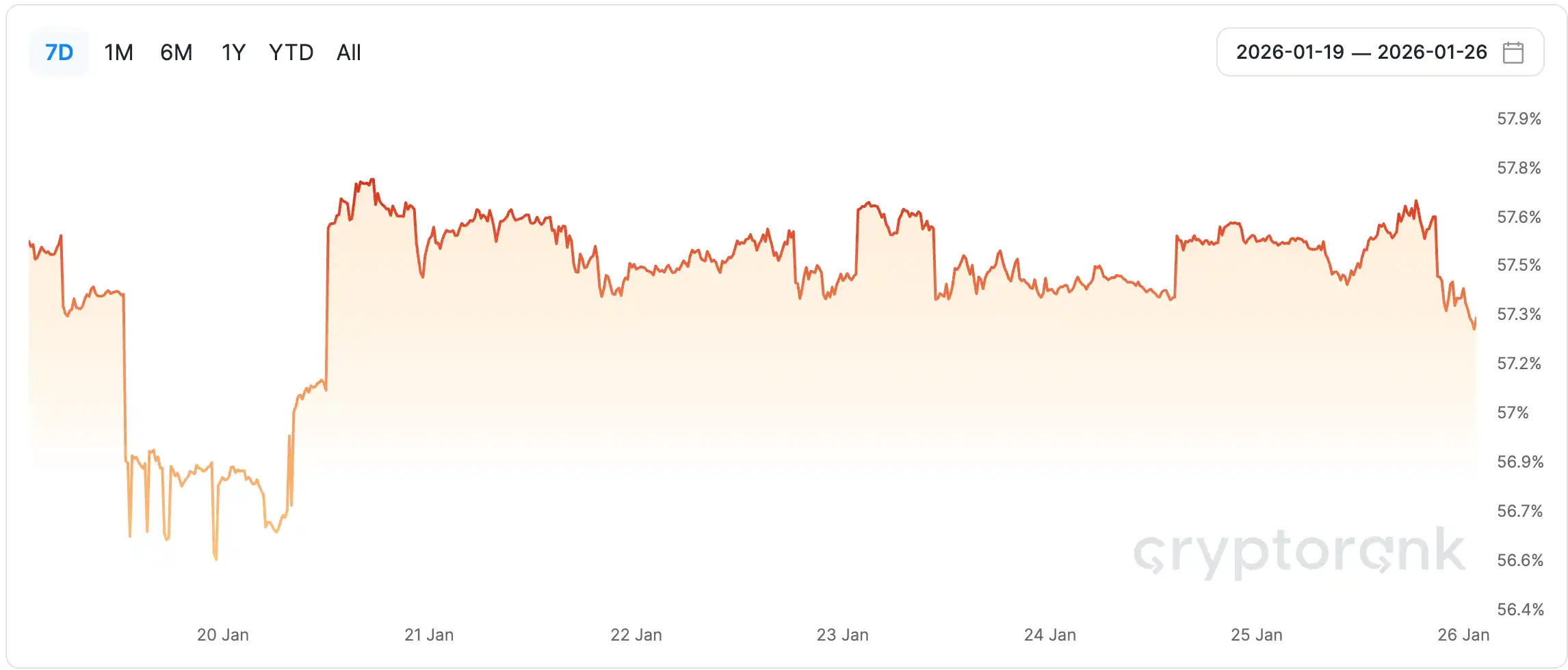
Data Source: Bitcoin dominance from cryptorank, https://cryptorank.io/charts/btc-dominance
Data as of January 25, 2026
As of the time of writing, Bitcoin's market cap is $1.74 trillion, accounting for 57.05% of the total cryptocurrency market cap. Meanwhile, the stablecoin market cap is $310.8 billion, accounting for 10.19% of the total cryptocurrency market cap.
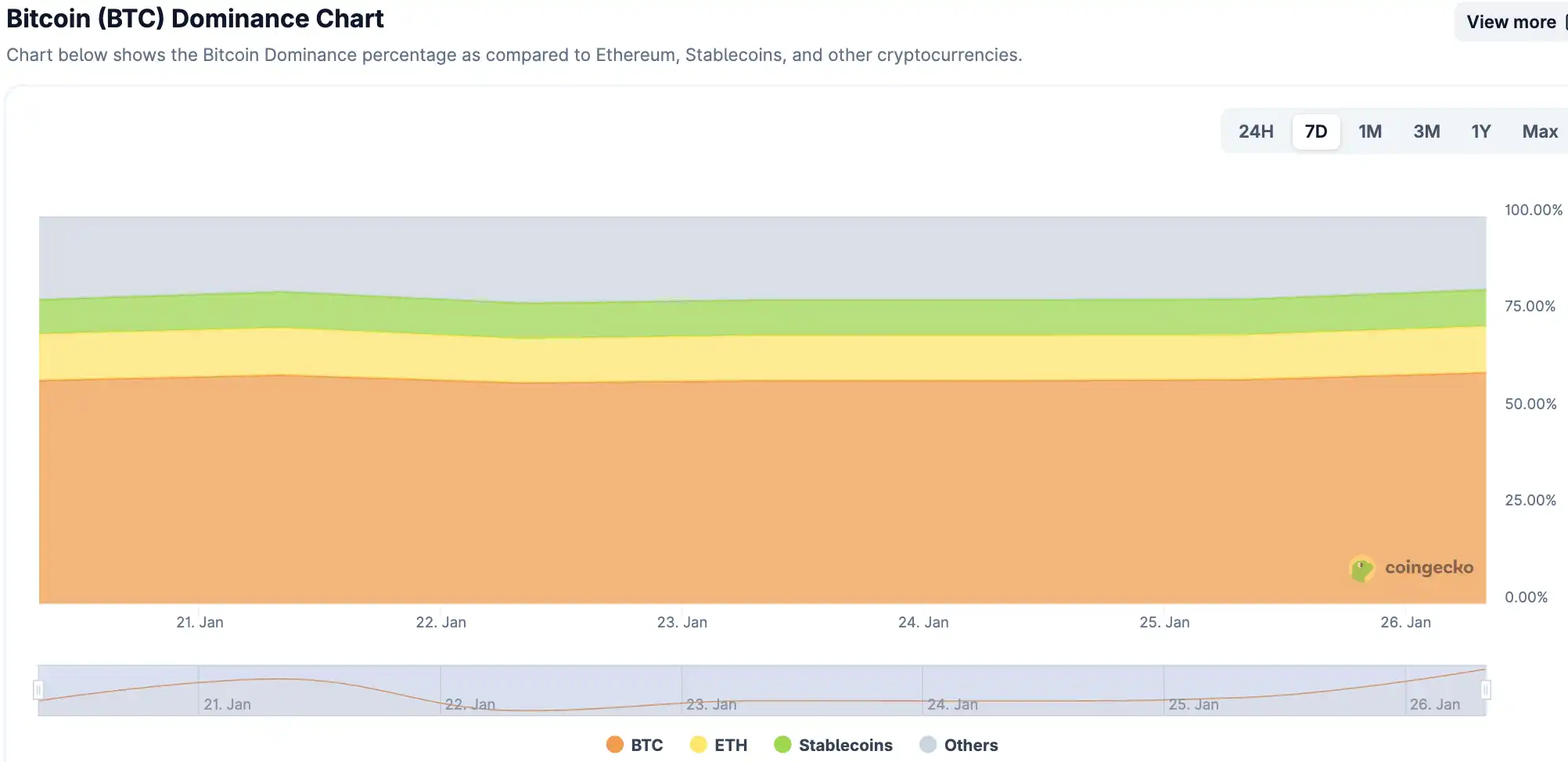
Data Source: coingecko, https://www.coingecko.com/en/charts
Data as of January 25, 2026
2. Fear & Greed Index
The Crypto Fear & Greed Index is 19, indicating Extreme Fear.
Data Source: Whale Alert, https://x.com/whale_alert
Data as of January 25, 2026
II. Hot Money Trends This Week
1. Top 5 Weekly Gainers: VC Coins and Meme Coins
Top 5 VC Coins by Gain in the Past Week
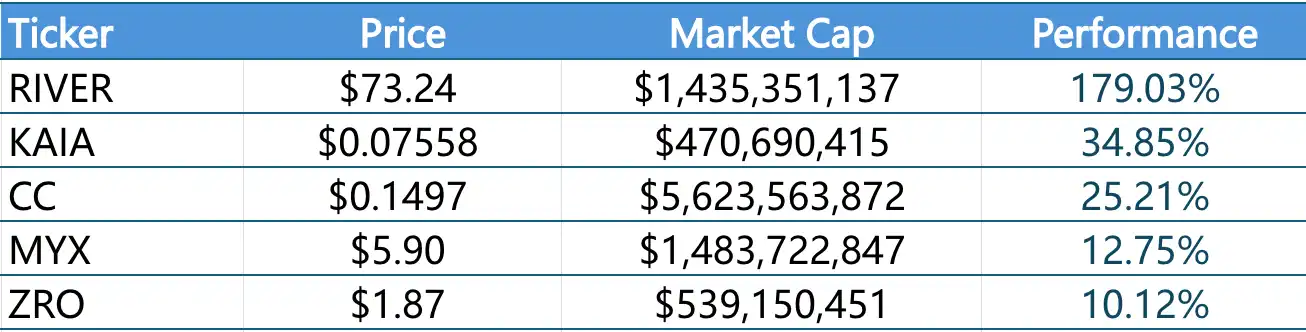
Data Source: CoinW Research Institute, coinmarketcap, https://coinmarketcap.com/...
Data as of January 25, 2026
Top 5 Meme Coins by Gain in the Past Week
Data as of January 25, 2026
2. New Project Insights
HyperLend is a crypto asset lending platform built on Hyperliquid's EVM blockchain, with the core goal of making crypto asset lending more efficient, transparent, and secure. Users can deposit their digital assets into the platform to earn yields or borrow against collateralized assets. The entire process is completed on-chain, with clear and verifiable fund flows and rules, leveraging the high liquidity advantages of the Hyperliquid ecosystem to improve capital efficiency. In the future, HyperLend also plans to expand into options, spot leverage trading, and other scenarios, deeply integrating with the Hyperliquid DEX to gradually develop into a more comprehensive on-chain financial ecosystem.
Lazbubu is a Web3-native AI companion smart agent built on BNB Chain. Through its独创的 DAT (Data Anchoring Token) mechanism, it anchors and records interactions between users and AI (such as chatting, decision-making, adventure activities, etc.) on the blockchain, making this behavioral data可持续验证且真正归属于用户. Compared to traditional AI, Lazbubu's growth is not temporary but accumulates an on-chain "growth history" through continuous interactions, allowing for personalized AI evolution. Users can view, manage, and even combine their data records, achieving data sovereignty and privacy control.
Cork Protocol is a "programmable risk layer" infrastructure protocol for the decentralized finance (DeFi) market, dedicated to building standardized risk pricing, hedging, and trading tools for on-chain assets (such as yield-generating stablecoins, vault tokens, liquid staking/restaking tokens, and real-world assets RWA). Cork's core technology allows asset managers and issuers to create customized swap markets, enhancing the redemption liquidity, risk transparency, and market confidence of these assets, thereby making complex on-chain risks quantifiable and tradable. This mechanism provides liquidity buffers, risk coverage, and higher capital efficiency for stablecoins, long-term hold assets, and on-chain portfolios of real-world assets, helping to drive institutional capital into the crypto market while narrowing the risk infrastructure gap between traditional finance and decentralized finance.
III. Industry News
1. Major Industry Events This Week
Solana Mobile's native token SKR officially launched on January 21, 2026, at 02:00 UTC, with a total supply of 10 billion tokens, positioned as an asset for ecosystem governance, incentives, and staking. Tokens allocated for airdrops, community treasury, and liquidity will be unlocked simultaneously. 30% of the tokens (approximately 3 billion) are reserved for Seeker phone users and ecosystem developers, with about 20% (nearly 2 billion) starting distribution on January 21, 2026, targeting over 100,000 users and nearly 200 developers. Specific airdrop amounts are tiered based on factors like device ownership and DApp activity. Users can claim the airdrop within 30 days after TGE opens by connecting their wallet to the Seed Vault Wallet. Solana Mobile is a mobile ecosystem project under Solana Labs, building a mobile-first Web3 ecosystem through its second-generation smartphone, Seeker, connecting hardware, decentralized applications, governance, and token incentives across multiple layers.
ETHGas completed its airdrop snapshot on January 19, 2026, at 00:00 (UTC) to identify eligible historically active users and officially迎来 TGE (Token Generation Event) on January 21, 2026, at 13:00 (UTC),同步开启代币上线与空投发放. This airdrop primarily targets early protocol users, participants in official tasks, or users who generated real Gas behavior, aiming to incentivize core contributors and promote early ecosystem participation. As an infrastructure project focused on Ethereum Gas fees and block space optimization, ETHGas is dedicated to improving the predictability and programmability of transaction costs, reducing user reliance on Gas volatility. Its token will be used for protocol governance and ecosystem incentives, marking the project's transition from the underlying infrastructure phase to a new stage of community-driven governance.
Somate (SOMT) plans to hold its Token Generation Event (TGE) on February 12, 2026, at 13:00 (UTC), with 20% of the tokens unlocked on that day and the remaining portion unlocked linearly over 6 months. Previously, Somate completed its IDO on the Spores Network launchpad from January 22 to January 24, 2026, with an issue price of approximately $0.05/SOMT, raising a total of about $200,000. Participants were required to complete KYC and stake according to platform rules. Somate (SOMT) is a Web3 platform for content creators and social scenarios, committed to reshaping the models of content creation, distribution, and value return through token incentive mechanisms.
Chimp Exchange (also known as ChimpX AI, token CHIMP) conducted its latest round of IDO from January 23 to January 24, 2026, with an issue price of approximately $1.50/CHIMP. 25% of the tokens from this round will be unlocked at TGE, with the rest released linearly over 3 months. However, the specific date for TGE has not been officially announced yet. Chimp Exchange is a Web3 trading platform that integrates AI-assisted trading with decentralized trading infrastructure, aiming to lower the barrier to entry for on-chain trading and asset management through intelligent strategies, automated tools, and data analysis capabilities.
2. Upcoming Major Events Next Week
The crypto wallet Rainbow officially announced key arrangements for its native token RNBW airdrop and Token Generation Event (TGE): The airdrop snapshot will be taken on January 26, 2026, at 16:20 EST (21:20 UTC), at which point the system will record users' Rainbow Points balances to determine airdrop eligibility and份额. The official RNBW airdrop distribution is scheduled for February 5, 2026. Previously, Rainbow had disclosed its tokenomics: RNBW has a total supply of 1 billion tokens, with 15% allocated to the airdrop, approximately 3% for the CoinList community pre-sale, 47% to the treasury, 12.2% to the team, 7.8% to investors, and 15% to the community; it is estimated that about 20% of the tokens will be in circulation at TGE (including the airdrop and pre-sale release portions).
HyperLend announced on January 20, 2026, that it will launch its native token HPL and is即将迎来代币生成事件(TGE); the specific date has not been officially announced yet. Shortly after TGE, token staking and locking functions will be launched. In HPL's tokenomics, approximately 30.14% is allocated for ecosystem growth and incentives, 25% for genesis distribution, 22.5% to core contributors, 17.36% to strategic investors, and 5% for liquidity. Strategic investors will unlock 10% of their allocation at TGE and subsequently unlock according to the既定锁定与线性释放安排. HyperLend is a decentralized lending protocol built on the Hyperliquid HyperEVM blockchain, dedicated to providing efficient and secure asset lending and liquidity services for ecosystem users, serving as the credit infrastructure for the entire Hyperliquid ecosystem.
Infinex's native token INX plans to hold its Token Generation Event (TGE) on January 30, 2026. Previously, the project completed its public sale from January 3-6, 2026, raising approximately $7.21 million, corresponding to 5% of the token supply, and refunded excess subscription funds to investors after the sale concluded. As a super application platform for cross-chain aggregated DeFi, Infinex aims to significantly lower the barrier to entry for users and simplify the overall DeFi operation experience through a unified account system, seamless cross-chain experience (covering multiple networks like Ethereum, Solana, Base), and Gas abstraction technology.
AntDrop will conduct its IDO on launchpads like Spores / KingdomStarter from February 1 to February 3, 2026 (UTC), with an issue price of approximately $0.01/ANT, aiming to raise about $200,000. The token allocation is set to unlock 10% at the future TGE, with the rest released linearly over 6 months. The token generation event time will be announced later. AntDrop is a multi-chain airdrop and token distribution infrastructure platform for the Web3 community and projects, aiming to connect users and project parties through task rewards, intelligent distribution, and transparent incentive mechanisms, supporting earning points by completing tasks and participating in airdrops and ecosystem activities.
3. Important Fundraising Last Week
BitGo successfully completed its Initial Public Offering (IPO) on the New York Stock Exchange (NYSE). The company issued approximately 11.82 million shares at a price of $18 per share, ultimately raising approximately $212.8 million in capital. Based on the issue price, BitGo's post-IPO valuation exceeded $2 billion. BitGo trades publicly on the NYSE under the ticker symbol BTGO. This IPO is not only a significant milestone for its own development but also the first major public offering event in the crypto industry in 2026, seen as a标志 of crypto asset infrastructure businesses gaining recognition from traditional capital markets. BitGo is a U.S.-based crypto asset custody and digital asset infrastructure company founded in 2013, primarily providing secure wallet custody, asset protection, staking, settlement, and other compliant services to institutional clients (such as exchanges, hedge funds, asset management companies, etc.), helping these institutions securely manage and use crypto assets like Bitcoin and Ethereum. (January 22, 2026)
Fintech and asset tokenization company Superstate announced the completion of an approximately $82.5 million Series B funding round, led by Bain Capital Crypto and Distributed Global, with participation from Haun Ventures, Brevan Howard Digital, Galaxy Digital, Bullish, ParaFi, and other institutions. Superstate is a technology company focused on leveraging blockchain technology to promote the tokenization of traditional financial securities. It currently manages over $1.23 billion in tokenized assets, including funds based on U.S. government securities (USTB) and crypto arbitrage funds (USCC). (January 22, 2026)
River announced the completion of a strategic funding round of approximately $12 million ($12M). In this round, TRON DAO, under Justin Sun, led the investment with approximately $8 million. Other significant investors included the Maelstrom Fund founded by Arthur Hayes, The Spartan Group, and several Nasdaq-listed companies and institutions from the United States and Europe, among other strategic investors. River is a crypto protocol building cross-chain stablecoin and on-chain liquidity infrastructure. Its core product is a stablecoin like satUSD that can be natively minted and used across multiple blockchains, aiming to solve the problems of cross-chain asset fragmentation and分散的流动性. (January 22, 2026)
IV. Reference Links
1. Coingecko:https://www.coingecko.com/en/charts
2. Coinglass:https://www.coinglass.com/pro/i/FearGreedIndex
3. Sosovalue:https://s极简风格,只翻译文本,保留原HTML标签和图片链接。>...
4. Ratiogang:https://ratiogang.com/
5. Defillama:https://defillama.com
6. L2Beat:https://l2beat.com/scaling/tvs
7. Footprint:https://www.footprint.network/public/research/chain/chain-ecosystem/layer-2-overview
8. Coinglass:https://www.coinglass.com/pro/stablecoin
9. HyperLend: https://hyperlend.finance/
10. Bitgo: https://www.bit极简风格,只翻译文本,保留原HTML标签和图片链接。>...
11. Superstate: https://superstate.com/
12. River: https://www.river.inc/
13. Lazbubu: https://lazbubu.ai/
14. Cork Protocol: https://cork.tech/
Domande pertinenti
QWhat was the total global cryptocurrency market capitalization as of January 25, 2026, and what was its weekly change?
AThe total global cryptocurrency market capitalization was $3.05 trillion as of January 25, 2026, representing a weekly decrease of 5.27% from the previous week's $3.22 trillion.
QWhat was the net flow for US Bitcoin and Ethereum spot ETFs for the reported week?
AFor the reported week, US Bitcoin spot ETFs had a net outflow of $1.33 billion, and US Ethereum spot ETFs had a net outflow of $611 million.
QWhich Layer 1 blockchain saw the largest weekly increase in daily active addresses, and what was the percentage increase?
AThe Sui blockchain saw the largest weekly increase in daily active addresses, rising from 448,000 to 664,000, a 48.36% increase.
QWhat significant corporate event did BitGo complete, and what was the amount raised?
ABitGo successfully completed an Initial Public Offering (IPO) on the New York Stock Exchange (NYSE), raising approximately $212.8 million.
QWhat is the primary function of the Cork Protocol as described in the report?
ACork Protocol is an infrastructure protocol that serves as a 'programmable risk layer' for the DeFi market, aiming to build standardized tools for risk pricing, hedging, and trading of on-chain assets.
Letture associate

Trading
