Coingecko Data: 11.5 Million Projects Died in 2025, The Most Devastating Year in Crypto History

marsbitPubblicato 2026-01-14Pubblicato ultima volta 2026-01-14

Introduzione

According to data from GeckoTerminal, 53.2% of all cryptocurrency projects have failed, with the vast majority of these failures—86.3%—occurring in 2025 alone. A staggering 11.6 million token projects died in 2025, making it the most devastating year in crypto history. This sharp decline in token viability is linked to extreme market turbulence, particularly within the memecoin sector. A record-breaking liquidation event on October 10, 2025, where $19 billion in leveraged positions were liquidated in 24 hours, triggered a chain reaction that led to the collapse of 7.7 million projects in Q4 alone. Despite the high failure rate, the total number of crypto projects exploded—growing from 428,383 projects on GeckoTerminal in 2021 to over 20.2 million by 2025. This surge is largely attributed to the rise of token launch platforms that made creating low-quality memecoins exceptionally easy. In comparison, 2024 saw 1.4 million project failures, accounting for 10.3% of all failures in the past five years, while failures from 2021 to 2023 made up just 3.4%. The data includes tokens that had at least one trade before failing and only counts "graduated" tokens from platforms like pump.fun.

Author:Shaun Paul Lee

Compiled by: Deep Tide TechFlow

How Many Cryptocurrencies Have "Died"?

According to data from GeckoTerminal, 53.2% of cryptocurrency projects have failed, with the majority of these failures concentrated in 2025. In 2025 alone, 11.6 million token projects came to an end, accounting for 86.3% of all failed projects. This phenomenon is closely related to the severe market turbulence throughout the year, particularly the impact on the memecoin sector.
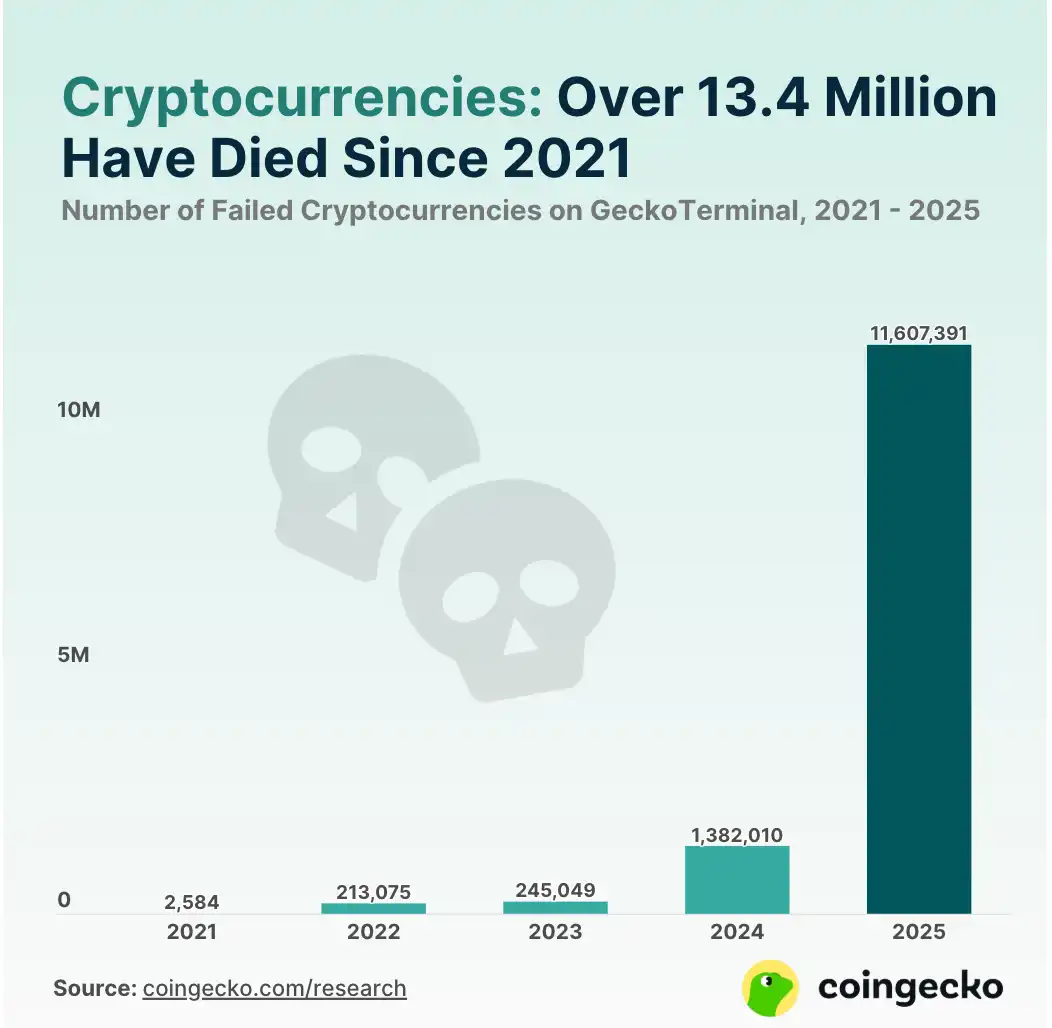
This sharp decline in token viability may be related to the market turmoil throughout the year, especially affecting the meme coin sector.

Shockingly, the fourth quarter of 2025 alone saw 7.7 million token projects collapse, accounting for 34.9% of all failed projects. This sharp decline is closely linked to the "liquidation chain reaction" that occurred on October 10. In this record-breaking event, a staggering $19 billion in leveraged positions were liquidated within 24 hours, making it the single largest day of deleveraging in cryptocurrency history.

Despite the extreme volatility in the cryptocurrency market in 2025, the total number of cryptocurrency projects grew dramatically. From 428,383 projects on GeckoTerminal in 2021, this number had surged to nearly 20.2 million projects by 2025. This growth is largely attributed to the rise of various token issuance platforms, which made creating low-quality memecoins and projects exceptionally easy.

86.3% of Cryptocurrencies Died in 2025
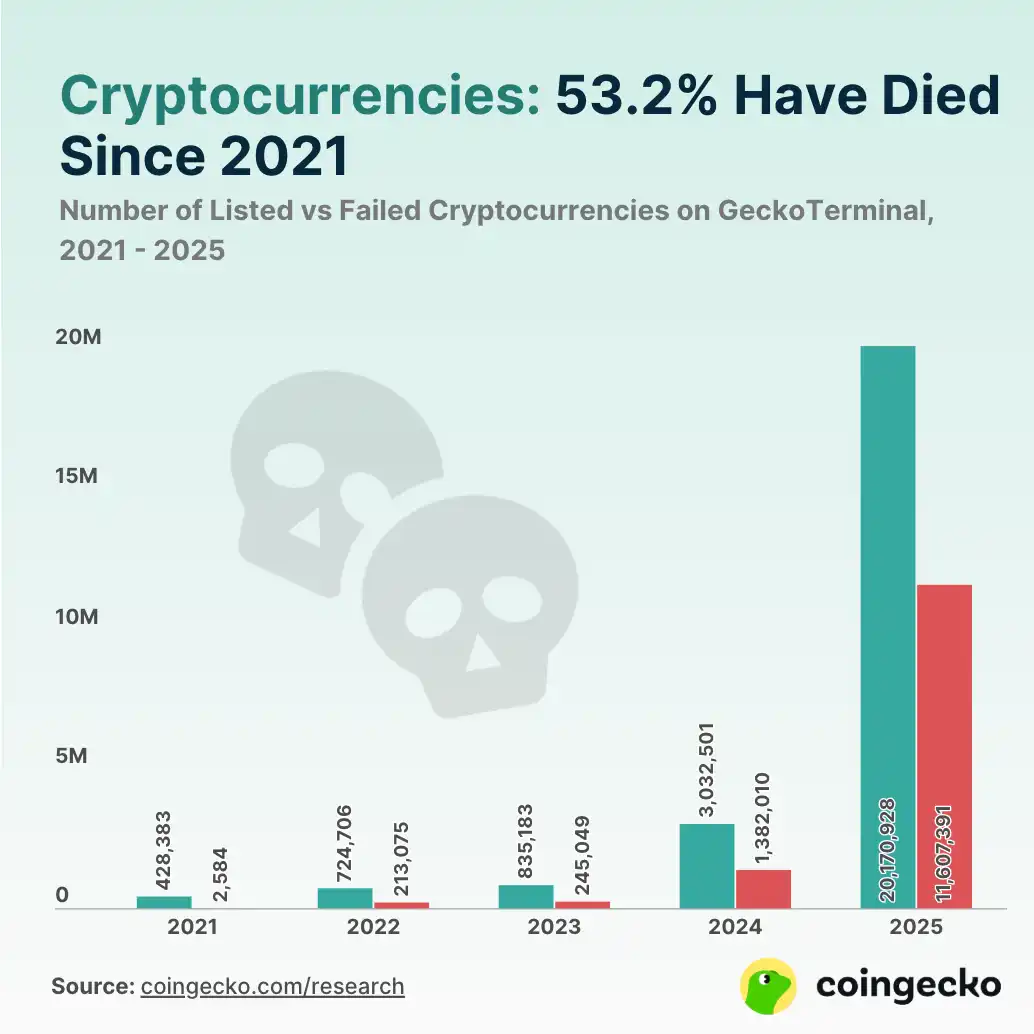
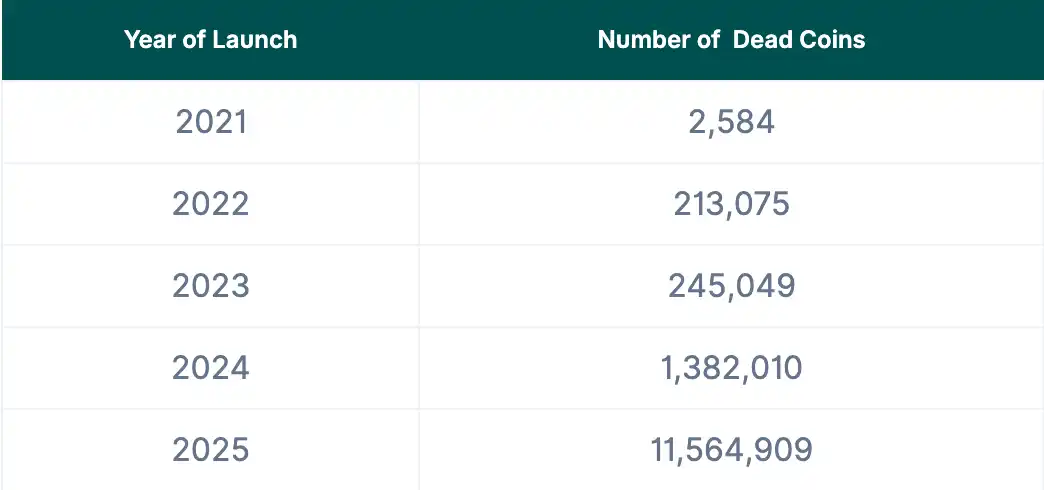
As of December 31, 2025, a total of 11.6 million cryptocurrency projects had failed, setting a new historical record for the number of failed projects in a single year. These failed projects account for 86.3% of all failure cases between 2021 and 2025.

This was followed by 2024, which saw approximately 1.4 million project failures, accounting for 10.3% of the total failures over the past five years. 2024 was also the second-highest peak for the growth in the number of cryptocurrency projects, with over 3 million new projects entering the market. However, before the launch of the pump.fun platform in 2024, the number of cryptocurrency failures remained at a relatively low six-figure level. In contrast, the total number of failed projects between 2021 and 2023 accounts for only 3.4% of the total failures over the past five years.

Year-by-Year Statistics: Cryptocurrency Failure Data

The following statistics show the number of failed cryptocurrency projects each year from 2021 to 2025:
Research Methodology

This study analyzed tokens and cryptocurrency projects (collectively referred to as "cryptocurrencies") that were once listed on GeckoTerminal between July 1, 2021, and December 31, 2025, but are no longer actively traded. These projects are classified as "failed" or "dead" and are grouped according to the year of their last active trade.

  • Only tokens that had at least one trade before failing are counted.
  • Additionally, only token projects that had "graduated" within the pump.fun platform were included.


Letture associate

Bitcoin Withdrawals Continue: 8 Years of Storage in a Coldcard Cold Wallet Ended in Zero

Coldcard Hardware Wallet Hacked: Losses Mount Due to Vulnerable Seed Generation A critical vulnerability in Coldcard hardware wallets has led to a continued wave of fund thefts. According to Galaxy Research, the total stolen has reached 1,367.05 BTC (approx. $88.6 million) from 4,585 addresses, a significant increase from the initial 594.5 BTC reported on July 30, 2026. Most of the stolen funds remain on the attackers' addresses. The issue is not with the current firmware, which Coinkite has updated, but with seed phrases generated on vulnerable devices between March 2021 and the release of fixed firmware versions. Due to a programmer error, devices switched from using a hardware random number generator to the software-based Yasmarang generator, which was initialized with publicly accessible data like the chip's serial number. This made the seed phrases predictable through offline brute-force attacks, meaning wallets remain at risk until funds are moved to a new wallet generated with the patched firmware. Affected devices include Mk2/Mk3 with firmware 4.0.1–4.1.9 (and up to 5.0.3), Mk4/Mk5 up to version 5.6.0, and Q models up to 1.5.0Q. The only exceptions are seeds created with a high-entropy method like at least 50 independent dice rolls or a strong unique BIP-39 passphrase. All other owners must generate a new seed on the fixed firmware and transfer their assets. A case highlighting the human impact involves a 39-year-old long-term investor who lost 2 BTC (approx. $130,000) in minutes. He had accumulated the Bitcoin over eight years through physical labor, viewing it as a financial lifeline and a retirement plan in a country suffering from hyperinflation. His story underscores that even conservative "buy and hold in cold storage" strategies can be compromised by such underlying technical flaws. From a technical perspective, this incident echoes historical failures where weak random number generators undermined cryptographic security, challenging the assumption that offline storage is automatically foolproof.

cryptonews.ru2 h fa

Bitcoin Withdrawals Continue: 8 Years of Storage in a Coldcard Cold Wallet Ended in Zero

cryptonews.ru2 h fa

Trading

Spot
活动图片



