Author: CoinGecko
Compiled by: Deep Tide TechFlow
In the last quarter of 2025, the cryptocurrency market experienced a sharp correction, with the total market capitalization plummeting by 23.7% to close at $3 trillion. This marks the first annual decline for the crypto market since 2022, down 10.4% year-on-year. Although the quarter once hit a historic high of $4.4 trillion, a historic $19 billion liquidation event in October led to a significant price drop. Despite the price pullback, market volatility drove the average daily trading volume to an annual high of $161.8 billion, while the stablecoin market grew by 48.9% year-on-year, reaching a record high of $311 billion.
This year, the cryptocurrency market showed a decoupling trend from traditional assets, with gold rising by 62.6% and the U.S. stock market performing excellently, while Bitcoin fell by 6.4%. However, institutional adoption deepened further, with Digital Asset Treasury Companies (DATCos) deploying at least $49.7 billion in 2025 to acquire over 5% of the total supply of Bitcoin and Ethereum. Other highlights include a surge of 302.7% in prediction market trading volume and a record high annual perpetual futures trading volume of $86.2 trillion on centralized exchanges. These data indicate that even as prices fall, market infrastructure and utility continue to expand.
Our "2025 Annual Cryptocurrency Industry Report" comprehensively covers the panorama of the crypto market, in-depth analysis of Bitcoin and Ethereum, and also explores the decentralized finance (DeFi) and non-fungible token (NFT) ecosystems, while reviewing the performance of centralized exchanges (CEX) and decentralized exchanges (DEX).
Below are the key highlights of the report, but be sure to read the full 60-page report content.
Seven Highlights from CoinGecko's "2025 Annual Cryptocurrency Industry Report"
- The total cryptocurrency market capitalization fell by 10.4% in 2025, closing at $3 trillion
- Stablecoin market capitalization surged by $102.1 billion (+48.9%) in 2025, hitting a record high of $311 billion
- Gold performed outstandingly in 2025, rising by 62.6%, while Bitcoin lagged, falling by 6.4%; the U.S. dollar and oil also performed poorly
- Digital Asset Treasury Companies (DATCos) invested at least $49.7 billion in 2025, with about 50% concentrated in the third quarter
- Prediction market trading volume grew by 302.7% in 2025, reaching $63.5 billion
- Centralized exchange perpetual futures trading volume grew by 47.4% in 2025, reaching $86.2 trillion, a record high
- Decentralized exchange perpetual futures trading volume grew by 346% in 2025, reaching $6.7 trillion, another record high
1. Total Cryptocurrency Market Cap Plunged 23.7% in Q4 2025 (a decrease of $946 billion), Closing the Year at $3 Trillion
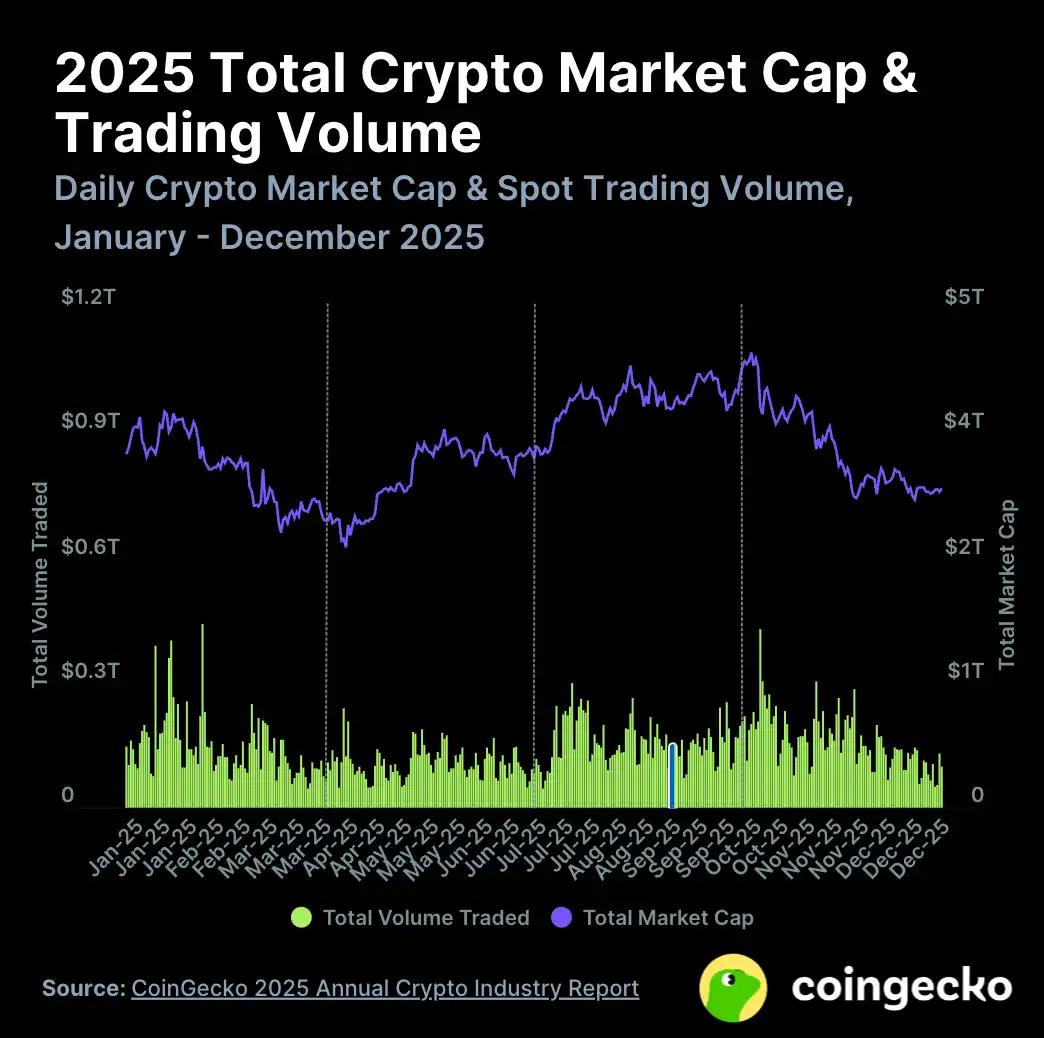
The total cryptocurrency market capitalization fell by 23.7% in the fourth quarter, a decrease of $946 billion, closing the year at $3 trillion, down 10.4% year-on-year. This is the first annual decline for the cryptocurrency market since 2022.
The fourth quarter of 2025 started strongly for the crypto market, with the total market cap once reaching a historic high of $4.4 trillion. However, this high did not last, as prices continued to fall until the end of November, then entered a volatile range until the end of the year. The trigger for this decline was the historic $19 billion liquidation event triggered by the U.S. announcement of 100% tariffs on China on October 10.
Meanwhile, the average daily trading volume in the fourth quarter grew to $161.8 billion, hitting an annual high, a quarter-on-quarter increase of 4.4%. This growth was mainly driven by the liquidation event and subsequent high volatility. However, as the market entered a volatile phase, trading volume gradually declined.
2. Stablecoin Market Cap Surged by $102.1 Billion (+48.9%) in 2025, Hitting a Record High of $311 Billion
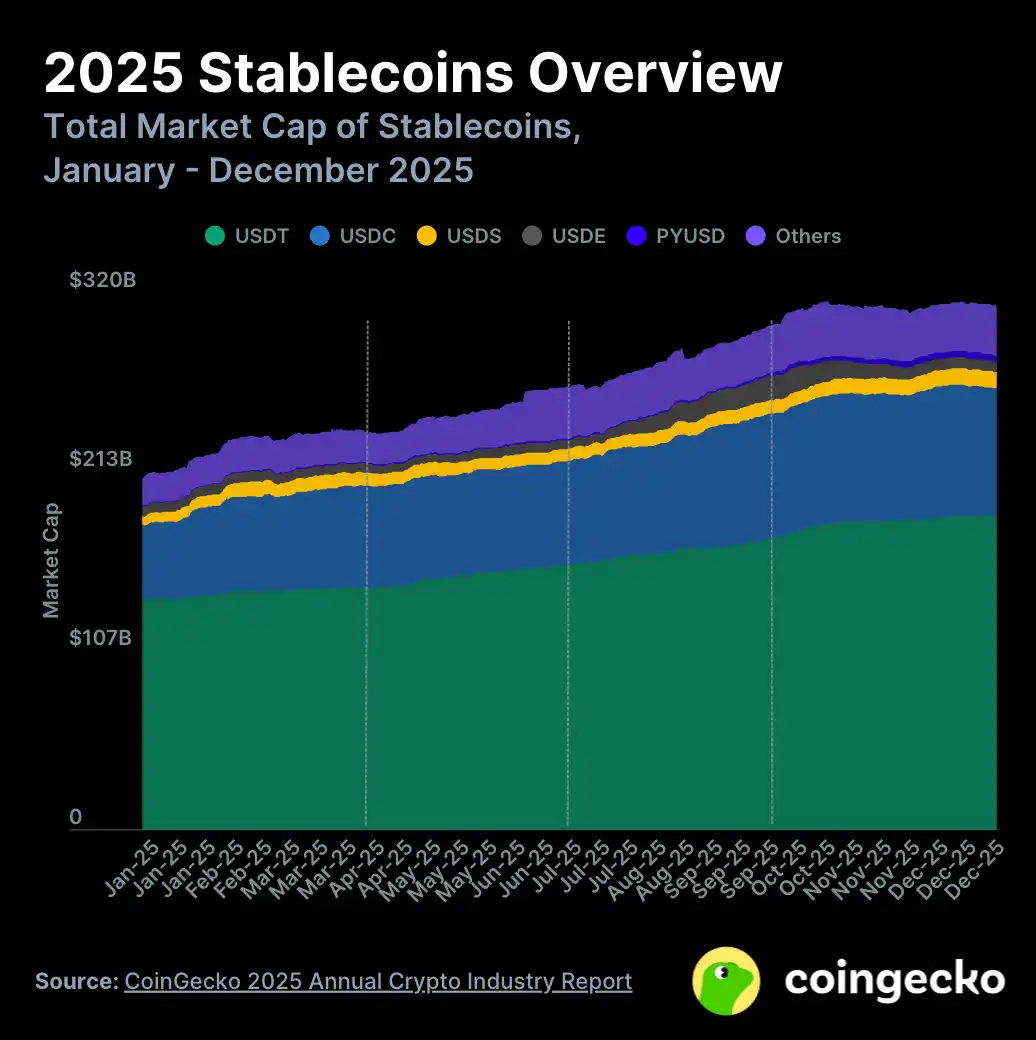
In the fourth quarter of 2025, the total stablecoin market capitalization grew by $6.3 billion, reaching a record high of $311 billion at the end of the quarter. For the full year, the stablecoin market grew by 48.9% year-on-year, adding $102.1 billion.
The biggest change in the fourth quarter came from the Ethereum ecosystem stablecoin Ethena's USDe, whose market capitalization plummeted by 57.3% (a decrease of $8.4 billion) after rapid deleveraging in mid-October. Due to a de-pegging event on the Binance platform, USDe's supply fell from a peak of nearly $15 billion to $6.3 billion, severely damaging investor confidence in high-yield circular strategies.
Meanwhile, PayPal's stablecoin PYUSD emerged strongly, with its market capitalization surging by 48.4% (an increase of $1.2 billion) to reach $3.6 billion, successfully becoming the fifth-largest stablecoin, replacing World Liberty Financial's USD1. Its growth was driven by YouTube's launch of a creator revenue payment feature and the approximately 4.25% yield offered by the Spark Savings Vault.
3. Gold Leads 2025: Up 62.6%, Bitcoin Lags, Down 6.4%, Dollar and Oil Also Weak
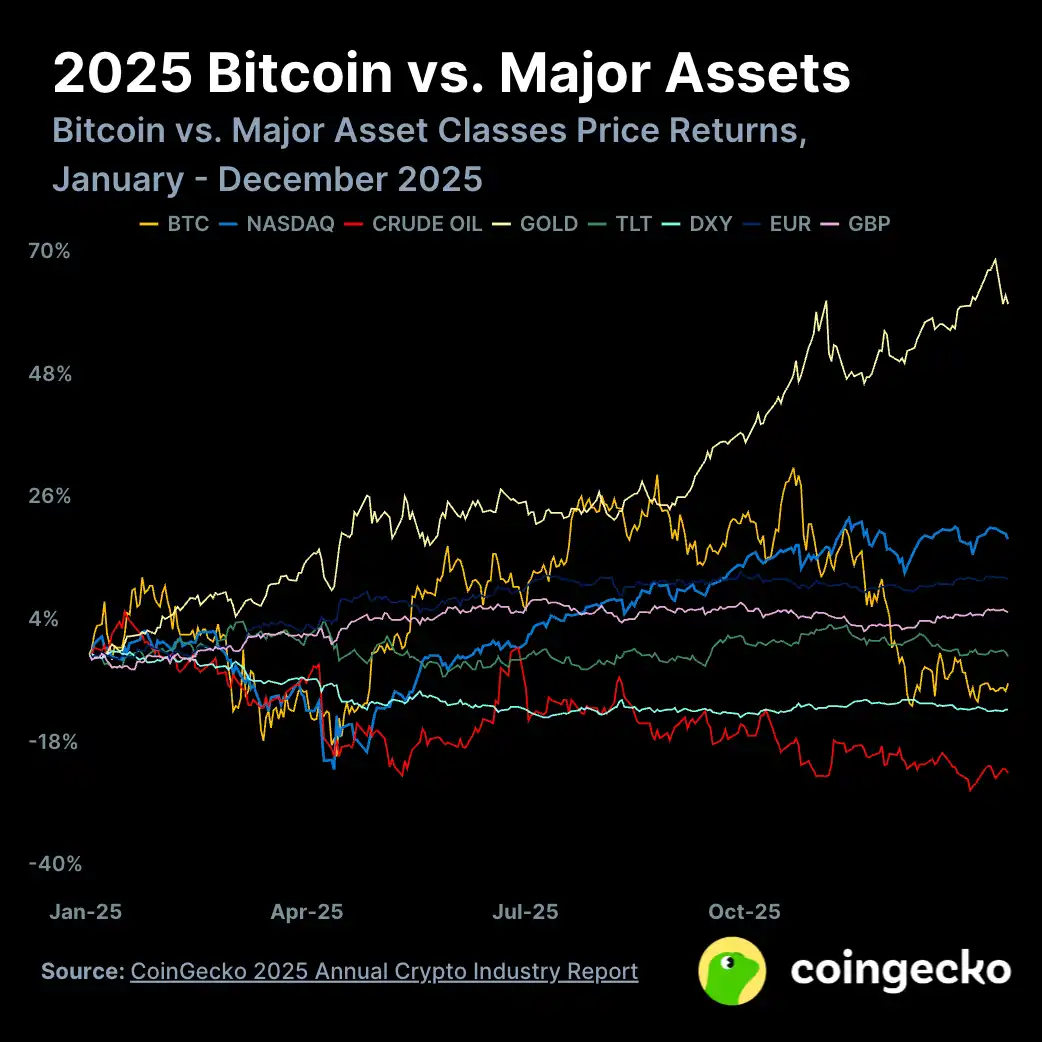
In 2025, gold was the standout performing asset, with a full-year increase of 62.6%. In contrast, Bitcoin performed poorly, falling by 6.4%, echoing the weak performance of the U.S. dollar and oil.
In 2025, gold performed particularly well, rising by 62.6% for the year. In the fourth quarter alone, gold grew by 11.4%, mainly driven by continued central bank purchases and tariff-related uncertainties. Following closely were U.S. stock markets, with the Nasdaq up 20.5% and the S&P 500 up 16.6%, benefiting from the ongoing AI narrative.
In contrast, while commodities and stocks performed strongly, Bitcoin (BTC) underperformed, falling by 6.4% for the year. Assets that performed worse than Bitcoin included the U.S. Dollar Index (down 10.0%, affected by interest rate cuts and political changes) and crude oil (down 21.5%, due to global oversupply and record production from non-OPEC countries).
4. Digital Asset Treasury Companies (DATCos) Invested at Least $49.7 Billion in 2025, with About 50% Concentrated in Q3
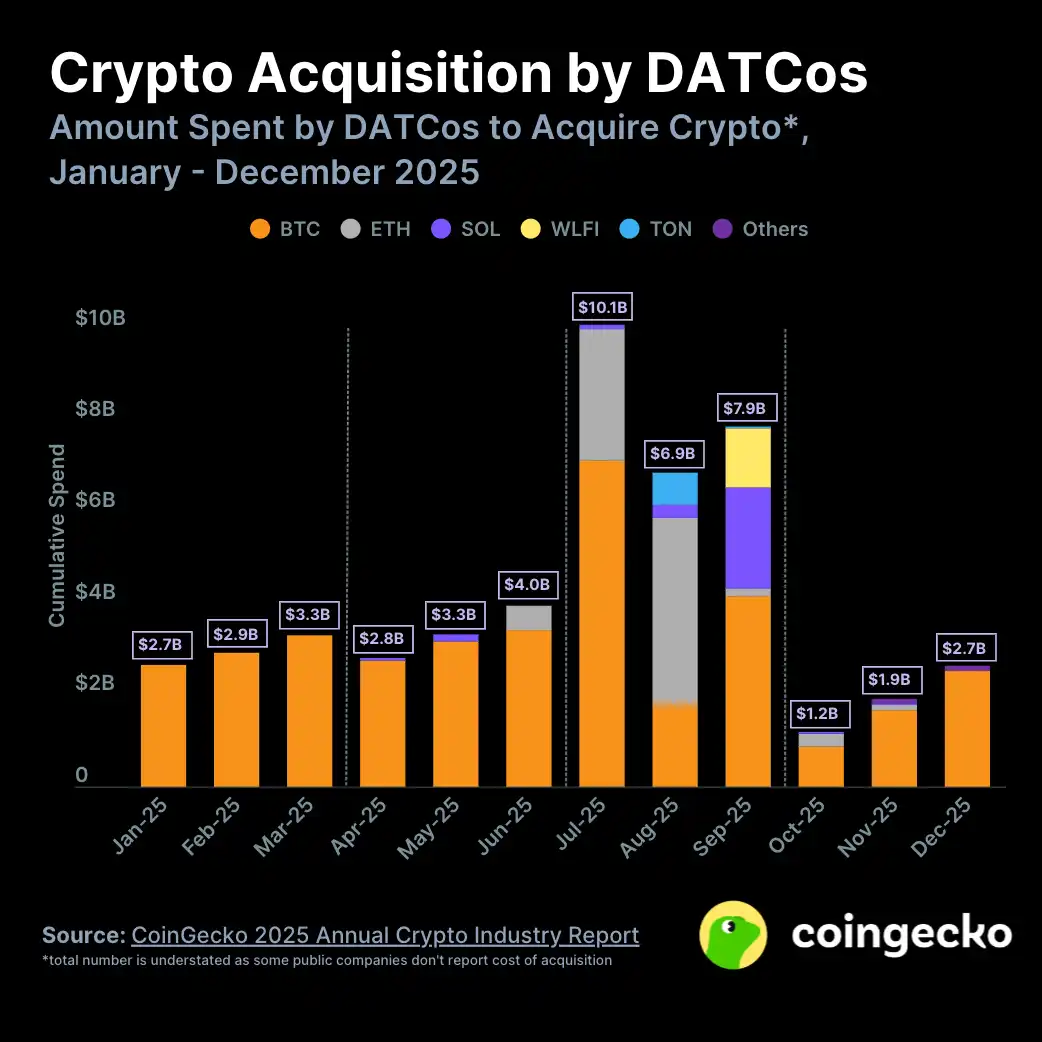
Digital Asset Treasury Companies (DATCos) became significant players in the market in 2025, investing a total of at least $49.7 billion in purchasing cryptocurrencies throughout the year. The third quarter was the peak of investment, accounting for half of the annual total, mainly due to a wave of emerging altcoin DATCos.
However, the pace of investment slowed significantly in the fourth quarter, with only $5.8 billion invested. The crypto market crash dragged down DATCos' stock prices, causing the adjusted net asset value (mNAV) of many DATCos to fall below 1.0. This forced them to use funds for stock buybacks rather than continuing to accumulate cryptocurrency.
As of January 1, 2026, DATCos collectively held $134 billion in crypto assets, a 137.2% increase from $56.5 billion on January 1, 2025. DATCos currently hold over 1 million Bitcoin and 6 million Ethereum, accounting for more than 5% of their total supply.
5. Prediction Market Trading Volume Surged 302.7% in 2025, Reaching $63.5 Billion
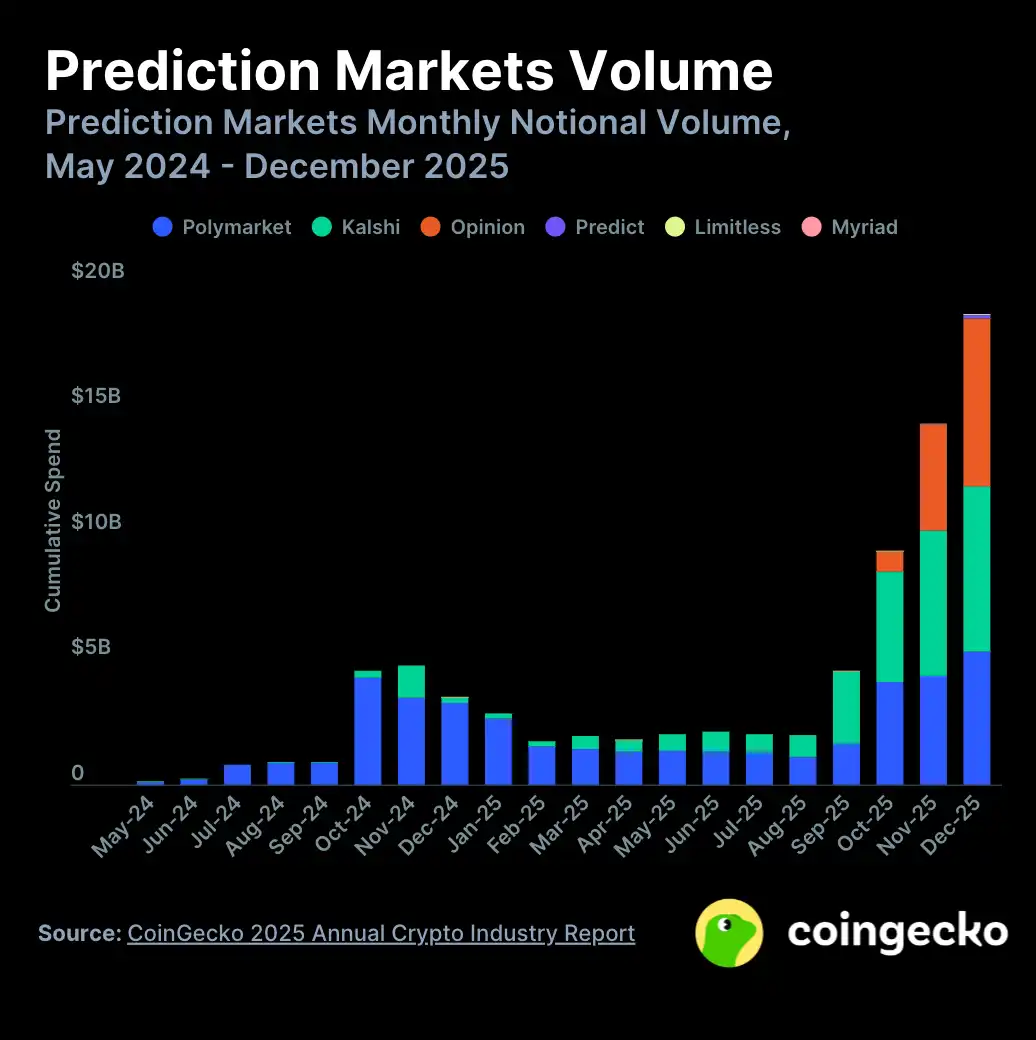
In 2025, prediction markets experienced explosive growth, with trading volume increasing by 302.7% year-on-year, reaching a record high of $63.5 billion.
Nominal trading volume in prediction markets surged from $15.8 billion in 2024 to $63.5 billion in 2025, a year-on-year increase of 302.7%.
At the beginning of 2025, Polymarket held an 85.6% market share in the first quarter but was overtaken by Kalshi in the fourth quarter. In Q4, Kalshi's market share reached 39.6%, while Polymarket ranked second with 32.4%. Meanwhile, Opinion, supported by Yzi Labs and based on the BNB Chain, launched in November, becoming a strong challenger to the existing markets. Opinion's trading volume reached $7 billion in December, on par with Kalshi, though current volume may be influenced by airdrop activities.
6. Centralized Exchange Perpetual Futures Trading Volume Grew 47.4% in 2025, Reaching $86.2 Trillion, a Record High
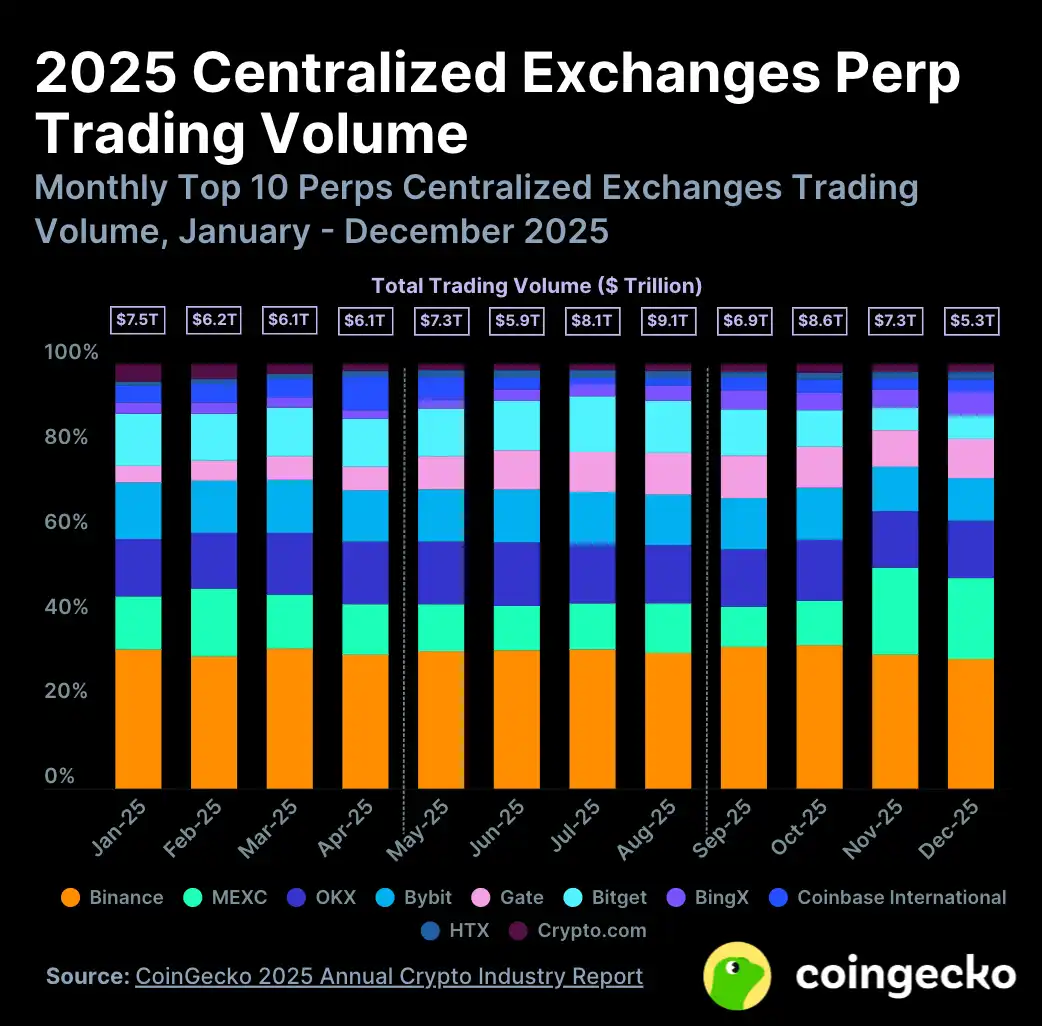
In the fourth quarter of 2025, the trading volume of the top ten centralized perpetual futures exchanges (Perp CEXes) recorded $21.2 trillion, down 12.0% from $24.0 trillion in the third quarter. The full-year trading volume reached $86.2 trillion, a 47.4% increase compared to 2024, setting a new historical record.
October 2025 became the second-highest trading volume month in history, after August, when Bitcoin hit its latest all-time high. In contrast, December was the quietest trading month of the year, with trading volume of only $5.3 trillion.
Throughout 2025, the market share of the top ten centralized perpetual futures exchanges remained relatively stable. The only significant change was MEXC's surge in trading volume in November and December, surpassing OKX, Bybit, and Bitget to become the second largest. Outside the top ten, KuCoin performed brightly in 2025, becoming the only non-top-ten perpetual futures exchange to break the $1 trillion trading volume mark.
7. Decentralized Exchange Perpetual Futures Trading Volume Grew 346% in 2025, Reaching $6.7 Trillion, Setting a New Record High
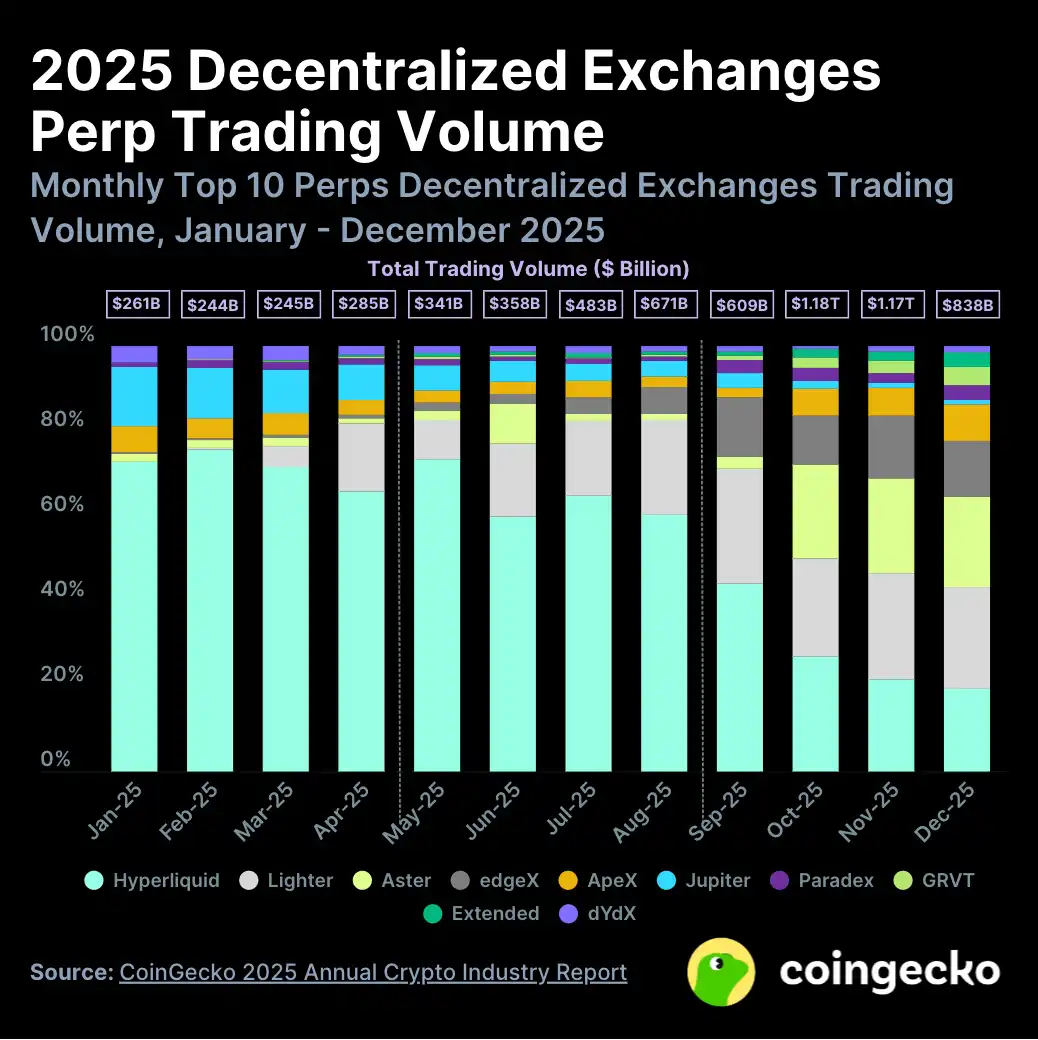
Decentralized perpetual futures exchange (Perp DEXes) trading volume grew by 80.8% in Q4 2025, from $1.8 trillion in Q3 to $3.2 trillion in Q4.
In 2025, the full-year trading volume of the top ten decentralized perpetual futures exchanges reached $6.7 trillion, a significant increase of 346% compared to $1.5 trillion in 2024. The ratio of Perp DEX to centralized perpetual futures exchange (CEX) trading volume jumped from 2.5% a year ago to 7.8%.
The growth in trading volume was mainly driven by incentives and airdrop activities provided by exchanges such as Lighter, Aster, edgeX, GRVT, and Paradex. Hyperliquid remained the most active perpetual decentralized exchange overall in 2025 but was overtaken by Lighter in the fourth quarter. Hyperliquid and Lighter have now entered the top ten perpetual futures exchanges by annual trading volume, recording $2.9 trillion and $1.3 trillion in trading volume, respectively.