Coinbase Stock Slides 4.3% as Nevada Gaming Regulator Targets Unlicensed Sports Betting Contracts

bitcoinistPubblicato 2026-02-05Pubblicato ultima volta 2026-02-05

Introduzione

Coinbase shares declined 4.3% as Nevada gaming regulators filed a civil complaint against the company, alleging its prediction market products constitute unlicensed sports betting. The state seeks to halt these markets, arguing they fall under Nevada's gambling laws rather than federal derivatives regulation. Coinbase, which partners with CFTC-regulated Kalshi, maintains the products are legal derivatives. The action adds to regulatory pressures on Coinbase, which has seen an 11-session stock decline amid legal uncertainties and a recent data breach. The company is challenging similar state-level actions in other jurisdictions, claiming exclusive CFTC oversight.

Coinbase shares continued their recent decline after Nevada regulators moved to block the crypto exchange’s prediction market products, adding another layer of legal uncertainty for the company.

The enforcement action highlights a growing conflict between state gaming authorities and platforms offering event-based contracts that resemble sports betting, even when those products operate under federal oversight.

On Monday, the Nevada Gaming Control Board filed a civil enforcement complaint against Coinbase Financial Markets in Carson City. Regulators are seeking a temporary restraining order and a permanent injunction to stop Coinbase from offering prediction markets tied to sports and elections within the state.

The board argues that these contracts amount to unlicensed gambling under Nevada law and should fall under state gaming authority rather than federal derivatives regulation.
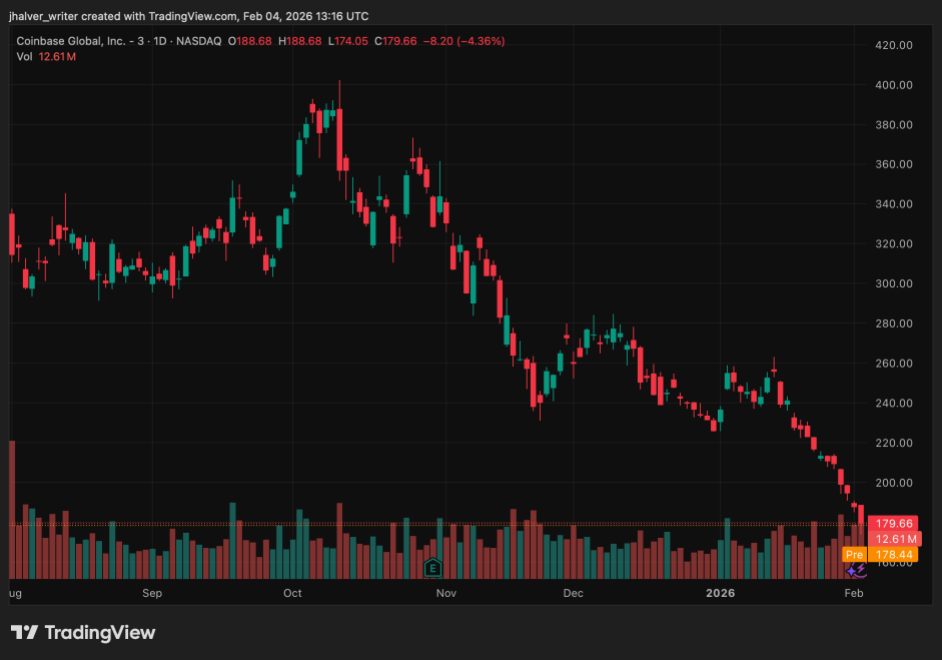
COIN's price trends to the downside on the daily chart. Source: COINUSD on Tradingview

Nevada Challenges Coinbase’s Prediction Markets

Coinbase launched its US prediction markets last month through a partnership with Kalshi, a Commodity Futures Trading Commission-regulated designated contract market.

The exchange maintains that these event-based contracts are federally regulated derivatives, not gambling products. Nevada officials disagree, saying contracts linked to sporting outcomes and elections constitute wagering activity and therefore require state gaming licenses.

In its filings, the board also raised concerns about age restrictions, noting that Coinbase allows users aged 18 and older to trade event contracts, below Nevada’s legal gambling age of 21.

Regulators said the platform’s continued operation creates ongoing harm and gives Coinbase an unfair advantage over licensed sportsbooks that must meet strict compliance, tax, and location requirements.

The action against Coinbase follows similar moves by Nevada against other prediction market platforms. A state court recently granted a temporary restraining order blocking Polymarket from offering event-based contracts to Nevada residents.

Legal Pressure Weighs on Coinbase Stock

The Nevada lawsuit has added to broader pressure on Coinbase shares. The stock fell 4.36% on Wednesday, extending its losing streak to eleven consecutive sessions and pushing it to its lowest level since April.

Investor sentiment has been weighed down by regulatory risks and a recent disclosure of an insider-related data breach affecting roughly 30 clients.

Coinbase has pushed back against state-level actions elsewhere, filing federal lawsuits against gaming regulators in Connecticut, Michigan, and Illinois. The company argues that prediction markets fall exclusively within the CFTC’s jurisdiction and that state enforcement efforts unlawfully restrict federally regulated products.

Cover image from ChatGPT, COINUSD chart on Tradingview

Domande pertinenti

QWhy did the Nevada Gaming Control Board file a complaint against Coinbase?

AThe Nevada Gaming Control Board filed a complaint because it argues that Coinbase's prediction market products tied to sports and elections constitute unlicensed gambling under Nevada law and should be regulated by the state gaming authority, not as federal derivatives.

QWhat is the impact of the Nevada enforcement action on Coinbase's stock?

AThe Nevada lawsuit contributed to a 4.36% decline in Coinbase's stock on Wednesday, extending its losing streak to eleven consecutive sessions and pushing it to its lowest level since April.

QHow does Coinbase defend its prediction market products against state regulators?

ACoinbase maintains that its event-based contracts are federally regulated derivatives overseen by the CFTC, not gambling products, and it has filed federal lawsuits arguing that state enforcement efforts unlawfully restrict these federally regulated products.

QWhat specific concerns did Nevada regulators raise about Coinbase's platform besides licensing?

ANevada regulators raised concerns about age restrictions, noting that Coinbase allows users aged 18 and older to trade, which is under Nevada's legal gambling age of 21, and that it gives Coinbase an unfair advantage over licensed sportsbooks that must meet strict compliance requirements.

QHas Nevada taken similar actions against other prediction market platforms besides Coinbase?

AYes, the Nevada Gaming Control Board has taken similar action against other platforms. A state court recently granted a temporary restraining order blocking Polymarket from offering event-based contracts to Nevada residents.

Letture associate

The "Impossible Triad" Is Fundamentally a Pseudo-Problem

The article argues that blockchain's fundamental limitation is not the scalability trilemma (decentralization, scalability, security), which has been largely solved, but the lack of **privacy** and, until recently, clear **legitimacy**. Blockchain is described as a slow, expensive, globally shared computer whose core value is censorship resistance and verifiability. While ideal for native digital assets like money (e.g., stablecoins), its default transparency acts as a **tax**, exposing all transactions and enabling MEV extraction, which deters serious institutional capital. Simultaneously, its permissionless nature created regulatory ambiguity. The piece contends that **privacy** is the missing critical feature. It rejects the false choice between total transparency and complete anonymity. Modern cryptography (like zero-knowledge proofs) enables **compliant privacy**: users can prove facts (solvency, KYC status, compliance) without revealing the underlying sensitive data (specific holdings, identities). This preserves auditability for regulators and eliminates the leak of financial information. With recent regulatory progress (e.g., the GENIUS Act) addressing legitimacy, adding default, provably compliant privacy becomes a pure upgrade. It transforms blockchain from a costly, public ledger into a confidential settlement layer, finally bridging the gap to mainstream institutional and individual adoption of on-chain finance.

链捕手12 h fa

The "Impossible Triad" Is Fundamentally a Pseudo-Problem

链捕手12 h fa

Optical Chips: Collective Capacity Expansion

The global optical chip industry is experiencing a massive wave of expansion driven by surging AI data center demand. Major players across the US, Japan, Europe, and China are aggressively investing to ramp up production capacity. In the US, Coherent is expanding its 6-inch Indium Phosphide (InP) semiconductor fab in Texas, supported by CHIPS Act funding and a $2 billion strategic investment from NVIDIA. Lumentum is building a new factory for InP optical devices, and Nokia is scaling its advanced photonic chip packaging and testing capabilities. NVIDIA's investments aim to secure future supply of critical lasers and optical interconnect products for AI infrastructure. Japan's JX Advanced Metals, a leading InP substrate supplier, plans a multi-billion yen investment to increase its capacity 7-10 times, strengthening its grip on the crucial upstream materials market. In Europe, IQE and Tower Semiconductor settled a patent dispute and signed a multi-year InP epitaxial wafer supply agreement, highlighting that next-generation silicon photonics platforms will integrate high-performance InP components. STMicroelectronics and Sivers Semiconductors are also expanding silicon photonics production and partnerships. China is rapidly building out its domestic supply chain. Dongshan Precision's subsidiary, Source Photonics, announced a $12 billion project to expand optical chip and module production. Companies like Sanan Optoelectronics and Yunnan Germanium are scaling up InP chip manufacturing and substrate production, moving towards vertical integration from materials to modules. While debate continues around the exact future architecture—whether CPO (Co-Packaged Optics), NPO, or pluggables will dominate—analysts like Morgan Stanley argue the underlying driver is unchangeable: the explosive growth in bandwidth demand. This will inevitably increase the volume of optical engines, lasers, and related content per GPU, regardless of the final technical path. The competition for "more light" in the AI era has intensified into a global, full-chain capacity race.

marsbit14 h fa

Optical Chips: Collective Capacity Expansion

marsbit14 h fa

Trading

Spot
Futures
活动图片