Coinbase Launches Crypto-Backed USDC Loans For UK Users In Latest Expansion

bitcoinistPubblicato 2026-04-21Pubblicato ultima volta 2026-04-21

Introduzione

Coinbase has expanded its crypto-backed USDC lending service to UK residents, allowing them to use Bitcoin (BTC), Ethereum (ETH), and Coinbase Wrapped Staked Ether (cbETH) as collateral. Powered by the on-chain protocol Morpho on the Base network, the service enables users to borrow up to $5 million in USDC without selling their crypto holdings. Collateral is locked in a smart contract until the loan is repaid, with liquidation triggered if the loan-to-value ratio exceeds a threshold. This follows the service’s successful US launch, where originations surpassed $2.17 billion. The move is part of Coinbase’s broader expansion in the UK, including savings accounts and DEX trading, and aligns with its efforts to integrate crypto into traditional finance, such as recently offering crypto-backed mortgages.

Building on its US success, crypto exchange Coinbase has rolled out crypto-backed USDC loans for UK residents, using Bitcoin (BTC) and Ethereum (ETH) as collateral. This expands the exchange’s growing suite of financial services in the region.

Crypto-Backed Loans Cross The Pond

On Monday, Coinbase, the largest crypto exchange in the US, announced that it has expanded its Borrow product to UK residents, unlocking more liquidity for users without having to sell their crypto holdings.

UK customers can now instantly borrow USDC using their Bitcoin, Ethereum, and Coinbase Wrapped Staked Ether (cbETH) as collateral, powered by Morpho, an on-chain protocol on the Base network.

Notably, Coinbase users will be able to borrow up to $5 million in USDC for Bitcoin-backed loans, depending on the amount of BTC pledged as collateral, the announcement explained.

The crypto exchange stated that collateral will be locked in a Morpho smart contract until the loan is fully repaid, and there is no fixed repayment schedule. However, it will be liquidated to repay the loan if the loan-to-value ratio exceeds a certain threshold, and Morpho will charge a liquidation penalty fee.

According to the Monday announcement, the launch expands access to the exchange’s crypto-backed lending service, which has seen multi-billion-dollar demand since launch in the US last year.

Providing access to crypto-backed loans in the UK is the first step in Coinbase’s ongoing efforts to expand following the launch of this offering in the US in January 2025. Initial interest in the service in the US has been substantial with total loan originations through Coinbase on Morpho growing to over $2.17B USDC as of April 14, 2026. Coinbase plans to continue expanding access to crypto-backed loans in more countries in the near future.

It also marks another step in Coinbase’s efforts to build a broader lineup of financial products in the country, following its successful registration as a crypto service provider by the Financial Conduct Authority (FCA) in February 2025. The exchange also launched savings accounts in the UK and DEX trading in November 2025 and April 2026, respectively.

Coinbase Expansion Continues

Coinbase’s latest launch also follows the company’s recent push to expand crypto-backed lending in traditional finance use cases. As reported by Bitcoinist, the exchange and Better Home & Finance launched a joint mortgage product for prospective home buyers to use their crypto holdings as collateral to fund their down payments on a Fannie Mae‐backed loan.

Per the announcement, the product aims to create a “direct pathway from digital wealth to homeownership” by allowing users to pledge Bitcoin and USDC held in a Coinbase account to secure a separate loan for their down payment.

Earlier this month, the exchange also achieved a crucial milestone in the US after receiving key approval that may unlock a broader market for the company. On April 2, Coinbase secured conditional approval from the Office of the Comptroller of the Currency (OCC), the main banking regulator, to charter Coinbase National Trust Company.

Although the company will not become a commercial bank and will not take retail deposits or engage in fractional reserve banking, the exchange noted the conditional approval marked a major step toward becoming a federally regulated crypto custodian, as it will allow Coinbase to “build the next chapter of finance,” boosted by the regulatory confidence.
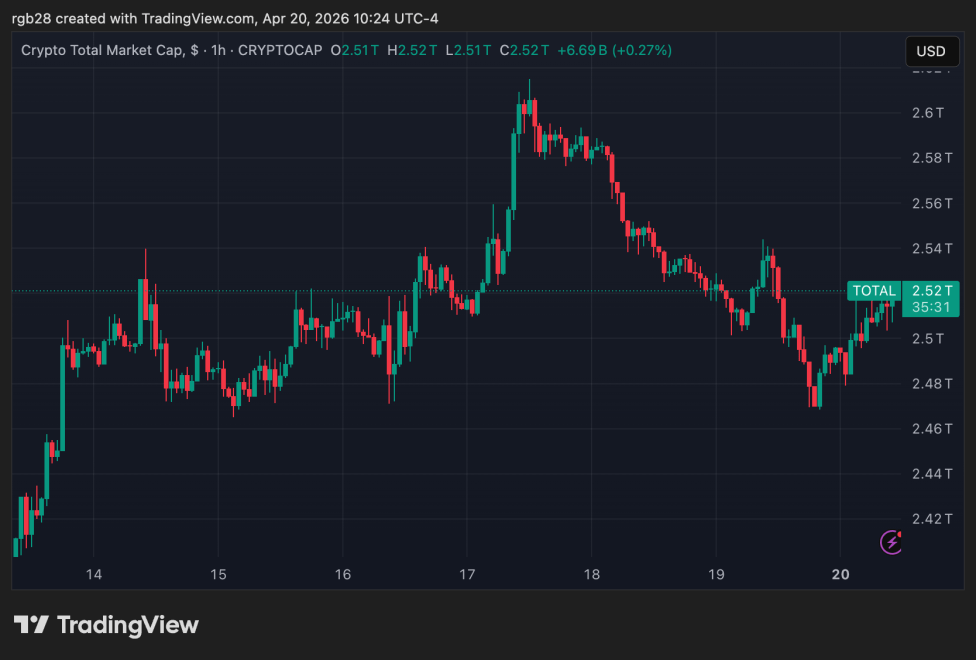
The total crypto market capitalization is at $2.52 trillion in the one-week chart. Source: TOTAL on TradingView

Domande pertinenti

QWhat new service has Coinbase launched for UK users and which cryptocurrencies can be used as collateral?

ACoinbase has launched crypto-backed USDC loans for UK users, allowing them to use Bitcoin (BTC), Ethereum (ETH), and Coinbase Wrapped Staked Ether (cbETH) as collateral.

QWhat is the maximum loan amount a user can borrow for a Bitcoin-backed loan and what determines this amount?

AUsers can borrow up to $5 million in USDC for a Bitcoin-backed loan, with the specific amount depending on the value of the BTC pledged as collateral.

QWhich on-chain protocol powers this new lending service and what happens to the collateral if the loan-to-value ratio is exceeded?

AThe service is powered by the Morpho protocol on the Base network. If the loan-to-value ratio exceeds a certain threshold, the collateral will be liquidated to repay the loan, and a liquidation penalty fee will be charged.

QWhat was the total value of loan originations through Coinbase on Morpho in the US as of April 14, 2026?

AThe total loan originations through Coinbase on Morpho in the US grew to over $2.17 billion USDC as of April 14, 2026.

QWhat recent regulatory approval did Coinbase receive in the article mentions as a crucial milestone for its expansion?

ACoinbase received conditional approval from the Office of the Comptroller of the Currency (OCC) to charter Coinbase National Trust Company, a major step toward becoming a federally regulated crypto custodian.

Letture associate

Apple Also Has to Pay Rent Now

Apple Pays Rent Too: The Two-Way Flow of "Traffic Tax" and "AI Capability Rent" Between Tech Giants For over two decades, Google has paid Apple an estimated $20 billion annually to remain the default search engine on Safari, a "traffic tax" for a critical user entry point. However, in 2026, the direction of this cash flow partially reversed. Apple agreed to pay Google roughly $1 billion per year to license its Gemini AI models, as Apple's own models reportedly struggled with complex tasks. This creates a unique dynamic: Apple acts as the "landlord" in the established search ecosystem, collecting rent from Google for access. Simultaneously, in the emerging AI arena, Apple becomes the "tenant," paying Google for access to cutting-edge AI capabilities it cannot currently match internally. While Apple claims its new models are "distilled" from Gemini outputs and contain "not a drop" of Google's original code, core dependencies remain. Its knowledge base is refined using Gemini's outputs, and its most powerful cloud model runs on Google's infrastructure. Apple has structured the deal as non-exclusive, allowing it to theoretically switch AI suppliers—a hedge against over-reliance. The future hinges on whether advanced AI models become a commodity (cheap and abundant) or remain a concentrated, scarce resource (expensive and controlled by few). Apple is betting on the former, leveraging its massive device ecosystem to be a powerful, choosy customer. If the latter proves true, its bargaining power could erode. This power dynamic is extending to developers. Apple, Google, and WeChat are all pushing for apps to expose their core functions as standardized "actions" or "intents" that their respective AI assistants (Siri, Gemini, WeChat AI) can directly call. The new scarce resource is no longer just app store visibility, but "being selected by the AI." The currency of "rent" has changed from a 30% revenue share to ceding control over how users interact with an app's functions.

marsbit1 h fa

Apple Also Has to Pay Rent Now

marsbit1 h fa

Missed the SpaceX IPO? WEEX's "First Trade Protection" Lets You Experience US Stock Trading Risk-Free.

With the excitement around SpaceX's recent public listing reigniting interest in the US stock market, Chinese investors face significant challenges accessing compliant and convenient trading channels following regulatory actions against major online brokers. This article explores the available options, highlighting their risks and limitations. Traditional paths for US stock investments remain problematic. Qualified Domestic Institutional Investor (QDII) and Listed Open-Ended Fund (LOF) products, while compliant, suffer from high fees, significant purchase premiums, and a very limited selection of assets. Small, unregulated offshore brokers pose substantial risks, including potential insolvency. While secure, VIP accounts at banks in Hong Kong or Singapore require high minimum deposits (often 1-2 million RMB) and in-person visits, placing them out of reach for most retail investors. The article positions cryptocurrency exchanges, specifically their TradFi (traditional finance on-chain) offerings, as a compelling alternative. Platforms like WEEX are noted for providing access to a wide range of US stocks and ETFs, including SpaceX (SPCXON), through tokenized assets. This method offers advantages such as a single account for both crypto and traditional assets, USDT-based settlement avoiding fiat complexities, flexible leverage, and robust risk management. To attract users, WEEX is promoting a "First Trade Guarantee" campaign. Running from June 15 to July 8 (UTC+8), it features a $30,000 prize pool. Users who trade $500 worth of US stock contracts can qualify for a guarantee on their first eligible trade: 100% loss coverage up to $30 or a 20% bonus on profits up to $30. The campaign is presented as a low-risk opportunity for both crypto natives and traditional investors to experience US stock trading.

marsbit1 h fa

Missed the SpaceX IPO? WEEX's "First Trade Protection" Lets You Experience US Stock Trading Risk-Free.

marsbit1 h fa

How Difficult is Chip Making? A Division Error Costs 475 Million Dollars

How Hard Is It to Make a Chip? A Division Error Cost $475 Million Chip expert Shi Kan, a researcher at the Chinese Academy of Sciences and a popular tech creator, explains the immense challenges of chip development. Chips are foundational to modern technology, but their creation is extraordinarily difficult. The journey from sand to a functional chip involves complex design and manufacturing, but a critical bottleneck is verification—ensuring the design works flawlessly before costly production. A single, undetected bug can have catastrophic consequences, as illustrated by the infamous 1994 Intel Pentium FDIV bug. A flaw in the floating-point division unit forced a recall costing $475 million. Unlike software, chips cannot be easily patched after manufacture, making "first-time success" paramount. However, industry surveys show only 24% of chip projects achieve this; over three-quarters require at least one costly re-spin due to design flaws. Verification has thus become the dominant phase, consuming up to 70% of the design cycle. The core challenge is a "verification impossible triangle" between high performance, good debuggability, and low cost. Exhaustively verifying a modern CPU core could take 15,000 years with software simulation, or 30 years with advanced hardware emulation—timeframes utterly impractical for development. Despite being essential, verification is often seen as unglamorous "dirty work," receiving less academic attention than fields like AI. Shi and his team are tackling this by developing an agile verification research framework called ENCORE, based on FPGA technology, to improve verification efficiency and debug capability. Beyond research, Shi engages in public science communication through long-form video content, aiming to demystify chip technology, AI, and computer science. He argues for the value of pursuing "hard and long-term" endeavors, whether in the meticulous world of chip verification or in creating substantive educational content, believing such sustained effort is likely the right path forward.

marsbit1 h fa

How Difficult is Chip Making? A Division Error Costs 475 Million Dollars

marsbit1 h fa

Trading

Spot
Futures
活动图片