Coinbase Is Redefining the Exchange

marsbitPubblicato 2025-12-18Pubblicato ultima volta 2025-12-18

Introduzione

Coinbase is redefining the exchange model by launching its most ambitious expansion to date, moving beyond cryptocurrency to build an "all-in-one" financial super app. The strategy is built on six core pillars: commission-free stock trading, prediction markets via a partnership with Kalshi, integration with Solana DEX aggregator Jupiter for seamless access to on-chain tokens, custom stablecoin services for enterprises, simplified derivatives trading, and enhanced support through AI tools and developer platforms. This expansion aims to merge traditional and crypto finance, offering integrated access to stocks, crypto, derivatives, and prediction markets in a single account. By aggregating decentralized liquidity into a user-friendly interface and prioritizing regulatory partnerships, Coinbase is blurring the lines between centralized and decentralized finance. The company’s broader vision includes deepening institutional services and advancing real-world asset tokenization, positioning itself as a comprehensive gateway to the future of finance—all within one app.

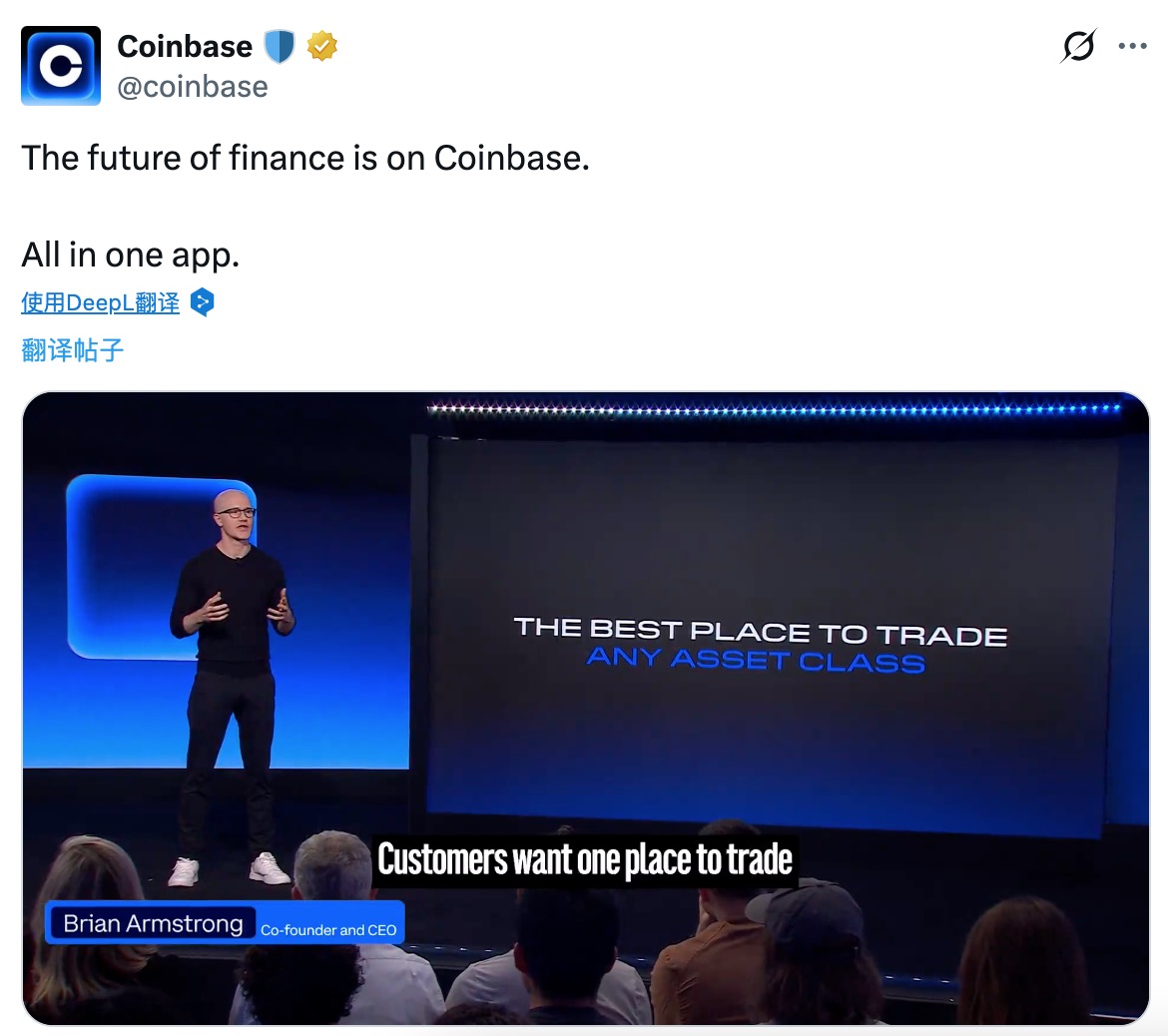
"The future of finance is on Coinbase. All in one app." With these two short sentences at today's System Update launch event, Coinbase charted a new course for its future in 2026 and even a decade beyond.

As an industry leader with a market cap exceeding $65 billion and the largest cryptocurrency trading platform in the United States, Coinbase has no intention of resting within its existing boundaries. It is initiating the most radical and disruptive product expansion in its 13-year history: breaking down the traditional compartments of the financial world to integrate crypto assets, stocks, derivatives, on-chain ecosystems, and even prediction markets into a single, seamless application experience. From partnering with Kalshi to launch prediction markets, to integrating Jupiter for seamless Solana DEX trading; from the introduction of zero-commission stock trading, to tailoring stablecoins for enterprises—these initiatives are not scattered product updates but are closely centered around a core strategy: building an "all-in-one exchange" that goes beyond cryptocurrency.
Pulling the perspective back reveals the full depth of this strategy. From the approval of its minority equity investment in CoinDCX by Indian regulators, to joining the U.S. "Tech Force" program to participate in the national fintech agenda; from launching the next-generation open protocol x402 V2 connecting AI and payments, to collaborating with traditional financial giants like Standard Chartered to explore institutional-grade digital asset services—Coinbase's year-end布局 has clearly outlined a strategic path: using cryptocurrency as a foundation and extending upwards, downwards, left, and right to weave a financial network covering retail and institutions, and blending centralized and decentralized services.

This heavyweight year-end launch undoubtedly sets the tone and raises the curtain for Coinbase's 2026 and beyond. A larger, more complex, and more ambitious Coinbase is emerging.

Six Business Pillars, Building the Foundation of the "All-in-One Exchange"

Coinbase's current expansion is a systematic restructuring of its financial product matrix. The six core businesses it released target different markets and user needs, collectively forming the solid foundation of the "all-in-one exchange."

Stock Trading: Opening the Door to Traditional Financial Markets

As a core move in this strategic expansion, Coinbase, through its FINRA-regulated subsidiary Coinbase Capital Markets Corp., officially offers U.S. users access to U.S. stock trading services. Furthermore, a company spokesperson clearly stated: "Zero-commission stock trading will be a permanent service on Coinbase." While the specific profit model for this aggressive pricing strategy has not been disclosed, it is clearly aimed at rapidly gaining market share and breaking down the commission barriers of traditional brokerages.

The breakthrough of the service lies not only in pricing but also in the integrated experience—users will be able to freely buy and sell stocks using USD or USDC within the same Coinbase account, achieving true integrated management of crypto assets and traditional financial assets. More notably, Coinbase will offer extended trading hours for select stocks—five days a week, 24 hours a day. This challenges the traditional financial market trading model and paves the way for a round-the-clock digital asset trading ecosystem. The company plans to add "thousands" of new listings in the coming months, significantly expanding the investable universe. Beyond spot trading, Coinbase is also laying the groundwork for deeper product innovation. The company is preparing the foundation for stock-linked perpetual futures, which will allow users outside the U.S. to gain continuous exposure to U.S. stocks through the higher capital efficiency of derivative forms. This product is planned to expand its coverage early next year, by which time Coinbase will have built a complete stock investment product line from spot to derivatives.

Furthermore, Coinbase has explicitly positioned this service as a strategic bridge to "asset tokenization." The company has announced plans to launch a dedicated "Coinbase Tokenize" platform in 2026, supporting the on-chain issuance and management of assets like stocks. Today's stock trading feature is precisely the key infrastructure being laid for tomorrow's global programmable asset market based on blockchain, reflecting Coinbase's long-term evolution path from a traditional financial access point to a future asset issuance platform.

Prediction Markets: Exploring Event-Driven Finance

While embracing traditional assets, Coinbase is also extending its reach into a more frontier area—prediction markets. Through a partnership with Kalshi, a leading platform regulated by the U.S. CFTC, Coinbase can introduce event contract trading—a niche but high-potential market—into its mainstream application. Holdings for these alternative investments are displayed alongside users' cryptocurrency, stock, and even cash balances in the same interface, achieving alternative diversification of the investment portfolio. The choice to partner with a licensed entity like Kalshi, rather than directly integrating with a decentralized protocol, also highlights Coinbase's prudent consideration of compliance frameworks when expanding into new businesses, aiming to establish a legal and credible market benchmark for such sensitive financial activities.

Starting with Solana, Embracing High-Activity Public Chain Ecosystems

As one of the world's largest centralized exchanges, Coinbase is acutely aware that its traditional listing processes struggle to match the agility of DEXs in capturing the explosive growth of emerging tokens. To address this, the company has taken a strategic step: directly integrating Jupiter, the largest DEX aggregator in the Solana ecosystem. This transforms its platform from a provider of a closed asset list into an aggregator of liquidity from open ecosystems. Users can seamlessly trade the vast array of newly minted tokens on Solana without leaving the app or managing complex wallets. All the complex cross-DEX routing and price discovery processes are handled by Jupiter in the background. This move cleverly "packages" the richness and liquidity of DeFi long-tail assets into the smooth user experience of a centralized platform. More importantly, it signals a shift in Coinbase's product philosophy from "we decide what you can trade" to "we help you trade everything." Coinbase stated that it plans to extend this integration model to other high-growth public chain networks in the future. A new paradigm may be taking shape, with Coinbase acting as a unified front-end interface aggregating liquidity from vast DEXs across multiple public chains.

Custom Stablecoins: Developing Enterprise-Grade Financial Services

In the stablecoin sector, a core track of the crypto economy, Coinbase has chosen to launch a "Custom Stablecoin" service, directly targeting the enterprise market. This service allows enterprise clients to use USDC as reserve assets to flexibly issue and customize their own branded stablecoins. This move puts Coinbase in direct competition with established issuance service providers like Paxos and Anchorage, opening up a new, high-margin "Finance-as-a-Service" business line for institutions. Beyond that, the deeper strategic significance of this new service lies in ecosystem building. Using USDC as the reserve asset will substantially strengthen USDC's position as the "base currency" within the stablecoin system. By attracting more enterprises to issue custom stablecoins based on USDC, Coinbase not only expands the application scenarios and market share of USDC but also builds a stablecoin ecosystem moat centered around itself, achieving the dual goals of business expansion and ecosystem strengthening.

According to Coinbase, early partners exploring the product include Flipcash, Solflare, and R2.

Simplified Derivatives Trading: Promoting the Popularization of Leverage Tools

Coinbase is making futures and perpetual contracts trading, previously aimed at professional users and mainly集中在 Coinbase Advanced, available to all U.S. traders through a redesigned, simplified interface. According to a Coinbase spokesperson, the new interface mimics the intuitive spot trading experience, significantly lowering the cognitive and operational barriers to leveraged products, enabling a broader range of retail users to easily participate in derivatives trading.

This strategic shift reflects Coinbase's keen insight into market demand. In an environment where spot market volatility may narrow, providing easy-to-use leveraged products can meet users' needs for capital efficiency and diverse strategies, and is also an important move for the platform to seek new revenue growth points. By "democratizing" professional financial tools, Coinbase can not only increase user stickiness and platform activity but also carve out a crypto-native competitive path in a derivatives market dominated by traditional brokers.

Comprehensive Support: AI Assistant, Developer Platform, and Business Services

Coinbase's current expansion is not just an enrichment of its product lines but also a comprehensive upgrade of its platform infrastructure. While expanding the categories of tradable assets, the company is building a multi-faceted support system covering individual investors, developers, and enterprise customers, providing all-around service support for its "all-in-one exchange" vision.

For individual users, the AI assistant "Coinbase Advisor" can provide personalized asset allocation advice and investment strategy analysis based on the user's specific holdings and real-time market data, offering intelligent, scalable advisory services traditionally reserved for high-net-worth individuals to every ordinary investor. Meanwhile, Base App, the on-chain "universal app" for ordinary users, has ended its Beta phase and launched in over 140 countries worldwide; at the developer ecosystem level, the upgraded developer platform provides a complete API suite covering custody, payments, trading, and stablecoins. Currently, companies including Deel, Papaya, Routable, and dLocal are using Coinbase's Payments API; in terms of business services, "Coinbase Business" currently provides compliant companies in the U.S. and Singapore with complete crypto-native financial solutions, including core functions such as global payments, digital asset management, USDC balance yield, and financial process automation. It is particularly noteworthy that Coinbase stated that business customers will gain access to fully synchronized trading function expansions, including all new asset classes like stocks and derivatives.

These three levels of support form an organic whole, collectively transforming Coinbase from a mere trade execution platform into comprehensive financial infrastructure integrating investment management, ecological innovation, and institutional services. This transformation not only enhances the platform's user stickiness and commercial value but also builds a complete business闭环 for Coinbase, from individuals to enterprises, from applications to ecosystems.

Summary

Coinbase's large-scale expansion of its product matrix marks a critical step in its formal transition from a specialized cryptocurrency exchange to a comprehensive "all-in-one exchange." By combining stocks, derivatives, on-chain assets, and even prediction markets with its traditional crypto business, and building a multi-faceted support system covering AI assistants, developer platforms, and enterprise-grade services, Coinbase is creating a truly integrated one-stop platform that merges traditional finance with the crypto ecosystem.

Of course, the industry has offered evaluations from different perspectives on this strategic shift. Adherents of decentralized ideals have expressed skepticism, viewing this move as a deviation from Crypto's original purpose. Other market observers, from the perspective of industry evolution, point out that the boundaries of fintech services are increasingly blurring—"Coinbase is becoming Robinhood, and Robinhood is becoming more like Coinbase."
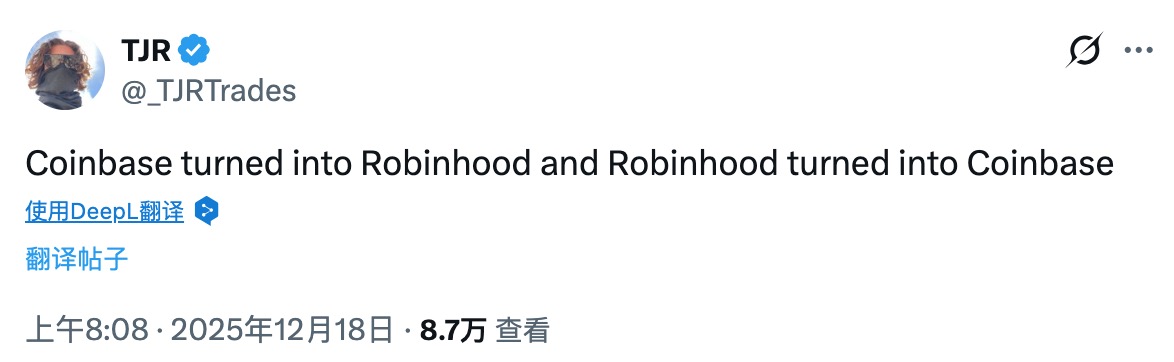
In essence, Coinbase is blurring the boundaries between centralized and decentralized finance. It packages DeFi liquidity into a smooth centralized experience, accesses traditional assets through compliance frameworks, and simultaneously lowers the barrier to on-chain participation through Base App. This path of "wanting both centralized experience and decentralized innovation" reflects the convergence trend in fintech development.

As Coinbase declared at the launch event—"The future of finance is on Coinbase. All in one app"—this statement is both a declaration of its own ambition and an apt description of the major trend towards integration and convergence in financial services in the digital age. Whether Coinbase can successfully realize this grand vision remains to be seen, but undoubtedly, it has already set a new benchmark worthy of attention and consideration for the entire industry.

Crypto di tendenza

Domande pertinenti

QWhat is the core strategic direction Coinbase announced for its future development?

ACoinbase is building an 'all-in-one exchange' that integrates crypto assets, stocks, derivatives, on-chain ecosystems, and prediction markets into a single seamless application experience, moving beyond being just a cryptocurrency exchange.

QHow is Coinbase expanding into traditional stock trading, and what is unique about its offering?

ACoinbase is offering zero-commission stock trading in the US through its FINRA-regulated subsidiary, allowing users to buy and sell stocks using USD or USDC within the same Coinbase account. It also plans to offer extended trading hours for some stocks and is laying the groundwork for stock-linked perpetual futures for non-US users.

QWhat strategic move did Coinbase make regarding the Solana ecosystem and decentralized exchanges (DEXs)?

ACoinbase integrated with Jupiter, the largest DEX aggregator on Solana, allowing its users to seamlessly trade a vast array of new tokens on Solana network directly within the Coinbase app without managing external wallets, effectively aggregating DeFi liquidity.

QWhat is the purpose of Coinbase's new 'Custom Stablecoin' service for enterprises?

AThe service allows enterprise clients to use USDC as a reserve asset to issue and customize their own branded stablecoins. This competes in the 'finance-as-a-service' market and strengthens USDC's role as a foundational currency within the stablecoin ecosystem.

QWhat are the three key support systems Coinbase is building to underpin its 'all-in-one exchange' vision?

ACoinbase is building a comprehensive support system consisting of: 1) 'Coinbase Advisor,' an AI assistant for personalized investment advice; 2) An upgraded developer platform with a full API suite; and 3) 'Coinbase Business,' offering crypto-native financial solutions for enterprises, including global payments and asset management.

Letture associate

Two Legends Lost in Three Days: Is Google's AI Talent Dam Cracking?

In three days, Google lost two AI legends. On June 18, Noam Shazeer, co-author of the seminal "Attention is All You Need" paper and Gemini co-lead, left for OpenAI. Just 48 hours later, John Jumper, 2024 Nobel laureate and AlphaFold lead, departed DeepMind for Anthropic. This follows Andrej Karpathy joining Anthropic in May. These moves highlight a structural trend: top AI talent is concentrating at mission-driven, pre-IPO firms like OpenAI and Anthropic, while Google becomes a primary source. The exodus stems from a core mission mismatch. Google's ad-centric model often subordinates AI research to product and revenue goals, creating friction for pioneers like Shazeer, who returned in 2024 only to leave again. In contrast, OpenAI and Anthropic offer singular focus on pushing AI boundaries, whether towards AGI or safety-aligned models, which deeply appeals to top researchers like Jumper. Financial incentives amplify the pull. With both OpenAI and Anthropic nearing IPO, employees stand to gain immensely from equity, an upside Google's mature stock cannot match. Furthermore, the 2023 merger of Google Brain and DeepMind, intended to consolidate strength, has instead created cultural tension and slowed the path from research to product, as evidenced by Gemini's pace. This talent redistribution is reshaping the AI landscape. While Google retains vast data and compute resources, its true crisis is the quiet, continuous loss of the people who define the field's future. The real moat in AI is not infrastructure, but the concentration of brilliant minds—a battle Google is currently losing.

marsbit16 min fa

Two Legends Lost in Three Days: Is Google's AI Talent Dam Cracking?

marsbit16 min fa

Behind the AI Report Card, Lies a Chinese 'Exam Setter'

Beyond the familiar performance charts like MMLU-Pro and MMMU, which major AI models strive to ace, stands a key "examiner": Chinese-Canadian researcher Wenhu Chen. An assistant professor at the University of Waterloo and founder of TIGERLab, Chen addresses the crucial need for more rigorous AI evaluation. As models like GPT-4 began scoring near-perfect results on older benchmarks like MMLU, it became difficult to distinguish their true capabilities. In response, Chen introduced MMLU-Pro in 2024, featuring harder, more reasoning-focused questions with more answer choices, successfully reintroducing meaningful performance gaps. His work extends to multi-modal evaluation with MMMU and its enhanced version, MMMU-Pro. These benchmarks test a model's ability to understand and reason with complex information from images, charts, and text across diverse academic subjects, exposing the significant challenges even top models face in genuine comprehension. Chen's background in complex QA, table reasoning, and his experience at Google DeepMind on projects like Gemini inform his approach. He understands that effective benchmarks must anticipate how models might "cheat" by memorizing data or avoiding visual analysis. His lab also actively researches video understanding and generation models (e.g., UniVideo, Vamba), ensuring his evaluation work is grounded in practical model-building challenges. Now at Meta's Super Intelligence Lab, Chen continues his focus on multi-modal data and evaluation, representing the deep yet often unseen contributions of Chinese talent in shaping the fundamental tools of the AI industry.

marsbit28 min fa

Behind the AI Report Card, Lies a Chinese 'Exam Setter'

marsbit28 min fa

Alliance Co-founder's Letter to Entrepreneurs: Written at the Moment Cursor Sold for $600 Billion

Alliance Co-founder's Letter to Entrepreneurs: On Cursor's $60 Billion Sale Many aspiring founders see massive exits like Cursor's $60B sale and wonder why they can't achieve the same, often concluding opportunities are exhausted. But great companies aren't built in obvious, crowded spaces. Cursor, like Stripe, Figma, and Shopify before it, started with a non-consensus belief about the future. Before ChatGPT, they believed AI would transform knowledge work. They focused on a genuinely exciting domain, became their own customer, and obsessed over power users. Their journey involved years of "glass-chewing" effort before the market was ready. The pattern is consistent: identify a long-term technological shift, find a missed entry point, and execute for years before the trend becomes obvious. First-generation products (PayPal, Adobe, Amazon) prove a market exists. Second-generation winners (Stripe, Figma, Shopify) rebuild that market around new insights, technology, or changing customer behaviors. Founders must identify their phase in the cycle. Early entrants like Coinbase or Cursor focus on making new technology usable for power users. Later entrants find the "yin" to the established "yang"—the blind spots incumbents miss as they grow distant from individual users. The key is deep market immersion. Use every product in your space. Talk to users. Build an audience. Stop looking for ideas and start *seeing* them everywhere. Then, choose one. The idea must offer a 10x improvement or solve a "hair-on-fire" pain point—something severe enough that users are already crafting workarounds. When building, avoid feature bloat. Ask: why would someone switch? Great startups rarely force new behaviors; they improve familiar workflows with drastically lower friction (e.g., Cursor forked VS Code instead of creating a new editor). Distribution is the underestimated moat. Before product-market fit, achieve distribution-market fit. How do customers discover new tools? Founders like those at Airbnb, Stripe, and Cursor did unscalable, manual work to recruit early users. The final, unteachable ingredient is resilience. Cursor built for years pre-market, faced rejection, and persisted. So did Airbnb, Nvidia, and Rain (which launched post-FTX collapse). The lesson isn't that these founders were smarter, but that they stayed in the game long enough for their insights to compound. Framework: Spot technological cycles. Cultivate unique insight. Obsess over your market. Talk to customers. Find a hair-on-fire problem. Build the simplest wedge. Win your distribution channel. Above all, don't quit when it gets hard. Most people won't do these things consistently. The few who do build the next generation of great companies. Go build.

marsbit32 min fa

Alliance Co-founder's Letter to Entrepreneurs: Written at the Moment Cursor Sold for $600 Billion

marsbit32 min fa

Weekly Editor's Picks (0613-0619)

Weekly Editor's Picks (0613-0619): Market Insights & Analysis This weekly digest curates in-depth analysis often lost in the information flow, focusing on key insights across macro trends, investment, and technology. **Macro & Geopolitics:** With the Strait of Hormuz reopening and military conflict shifting to negotiation, markets are pivoting from "war shock" to "supply restoration." Trades include shorting crude risk premiums, longing airlines/tourism, Asian energy importers, and bond duration, while shorting inflation expectations. LNG, fertilizer, and chemical chains are also being repriced. **Investment & VC:** Ray Dalio advises against betting on concentrated AI giants dominating indices, advocating for diversified portfolios of high-quality, low-correlation assets instead. Analysis covers the 4-year crypto cycle, predicting the core surviving product by 2029 will be asset trading markets. Current BTC metrics suggest a potential bottoming zone, presenting a patient accumulation window. SpaceX's high-profile IPO at a $2.1T valuation faces scrutiny over fundamentals, with key watchpoints being its likely inclusion in the Nasdaq index and Q2 earnings. Concerns are raised about potential "gamma squeeze" and systemic risks if its narrative-driven valuation gets amplified by passive index funds. Robinhood (HOOD) is noted for breaking its high correlation with crypto, bolstered by its stock trading and new underwriting business. **Web3 & AI:** A warning highlights ~$1.8T in off-balance-sheet AI infrastructure commitments (purchase commitments, leases) as a potential systemic risk if AI monetization lags. AI models are being used for World Cup predictions, adding a new layer for betting markets. A cost breakdown of a $20 AI subscription reveals the supply chain from model companies to cloud, GPUs, and power. **Prediction Markets:** The emergence of prediction market "concept stocks" is noted, with Robinhood developing its own platform, Rothera, signaling a shift from market competition to a "channel war" for user access. **CeFi & DeFi:** The SpaceX IPO tested perpetual contract mechanisms for pre-IPO assets, highlighting challenges in handling corporate actions like stock splits on-chain. The de-pegging of STRC (Strategy's preferred share) to ~$89 reflects market concerns over MicroStrategy's capital structure and BTC-backed leverage model. BlackRock's covered-call Bitcoin ETF (BITA) offers yield but caps upside, appealing to yield-seeking institutions. **Ethereum:** An opinion piece argues Ethereum's core strength is its vast developer community and composability, solidifying its role as the default operating system for the financial internet. **Weekly Hot Topics:** Include the US-Iran deal reopening the Strait of Hormuz, Fed's hawkish hold, Anthropic restricting model access, SpaceX acquiring Cursor, and a humorous stock surge for "Liuliumei" due to its "LLM" ticker.

marsbit37 min fa

Weekly Editor's Picks (0613-0619)

marsbit37 min fa

Alliance's Co-Founder's Letter to Entrepreneurs: Written on the Occasion of Cursor's $60 Billion Sale

In this letter to entrepreneurs, Alliance reflects on the success of Cursor's $60 billion sale to Elon Musk, using it as a case study to counter the misconception that opportunities in crowded fields like AI or crypto are exhausted. The piece argues that great companies like Cursor, Stripe, Figma, and Shopify are not built by geniuses with perfect ideas, but by founders who start with a non-consensus belief about the future and build for years before that future becomes obvious to everyone. They identify long-term shifts, find overlooked entry points, and execute relentlessly. The framework for success involves: 1. **Identifying your place in the technology cycle**: Early-stage opportunities focus on making new tech usable for power users (e.g., Coinbase, Cursor). Later-stage opportunities involve finding the "yin" to an existing "yang"—the blind spots of first-generation players (e.g., Stripe vs. PayPal, Figma vs. Adobe). 2. **Cultivating unique insights**: Immerse yourself deeply in the market. Use every product, talk to users, and build an audience. Insights will emerge naturally from deep engagement. 3. **Finding a "hair-on-fire" problem**: Look for a 10x improvement or a severe, urgent pain point. The strongest signal is people already building clumsy workarounds. 4. **Building a focused MVP**: Don't just add features because you can. Ask why users would abandon their current tool for yours. The best startups rarely force new behaviors; they improve familiar workflows with drastically lower friction. 5. **Winning a distribution channel**: Distribution is often the moat. Before product-market fit, achieve channel-market fit. Find where your customers are and build an engine to reach them, even through unscalable, manual efforts initially. 6. **Persistence**: The final, unteachable ingredient is resilience. Success stories like Cursor, Airbnb, and Nvidia involved years of grinding, rejection, and perseverance when the path forward seemed unclear. The conclusion is that there is no secret. Most people fail to consistently execute these steps over the long term. The few who do build the companies that define the next era. The world is yours to create.

链捕手42 min fa

Alliance's Co-Founder's Letter to Entrepreneurs: Written on the Occasion of Cursor's $60 Billion Sale

链捕手42 min fa

Trading

Spot
Futures

Articoli Popolari

Come comprare ONE

Benvenuto in HTX.com! Abbiamo reso l'acquisto di Harmony (ONE) semplice e conveniente. Segui la nostra guida passo passo per intraprendere il tuo viaggio nel mondo delle criptovalute.Step 1: Crea il tuo Account HTXUsa la tua email o numero di telefono per registrarti il tuo account gratuito su HTX. Vivi un'esperienza facile e sblocca tutte le funzionalità,Crea il mio accountStep 2: Vai in Acquista crypto e seleziona il tuo metodo di pagamentoCarta di credito/debito: utilizza la tua Visa o Mastercard per acquistare immediatamente HarmonyONE.Bilancio: Usa i fondi dal bilancio del tuo account HTX per fare trading senza problemi.Terze parti: abbiamo aggiunto metodi di pagamento molto utilizzati come Google Pay e Apple Pay per maggiore comodità.P2P: Fai trading direttamente con altri utenti HTX.Over-the-Counter (OTC): Offriamo servizi su misura e tassi di cambio competitivi per i trader.Step 3: Conserva Harmony (ONE)Dopo aver acquistato Harmony (ONE), conserva nel tuo account HTX. In alternativa, puoi inviare tramite trasferimento blockchain o scambiare per altre criptovalute.Step 4: Scambia Harmony (ONE)Scambia facilmente Harmony (ONE) nel mercato spot di HTX. Accedi al tuo account, seleziona la tua coppia di trading, esegui le tue operazioni e monitora in tempo reale. Offriamo un'esperienza user-friendly sia per chi ha appena iniziato che per i trader più esperti.

326 Totale visualizzazioniPubblicato il 2024.12.12Aggiornato il 2026.06.02

Come comprare ONE

Discussioni

Benvenuto nella Community HTX. Qui puoi rimanere informato sugli ultimi sviluppi della piattaforma e accedere ad approfondimenti esperti sul mercato. Le opinioni degli utenti sul prezzo di ONE ONE sono presentate come di seguito.

活动图片