Coinbase CLO turns bullish on CLARITY: ‘Confident we’re going to see progress’

ambcryptoPubblicato 2026-04-02Pubblicato ultima volta 2026-04-02

Introduzione

Coinbase Chief Legal Officer Paul Grewal expressed strong optimism about the imminent passage of the Digital Asset Market CLARITY Act of 2025, predicting a breakthrough in U.S. crypto regulation within the next 48 hours. Despite resistance from traditional banks, Grewal emphasized the importance of the bill in fulfilling former President Trump’s vision of making the U.S. a global crypto capital. He differentiated crypto from fractional-reserve banking, dismissing concerns about deposit flight due to stablecoins. His shift in stance surprised Patrick Witt of the President’s Council on Digital Assets, given Coinbase’s previous hesitation. Polymarket odds of the bill becoming law by 2026 rose to 65%, reflecting growing confidence.

An interesting plot twist has emerged in the ongoing chatter around the Digital Asset Market CLARITY Act of 2025.

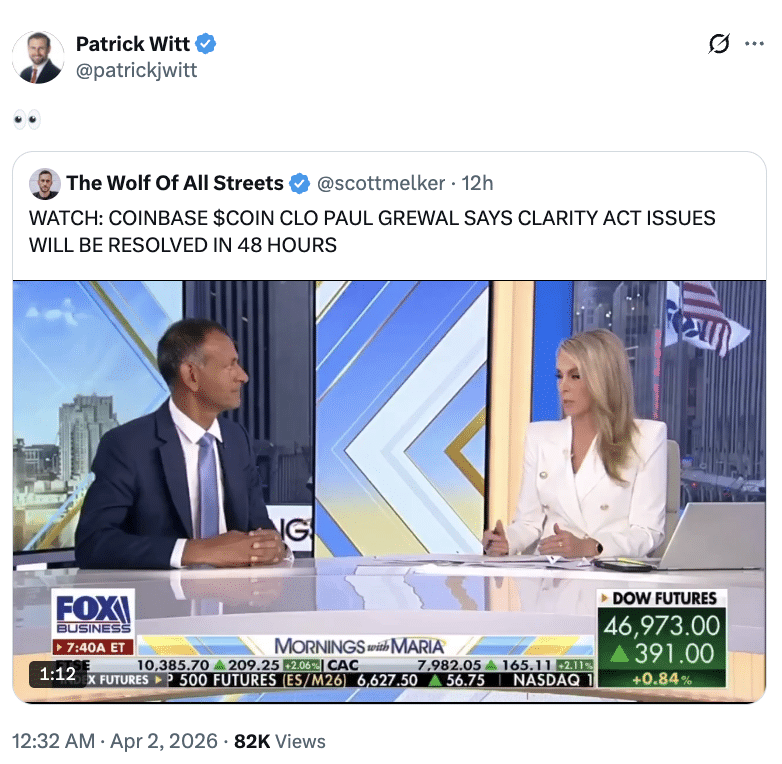
Coinbase Chief Legal Officer (CLO) Paul Grewal, in a recent television appearance, has shared his optimism about the passage of the crypto bill. He believes that the U.S. is on the verge of a major crypto breakthrough despite banks’ resistance.

More importantly, Grewal revealed that the deal between crypto and banks will likely pass within the next 48 hours.

I’m very confident we’re going to see progress.

However, he also pointed out that,

Other key elements of the bill are critically important to making sure that President Trump’s vision of the United States as the crypto capital world is fulfilled.

Coinbase’s CLO is confident about the CLARITY Act passage

Explaining his stance, Coinbase CLO underlined that rules might be different for banks and crypto because “the game is very different”.

While comparing traditional banks and stablecoins, Grewal highlighted how banks operate on fractional reserve lending—where they hold less and focus more on deposits and lend-outs.

However, as the ongoing debate around ‘yield generations’ surges, critics believe that stablecoin could halt people from withdrawing money from banks. But speaking in defense, Grewal rejected that notion, stating,

There has been no evidence of deposit flight whatsoever.

He also stressed how the GENIUS Act introduced the initial rule for crypto and that the CLARITY Act is the finish line for a complete regulatory framework.

Shift in stance shocks executives

This optimism from Grewal comes after Coinbase’s recent holdout. For those unaware, this stepback had pushed Patrick Witt, the executive director of the President’s Council on Digital Assets, to issue a hidden warning at Coinbase.

However, after hearing Paul Grewal’s shift in stance. Witt expressed his surprise.
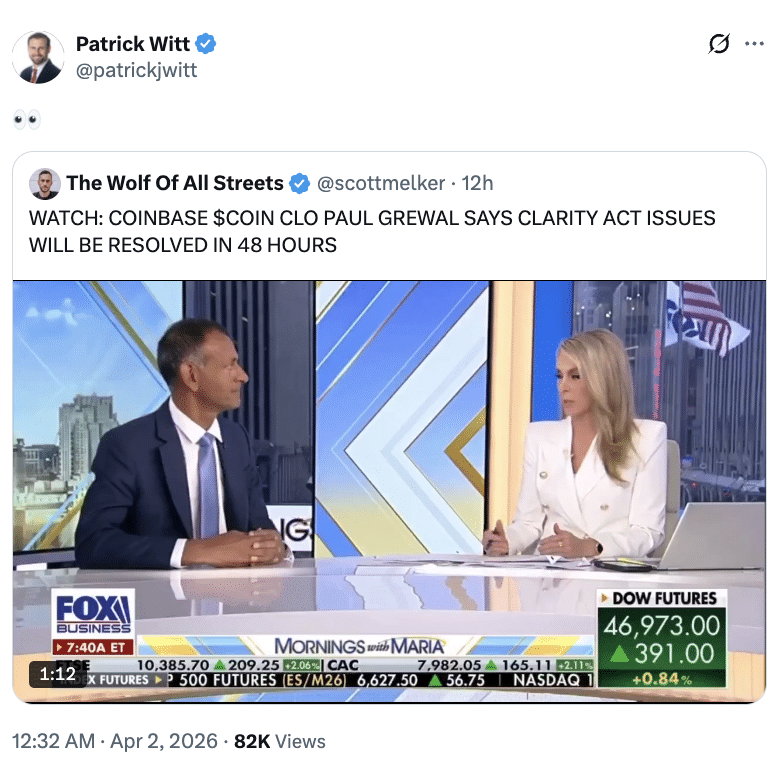
Source: Patrick Witt/X

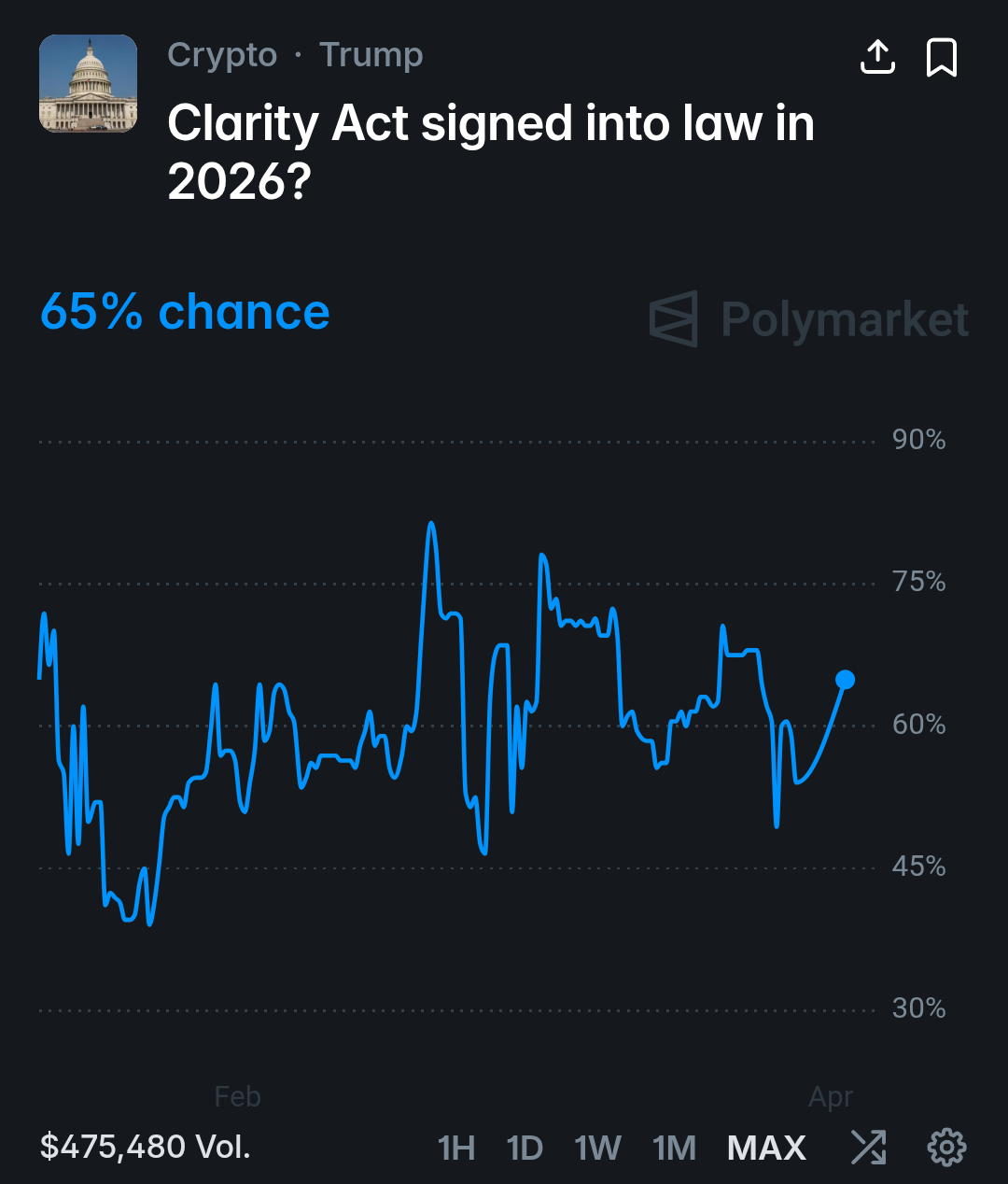
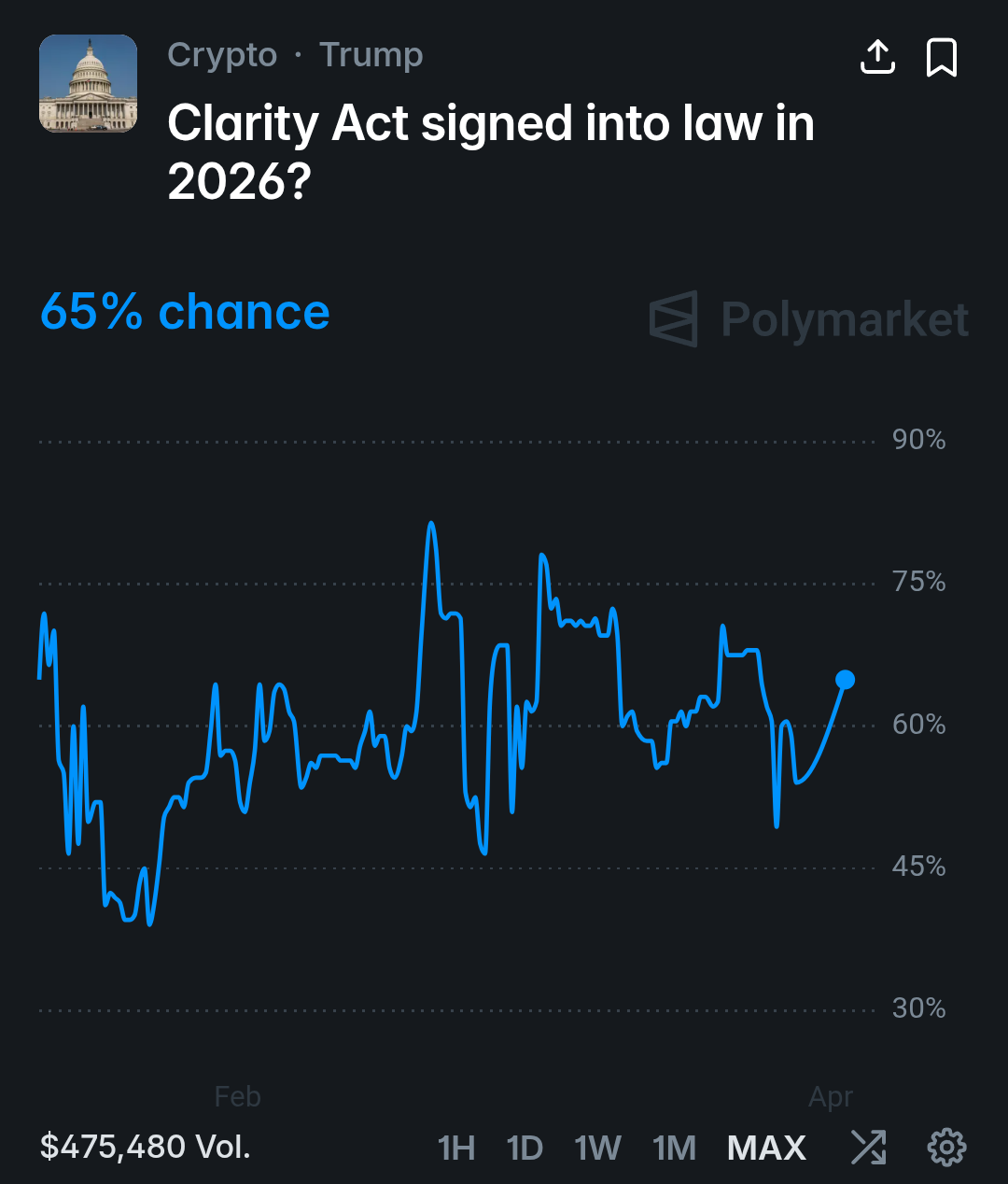
Meanwhile, the Polymarket odds of the CLARITY Act being signed into law in 2026 confirmed the positive sentiment, as it stood at 65% at the time of reporting.
Source: Polymarket

Final Summary

  • Paul Grewal’s optimism about the CLARTY Act shocks Patrick Witt, considering Coinbase’s past holdout.
  • Polymarket odds rocketed to 65%, reflecting this increased optimism.

Domande pertinenti

QWhat is Paul Grewal's position at Coinbase and what is his recent stance on the CLARITY Act?

APaul Grewal is the Chief Legal Officer (CLO) of Coinbase, and he has recently expressed optimism and confidence about the passage of the CLARITY Act.

QAccording to Grewal, when is the deal between crypto and banks likely to pass?

AGrewal revealed that the deal between crypto and banks is likely to pass within the next 48 hours.

QHow did Patrick Witt react to Paul Grewal's shift in stance on the CLARITY Act?

APatrick Witt, the executive director of the President’s Council on Digital Assets, expressed surprise at Paul Grewal's shift in stance, considering Coinbase's previous holdout.

QWhat were the Polymarket odds for the CLARITY Act being signed into law in 2026 at the time of reporting?

AThe Polymarket odds for the CLARITY Act being signed into law in 2026 stood at 65% at the time of reporting.

QWhat key difference did Grewal highlight between traditional banks and stablecoins?

AGrewal highlighted that traditional banks operate on fractional reserve lending, where they hold less and focus more on deposits and lend-outs, while implying stablecoins operate differently.

Letture associate

Bitcoin Withdrawals Continue: 8 Years of Storage in a Coldcard Cold Wallet Ended in Zero

Coldcard Hardware Wallet Hacked: Losses Mount Due to Vulnerable Seed Generation A critical vulnerability in Coldcard hardware wallets has led to a continued wave of fund thefts. According to Galaxy Research, the total stolen has reached 1,367.05 BTC (approx. $88.6 million) from 4,585 addresses, a significant increase from the initial 594.5 BTC reported on July 30, 2026. Most of the stolen funds remain on the attackers' addresses. The issue is not with the current firmware, which Coinkite has updated, but with seed phrases generated on vulnerable devices between March 2021 and the release of fixed firmware versions. Due to a programmer error, devices switched from using a hardware random number generator to the software-based Yasmarang generator, which was initialized with publicly accessible data like the chip's serial number. This made the seed phrases predictable through offline brute-force attacks, meaning wallets remain at risk until funds are moved to a new wallet generated with the patched firmware. Affected devices include Mk2/Mk3 with firmware 4.0.1–4.1.9 (and up to 5.0.3), Mk4/Mk5 up to version 5.6.0, and Q models up to 1.5.0Q. The only exceptions are seeds created with a high-entropy method like at least 50 independent dice rolls or a strong unique BIP-39 passphrase. All other owners must generate a new seed on the fixed firmware and transfer their assets. A case highlighting the human impact involves a 39-year-old long-term investor who lost 2 BTC (approx. $130,000) in minutes. He had accumulated the Bitcoin over eight years through physical labor, viewing it as a financial lifeline and a retirement plan in a country suffering from hyperinflation. His story underscores that even conservative "buy and hold in cold storage" strategies can be compromised by such underlying technical flaws. From a technical perspective, this incident echoes historical failures where weak random number generators undermined cryptographic security, challenging the assumption that offline storage is automatically foolproof.

cryptonews.ru2 h fa

Bitcoin Withdrawals Continue: 8 Years of Storage in a Coldcard Cold Wallet Ended in Zero

cryptonews.ru2 h fa

Trading

Spot
活动图片