Coinbase-Backed Stand With Crypto Discloses Political Plan For 2026 Midterm Elections

bitcoinistPubblicato 2026-03-27Pubblicato ultima volta 2026-03-27

Introduzione

Coinbase-backed advocacy group Stand With Crypto has announced its first endorsements for the 2026 U.S. midterm elections and launched an online voter hub to mobilize pro-crypto voters. The group endorsed six incumbent lawmakers from both major parties and will focus on competitive House races where crypto issues may be decisive. The voter hub provides information on candidates' positions, including scorecards based on public statements and legislative records. With over 2.7 million advocates, the group aims to turn crypto supporters into a influential voting bloc. A survey revealed that 59% of crypto owners are swing voters, and 80% are highly motivated to vote. Nearly two-thirds would support candidates backing the crypto industry, and 74% favor those supporting clearer regulations.

Stand With Crypto, an advocacy group backed by crypto exchange Coinbase (COIN), has unveiled its first endorsements for the upcoming midterm elections in the United States and unveiled a new online voter hub aimed at mobilizing pro-crypto voters.

Stand With Crypto Builds Voter Tools

In a Thursday press release, the organization said it will back six incumbent lawmakers from both major parties and focus resources on a set of competitive House contests where it believes crypto issues could be decisive.

The voter hub, the group said, will compile up-to-date information on congressional candidates’ positions on digital assets, including scorecards that rate candidates’ favorability based on public statements, legislative records, and responses to a Stand With Crypto questionnaire.

The group described the hub as a tool to equip its network — more than 2.7 million advocates nationwide — with the information needed to cast informed ballots in November.
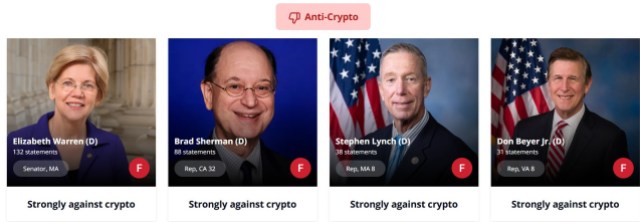
Stand With Crypto’s scorecard for each candidate

Mason Lynaugh, executive director of the Coinbase-backed group, framed the initiative as an effort to convert crypto supporters into an influential voting bloc, stating:

This year, crypto voters are poised to play a powerful and decisive role at the ballot box — our goal is to equip our more than 2.7 million advocates across the country with the tools they need to make informed choices this November.

Lynaugh added that the organization’s priority races are intended to help ensure that the 120th Congress is “the most pro-crypto session in America’s history,” and that the initial slate of endorsed candidates already has a record of supporting clear, pragmatic policies that foster innovation.

Stand With Crypto named six members of Congress in its first endorsement round: Representative Zach Nunn (R-Iowa), Rep. Susie Lee (D-Nevada), Rep. Mike Lawler (R-New York), Rep. Don Davis (D-North Carolina), Rep. Greg Landsman (D-Ohio), and Rep. Rob Borsellino Bresnahan (R-Pennsylvania).

Majority Of Crypto Owners Want Clearer Rules

The group also reported that among 1,000 crypto owners and advocates polled, 59% of crypto owners and 77% of Stand With Crypto advocates are heterogeneous voters who do not reliably vote for a single party.

The group noted that nearly a third of these voters are persuadable in their respective US Senate contests, suggesting that candidates’ positions on cryptocurrencies could sway outcomes.

Survey results also suggest crypto owners are highly motivated to vote: nearly 80% described themselves as “almost certain” to vote in 2026, and more than 75% said they were enthusiastic about participating in the general election — figures Stand With Crypto said outpace the broader adult population.

A majority (64%) of crypto owners said they would be enthusiastic about supporting candidates who back the cryptocurrency industry, and about 47% said they could back a candidate who agreed with them on crypto even if they disagreed on other policy areas.

Importantly for ongoing congressional negotiations on the anticipated CLARITY Act, 74% of crypto owners said they would be more likely to support candidates who favor clearer regulatory frameworks for the sector, with 31% saying they would be much more likely to do so.

The daily chart shows Coinbase’s stock dropping near $170 on Thursday trading session. Source: COIN on TradingView.com

Featured image from OpenArt, chart from TradingView.com

Domande pertinenti

QWhat is the main goal of Stand With Crypto's new political initiative for the 2026 midterm elections?

AThe main goal is to mobilize pro-crypto voters by providing them with information and tools, and to help ensure that the 120th Congress becomes 'the most pro-crypto session in America's history'.

QHow many advocates does Stand With Crypto claim to have in its nationwide network?

AStand With Crypto claims to have more than 2.7 million advocates in its nationwide network.

QWhich six incumbent lawmakers did Stand With Crypto endorse in its first round?

AThe endorsed lawmakers are Rep. Zach Nunn (R-Iowa), Rep. Susie Lee (D-Nevada), Rep. Mike Lawler (R-New York), Rep. Don Davis (D-North Carolina), Rep. Greg Landsman (D-Ohio), and Rep. Rob Borsellino Bresnahan (R-Pennsylvania).

QAccording to the group's survey, what percentage of crypto owners are 'almost certain' to vote in the 2026 election?

ANearly 80% of the crypto owners surveyed described themselves as 'almost certain' to vote in the 2026 election.

QWhat key piece of legislation is mentioned in relation to the survey results on regulatory frameworks?

AThe anticipated CLARITY Act is mentioned, with 74% of crypto owners saying they would be more likely to support candidates who favor clearer regulatory frameworks for the sector.

Letture associate

Dan Koe: The Counterintuitive Truth—You Don't Need to Remember Everything You Read

Dan Koe: The Counterintuitive Truth — You Don't Need to Remember Everything You Read The central idea is that deliberately trying to remember information is often misguided. True learning isn't about memorizing facts but about having important knowledge surface naturally when needed through use. Most forgetting is normal, not a failure. The article reframes learning using a control theory framework—a four-step feedback loop: having a clear Goal, accurately Sensing your current state, Comparing the gap, and Acting to close it. Most learning stalls because people only do step 2 (blind input) without a goal to create the necessary "error signal" for focused action. The most effective method is to start with output, not input. Begin a meaningful personal project first, and learn only what's necessary to complete it. This project-driven, "just-in-time" learning ensures knowledge is contextual and retained. The concept of a "Second Brain" often fails because it becomes a digital graveyard—over-collected and under-utilized. The goal should be building a "Second Subconscious"—a dynamic system that proactively surfaces relevant ideas during creation, not a static storage vault. Tools like Obsidian+Claude or Eden can help by automating organization and enabling semantic search, but their value depends on linking knowledge to active projects. Ultimately, what matters is not what you store, but what you filter and internalize. Focus on ideas that shape your worldview, use projects as filters, and transform collected material through writing and sharing. AI should be used to reduce friction in research and editing, not to formulate your core views. In conclusion, remembering is a byproduct, not the goal. Knowledge that sticks comes from pursuing personal goals, applying it in real projects, and digesting it through creation. The tools are merely aids; the crucial step is to start doing meaningful work and let the necessary knowledge find you.

marsbit50 min fa

Dan Koe: The Counterintuitive Truth—You Don't Need to Remember Everything You Read

marsbit50 min fa

A New Era: The Fundamental Transformation of China's Entrepreneurs

A profound generational shift is underway among Chinese entrepreneurs. The wealth and influence once dominated by real estate and internet giants is now being claimed by a new wave of founders driving breakthroughs in AI, semiconductors, and robotics. This change is vividly reflected in 2026's wealth rankings. Figures like Zhang Yiming (ByteDance), Liang Wenfeng (DeepSeek), Chen Tianshi (Cambricon), and Wang Xingxing (Unitree Robotics) are ascending. Their wealth stems not from traditional business models but from market expectations for future technological competitiveness, with AI, chips, and smart hardware becoming the primary engines of wealth creation. Their common trait is a foundational focus on technology, often starting from the laboratory rather than a business plan. Examples include Chen Tianshi's decade-long push in AI chips, Liang Wenfeng's core algorithmic innovations at DeepSeek with a compact team, and Zhu Yiming's "no salary until profitable" 9-year journey to build Changxin Memory into a global DRAM player. This transition marks a fundamental shift in China's economic imperative: from commercial expansion and learning to indigenous innovation and deep industrial capability. While the previous generation built the foundational market and infrastructure, this new cohort is tasked with achieving global leadership in core technologies, moving China from "keeping pace" to pioneering original, breakthrough innovations that are industrialized at scale. The baton is being passed to those competing on the world stage through technological originality.

marsbit50 min fa

A New Era: The Fundamental Transformation of China's Entrepreneurs

marsbit50 min fa

Once-Popular Web3 Enters Wave of Layoffs

The once-hot Web3 industry is experiencing a severe wave of layoffs. While many companies attribute job cuts to AI-driven restructuring, the primary reason is often financial pressure. The Web3 sector, at the intersection of tech and finance, has been hit particularly hard. Employees at major cryptocurrency exchanges report sudden, impersonal layoffs—often with system access revoked overnight—and minimal or no severance. Common tactics include setting impossible performance targets or terminating employees for minor policy violations. The working atmosphere has become toxic, marked by intense monitoring, excessive meetings, and management obsessed with control and internal politics rather than product innovation. The industry's core business model is collapsing. Exchange revenue from trading fees and listing charges has plummeted due to a decline in quality projects and retail investor exodus. Events like the massive forced liquidation on October 10th further shattered confidence. Competition from on-chain derivatives platforms and prediction markets is intensifying the downturn. As layoffs continue, displaced workers struggle to find new opportunities. Many transition to the AI sector, but face significant bias from traditional finance and even some AI firms, which view crypto industry experience with suspicion. The current downturn appears more structural than cyclical, driven by unsustainable practices, internal strife, and a failure to innovate, raising questions about the industry's future trajectory.

marsbit1 h fa

Once-Popular Web3 Enters Wave of Layoffs

marsbit1 h fa

Trading

Spot
活动图片