Coinbase and Ripple CEOs Join CFTC Advisory Panel Overseeing Digital Assets

TheNewsCryptoPubblicato 2026-02-13Pubblicato ultima volta 2026-02-13

Introduzione

The U.S. Commodity Futures Trading Commission (CFTC) has formed a new advisory committee focused on digital assets, appointing key industry leaders including Coinbase CEO Brian Armstrong and Ripple CEO Brad Garlinghouse. The committee, established under the Digital Commodities Consumer Protection Act, will provide expertise on regulatory and market developments. It includes representatives from crypto exchanges, stablecoin issuers, derivatives desks, and blockchain firms. The group will meet at least four times in 2026 to address issues like compliance, risk management, market transparency, and regulatory coordination. Their input will help shape future CFTC rules and oversight approaches for digital asset markets.

The United States Commodity Futures Trading Commission announced appointments to a new committee that would provide advice on regulatory and industry developments regarding digital assets. Coinbase CEO Brian Armstrong confirmed his position as a member of the committee representing crypto exchange interests. The advisory committee also has Ripple CEO Brad Garlinghouse as a member, offering information from a prominent payments blockchain company. The committee has various members representing companies in digital assets, finance, and blockchain technology. The committee also has members from a company that issues a stablecoin and a derivatives desk manager.

CFTC Chairman Rostin Behnam stated the committee would assist in helping regulators grasp the intricacies of the digital market. The members would contribute their expertise and knowledge from the digital asset marketplace. This advisory committee would meet at least four times in 2026 to discuss the problems regulators face in their work. The CFTC formed the committee through the Digital Commodities Consumer Protection Act’s powers. They would concentrate their focus on market issues such as compliance and risk management.
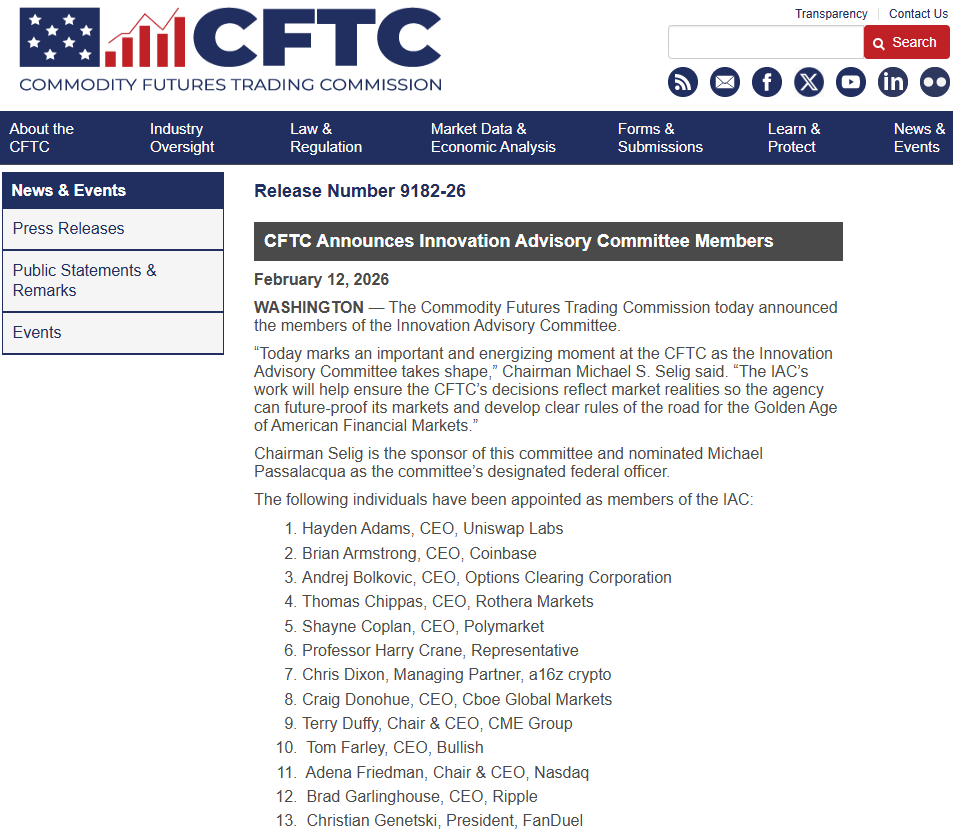
The committee has executives from companies such as Paxos, Cumberland, Galaxy Digital, among other companies. A representative of the stablecoin issuer has knowledge of liquidity and a framework for redemption. The diversity of the group is evident since there is knowledge on trading platforms, derivatives exchanges, and blockchain operations. The members of the CFTC’s advisory panel are compliance experts and know legal issues. The committee has experts from fintech and blockchain-based think tanks. The experts know derivatives exchanges, clearing operations, and blockchain operations.

Committee Aims and Regulatory Role

The Advisory Group will review options for enhancing digital asset markets under U.S. laws. The members will be able to review the risk issues faced by participants in the digital markets, whether retail or institutional. The members will also give opinions on compliance issues faced and law enforcement. The panel may also discuss transparency issues in digital markets in the U.S. The issue of coordination between U.S. regulatory authorities may also come up.

The committee members may assist the CFTC in oversight roles for new technologies. These could involve data infrastructures and market settlement systems. The contributions from the members to the CFTC may shape the proposals for future rules set forth by the agency.

Highlighted Crypto News:

U.S. Bankers Urge OCC to Slow Crypto Trust Bank Charters

TagsBlockchainBrad GarlinghouseCFTCCoinbaseCryptocurrencyexchangePaxosRipple

Domande pertinenti

QWho are the two prominent CEOs appointed to the CFTC's new advisory committee for digital assets?

ACoinbase CEO Brian Armstrong and Ripple CEO Brad Garlinghouse.

QWhat is the primary purpose of the CFTC's newly formed advisory committee?

ATo provide advice on regulatory and industry developments regarding digital assets and assist regulators in grasping the intricacies of the digital market.

QHow many times is the advisory committee scheduled to meet in 2026?

AAt least four times.

QWhich act granted the CFTC the power to form this digital assets advisory committee?

AThe Digital Commodities Consumer Protection Act.

QBesides crypto exchanges, what other types of companies are represented on the committee?

AA stablecoin issuer, a derivatives desk manager, fintech companies, blockchain-based think tanks, and companies like Paxos, Cumberland, and Galaxy Digital.

Letture associate

Global Stock Market's Storm Center: South Korea's Stock Market De-leveraging Is Largely Complete

Storm's Eye: South Korean Market De-leveraging Nears Completion The recent sharp correction in South Korean equities, with the KOSPI index dropping 32% from its June high, has been a key trigger for global tech stock volatility. The core driver was not a fundamental shift but a forced de-leveraging process within the market's unique structure, which is now largely complete. Two main leverage channels amplified the sell-off: 1. **Leveraged ETFs:** Their size, proportionally four times larger than in the U.S., peaked near $50 billion. Their mandatory daily rebalancing mechanism created a vicious cycle of "price drop → forced selling → further drop." Approximately 75% of this excess has been unwound, shrinking to $26 billion, with regulatory curbs now blocking new inflows. 2. **Hedge Fund Leverage:** Using swaps to magnify exposure, hedge funds saw their net long positioning fall by over 50% from peak levels. The most intense phase of this institutional de-leveraging is over. In contrast, **retail margin debt** poses minimal systemic risk. At 0.5% of market cap, it is far lower than in the U.S. or China, lacks automatic triggers, and is concentrated in smaller stocks. The conclusion: the high-leverage structures most prone to "chain-reaction selling" have been substantially cleared. The market is transitioning from a liquidity-driven crash to one priced more on fundamentals. The article argues that the AI trend—centered on Korean memory chips—remains intact. This episode represents a painful but necessary clearing of crowded trades, not the end of the AI revolution. For investors, the key question is conviction in the long-term AI direction; if the trend is real, current volatility is a cost of entry, not a terminal risk.

链捕手1 h fa

Global Stock Market's Storm Center: South Korea's Stock Market De-leveraging Is Largely Complete

链捕手1 h fa

Trading

Spot
活动图片





