CNBC Teases Deal Between Banks And Crypto For Long-Awaited Market Structure Bill

bitcoinistPubblicato 2026-03-20Pubblicato ultima volta 2026-03-20

Introduzione

CNBC reports that banking and cryptocurrency representatives are nearing a tentative agreement, potentially advancing the stalled CLARITY Act. Senate Banking Committee lawmakers may have reached a compromise, with a markup and vote expected soon. Key discussions involve stablecoin reward structures, though staff indicate negotiators are "99% of the way there." Additionally, Republicans are considering adding community bank deregulatory provisions from a House housing bill into the crypto legislation as part of a broader political trade-off to secure support. Talks remain fluid, and no final decisions have been made.

CNBC reported on Friday that a tentative agreement between banking and cryptocurrency industry representatives could be announced later today, potentially clearing a path for the long-stalled crypto market-structure legislation known as the CLARITY Act.

Lawmakers Near Agreement On Crypto Bill

The network’s coverage, citing industry insiders and Capitol Hill chatter, said lawmakers in the Senate Banking Committee may have reached a compromise and are now positioned to schedule a markup and vote; the Agriculture Committee already completed a procedural vote in January.

According to the CNBC piece, discussions in recent days have intensified as stakeholders seek common ground on a range of contentious issues.

One persistent sticking point is whether banks will accept proposed stablecoin reward structures. That question remains unresolved, the report said, even as other elements of the package appear to be coalescing.

However, a separate update surfaced Thursday evening from Eleanor Terrett, who quoted Senate staff saying negotiators were “99% of the way there on stablecoin yield,” and that talks over the digital-asset components of the bill “are in a good place.”

The staff added that Senator Cynthia Lummis viewed the day’s meeting as productive and positive. Still, the language in both reports underscores that while momentum has built, the details are not finalized and could change as negotiators work through remaining points.

Bank Changes Into CLARITY Act

The negotiations have also taken on a broader legislative and political dimension. Politico reported Thursday that Senate Banking Committee Republicans are exploring whether to fold community bank deregulatory provisions—taken from a House-passed housing bill—into the CLARITY Act as part of a trade.

The idea would be to include the banking-related rollbacks in the crypto bill in exchange for House Republicans accepting the Senate’s housing package as written.

That proposal was discussed privately during a closed-door meeting on Thursday morning that reportedly included Trump administration officials and GOP committee members.

According to Politico, the talks are fluid, and no final decisions have been made; proponents say such a swap could help secure House support for the Senate’s housing measures without further amendments.

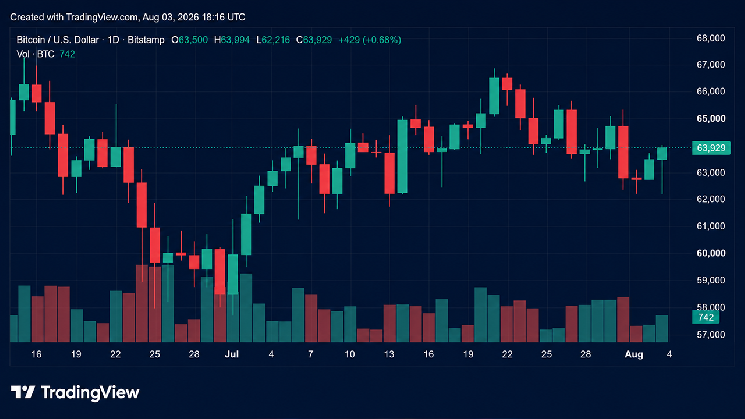
The daily chart shows the total crypto market cap at $2.38 trillion. Source: TOTAL on TradingView.com

Featured image from OpenArt, chart from TradingView.com

Letture associate

Gensyn AI: Don't Let AI Repeat the Mistakes of the Internet

In recent months, the rapid growth of the AI industry has attracted significant talent from the crypto sector. A persistent question among researchers intersecting both fields is whether blockchain can become a foundational part of AI infrastructure. While many previous AI and Crypto projects focused on application layers (like AI Agents, on-chain reasoning, data markets, and compute rentals), few achieved viable commercial models. Gensyn differentiates itself by targeting the most critical and expensive layer of AI: model training. Gensyn aims to organize globally distributed GPU resources into an open AI training network. Developers can submit training tasks, nodes provide computational power, and the network verifies results while distributing incentives. The core issue addressed is not decentralization for its own sake, but the increasing centralization of compute power among tech giants. In the era of large models, access to GPUs (like the H100) has become a decisive bottleneck, dictating the pace of AI development. Major AI companies are heavily dependent on large cloud providers for compute resources. Gensyn's approach is significant for several reasons: 1) It operates at the core infrastructure layer (model training), the most resource-intensive and technically demanding part of the AI value chain. 2) It proposes a more open, collaborative model for compute, potentially increasing resource utilization by dynamically pooling idle GPUs, similar to early cloud computing logic. 3) Its technical moat lies in solving complex challenges like verifying training results, ensuring node honesty, and maintaining reliability in a distributed environment—making it more of a deep-tech infrastructure company. 4) It targets a validated, high-growth market with genuine demand, rather than pursuing blockchain integration without purpose. Ultimately, the boundaries between Crypto and AI are blurring. AI requires global resource coordination, incentive mechanisms, and collaborative systems—areas where crypto-native solutions excel. Gensyn represents a step toward making advanced training capabilities more accessible and collaborative, moving beyond a niche controlled by a few giants. If successful, it could evolve into a fundamental piece of AI infrastructure, where the most enduring value in the AI era is often created.

marsbit10 h fa

Gensyn AI: Don't Let AI Repeat the Mistakes of the Internet

marsbit10 h fa

Why is China's AI Developing So Fast? The Answer Lies Inside the Labs

A US researcher's visit to China's top AI labs reveals distinct cultural and organizational factors driving China's rapid AI development. While talent, data, and compute are similar to the West, Chinese labs excel through a pragmatic, execution-focused culture: less emphasis on individual stardom and conceptual debate, and more on teamwork, engineering optimization, and mastering the full tech stack. A key advantage is the integration of young students and researchers who approach model-building with fresh perspectives and low ego, prioritizing collective progress over personal credit. This contrasts with the US culture of self-promotion and "star scientist" narratives. Chinese labs also exhibit a strong "build, don't buy" mentality, preferring to develop core capabilities—like data pipelines and environments—in-house rather than relying on external services. The ecosystem feels more collaborative than tribal, with mutual respect among labs. While government support exists, its scale is unclear, and technical decisions appear driven by labs, not state mandates. Chinese companies across sectors, from platforms to consumer tech, are building their own foundational models to control their tech destiny, reflecting a broader cultural drive for technological sovereignty. Demand for AI is emerging, with spending patterns potentially mirroring cloud infrastructure more than traditional SaaS. Despite challenges like a less mature data industry and GPU shortages, Chinese labs are propelled by vast talent, rapid iteration, and deep integration with the open-source community. The competition is evolving beyond a pure model race into a contest of organizational execution, developer ecosystems, and industrial pragmatism.

marsbit12 h fa

Why is China's AI Developing So Fast? The Answer Lies Inside the Labs

marsbit12 h fa

3 Years, 5 Times: The Rebirth of a Century-Old Glass Factory

Corning, a 175-year-old glass company, is experiencing a dramatic revival as a key player in AI infrastructure, driven by surging demand for high-performance optical fiber in data centers. AI data centers require vastly more fiber than traditional ones—5 to 10 times as much per rack—to handle high-speed data transmission between GPUs. This structural demand shift, coupled with supply constraints from the lengthy expansion cycle for fiber preforms, has created a significant supply-demand gap. Nvidia has invested in Corning, along with Lumentum and Coherent, in a $4.5 billion total commitment to secure the optical supply chain for AI. Corning's competitive edge lies in its expertise in producing ultra-low-loss, high-density, and bend-resistant specialty fiber, which is critical for 800G+ and future 1.6T data rates. Its deep involvement in co-packaged optics (CPO) with partners like Nvidia further solidifies its position. While not the largest fiber manufacturer globally, Corning's revenue from enterprise/data center clients now exceeds 40% of its optical communications sales, and it has secured multi-year supply agreements with major hyperscalers including Meta and Nvidia. Financially, Corning's optical communications revenue has surged, doubling from $1.3 billion in 2023 to over $3 billion in 2025. Its stock price has risen nearly 6-fold since late 2023. Key future catalysts include the rollout of Nvidia's CPO products and the scale of undisclosed customer agreements. However, risks include high current valuations and potential disruption from next-generation technologies like hollow-core fiber. The company's long-term bet on light over electricity, maintained even through the telecom bubble crash, is now being validated by the AI boom.

marsbit12 h fa

3 Years, 5 Times: The Rebirth of a Century-Old Glass Factory

marsbit12 h fa

Trading

Spot
Futures
活动图片