Cloudflare Introduces AI-Based Wallets Designed for Unmanned Purchases

cryptonews.ruPubblicato 2026-08-05Pubblicato ultima volta 2026-08-05

Introduzione

Cloudflare has announced AI-powered "Wallets X" designed to enable autonomous agent commerce. The system addresses a key barrier: AI agents currently cannot easily identify themselves or pay for API access and digital content on their own, often requiring human intervention. The solution involves two linked wallets. "Account wallets" are owned and funded by humans, who set spending rules. "Agent wallets" are owned by the AI agents themselves and operate via API keys. Each agent wallet has a spending limit drawn from its linked human account, acting as a safety net—e.g., a $100 weekly limit for AI computations. This allows agents to independently explore and pay for services within their budget. The payment technology is based on the x402 protocol, which attaches micropayments in stablecoins directly to standard web requests. This works with Cloudflare's recently announced Monetization Gateway, aiming to create a "driverless marketplace" for AI services. To solve the identity problem, Cloudflare introduces `cloudflare.pay`, a system linking a wallet to an account. This allows an agent to optionally identify itself (e.g., `research.example.cloudflare.pay`), helping merchants distinguish between bots, AI agents, and humans. The identity system builds on the existing Web Bot Auth technology. Cloudflare cites the growing volume of bot traffic as a key driver, betting that equipping AI agents with wallets, spending limits, and optional identity will smooth the transition to mor...

The company announced Cloudflare Wallets X on its blog, describing a tool that allows users to obtain a wallet ID for their account and soon use this wallet to pay for APIs and digital content. An API, or Application Programming Interface, is a set of rules that allows one software to interact with another. Companies often charge for access to their APIs, and until now, an AI agent had no simple way to pay for this access itself.
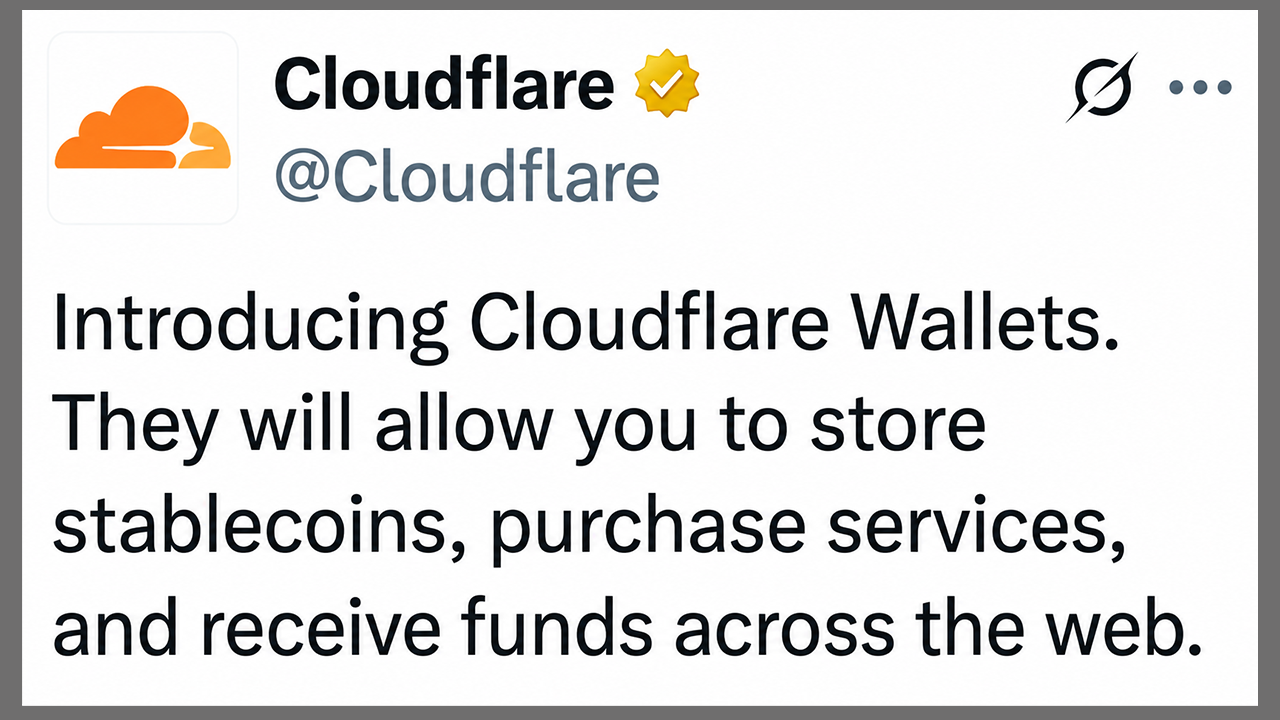
Image source: X

This gap was a real obstacle. When an AI agent wants to try a new service, it typically lands on a login page designed for a human, not a machine. The agent has no simple way to verify its identity or make a payment. Faced with this barrier, agents usually stop and ask a human to complete the task. Cloudflare notes that these obstacles slow the growth of so-called "agent commerce"—the use of software that independently makes purchasing decisions.

Two Wallets, One Goal: Enabling Agents to Act Independently

Cloudflare's solution splits the system into two parts. "Account Wallets" belong to people. A person funds the wallet, sets rules, and can withdraw money at any time. Virtual wallets belong to the agents themselves and operate via API keys rather than a login screen. An agent spending funds from a virtual wallet can only spend what its owner permits, as each virtual wallet has a limit defined by its associated account wallet.

This limit is the "safety net." For example, an employer could give each employee a virtual wallet with a $100 weekly limit for AI compute—that is, the computational work an artificial intelligence (AI) model performs to generate responses. If an agent tries to spend more than this limit, it needs to ask a human to manually override the limit. Cloudflare views these limits more as a form of freedom than a restriction. An agent responsible for $10 can be trusted to explore dozens of low-cost services independently, while an agent responsible for $1,000 needs closer supervision.

Micro-Payments Tied to Web Requests

The payment technology underpinning the wallets is called x402—a protocol that ties micropayments in stablecoins directly to standard web requests. Stablecoins are digital currencies designed to maintain a stable value, typically pegged to the US dollar. Cloudflare timed the wallet launch with its Monetization Gateway—a tool announced earlier this month that allows website and app owners to charge for their content or APIs without having to build separate payment infrastructure.

Together, these two tools aim to create what Cloudflare calls a "driverless marketplace," where AI agents can browse, test, and pay for services without human involvement in every transaction.

Giving Machines an Identity That Merchants Can Trust

Payment alone doesn't solve all the problems agents face on the web. Companies still have virtually no way to determine exactly who is generating traffic on their site: a human, a bot, or an AI agent acting on behalf of a real customer. Cloudflare addresses this with cloudflare.pay—a system that links a wallet to an account, allowing an agent to optionally identify itself, for example, as an agent operating for research.example.cloudflare.pay. Disclosing identity will be voluntary, and merchants themselves will decide whether to treat identified agents differently from anonymous ones.

According to Cloudflare, this system builds upon Web Bot Auth—an existing technology that allows agents to register their identity using a cryptographic key pair. The wallet ID converts this key pair into a form a human can read and remember.

Why This Matters Right Now

Cloudflare pointed to one metric driving the urgency of the launch: most traffic on the internet is now generated by bots, not people. As AI agents take on more tasks like shopping, searching for information, and booking, the company is betting that giving them a wallet, spending limits, and optional identity will make this transition smoother for both sides of the transaction.

The company stated it will start with simple funding and withdrawal methods in supported regions, giving users the ability to self-fund wallets using stablecoins.

What to Expect Next

Cloudflare has not yet published a full schedule for enabling payments across all x402-compatible sites. Companies and developers can already register a wallet ID; more details will become available as the identification standards developed by the x402 Foundation evolve.

end-content

Domande pertinenti

QWhat is Cloudflare Wallets X and what problem does it aim to solve?

ACloudflare Wallets X is a tool announced by Cloudflare that provides AI agents with a wallet identifier for their account. It is designed to allow these agents to autonomously pay for APIs and digital content. The core problem it solves is that AI agents previously had no simple way to confirm their identity or make payments when encountering human-centric login pages or payment systems, which hindered the growth of 'agentic commerce'.

QHow does the Cloudflare Wallets system separate the roles of humans and AI agents in terms of wallet management?

AThe Cloudflare Wallets system divides the architecture into two parts. 'Account wallets' belong to humans, who fund the wallet, set rules, and can withdraw money. 'Virtual wallets' belong to the AI agents themselves and operate via API keys, not login screens. A virtual wallet's spending is governed by a limit set by its linked human account wallet, acting as a safeguard.

QWhat payment protocol and digital currency does Cloudflare Wallets X use for its micro-payments?

AThe wallets use a protocol called x402, which ties micropayments directly to standard web requests. These payments are made in stablecoins, which are digital currencies designed to maintain a stable value, typically pegged to the US dollar.

QHow does Cloudflare's system, `cloudflare.pay`, help establish identity for AI agents online?

AThe `cloudflare.pay` system links a wallet to an account, enabling an AI agent to optionally identify itself (e.g., as an agent working for 'research.example.cloudflare.pay'). This identity is based on the existing Web Bot Auth technology, which allows agents to register their identity using a cryptographic key pair. The wallet identifier converts this key pair into a human-readable form.

QAccording to the article, why is launching this wallet system particularly urgent right now?

ACloudflare cites that most internet traffic is now generated by bots rather than humans. As AI agents take on more purchasing, information search, and booking tasks, the company is betting that providing them with wallets, spending limits, and optional identity will make the transition smoother for both sides of a transaction in the emerging automated marketplace.

Letture associate

How AI Agents Simplify Mastering Complex Web3 Tools

Coinfello has launched a major update, Fello 2, featuring an AI agent platform designed to simplify complex Web3 operations. Users can now create, execute, and automate on-chain financial strategies using simple language prompts. The update introduces an intent-based infrastructure that eliminates manual, multi-step interactions with dApps, replacing them with a single command. Traditionally, tasks like managing yield strategies or monitoring loan positions required juggling multiple applications, manual transaction approvals, and constant market monitoring. Fello 2 allows users to describe a strategy once; the AI agent then analyzes conditions, formulates an execution plan for user review, and handles continuous background monitoring and security. The platform operates on a non-custodial delegation model where the agent never holds private keys and proactively screens transactions to reject phishing attempts, drainer scripts, and blind signing requests. Users with standard wallets can monitor positions without a new wallet, only needing one with automation features for active fund transfers. Coinfello's COO, Minchi Park, stated that natural language interfaces address a core misconception in Web3 UX: they separate the mechanics of tools from financial literacy. The barrier is often not understanding financial risks, but the operational costs of navigating multiple chains and managing protocol approvals. She noted that these AI agents excel in complex edge cases, such as prioritizing margin protection over principal repayment during volatile market drops, and can calculate true net yield by factoring in gas and protocol fees. Park predicts that as agent-based workflows expand, dApp interfaces will become secondary to contract clarity and pure performance. "If a user's entry point is a prompt, your interface stops being the evaluation criteria," she said. Alongside Fello 2, Coinfello launched a rewards program paid in MON, Monad's native token, offering 100% fee rebates during an initial promo period. Future updates will allow earned rewards to be deposited into a self-custodied account managed by Fello for auto-compounding. A co-founder emphasized that Fello 2 converts manual processes into automated actions, managing schedules and conditions within the user's own wallet, with no unapproved operations.

cryptonews.ru7 min fa

How AI Agents Simplify Mastering Complex Web3 Tools

cryptonews.ru7 min fa

Trading

Spot
活动图片