Claude Doesn't Submit Code Directly After Writing It: Runs 4 Skills for Self-Check, Fixes Issues, Then Comes Back to You

marsbitPubblicato 2026-07-27Pubblicato ultima volta 2026-07-27

Introduzione

Claude No Longer Submits Code Directly: 4 Self-Check Skills to Run Before Coming Back to You AI already writes code, but the burden of reviewing it still falls on you. To address this, Anthropic has built a "verification loop" into Claude Code. After writing code, Claude now runs four self-check skills before delivering the work: * `/code-review`: Finds potential bugs and provides review feedback. * `/simplify`: Cleans up the diff, removing redundant or over-complex implementations to reduce future maintenance costs. * `/verify`: Performs end-to-end validation, actually running the application to confirm the feature works, not just appears to. * `/design`: Used only for UI changes; cross-references the implementation against the project's DESIGN.md file. This loop extends the AI agent's workflow from "gather context → execute" to "gather context → execute → auto-verify → fix → re-verify." It tackles the new bottleneck in AI-assisted development: the speed of verifying code now outpaces human review. These skills are built on Claude Code's existing verification foundation (like running apps and using linters). Teams can create their own custom verification skills by documenting their repetitive manual checks in plain language as Markdown files. Verification can be triggered at four levels: manually (Standalone), embedded in a task, chained with other skills, or automatically on every PR (On every PR). The shift signifies that competition in AI programming is movin...

AI has taken over the task of writing code. But the job of acceptance still falls on you.

Whether a piece of code is written correctly or not is not AI's responsibility; ultimately, you still have to go through it line by line. This hurdle has stumped many people.

Recently, Anthropic has also integrated AI acceptance into the loop.

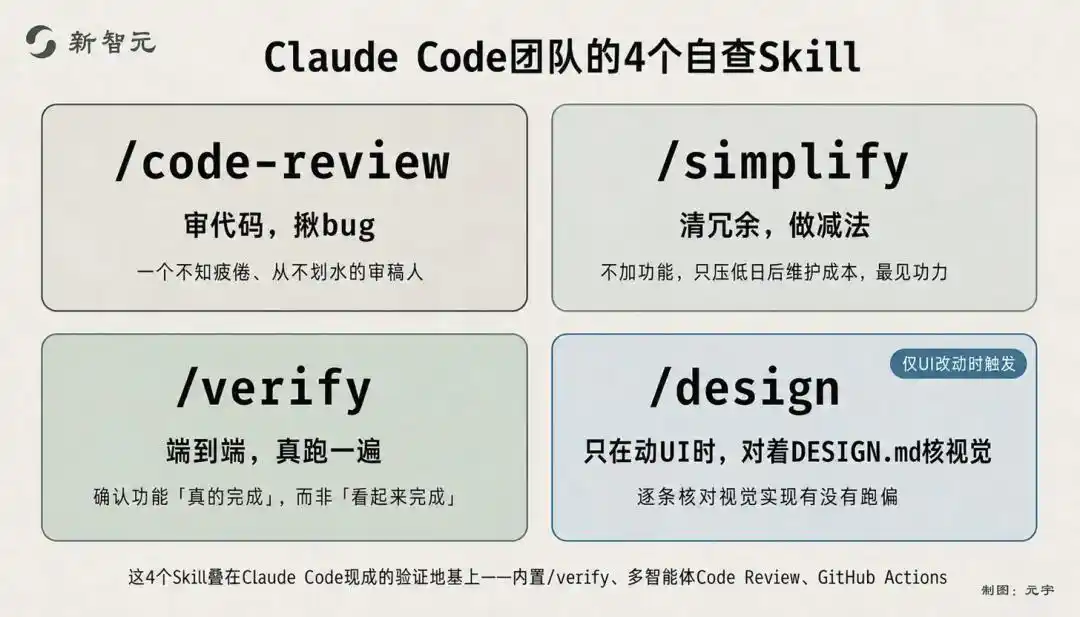
They made Claude, after writing code, not immediately hand it over. Instead, it runs four checks itself first:

/code-review to root out bugs, /simplify to clean up redundant implementations, /verify to perform end-to-end verification, and if the UI was touched this time, use /design to cross-check against the visual specifications in DESIGN.md.

Only after running through all four does it count as delivered.

On July 22nd, the Claude Code team publicly shared this internal "verification loop."

In other words, after Claude writes code, it first finds and fixes errors on its own before coming back to you.

This signifies AI evolving from "being able to write code" to "being able to check the code it wrote."

Agent Work Loop Gains an Extra Verification Step

Anthropic gave this system a name: the verification loop.

The official definition is simple: it's an iterative process where Claude checks and attempts to fix its own work.

What it changes is the agent's work cycle.

Previously, it was "gather context → execute action → manual check." The final step rested on humans: the AI hands over the work, and you have to review it line by line.

Now this line is extended to "gather context → execute action → automatic verification → fix → verify again." Checking and fixing are placed back inside the loop.
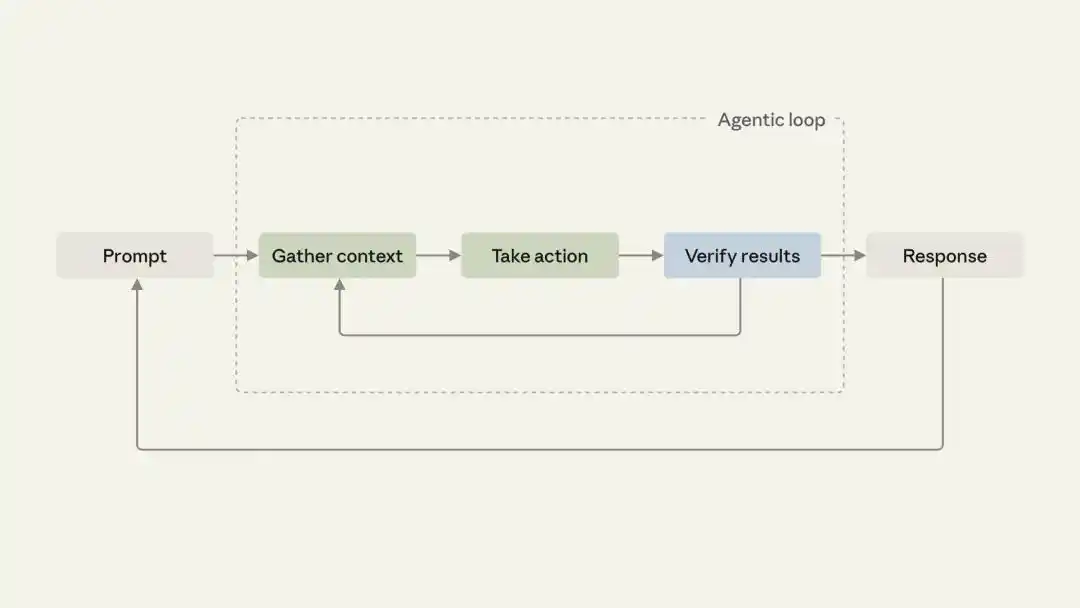
Anthropic's official agent cycle diagram: after a prompt comes in, Claude gathers context, executes actions, verifies results. If verification fails, it loops back; only when it passes does it return.

Some checks Claude already knows how to do. Deterministic signals in the codebase, like type checker, linter, running tests, runtime errors—it can read these and will fix them as it goes.

The real trouble lies with another category: whether the UI changes are correct, whether the user flow is smooth, whether this change has buried unseen pitfalls...

In the past, these could only be caught by humans watching, performing the same checks dozens or hundreds of times.

Anthropic's solution is to write down each of those manual checks you perform every time, package them into Skills, and have Claude execute them automatically for each task.

For decades, all software engineering processes—writing requirements, planning, layer upon layer of reviews, endless meetings—were essentially because: writing code was too slow, and engineers' time was too valuable.

But when AI makes the act of writing code faster and cheaper, this premise disappears.

The Claude Code team's own assessment is: the bottleneck hasn't vanished; it has merely shifted: from "writing code" to verification, code review, security, and other such stages.

Code is generated too quickly. The new problem becomes: are these codes correct, who will maintain them, can people keep up with the pace of reviewing code.

Faced with this new bottleneck, the Claude Code team first experimented on themselves.

The 4 Self-Check Skills the Claude Code Team Uses Daily

Internally, the Claude Code team uses these four self-check Skills every day.

/code-review, specialized in reviewing code changes, rooting out potential bugs, and providing review comments along the way.

This is like having a tireless reviewer on standby.

/simplify, cleans up the diff for this change, removing convoluted, complex implementations to make the structure simpler.

It doesn't add features for you; instead, it removes redundancy, simplifies implementation, pushing down future maintenance costs.

This point is crucial and requires real skill. Most people write code by adding more; tools that proactively simplify are particularly valuable.

/verify, performs end-to-end verification, actually running things to confirm the feature is truly complete, not just "looks complete."

/design, only comes into play when the UI is touched. It cross-checks against the DESIGN.md in the repository, verifying point by point if your visual implementation has deviated.

These 4 Skills didn't appear out of thin air.

Underlying them, Claude Code has already laid a foundation of existing verification support:

The built-in /verify can run the application to observe changes; you specify the build and test commands in CLAUDE.md, and it follows them. There's also Code Review specifically for multi-agent reviews on PRs, and GitHub Actions that automatically trigger on every commit.

The team's 4 Skills are like adding their own layer of process on top of this general foundation.
How to Write Your Own Verification Skill?

Anthropic's method is also simple:

Write down that manual step you always perform in plain language, as if you were explaining precautions to a new colleague on their first day.

If you're even stuck on how to describe this check step, you can first ask Claude to provide a version of general best practices and then modify it.

Your version will likely differ from the generic approach at a few key points, and those differences are precisely the things most worth documenting.

Checks don't necessarily have to be vague judgments like "feels right or not."

For example: any change that deletes a database field without an accompanying data migration step should be rejected. This is a "local rule" that a generic linter will never catch but is specific to your project.

Any rule you've only been able to enforce by manually watching like a hawk is worth writing into a loop.

What to do after writing it?

Throw it to skill-creator to have it interview you back, or simply drop a Markdown file into .claude/skills/.

The simplest verification Skill is a few lines of instructions plus a body paragraph. Then test it once on a new task to confirm this check step actually runs. If not, fix it.

For Skills you can't modify, like built-in ones or those hosted by plugins, there's a workaround: write a wrapper Skill that first calls the original, then calls your verification. A detour, but it still embeds the check.

Verification Isn't One-Size-Fits-All; It Has 4 Levels

After packaging checks into Skills, the next question is: when should this thing trigger?

Anthropic provides 4 levels of automation, from loose to tight.

Standalone: You remember to manually invoke it.

Embedded: Embedded into a specific task flow, running alongside it.

Chained: Several verification Skills strung into a chain, automatically running one after another.

On every PR: The strictest level, automatically running on every code commit.

The official term for the middle layer transition is "from habit to contract."

What was "I always remember to run /verify after /simplify" as a personal habit becomes "automatically call /verify after /simplify runs" as a fixed contract once chained.

The entire chain completes the development loop on its own, only coming back to you when your approval is needed.

The longer the chain, the higher the reliability, but the official team specifically cautioned: chained verification will genuinely burn through tokens.

So don't immediately set all checks as PR gates that block every commit. The right approach is to first see if it's stable, then gradually add more.

Behind the 4 Skills: AI Programming is Changing Tracks

Behind the 4 Skills, the competition in AI programming is shifting from generation to verification.

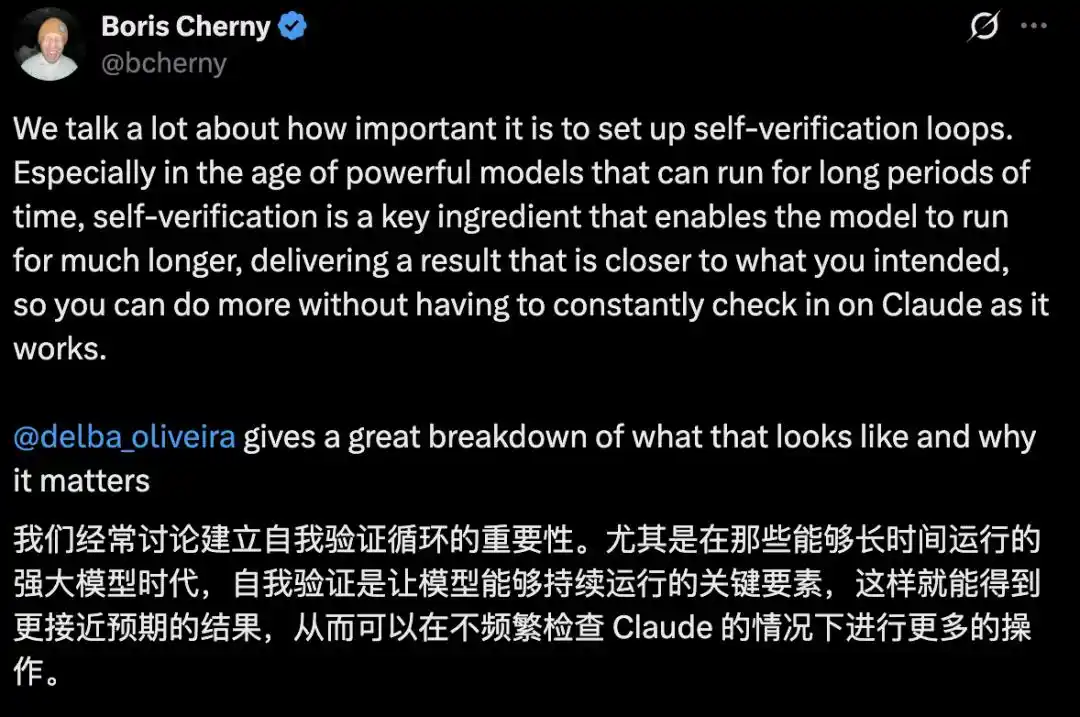
The creator of Claude Code has given the same assessment.

On June 9th of this year, he tweeted: In an era where powerful models can run autonomously for long periods, self-verification is key to letting models run longer and produce results closer to your expectations. You don't have to watch Claude frequently to hand over more work.

Simply put, the more solid the verification, the more confidently an agent can run; the longer it runs, the less hassle for humans.
In the past, we relied on prompts, but they have a ceiling too: they only solve the task at hand; next time you start from scratch.

Let's first correct a common misunderstanding: A Skill is not a piece of Markdown prompt.

It's a capability module containing instructions, file structure, scripts, tool calls, configuration, and an entire workflow. It's about solidifying a team's check steps, design norms, and lessons learned into a package readily available for Claude to reference when needed.

More crucially, Skills are evolving from a feature of Claude Code into an open standard across vendors.

According to industry analysis, GitHub Copilot, Cursor, OpenAI Codex, and Gemini CLI have already adopted the same format.

This means the Skills you solidify for your team won't be locked into one specific tool. They will encapsulate your team's experience, norms, and check processes, turning into reusable capabilities.

This also highlights a stark reality: the same Claude might yield efficiency differences of several times between different teams. This gap isn't due to the model but rather the workflow:

Have you written checks into Skills? Have you set up verification loops? Have you enabled the agent to run its own feedback loop to completion?

Ultimately, an agent's capability is an addition problem: model, plus tools, plus verification mechanisms, plus workflow.

The model aspect is becoming more similar across vendors. What truly creates distance are the latter three items, all of which are in the user's hands.

Of course, what this blog post demonstrates is the process optimization of AI-assisted development, not "AI can already write software independently." It still requires engineers and cannot handle production-grade delivery without humans.

Therefore, it's not about agents coming to take human engineers' jobs, but the direction is already clear.

In the past, we've been teaching AI how to write code. Now we need to start teaching it to verify if what it wrote is correct.

For someone who uses AI to write code every day, the day when "having to manually review everything before leaving work" can finally be entrusted to AI with peace of mind is the day it truly starts carrying the load for you.

References:

https://claude.com/blog/building-verification-loops-in-claude-code-with-skills

https://claude.com/blog/getting-started-with-loops?utm_source=chatgpt.com

This article is from the WeChat public account "New Zhiyuan", author: ASI Revelation

Crypto di tendenza

Domande pertinenti

QWhat is the core innovation described in the article regarding Claude's code generation?

AThe core innovation is the introduction of a 'verification loop' where Claude, after writing code, automatically runs it through four specialized Skill checks (code-review, simplify, verify, design) to find and fix errors before delivering the final code to the user.

QWhat are the four primary verification Skills used by the Claude Code team internally?

AThe four primary Skills are: /code-review (to catch potential bugs and provide review comments), /simplify (to clean up and streamline the implementation), /verify (to perform end-to-end functional verification), and /design (to ensure UI changes align with a project's DESIGN.md file).

QWhat is the key difference between a traditional AI coding workflow and the new 'verification loop' workflow?

AThe traditional workflow is: 'collect context -> execute action -> human review'. The new 'verification loop' workflow extends this to: 'collect context -> execute action -> automatic verification -> repair -> re-verify', embedding the review and repair steps back into an automated loop before returning to the user.

QAccording to the article, what is the main 'bottleneck' that has shifted as AI code generation becomes faster?

AThe main bottleneck has shifted from 'writing code' to the verification, code review, and security aspects. The article states that the new problem is ensuring the rapidly generated code is correct, maintainable, and can be reviewed at the required pace.

QHow does the article describe the nature and importance of 'Skills' compared to simple prompts?

AA Skill is described not as a simple prompt, but as a modular capability package. It contains instructions, file structures, scripts, tool calls, configurations, and workflows. It is a way to encapsulate a team's review steps, design standards, and learned lessons into a reusable asset that Claude can access autonomously.

Letture associate

Claude Code Slashes 80% of Prompt Tokens, But Opus 5 Just Adds Them Right Back In

Claude Code, the AI coding assistant from Anthropic, recently announced a massive reduction of over 80% in its system prompt content for models like Opus 5 and Fable 5. The goal was to remove verbose, often conflicting, rules (like strict commenting and documentation requirements) and replace them with a simpler directive: write code that matches the style of the surrounding project. This "pruning" aims to make the model more efficient by reducing internal conflict from overlapping instructions, with no measurable performance drop reported. However, a developer's (@chenchengpro) investigation revealed a twist. While the prompt was drastically cut from 15,225 characters in Opus 4.7 to 4,467 in Opus 4.8, it *increased* by approximately 72% to 7,694 characters in Opus 5. This isn't a contradiction. The "over 80% cut" refers to the overall shift from the old, detailed rulebook-style prompts to a new, streamlined system. The 72% increase for Opus 5 represents new, targeted instructions added to manage the model's enhanced capabilities. Opus 5 is more proactive—it likes to report progress, generate longer outputs, use sub-agents, and expand task scope. The added prompt content (roughly 3,755 characters) primarily provides guidelines for "Delivering work" (controlling task scope, progress reporting) and "Corrections" (limiting excessive self-correction). These new rules are necessary to curb potential over-engineering on simple tasks, ensuring efficiency even as the model becomes more independent. In short, the old, restrictive manual was deleted, but new guidelines were written to harness the model's newfound initiative.

marsbit2 min fa

Claude Code Slashes 80% of Prompt Tokens, But Opus 5 Just Adds Them Right Back In

marsbit2 min fa

One-Third of arXiv 'Contaminated', 65% of CS Papers Smell of AI, Only 0.7% in Math

Approximately one-third of recently posted arXiv papers show signs of significant AI-generated text, according to a new study. An analysis of 12,750 papers from January 2023 to July 2026 across ten disciplines found a sharp increase in AI text markers following ChatGPT's release, with the overall detection rate reaching 32% in the latest quarter and peaking near 39% in early 2026. The rate varies drastically by field. Computer Science papers lead at 65%, followed by Quantitative Biology (56.3%) and Electrical Engineering (51.3%). Mathematics, however, has the lowest detection rate at just 0.7%. The study's authors note this could be due to mathematicians using AI less or because the detector struggles with the high volume of formulas and symbolic notation in math papers, leaving the true cause unclear. The research highlights that the detector identifies a statistical "AI style" in the text rather than proving full AI authorship. It cannot distinguish between light AI-assisted editing and fully AI-generated content. Furthermore, the detector can produce false positives, as some pre-ChatGPT academic writing also exhibits patterns now flagged as "AI-like." The growing use of AI, particularly in highly competitive fields, is creating a cycle where researchers may feel pressured to adopt AI tools to keep pace. The findings raise questions about the changing nature of academic writing and the emergence of a new "AI style" that is increasingly difficult to distinguish from human prose, potentially undermining trust in written text regardless of its true origin.

marsbit4 min fa

One-Third of arXiv 'Contaminated', 65% of CS Papers Smell of AI, Only 0.7% in Math

marsbit4 min fa

The Biggest Enemy of the AI Bull Market Is Not a Bubble, But the Bond Market?

The bond market is emerging as the most dangerous variable for the AI stock rally. US Bank's chief investment strategist Michael Hartnett warns that surging bond yields are tightening financial conditions beyond what corporate earnings can support. Key indicators include the 30-year Treasury yield hitting 5.2% (a high since 2007) and real yields reaching 3% (a peak since 2008). Hartnett argues this bond market stress could force the Fed to hike rates, which would be detrimental to equities. A critical risk signal would be if the bullish combination of "rising yields & rising bank stocks" flips to "rising yields & falling bank stocks," potentially triggering a broader de-risking in markets. Simultaneously, credit risk for hyperscale cloud companies has reached record highs, with Credit Default Swaps (CDS) at unprecedented levels. This reflects bond investors' growing skepticism about the return on investment from the massive AI capital expenditure boom. The core concern is: if debt markets refuse to fund the AI spending spree, where will the capital for expensive memory chips and potentially unprofitable frontier models come from? Hartnett frames the current dynamic as "FCI > EPS" – where tightening Financial Conditions outweigh the support from Earnings Per Share. He advises a defensive tilt: going long defensive stocks, high-dividend stocks, and long-duration bonds, while shorting bank stocks, brokers, tech, and industrials to hedge against a potential reversal of the "boom" narrative. From a macro perspective, the 2020s are characterized by supply-side constraints (labor, imports, oil) rather than demand, while bond and equity supply remains abundant due to persistent fiscal deficits and reduced corporate buybacks. In this environment, Hartnett sees gold and Bitcoin quietly forming a base in 2026.

marsbit7 min fa

The Biggest Enemy of the AI Bull Market Is Not a Bubble, But the Bond Market?

marsbit7 min fa

"Injective Nova Program" Final Demo Day Summit Finals Successfully Concluded: TOP3 Teams Announced, Co-creating a New Paradigm of AI × Web3

"Injective Nova Program" Final Demo Day Successfully Concludes in Hangzhou: Top 3 Teams Announced, Shaping the New Paradigm of AI × Web3 On July 25, 2026, the Final Demo Day of the "Injective Nova Program," jointly launched by Injective, Microsoft, and Web3Labs, was successfully held in Hangzhou. The event gathered global blockchain experts, AI developers, top VC representatives, and ecosystem partners to witness innovations at the intersection of AI and decentralized networks. The program generated significant global interest, receiving 89 applications from over 10 countries and achieving over 1,000,000 ecosystem impressions. After a rigorous review, a global Top 10 was announced on July 10. These teams participated in an exclusive visit to Microsoft's Beijing headquarters for deep technical exchanges on July 16. At the final demo day, the Top 10 teams delivered live presentations. The jury evaluated projects based on technological innovation, commercial potential, and synergy with the Injective ecosystem, ultimately awarding the top three positions. All winning and shortlisted projects will receive comprehensive incubation support, technical resources, and capital access from Injective, Microsoft, and Web3Labs. The successful conclusion of the Final Demo Day marks a significant milestone for the first phase of the Injective Nova Program. The organizers plan to continue supporting global builders and exploring the limitless possibilities of AI and decentralized technology integration.

marsbit12 min fa

"Injective Nova Program" Final Demo Day Summit Finals Successfully Concluded: TOP3 Teams Announced, Co-creating a New Paradigm of AI × Web3

marsbit12 min fa

Trading

Spot

Articoli Popolari

Come comprare 4

Benvenuto in HTX.com! Abbiamo reso l'acquisto di 4 (4) semplice e conveniente. Segui la nostra guida passo passo per intraprendere il tuo viaggio nel mondo delle criptovalute.Step 1: Crea il tuo Account HTXUsa la tua email o numero di telefono per registrarti il tuo account gratuito su HTX. Vivi un'esperienza facile e sblocca tutte le funzionalità,Crea il mio accountStep 2: Vai in Acquista crypto e seleziona il tuo metodo di pagamentoCarta di credito/debito: utilizza la tua Visa o Mastercard per acquistare immediatamente 44.Bilancio: Usa i fondi dal bilancio del tuo account HTX per fare trading senza problemi.Terze parti: abbiamo aggiunto metodi di pagamento molto utilizzati come Google Pay e Apple Pay per maggiore comodità.P2P: Fai trading direttamente con altri utenti HTX.Over-the-Counter (OTC): Offriamo servizi su misura e tassi di cambio competitivi per i trader.Step 3: Conserva 4 (4)Dopo aver acquistato 4 (4), conserva nel tuo account HTX. In alternativa, puoi inviare tramite trasferimento blockchain o scambiare per altre criptovalute.Step 4: Scambia 4 (4)Scambia facilmente 4 (4) nel mercato spot di HTX. Accedi al tuo account, seleziona la tua coppia di trading, esegui le tue operazioni e monitora in tempo reale. Offriamo un'esperienza user-friendly sia per chi ha appena iniziato che per i trader più esperti.

394 Totale visualizzazioniPubblicato il 2025.10.20Aggiornato il 2026.06.02

Come comprare 4

Discussioni

Benvenuto nella Community HTX. Qui puoi rimanere informato sugli ultimi sviluppi della piattaforma e accedere ad approfondimenti esperti sul mercato. Le opinioni degli utenti sul prezzo di 4 4 sono presentate come di seguito.

活动图片