Clarity Act Outlook: No Yield, No Payment

marsbitPubblicato 2026-05-19Pubblicato ultima volta 2026-05-19

Introduzione

"Clear Act Outlook: No Yield, No Payment" analyzes the evolving U.S. regulatory landscape for stablecoins, focusing on the interplay between the proposed "Clarity Act" and the existing "Genius Act." The article argues that the Genius Act successfully fostered "payment stablecoins" by permitting tokenized assets like U.S. Treasuries as reserves. This created a structured market where stablecoin issuers (like USDC) must hold these reserves, often purchased as Tokenized Money Market Funds (TMMFs) from giants like BlackRock. These TMMFs are primarily B2B products, ensuring user-facing stablecoins remain non-interest-bearing and used primarily for payments. The upcoming Clarity Act is seen as the next phase, aiming to restrict passive yield on stablecoins. Its goal is to dismantle the arbitrage advantage of offshore stablecoins like USDT by redirecting Treasury demand towards compliant, U.S.-sanctioned TMMFs. For on-chain and compliant offshore dollars, this creates new pressure: they must spur adoption and utility to generate yield, as simple Treasury staking may be restricted. This indirectly promotes dollar circulation and sustained Treasury purchases. Ultimately, the analysis posits that U.S. regulation seeks to create a new dollar distribution model. By separating payment function from yield generation and anchoring both to U.S. debt instruments, it aims to embed the dollar and Treasury demand into the global crypto economy, managing yields through sanctioned intermediarie...

Author: Zuo Ye

The Clarity Act is progressing smoothly, with multiple benefits expected mid-year for stablecoins, tokenization, and DeFi development. However, prohibiting passive yield on stablecoins will also cast some uncertainty over the on-chain outlook.

This is not unwarranted anxiety. From ETFs, DAT, to Wall Street's attempts at RWA, the battle for crypto pricing power continues. Compliance often means accepting established frameworks, snuffing out grassroots innovation in the name of stability.

ETFs sacrifice BTCFi, DAT creates systemic crises, RWA rejects existing public chains.

On the surface, the Clarity Act compresses the arbitrage space for offshore dollar stablecoins like $USDT. But in reality, by separating and recombining payment and yield, the US is experimenting with a new model for dollar circulation beyond gold, oil, and credit.

The story of payment stablecoins is basically over; the chapter of yield-bearing stablecoins is about to begin.

Surround on Three Sides, Payment Stablecoins

Setting my heart on money learning pleasure more than Thee.

There has always been a question: How exactly does the Genius Act facilitate the "payment stablecoin" narrative to become reality?

As Wall Street giants lay the groundwork for tokenization on the eve of the Clarity Act's passage, this confusion intensifies. Yes, you heard right—they are laying the groundwork for tokenization business to enable stablecoin yield.

  • On May 8th, besides BUILD, BlackRock plans to launch two new TMMFs (Tokenized Money Market Funds): BSTBL and BRSRV.
  • On May 13th, besides MONY, JPMorgan Chase launched a second TMMF, JLTXX.

Moreover, BlackRock explicitly stated that the new products aim to meet the growing needs of stablecoin issuers, while JPMorgan also emphasized compliance with relevant qualification requirements of the Genius Act.

Examining the text closely, the Genius Act indeed adds provisions for tokenization, allowing tokenized forms of US Treasuries and dollars to serve as stablecoin reserve assets.

This doesn't explain the relationship between stablecoins, tokenization, and payment. We need to explore further.

Under the Genius Act, stablecoin issuance licenses are allocated to the OCC's federal charter bank mechanism. Such banks cannot take deposits, require full reserves, and must not encroach on commercial bank lending business.

In this scenario, policy creates market demand. Stablecoin issuers either build their own reserves—like USDT and USDC frantically buying US Treasuries, surpassing many sovereign nations—or directly purchase RWA assets like TMMFs. This is crucial for stablecoins like USDS/sUSDS that rely on profit-sharing to attract users.

  1. It avoids the complex process of subscribing to and redeeming US Treasuries.
  2. On-chain profit-sharing and real-time yield generation better align with user habits.

According to data from @ElectricCapital, 98% of BlackRock's BUIDL shares were subscribed to by various yield-bearing stablecoin issuers.

And, most ingeniously, retail investors cannot directly purchase tokenized products. Policy shapes the market structure; this is the secret of how the Genius Act creates "payment stablecoins."

An act cannot solely rely on coercive power to make market participants comply; otherwise, USDT wouldn't have remained underground for so many years. Only by following market trends can it achieve significant results with minimal effort.
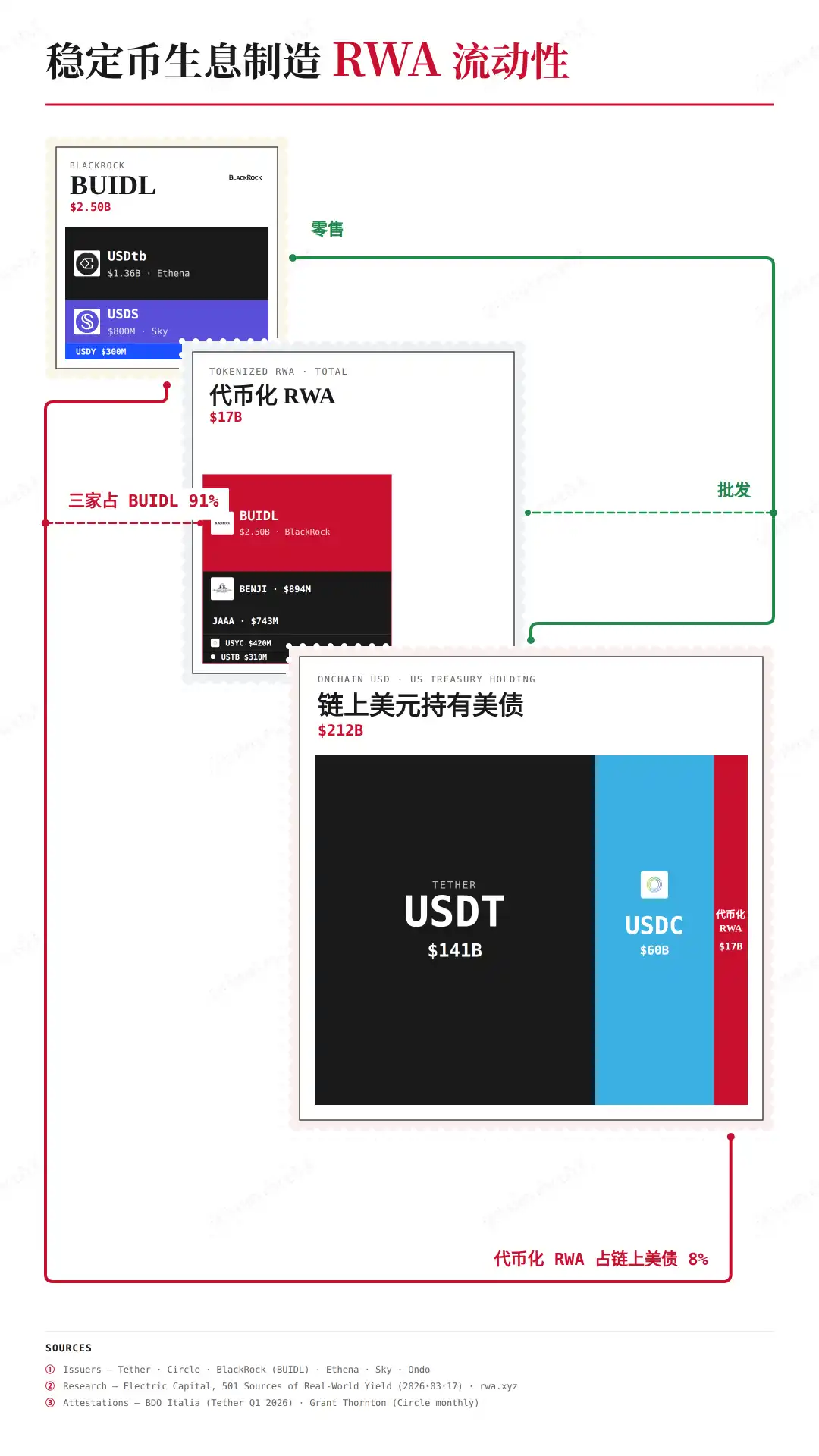
Caption: TMMF Supporting Payment Stablecoins

Data Source: @ElectricCapital

BlackRock's tokenized products, while circulating on-chain, cannot be purchased "permissionlessly" and still require compliance with KYC, accredited investor checks, etc., essentially targeting B2B sales.

You cannot monitor decentralized individual transactions, just as the US government cannot monitor the circulation of physical dollar cash. However, monitoring a few giants is much simpler.

By recognizing tokenized assets, the US cleverly constructs a feasible framework among stablecoin issuers, Wall Street giants, and regulators. The stablecoins users receive can only be used for payment because they cannot generate yield.

A single Genius Act binds stablecoins and tokenization together. This also answers the earlier confusion: it makes stablecoins the retail endpoint layer for US Treasuries.

The previous dollar relied on the commercial banking credit mechanism; the future dollar will rely on the intermediary role of tokenization companies.

Arbitrage Space, Yield-Bearing Stablecoins

Caring for worldly things more than God.

If the Genius Act's recognition of tokenization created payment stablecoins, then the Clarity Act's restrictions on tokenization guide the development of yield-bearing stablecoins.

The importance of yield-bearing lies not in the banking sector's fear of deposit outflows—JPMorgan has difficulty opening accounts, Coinbase has difficulty making money.

Consider this: Under the Clarity Act, if users choose to stake for yield, ideally, the stablecoin issuer's interest can only come from US Treasury products.

But this raises new questions. Issuers of on-chain stablecoins like Sky/Ethena, in a sense, don't need an OCC bank license first. Therefore, new arrangements are needed for yield, especially DeFi yield.

Excessive regulatory costs are the essential reason for Congress's "lenient" arrangements for DeFi development. Beyond that, the dollar needs stablecoins as a distribution channel.
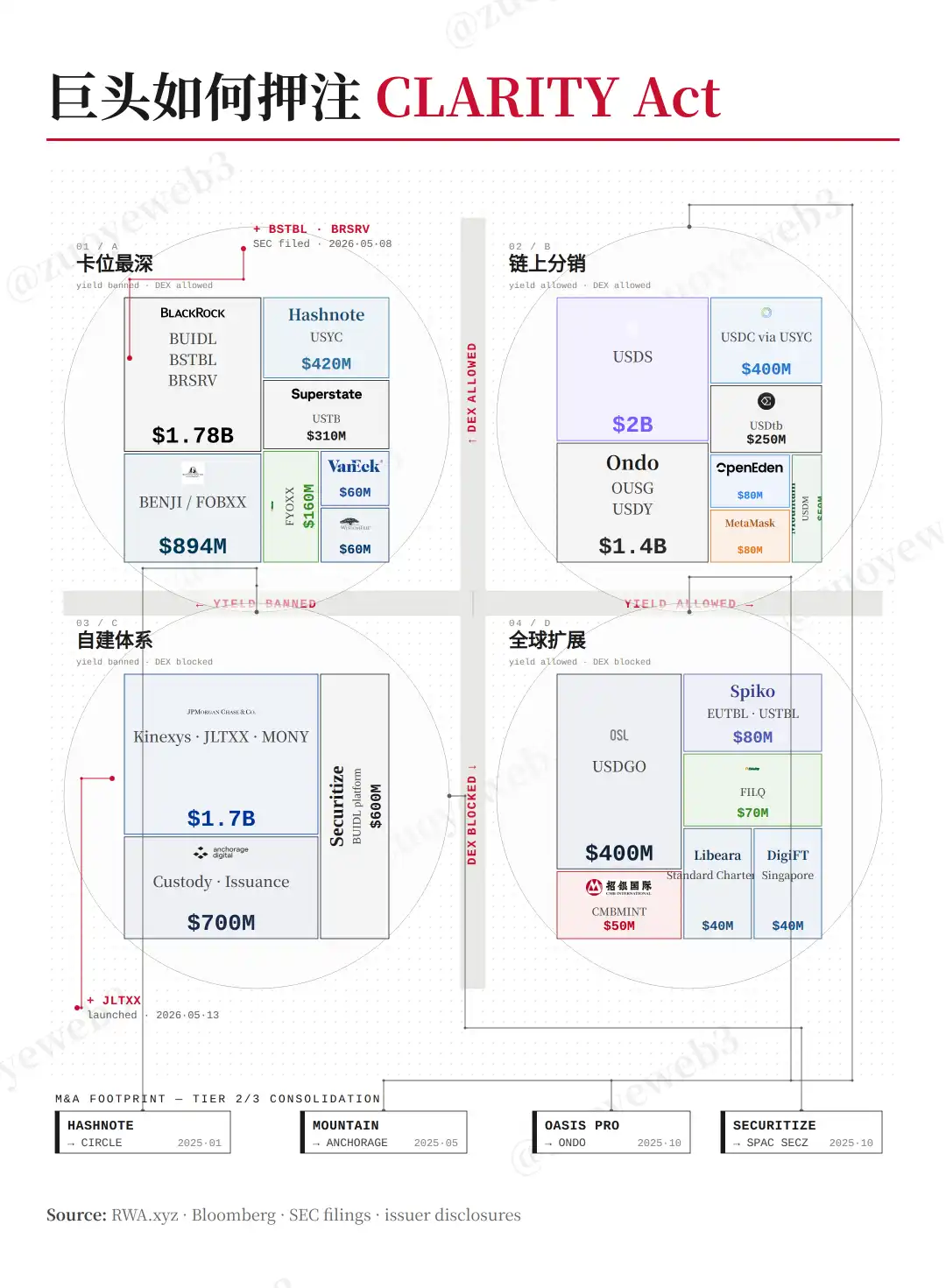
Caption: Giants Rushing into the Clarity Act

Image Source: @zuoyeweb3

This distribution is divided into two major categories: first, the B2B customer acquisition path among giants; second, on-chain and cross-regional C2C arbitrage issuance.

Among giants, the bet is on the strictness of the "ban on passive yield," which also changes the intermediary role. If DeFi is also restricted, consortium chain models may revive; if relatively relaxed, deeper cooperation with on-chain stablecoins is possible.

Furthermore, the giants' intermediary model is hard to bypass. Ondo and others choose to serve as the retail distribution layer for giants, while OSL and others choose the overseas compliant dollar stablecoin track.

Extending further, Sky's inclusion of diversified "RWAs" in USDS reserves is essentially leveraged arbitrage, quietly switching from full reserves to fractional reserves.

A mainstream demand emerging next: How to increase stablecoin yields based on US Treasuries? This requires more complex financial engineering designs, which is where various DeFi yield strategies come into play.

It can be seen that the yield mechanism targets offshore dollar stablecoins like $USDT, aiming to replace their position as Treasury buyers with BlackRock's TMMFs.

For on-chain dollars and compliant offshore dollars, new arbitrage spaces will emerge. They cannot stably earn scaled US Treasury yields and must continuously promote utilization growth, indirectly promoting dollar circulation and stable Treasury purchases.

In this process of tightening and loosening, users will be incentivized to use stablecoins because holding them leads to devaluation. The interest generated from usage flows back into the US financial system because the underlying asset is US Treasuries.

This is the true purpose of the Clarity Act: to create individual demand for the dollar on a global scale. Stablecoin issuance requires US Treasuries, stablecoin yield requires US Treasuries, ultimately completing the cycle.

Conclusion

To transcend the limitations of sovereign states, one must rely on rigid demand like payment.

But to promote the adoption of stablecoins, one must rely on direct mechanisms like yield.

The focus of both the Genius Act and the Clarity Act lies in the intertwining of stablecoins and yield. Because DeFi and cross-regional arbitrage cannot be fully controlled, Wall Street is needed as an intermediary to manage yields. This also gives us reassurance: Regardless of whether the Clarity Act passes on schedule, arbitrage mechanisms never sleep.


Domande pertinenti

QWhat is the main purpose of the 'Clarity Act' and the 'Genius Act' as discussed in the article regarding stablecoins?

AThe main purpose of these acts, particularly the 'Clarity Act', is to regulate stablecoins by separating their payment function from interest-bearing capabilities. This is designed to make U.S. dollar stablecoins a retail layer for U.S. Treasuries, creating a global demand loop where stablecoin issuance and usage ultimately cycle back to support the U.S. financial system and Treasury purchases.

QAccording to the article, how do Wall Street giants like BlackRock and JPMorgan Chase fit into the new regulatory framework for stablecoins?

AWall Street giants are positioning themselves as intermediaries by launching tokenized money market funds (TMMFs), like BlackRock's BSTBL/BRSRV and JPMorgan's JLTXX. These TMMFs serve as compliant, KYC-gated reserve assets for stablecoin issuers, replacing their direct purchases of U.S. Treasuries. This creates a controlled B2B market structure that aligns with the regulatory goals of the 'Genius Act'.

QWhat is the significance of prohibiting passive yield on payment stablecoins under the 'Clarity Act'?

AProhibiting passive yield on payment stablecoins aims to force users to spend or utilize the stablecoins for transactions rather than holding them as savings. Any interest generated must come from underlying U.S. Treasury products, channeling profits back to the U.S. financial system. This policy targets offshore stablecoins like USDT, aiming to replace their role as Treasury buyers with compliant products like Wall Street's TMMFs.

QWhat new arbitrage opportunities might emerge for on-chain and offshore compliant dollar stablecoins under the proposed regulations?

ANew arbitrage opportunities will arise as these stablecoins cannot earn scalable yields from U.S. Treasuries directly. To remain competitive, they must innovate by increasing their utilization rates and developing complex financial engineering strategies within DeFi to generate higher returns. This indirectly promotes greater dollar circulation and stable demand for U.S. Treasuries.

QHow does the article view the role of DeFi in relation to the upcoming 'Clarity Act' regulations?

AThe article suggests that due to high regulatory costs, Congress may provide a relatively 'lenient' arrangement for DeFi development. DeFi's role will be crucial in designing complex yield strategies that go beyond simple U.S. Treasury backing, helping compliant stablecoins generate competitive returns. However, if regulations strictly limit DeFi's passive yield mechanisms, it could lead to a revival of consortium chain models as an alternative.

Letture associate

Who Funds the Agents?

**Summary: Who Funds AI Agents?** OpenAI recently shut down a feature allowing AI agents to shop for users, highlighting the challenge of creating a secure and regulated environment for agent-driven transactions. While payment infrastructure exists, a crucial governance layer—defining spending limits, fraud detection, tax handling, and return policies—is largely missing. The potential is enormous: AI agents already processed $73M across 176M transactions last year, with McKinsey forecasting this could grow to $3-5T in global consumer commerce by 2030. The core competition isn't just about processing payments, which can be very cheap (especially with crypto-based settlement), but about controlling the rules that govern agent spending. Key players like Stripe and Coinbase are racing to dominate this governance layer. Stripe's acquisition of wallet provider Privy allows it to set spending policies, identity checks, and human-in-the-loop approvals directly at the wallet level. Similarly, Coinbase's stack, including its x402 protocol and AgentKit, embeds governance rules. This vertical integration across settlement, wallet, and governance layers is becoming the dominant strategy. Control over the governance layer is where significant future value lies. If agents handle trillions in transactions, even a small fee for managing compliance, fraud prevention, and policy enforcement could generate billions in annual revenue. The companies that successfully integrate across the payment stack will capture value from idle agent balances, transaction fees, and governance services, positioning themselves as the foundational banks of the AI agent economy.

marsbit8 min fa

Who Funds the Agents?

marsbit8 min fa

A Nation Blocks Chips, a Giant Buys a Nuclear Power Plant: Why It's Time to Seriously Consider DeAI

**Title: Great Powers Blockade Chips, Giants Buy Nuclear Plants: Why It's Time to Seriously Consider DeAI** In May 2026, the US closed loopholes for Chinese firms to acquire advanced NVIDIA chips via overseas subsidiaries. That same month, Kenya halted a $1B geothermal data center project involving Microsoft, fearing its immense energy consumption. Meanwhile, Huawei announced mass production of its Ascend AI chip. These disparate events underscore a new reality: the competition for computing power ("compute") has escalated beyond the tech industry, becoming a geopolitical and infrastructural battleground. A new era of oligopoly is forming, with control over the AI stack—from GPU chips (NVIDIA) and cloud platforms (AWS, Azure, Google Cloud) to foundational models (OpenAI, Anthropic)—concentrating in a few Western "AI Octopus" corporations. This centralization creates systemic risks: pricing power and platform lock-in for users, infrastructure fragility, and a widening "compute divide" that threatens to marginalize nations without independent AI capacity. An "AI Iron Curtain" is deepening through export controls. In response, some nations like Saudi Arabia and the UAE are investing heavily to buy compute power, aiming to transition from oil to AI economies. The EU seeks to triple its compute capacity by 2030 to reduce dependency. However, the spending gap is vast, with four US tech giants alone planning ~$750B in AI capex for 2026. The race is increasingly constrained by energy, with AI tasks consuming up to 1000x more power than web searches, pushing firms to even acquire nuclear plants. This landscape is fueling interest in Decentralized AI (DeAI). It proposes a third way: using open protocols to coordinate a global network of idle GPUs, independent developers, and data centers, creating an AI infrastructure without a single controlling entity. Leveraging blockchain and cryptographic verification, DeAI aims to break market concentration, disperse energy demands, reduce geopolitical dependencies, and enhance transparency. While still nascent in performance and stability, DeAI's core promise is not immediate superiority but providing a crucial alternative architecture to resist monopoly, censorship, and centralized power. As specialized AI hardware costs fall and open-source models flourish, the window to build this foundation is open. The very existence of such competition serves as a vital check against the inevitable abuse of concentrated power.

marsbit1 h fa

A Nation Blocks Chips, a Giant Buys a Nuclear Power Plant: Why It's Time to Seriously Consider DeAI

marsbit1 h fa

Outpoll Review: A Prediction Market Platform Built for Active Traders

Outpoll Review: A Prediction Market Platform Built for Active Traders In recent years, prediction markets have grown from a niche sector to a mainstream arena, attracting billions in trading volume and institutional capital. However, the user experience and tools for traders have not kept pace. Outpoll, a new global prediction market platform, aims to fill this gap by providing enhanced trading infrastructure for active and professional traders. Built on standard prediction market principles, Outpoll allows users to trade on the outcome of specific events. It uses fully collateralized contracts with USDC settlement, charges a competitive 0.1% fee per trade, and provides clear settlement rules upfront to minimize disputes. A key focus for Outpoll is its professional-grade trading tools. The platform supports limit and market orders, as well as take-profit and stop-loss orders for open positions—features uncommon in prediction markets. For automated trading, Outpoll offers comprehensive REST and WebSocket APIs, enabling portfolio management, price arbitrage, and integration with existing tools. The platform also features a creator-led market model, where approved experts and community leaders can create and manage markets for niche topics under platform supervision. Its integrated interface combines news feeds directly with trading functions, allowing users to monitor events and manage positions seamlessly. Outpoll launched with a native Android app (available on Google Play) and plans an iOS version later this year. In summary, Outpoll distinguishes itself with trader-focused tools, practical APIs, transparent and collateralized markets, integrated news, and an expanding creator program. For active traders, its advanced order types and API access alone make it a platform worth watching. Outpoll is now globally accessible via outpoll.com and Google Play.

marsbit1 h fa

Outpoll Review: A Prediction Market Platform Built for Active Traders

marsbit1 h fa

Trading

Spot
Futures
活动图片




