Circle's Pullback: Still Worth Buying?

marsbitPubblicato 2026-04-04Pubblicato ultima volta 2026-04-04

Introduzione

Circle: Still Worth Buying After the Pullback? Circle, the issuer of the second-largest stablecoin USDC, is at a critical juncture. Its current valuation of $15-20B primarily reflects its interest income from $770B in USDC reserves. However, data suggests a potential transformation into a fee-based digital dollar infrastructure network. Key evidence for this shift includes: * USDC's on-chain transaction volume grew 247% in FY2025, far outpacing its 72% circulation growth, indicating it's being *used* more, not just held. * Adjusted for on-chain noise, USDC dominates real economic settlement volume (64% per Visa data), despite USDT having 2.4x its market cap. Circle's three-layer revenue structure is evolving: 1. **Interest Income (95% of current revenue):** Tied to USDC circulation and interest rates. Faces headwinds from potential Fed cuts and a revenue-sharing agreement with Coinbase. 2. **Payment & Transaction Fees:** The key to becoming an infrastructure play. The Circle Payments Network (CPN) is scaling rapidly ($5.7B annualized TPV), and non-interest revenue surged to $37M/quarter. 3. **Settlement Platform (Arc):** A long-term bet on becoming an institutional settlement standard, though its value remains unproven. Near-term catalysts include the Coinbase revenue-sharing agreement renewal (Aug 2026) and potential full OCC bank charter approval. A 3-5x return is plausible if USDC circulation grows at 40% CAGR. A 10x return requires multiple successes: CPN scal...

Author: Leo Z

I. What is Circle

Circle is the issuer of USDC. USDC is the world's second-largest stablecoin, with a circulation of approximately $770 billion. Each USDC is backed by an equivalent amount of US dollar assets (primarily short-term US Treasury bonds) as reserves.

Circle's revenue source is simple: it invests these reserves in US Treasury bonds to earn an interest spread. FY2025 total revenue was $2.75 billion, with 95% coming from reserve interest. It went public in June 2025, with a current market capitalization of approximately $150-200 billion.

The market's pricing of Circle is essentially equal to "USDC circulation × interest rate × a conservative multiple." This means: if you believe Circle is merely a company that earns interest, the current pricing is roughly fair. If you believe it is transforming into a fee-based digital dollar infrastructure network, then the current price does not reflect this value at all.

This article aims to answer: Is this transformation happening? How much evidence is there? What is it worth?

II. Core Question: Is USDC Being "Held" or "Used"?

Before discussing valuation, answer a question more important than any financial model.

For the same $770 billion USDC, if it is just held by institutions to earn interest spread, then Circle is an interest rate-sensitive financial company, valued at 10-15x. If it is being frequently used for payments, settlements, cross-border transfers, and developer calls, then Circle is growing into a fee-based infrastructure network, valued at 25-30x.

Two key data points can help you judge:

First, the growth rate of USDC's on-chain transaction volume far exceeds its circulation growth rate. In FY2025, USDC circulation grew by 72%, but on-chain transaction volume grew by 247%. This means each USDC dollar is being used more frequently. This is not "the stock is getting larger," but "the flow velocity is increasing."

Second, USDC has surpassed USDT to become the largest settlement asset. Visa Onchain Analytics filters out approximately 85% of on-chain noise (bots, internal exchange transfers, high-frequency arbitrage). After this adjustment, USDC accounts for 64% of real economic settlement volume (Mizuho, February 2026), while USDT accounts for only about 28%—even though USDT's circulation is 2.4 times that of USDC.

This gap itself is the strongest signal: USDC is transitioning from an "asset people hold" to a "network people use." But this transition is not yet complete—later we will discuss the conditions needed for it to be confirmed.

III. Three-Tier Revenue Structure

Circle's revenue is divided into three tiers. The market is almost only pricing the first tier.

Tier 1: USDC Interest Income—How Circle Makes Money Today

USDC is Circle's starting point and the source of 95% of its current revenue. As of the end of 2025, USDC circulation was $753 billion, a year-on-year increase of 72%, far exceeding Circle's own annualized growth target of 40%.

The revenue logic is simple: approximately 80% of USDC reserves are invested in short-term US Treasury bonds (via the BlackRock-managed USDXX fund), earning an interest spread.

Interest Income ≈ Average USDC Circulation × Reserve Yield

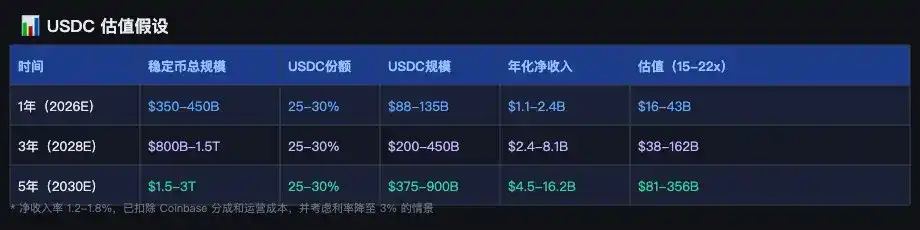
The reserve yield in Q4 2025 was 3.81%, down 68 basis points from the previous quarter. This exposes the core contradiction: circulation is growing rapidly, but interest rates are falling, and the two are offsetting each other. If the Fed's target rate drops to 3%, Circle would need USDC to grow to over $1.5 trillion to maintain its current income level.

Structural issue: Coinbase takes most of the revenue. According to the revenue-sharing agreement signed in 2023, 100% of the interest on USDC on the Coinbase platform goes to Coinbase, and Coinbase takes 50% of the interest off-platform. In FY2025, for every $1 of interest Circle earned, about 60 cents was given to distribution partners.

The good news is that margins are improving. The RLDC (Revenue Less Distribution Costs) margin expanded from 30.0% in Q4 2024 to 40.1% in Q4 2025. The net income rate is 1.2-1.8%, after deducting Coinbase's share and operating costs.
Tier 2: Payment & Transaction Revenue—The New Business in Development

This is the key to determining whether Circle can shed the "interest rate company" label.

CPN (Circle Payments Network) launched in May 2025, providing banks, payment companies, and enterprises with 24/7 cross-border settlement based on USDC. As of February 2026, the annualized TPV reached $5.7 billion, growing about 100-fold since launch. 55 institutions are connected, 74 are under review, and 500+ are in the pipeline. It covers 14 markets including Brazil, Canada, Hong Kong, India, Mexico, Nigeria, and the US.

But $5.7 billion compared to the global cross-border payment market of $160 trillion is still less than 0.04%. The value of CPN lies not in its current scale but in whether its growth can be sustained. If it captures 1% of the cross-border market, that would be $1.6 trillion in annualized transaction volume—the fees generated could approach or even exceed interest income and are not affected by interest rates.

CCTP (Cross-Chain Transfer Protocol) enables native cross-chain transfer of USDC through "burn-mint." It processed $41.3 billion in Q4 2025, a year-on-year increase of 3.7 times. USDC's cross-chain market share rose from 25% at the end of 2024 to 62% in January 2026, covering 30 chains. CCTP V2 introduced Fast Transfer fees—a new revenue source.

Other Revenue (non-interest income) is the most direct "evidence of transformation." In FY2025, it surged from $3 million per quarter to $37 million per quarter, including $24.7 million from subscription services, $12.2 million from transaction revenue, and $7 million from Canton Network validator node revenue. Management guidance for 2026 is $150-170 million.

This revenue is not affected by interest rates and does not require sharing with Coinbase. When it exceeds 10% of total revenue, the market may start to view Circle with a different valuation method. Currently, it is about 4%.

Tier 3: Settlement Platform—Long-Term Possibility

Arc is an institutional-grade settlement chain planned by Circle to launch its mainnet in 2026, with USDC as the native gas token. The testnet has already processed over 166 million transactions, with a confirmation time of 0.5 seconds, and 100+ institutions participating (including Goldman Sachs and Mastercard).

Arc's roadmap is divided into four phases:

M1 Public Testnet (completed) → M2 Real Funds On-Chain (2026) → M3 Margin/Collateral/Settlement Scenarios Live (2027-28) → M4 Integrated into Institutional Standard Operating Procedures (2029-30)

Before M2, Arc's value is zero. But if it eventually becomes the institutional settlement standard, Circle's value will no longer be that of a "fee company" but a "platform company." This is a necessary condition for 10x+ returns.

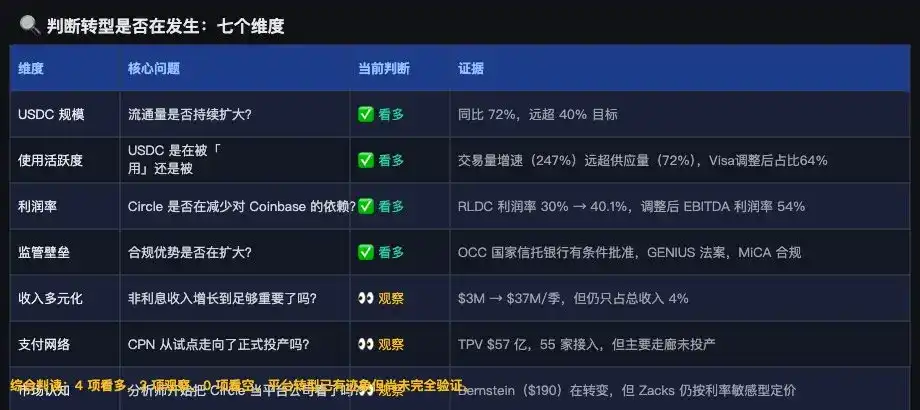
IV. Judging Whether the Transformation Is Happening: Seven Dimensions

Looking at any single indicator can be misleading. The key is to see if multiple dimensions are improving simultaneously—when scale, activity, margins, new revenue, and user growth all point in the same direction, the transformation is happening.
V. Three Most Important Tracking Metrics

1 USDC Circulation (Check Daily)

The base of Circle's income. Circulation × Reserve Yield = Interest Income. Track "Quarterly Average Circulation" rather than the end-of-period snapshot. Currently about $770 billion.

Data Sources: defillama.com/stablecoin/usd-coin (updated daily), circle.com/transparency (weekly reserve attestation)

2 USDC's Share of Visa-Adjusted Transaction Volume (Check Weekly)

Answers the core question: Is USDC being used or held? Supply is only 25%, but adjusted transaction volume is 64%—each USDC dollar does 2-3 times more work than a USDT dollar.

Data Source: visaonchainanalytics.com → Filter by Stablecoin → Click "Show % of Total" → Read the USDC line

3 Other Revenue, Non-Interest Income (Check Quarterly)

The only indicator that directly proves Circle is making money beyond interest. Not affected by interest rates, no sharing with Coinbase. Currently $37 million/quarter, guidance $150-170 million (2026). Valuation methods will change when it breaks through 10% of total revenue.

Data Sources: circle.com/pressroom (quarterly earnings reports), SEC EDGAR search for Circle Internet Group

VI. Near-Term Catalysts

Coinbase Revenue-Sharing Agreement Expiration (August 2026)

This is the single biggest catalyst within 24 months. Currently, Circle gives about 60% of its revenue to distribution partners. If renegotiation raises the RLDC margin from 40% to 50-55%, the effect would be equivalent to an instant 25-35% increase in profit. But Coinbase has little incentive to concede significantly—USDC distribution on the Coinbase platform remains Circle's biggest growth engine. The outcome is uncertain, but the direction is likely better than the status quo.

OCC National Trust Bank Charter

Conditionally approved in December 2025. Full approval would mean:可以直接在美联储开主账户 (earn IORB rate, eliminate counterparty risk), bypass commercial banks to handle the annual $483 billion mint/redemption flow, and build an insurmountable trust barrier for corporate and government adoption of USDC. No other stablecoin issuer has this.

x402 Foundation (Established April 2026)

Coinbase contributed the x402 payment protocol to the Linux Foundation. x402 activates the HTTP 402 status code as an internet-native payment layer, enabling AI agents, APIs, and applications to settle directly within HTTP interactions—using USDC by default.

Participants: Google, AWS, Stripe, Visa, Mastercard, Amex, Shopify, Microsoft, Cloudflare, Circle. If x402 becomes the standard for AI agent payments, every machine-to-machine microtransaction would increase USDC's usage (velocity) without needing to increase holdings (supply).

Note: x402 is led by Coinbase, not Circle. Impact on CRCL: mildly bullish, expands USDC's use cases but does not change the magnitude of the fundamentals.

VII. Conditions for 5-10x Returns

3-5x (High Confidence)—Purely from USDC Growth

USDC at a 40% CAGR reaches approximately $2-3 trillion by 2028. Even if rates drop to 3%, $2.5T × 1.5% net spread = $37.5 billion net income. At 20x, market cap is $750 billion. From the current $150-200 billion to $750 billion is about 4x. Requires no contribution from CPN or Arc.

10x (Requires Multiple Conditions to Materialize Simultaneously)

From $15-20B to $150-200B, must happen simultaneously:

1. CPN TPV breaks through $100 billion in 2-3 years, with at least one major corridor entering full production.

2. Coinbase revenue-sharing agreement improves, RLDC margin reaches 50%+.

3. Other Revenue exceeds 10% of total revenue, proving scalable non-interest income.

4. Arc reaches at least the M2 stage (real funds on-chain), starts being priced by the market.

Currently, only the second condition (margin) is clearly improving. A 10x return is a position you "earn," not one you "gamble" on.

VIII. Main Risks

Interest Rates Fall Faster Than USDC Grows

Q4 2025 already showed this signal: rates fell 68bps, partially offsetting 100% circulation growth. If the Fed drops to 2.5-3% in 2026-2027, there could be a window of 1-2 quarters of earnings below expectations.

Tether's Compliance

USDC's biggest differentiating advantage is compliance. But Tether earned $10 billion in the first three quarters of 2025 and is in talks with the Big Four accounting firms for a full audit. If Tether gains compliant status within 2-3 years, USDC's differentiated advantage could be significantly weakened. USDT currently has over 60% market share and a market cap of $1.83 trillion—it has ample resources.

Competition from New Yield-Bearing Stablecoins & Payment Giants Like Stripe

Ethena (USDe), Sky, and other new stablecoins are grabbing market share by paying yields directly to holders. Circle, bound by its regulatory compliance position, currently cannot pay interest directly to USDC holders.

Stripe is a founding member of the x402 Foundation and is also building its own stablecoin payment system. Stripe's strategy is to integrate all potential winning standards—its involvement does not represent exclusive support for USDC, nor does it preclude Stripe from launching its own stablecoin or deeply integrating USDT in the future.

IX. Conclusion

Circle is not a company that "will definitely become a trillion-dollar" company. But it might be one of the few fintech companies today that has the structural conditions to potentially reach that ceiling.
Current pricing almost only reflects USDC interest income. The market is asking: Is Circle an interest rate-driven financial company, or a fee-based digital dollar infrastructure? The answer is not yet certain—but the data is leaning towards the latter.

The core things to track are three: Is USDC circulation growing? Is each USDC dollar being used more frequently? Is non-interest income increasing? When all three improve simultaneously, the transformation is happening.

Data Sources: Circle IR, SEC EDGAR, DefiLlama, Visa Onchain Analytics, Artemis Terminal, CoinDesk, Mizuho Research

Disclaimer: This article does not constitute investment advice. All data is as of April 2026.

Domande pertinenti

QWhat is the core business model of Circle and its primary source of revenue?

ACircle is the issuer of USDC, the world's second-largest stablecoin. Its core business model involves investing the dollar-denominated reserves backing USDC (primarily in short-term U.S. Treasuries) and earning the interest spread. For FY2025, approximately 95% of its total revenue of $2.75 billion came from this reserve interest income.

QWhat are the two key data points that suggest USDC is transitioning from an asset being 'held' to being 'used'?

AThe two key data points are: 1) USDC's on-chain transaction volume grew 247% in FY2025, significantly outpacing its 72% circulation growth, indicating each dollar is being used more frequently. 2) Adjusted data from Visa Onchain Analytics shows USDC accounts for 64% of real economic settlement volume, despite having a circulation only about 40% the size of USDT's, demonstrating it is the dominant asset for actual economic activity.

QWhat are the three layers of Circle's revenue structure as described in the article?

ACircle's three-layer revenue structure consists of: 1) USDC Interest Income: The primary current revenue from reserve investments. 2) Payment & Transaction Revenue: Income from new services like the Circle Payments Network (CPN) and the Cross-Chain Transfer Protocol (CCTP). 3) Settlement Platform: The potential long-term revenue from Arc, an institutional-grade settlement chain with USDC as its native gas token, which is not yet operational with real funds.

QWhat is identified as the single biggest catalyst for Circle within the next 24 months?

AThe expiration of the revenue-sharing agreement with Coinbase in August 2026 is identified as the single biggest catalyst. Currently, Circle shares approximately 60% of its interest revenue with partners like Coinbase. A renegotiation that improves Circle's Revenue Less Distribution Costs (RLDC) margin could significantly boost its profitability.

QAccording to the article, what conditions are necessary for Circle to achieve a potential 10x return on investment?

AA 10x return requires multiple conditions to be met simultaneously: 1) Circle Payments Network (CPN) TPV exceeding $100 billion within 2-3 years. 2) An improved Coinbase revenue-sharing agreement, raising RLDC margins to 50%+. 3) Non-interest revenue ('Other Revenue') exceeding 10% of total revenue. 4) The Arc settlement platform progressing to at least its M2 stage (real funds on-chain), allowing the market to begin pricing in its value.

Letture associate

First Batch of Keynote Speakers and Partners Announced! Web2+3 Summit: Defining the Next Generation of Digital Economy

Web2+3 Summit: Defining the Next Generation of Digital Economy The 6th BEYOND International Technology Innovation Expo (BEYOND Expo 2026), Asia's largest tech and ecosystem exhibition, is launching a dedicated Web2+3 stage for the first time. Co-hosted by BEYOND Expo and ChainNeXT Group, the Web3 Summit will take place from May 28–30, 2026. Against the backdrop of accelerating global tech integration, the boundaries between Web2 and Web3 are rapidly blurring. With clearer global regulations for blockchain-driven internet (Web3) and the special issuance of a Hong Kong dollar stable币 license by the Hong Kong SAR government on April 10, 2026, Web3's decentralized principles are quickly merging with traditional industries (Web2) such as e-commerce, finance, and artificial intelligence. Focused on blockchain-driven digital economy elements, the summit will center on three core principles—implementability, commercial viability, and compliance. It will bring together top Web3 experts to discuss key integration areas like stablecoin payment finance (PayFi), real-world asset tokenization (RWA), and decentralized AI (DeAI), unveiling new opportunities for industrial innovation. The first wave of confirmed speakers includes Jack Kong (Director of Hong Kong Cyberport, Chairman of Nano Labs), Yat Siu (Chairman of Animoca Brands), Michael Wu (Co-founder & CEO of Amber Group), Michael Heinrich (Co-founder & CEO of 0G), and Art Abal (Co-founder of Vana). More Web3 ecosystem pioneers, AI, and fintech experts will be announced soon. Core forum topics include: - Web2+DeAI: New AI Paradigms Driven by Decentralized Infrastructure - Web2+RWA: Real-World Asset Tokenization and Global Liquidity - Web2+PayFi: Cross-Border Payments and Financial Innovation Powered by Crypto Infrastructure - Web2+3 AI: Autonomous Agents and the Crypto Economy - Web2+3 Wealth: On-Chain and Off-Chain Integrated Investment Ecosystems - Web2+3 Commerce: A New Landscape for Global Trade Driven by Stablecoins Additional agenda details will be released in the near future.

marsbit1 h fa

First Batch of Keynote Speakers and Partners Announced! Web2+3 Summit: Defining the Next Generation of Digital Economy

marsbit1 h fa

Trading

Spot
Futures

Articoli Popolari

Cosa è USDC(WORMHOLE)

USD Coin (Wormhole): Una panoramica completa Introduzione Nel mondo in rapida evoluzione delle criptovalute, USD Coin (Wormhole), noto come $USDC(Wormhole), si distingue come una soluzione pionieristica all'interno del panorama DeFi (Finanza Decentralizzata). Operando su diverse piattaforme blockchain, tra cui Solana, USD Coin (Wormhole) è più di una semplice rappresentazione digitale del dollaro statunitense. Incarna lo spirito innovativo della finanza moderna, consentendo transazioni senza attriti tra diverse blockchain e migliorando l'interoperabilità tra i vari ecosistemi blockchain attraverso il protocollo avanzato Wormhole. Cos'è USD Coin (Wormhole)? USD Coin (Wormhole) è una versione tokenizzata del dollaro USA progettata per facilitare transazioni senza attriti attraverso diverse reti blockchain. Il suo obiettivo principale è quello di aumentare la liquidità e migliorare la funzionalità dell'ecosistema DeFi. Sfruttando il protocollo Wormhole, che stabilisce una robusta rete di comunicazione cross-chain, gli utenti possono trasferire senza sforzo i token USDC su varie piattaforme. Questa capacità cross-chain segna un avanzamento significativo nell'uso delle criptovalute, promuovendo un ecosistema più interconnesso ed efficiente in cui gli asset possono fluire liberamente tra diverse blockchain. La proposta di valore di USD Coin (Wormhole) risiede non solo nella sua stabilità, essendo ancorata al dollaro USA, ma anche nella sua capacità di colmare le lacune tra ambienti blockchain disparati. Questo approccio innovativo favorisce un maggior livello di partecipazione tra utenti e sviluppatori, aprendo la strada a nuove ed entusiasmanti applicazioni nella finanza decentralizzata. Chi è il creatore di USD Coin (Wormhole)? Le origini di USD Coin (Wormhole) sono intrecciate con la rete Wormhole, sviluppata da Jump Crypto. Sebbene i creatori individuali specifici non siano documentati in modo prominente, Jump Crypto è nota per il suo coinvolgimento nel progresso della tecnologia blockchain e nel supporto delle sue applicazioni in ambito finanziario. Creando la rete Wormhole, Jump Crypto ha svolto un ruolo fondamentale nella promozione dei trasferimenti di asset cross-chain, aumentando l'efficienza e la diversità dell'uso delle criptovalute. Chi sono gli investitori di USD Coin (Wormhole)? Il successo di USD Coin (Wormhole) è sostenuto da investimenti di diversi fondi e organizzazioni note all'interno del settore delle criptovalute. Gli investitori chiave includono: Coinbase Ventures: Un'importante divisione di venture capital sostenuta da uno dei principali scambi di criptovalute del settore, Coinbase Ventures fornisce capitale essenziale e supporto strategico a promettenti progetti blockchain. Arrington XRP Capital: Specializzata in asset digitali, Arrington XRP Capital riconosce il potenziale di progetti innovativi come USD Coin (Wormhole) e ha investito di conseguenza per sostenere il suo sviluppo. Jump Trading: Come organizzazione madre di Jump Crypto, Jump Trading porta non solo investimenti ma anche una ricchezza di esperienza nella tecnologia di trading e nella dinamica di mercato per rafforzare il progetto Wormhole. Come funziona USD Coin (Wormhole)? Il framework operativo di USD Coin (Wormhole) è progettato per facilitare transazioni cross-chain efficaci, massimizzando sicurezza ed efficienza. Ecco una panoramica semplificata di come funziona: Blocco degli asset: Quando un utente desidera trasferire USDC da una blockchain all'altra, prima blocca i propri token sulla blockchain di origine. Questo processo assicura che gli asset siano sicuri e siano pronti per essere bruciati o trasferiti successivamente. Creazione di token: Dopo che i token sono stati bloccati, viene coniato un equivalente di USDC sulla blockchain di destinazione. Ciò fornisce all'utente accesso ai propri fondi su una nuova piattaforma, riflettendo la flessibilità che il protocollo Wormhole consente. Trasferimento cross-chain: Il protocollo Wormhole facilita in modo efficiente l'intero processo di trasferimento. Assicura che una volta che l'USDC è coniato sulla catena di destinazione, i token equivalenti vengano bruciati sulla catena di origine. Il risultato è un trasferimento senza soluzione di continuità di valore tra due ambienti blockchain distinti. Questa metodologia cross-chain assicura che le transazioni rimangano sicure e trasparenti, migliorando significativamente la liquidità all'interno dei diversi ecosistemi DeFi. Cronologia di USD Coin (Wormhole) Comprendere l'evoluzione di USD Coin (Wormhole) fornisce un contesto vitale per la sua importanza nell'arena delle criptovalute. Ecco una cronologia che evidenzia importanti traguardi nella storia del progetto: 2021: Il progetto Wormhole viene lanciato, stabilendo un framework per i trasferimenti di asset cross-chain e preparando il terreno per lo sviluppo di USD Coin (Wormhole). 2022: La rete Wormhole affronta una significativa sfida con una violazione della sicurezza che porta a un furto di 325 milioni di dollari. Tuttavia, l'incidente viene successivamente affrontato e rimborsato da Jump Crypto, dimostrando l'impegno del progetto per la sicurezza e la trasparenza. 2023: USD Coin (Wormhole) si integra con il protocollo di trasferimento cross-chain di Circle (CCTP), migliorando le sue capacità per i trasferimenti cross-chain e consolidando ulteriormente la sua posizione all'interno dell'ecosistema DeFi. 2024: Continuano lo sviluppo e l'espansione della rete Wormhole, mirati ad aumentare l'utilità e la portata di USD Coin (Wormhole) e a migliorare il suo framework operativo. Caratteristiche principali Il successo di USD Coin (Wormhole) può essere attribuito a diverse caratteristiche chiave che lo differenziano da altre offerte di criptovalute: Interoperabilità cross-chain Al centro di USD Coin (Wormhole) c'è la sua capacità di facilitare trasferimenti senza soluzione di continuità attraverso più reti blockchain. Questa interoperabilità funge da pietra miliare per la finanza decentralizzata, consentendo a varie piattaforme di interagire tra loro, accelerando così l'evoluzione dei servizi finanziari. Sicurezza Wormhole impiega una rete Guardian ben progettata composta da validatori di nodi che garantiscono transazioni cross-chain sicure. Questo monitoraggio collettivo riduce al minimo il rischio di frodi e fornisce agli utenti la certezza che i loro asset siano protetti durante i trasferimenti cross-chain. Miglioramento della liquidità Consentendo a USDC di circolare liberamente tra diverse blockchain, USD Coin (Wormhole) aumenta la liquidità nell'ecosistema DeFi. Questa maggiore liquidità può favorire operazioni di trading più efficienti, contribuire a strategie di prezzo migliori e migliorare la dinamica generale del mercato che racchiude vari asset digitali. Conclusione USD Coin (Wormhole) rappresenta un'innovazione fondamentale nello spazio blockchain, rafforzando le capacità della finanza decentralizzata (DeFi) e stabilendo un ecosistema finanziario più connesso. Con il suo robusto framework per le transazioni cross-chain, le caratteristiche di sicurezza e un forte sostegno da parte di investitori di valore, USD Coin (Wormhole) è posizionato per giocare un ruolo chiave nel futuro delle criptovalute. Mentre il panorama della finanza digitale continua ad evolversi, USD Coin (Wormhole) non solo abbraccia il futuro dell'interconnessione tra le reti blockchain, ma riafferma anche il potere della tokenizzazione e della tecnologia blockchain nel trasformare il modo in cui percepiamo e utilizziamo il valore in un mondo digitale. Navigando nelle complessità della funzionalità cross-chain, dimostra un approccio sofisticato per abilitare l'inclusività finanziaria e l'innovazione nel mondo delle criptovalute.

142 Totale visualizzazioniPubblicato il 2024.04.03Aggiornato il 2024.12.03

Cosa è USDC(WORMHOLE)

Cosa è $USDC

Classic USDC: Una Panoramica Completa Introduzione a Classic USDC Nel panorama in rapida evoluzione del mercato delle criptovalute, le stablecoin sono emerse come componenti critici, in particolare nel fornire stabilità in mezzo alla volatilità che caratterizza gli asset digitali. Uno di questi progetti è Classic USDC, un'iniziativa di valuta digitale che mira a offrire un mezzo di scambio stabile e affidabile. Mantenendo un peg di 1:1 con il dollaro statunitense, Classic USDC si sforza di offrire agli utenti un asset digitale affidabile, attrezzato per varie applicazioni all'interno degli ecosistemi web3 e criptovalute. Cos'è Classic USDC? Classic USDC è fondamentalmente una stablecoin, un tipo di criptovaluta progettata per minimizzare la volatilità dei prezzi tipicamente vista nel mercato degli asset digitali. In particolare, Classic USDC aspira a rappresentare da vicino il valore del dollaro statunitense, assicurando che gli utenti possano sfruttare questa valuta digitale per transazioni, risparmi e altre attività finanziarie senza la paura di improvvisi cambiamenti di prezzo che altrimenti possono affliggere molte criptovalute. L'obiettivo principale di Classic USDC è fornire un equivalente digitale affidabile e degno di fiducia del dollaro statunitense, progettato per un'integrazione senza soluzione di continuità in una vasta gamma di applicazioni web3, piattaforme di finanza decentralizzata (DeFi) e altri sistemi finanziari correlati alle criptovalute. Offrendo una valuta digitale stabile, Classic USDC cerca di facilitare il commercio quotidiano, rendere la tecnologia blockchain più user-friendly e incoraggiare l'adozione delle criptovalute per un utilizzo generalizzato. Creatore di Classic USDC L'identità del creatore o del team di sviluppo dietro Classic USDC rimane per lo più sconosciuta, e la mancanza di trasparenza ha portato a un certo grado di incertezza riguardo alle origini del progetto. Mentre molte iniziative di criptovaluta mettono in mostra i loro fondatori e team di sviluppo, Classic USDC non fornisce informazioni chiare sui suoi creatori, il che pone delle sfide per potenziali utenti o investitori che valutano la credibilità e l'affidabilità del progetto. Investitori di Classic USDC A fianco dell'ambiguità riguardo ai suoi creatori, Classic USDC manca anche di specificità riguardo ai suoi investitori. Il sostegno finanziario di un progetto può spesso conferirgli credibilità e stabilizzare le sue operazioni; tuttavia, l'assenza di fondazioni o organizzazioni di investimento documentate a sostegno di Classic USDC solleva interrogativi sulla sua struttura di finanziamento. Questa mancanza di chiarezza potrebbe potenzialmente ostacolare la fiducia degli stakeholder nel progetto. Come Funziona Classic USDC? I meccanismi operativi di Classic USDC si basano fortemente sul suo sistema di riserve, fondamentale per le basi di qualsiasi stablecoin. Classic USDC si impegna a mantenere una riserva di attivi che corrispondono direttamente al valore della valuta digitale in circolazione. In particolare, per ogni token Classic USDC emesso, un equivalente di attivi di supporto è mantenuto in riserva, sia in contante che in equivalenti di contante. Questa strategia è progettata per sostenere il valore di Classic USDC, offrendo rassicurazione agli utenti che il riscatto dei loro token per dollari statunitensi è fattibile in qualsiasi momento. Questa struttura di riserva mira a migliorare la stabilità e l'affidabilità di Classic USDC, posizionandolo come un'alternativa sicura nel mercato delle criptovalute. Garantendo che il valore di Classic USDC sia costantemente correlato al dollaro statunitense, il progetto aspira a instillare fiducia tra gli utenti che potrebbero essere cauti nei confronti delle dinamiche di mercato più ampie. Cronologia di Classic USDC La storia di Classic USDC è segnata da diversi traguardi chiave che riflettono il suo viaggio e la sua evoluzione all'interno dell'ecosistema delle criptovalute: 2021: L'inizio di Classic USDC è notato, introducendo una nuova opzione di valuta digitale progettata per la stabilità. Durante quest'anno, sono emerse le prime registrazioni dell'attività del token e sono stati stabiliti i suoi livelli di prezzo iniziali. 2024: Classic USDC inizia a sperimentare significative fluttuazioni di prezzo, mentre il mercato delle criptovalute nel complesso si confronta con varie tendenze e sentiment degli utenti. Emergono previsioni riguardo al suo potenziale futuro, indicando un forte interesse da parte di osservatori di mercato e analisti che prevedono opportunità di crescita. Proiezioni Future Gli esperti speculano che Classic USDC potrebbe raggiungere livelli più elevati di adozione e stabilità negli anni a venire, con ulteriori sviluppi previsti intorno al 2025 e 2026. Tuttavia, queste proiezioni dovrebbero essere affrontate con ottimismo cauto, poiché il mercato delle criptovalute è intrinsecamente imprevedibile e vari fattori esterni potrebbero influenzare la traiettoria di Classic USDC. Punti Chiave su Classic USDC Stabilità: La proposta centrale di Classic USDC ruota attorno alla fornitura di una valuta digitale che paralleli il valore del dollaro statunitense, assicurando così stabilità in un mercato spesso volatile. Sistema di Riserva: L'impegno del progetto a mantenere una riserva di attivi per sostenere il suo valore sottolinea la sua affidabilità e solidità operativa. Integrazione Web3 e Crypto: Classic USDC è progettato per facilitare una facile integrazione all'interno di varie applicazioni, mirando a migliorare l'esperienza dell'utente e ampliare l'accettazione delle criptovalute nelle transazioni quotidiane. Potenziale di Crescita Futuro: Anche se è ancora emergente, Classic USDC detiene vie prospettiche per la crescita poiché la consapevolezza e l'utilizzo delle stablecoin aumenta nei contesti web3 e crypto. Conclusione Classic USDC si presenta come un'iniziativa di stablecoin notevole all'interno della sfera delle criptovalute, sforzandosi di fornire agli utenti una valuta digitale affidabile che incarna la stabilità del dollaro statunitense. Nonostante le incertezze riguardo ai suoi creatori e al sostegno finanziario, i principi fondamentali di Classic USDC—centrati su assicurazioni supportate da riserve—cercano di posizionarlo come un'opzione degna di fiducia per individui e aziende che navigano nell'economia digitale. Con uno sguardo verso il futuro, gli analisti di mercato sono ansiosi di osservare come Classic USDC evolve in risposta alle dinamiche in cambiamento del panorama delle criptovalute, potenzialmente affermandosi come un attore significativo nel regno delle stablecoin.

41 Totale visualizzazioniPubblicato il 2024.05.01Aggiornato il 2024.12.03

Cosa è $USDC

Come comprare USDC

Benvenuto in HTX.com! Abbiamo reso l'acquisto di USD Coin (USDC) semplice e conveniente. Segui la nostra guida passo passo per intraprendere il tuo viaggio nel mondo delle criptovalute.Step 1: Crea il tuo Account HTXUsa la tua email o numero di telefono per registrarti il tuo account gratuito su HTX. Vivi un'esperienza facile e sblocca tutte le funzionalità,Crea il mio accountStep 2: Vai in Acquista crypto e seleziona il tuo metodo di pagamentoCarta di credito/debito: utilizza la tua Visa o Mastercard per acquistare immediatamente USD CoinUSDC.Bilancio: Usa i fondi dal bilancio del tuo account HTX per fare trading senza problemi.Terze parti: abbiamo aggiunto metodi di pagamento molto utilizzati come Google Pay e Apple Pay per maggiore comodità.P2P: Fai trading direttamente con altri utenti HTX.Over-the-Counter (OTC): Offriamo servizi su misura e tassi di cambio competitivi per i trader.Step 3: Conserva USD Coin (USDC)Dopo aver acquistato USD Coin (USDC), conserva nel tuo account HTX. In alternativa, puoi inviare tramite trasferimento blockchain o scambiare per altre criptovalute.Step 4: Scambia USD Coin (USDC)Scambia facilmente USD Coin (USDC) nel mercato spot di HTX. Accedi al tuo account, seleziona la tua coppia di trading, esegui le tue operazioni e monitora in tempo reale. Offriamo un'esperienza user-friendly sia per chi ha appena iniziato che per i trader più esperti.

369 Totale visualizzazioniPubblicato il 2024.12.11Aggiornato il 2025.03.21

Come comprare USDC

Discussioni

Benvenuto nella Community HTX. Qui puoi rimanere informato sugli ultimi sviluppi della piattaforma e accedere ad approfondimenti esperti sul mercato. Le opinioni degli utenti sul prezzo di USDC USDC sono presentate come di seguito.

活动图片