Circle: Why Do 95% of Stablecoins Ultimately Fail?

marsbitPubblicato 2026-02-03Pubblicato ultima volta 2026-02-03

Introduzione

The article "The Stablecoin Trap: Issuing a Stablecoin Without the Infrastructure to Run One" by Kash Razzaghi of Circle discusses the critical considerations for companies interested in stablecoins. While many executives are drawn to the idea of issuing their own stablecoin due to the market's growth (from $2050B to over $3000B in 2025), the author argues this is a strategic, not just technical, decision. Creating a stablecoin is relatively simple from an engineering perspective, but operating a trusted, regulated one requires a robust, 24/7 financial infrastructure. This includes real-time reserve management, daily bank reconciliations, independent audits, compliance reporting, and risk management systems. These operational burdens are complex, costly, and amplify reputational risk. The market has seen hundreds of stablecoin projects, but approximately 95% fail to achieve lasting, global scale. The key differentiator is not technology but trust, built through transparency, consistent redeemability, and proven performance across market cycles. Incidents like accidental trillion-dollar mints or temporary de-peggings highlight the severe consequences of operational flaws. Instead of building their own, most companies should focus on integrating existing, established stablecoins like USDC or EURC into their businesses. This allows them to benefit from instant settlement, global reach, and interoperability without the immense operational overhead. The industry is converging o...

Original Title: The Stablecoin Trap: Issuing a Stablecoin Without the Infrastructure to Run One

Original Author: Kash Razzaghi, Circle

Compiled by: Peggy, BlockBeats

Editor's Note: As regulatory clarity improves and institutional participation increases, stablecoins are evolving from technical tools into critical financial infrastructure. This article points out that issuing a stablecoin is not merely a technical choice but a long-term strategy centered on trust, liquidity, and compliance capabilities. Most projects fail to scale, and the market is naturally converging toward a few mature networks. For most businesses, the real question is not "whether to issue a coin" but "how to effectively use stablecoins" to create growth opportunities for their operations.

Below is the original text:

In recent months, I have repeatedly had familiar conversations with executives from some of the world's largest companies. They have shown strong interest in stablecoins like USDC and EURC—digital versions of the US dollar and euro—that enable near-instant, cross-border transfers. Many of them are also considering: Should we issue our own stablecoin?

This impulse is understandable. The market has already achieved significant scale and sustained growth momentum. In 2025, the total market capitalization of stablecoins grew from approximately $205 billion on January 1, 2025, to over $300 billion by December 31, 2025. USDC, issued by Circle, remains one of the core assets in this category, closing out 2025 with a market cap exceeding $75 billion.

However, before entering the market, every company should first ask itself: Do you simply want to use stablecoins for your business, or do you intend to enter the "business of issuing stablecoins"?

This is not a technical question but a strategic one: Is issuing currency a core part of your business model?

Relatively speaking, creating a stablecoin on a blockchain is the easiest part. Essentially, it is a software engineering exercise: writing and deploying a token contract on a blockchain. With an engineering team or, in some cases, leveraging white-label partners, a token can be launched in a relatively short time. But once the product is live, operating a stablecoin means supporting a 24/7 financial infrastructure.

To operate a trusted, regulated stablecoin—one that meets the expectations of institutions, regulators, and millions of users—requires real-time reserve management across different market cycles, daily reconciliation with multiple banking partners, independent audits, and compliance and regulatory reporting across multiple jurisdictions. This means building round-the-clock compliance, risk management, treasury management, and liquidity operations systems, with clear escalation and resolution mechanisms in stress scenarios and zero tolerance for errors. These capabilities are not something that can be "outsourced once and forgotten"; as scale increases, they accumulate and amplify in cost, complexity, and reputational risk.

From a systemic perspective, each new, closed-loop proprietary stablecoin further fragments liquidity and trust. Each issuer is redundantly building reserves, compliance systems, and redemption channels, ultimately weakening the overall depth and resilience that stablecoins rely on during times of stress. In contrast, integrating USDC allows for the consolidation of liquidity, standards, and operational capabilities into a widely adopted, unified network from day one.

For corporate executives evaluating this decision, the differences between these two paths become particularly clear when viewed from an operational perspective:
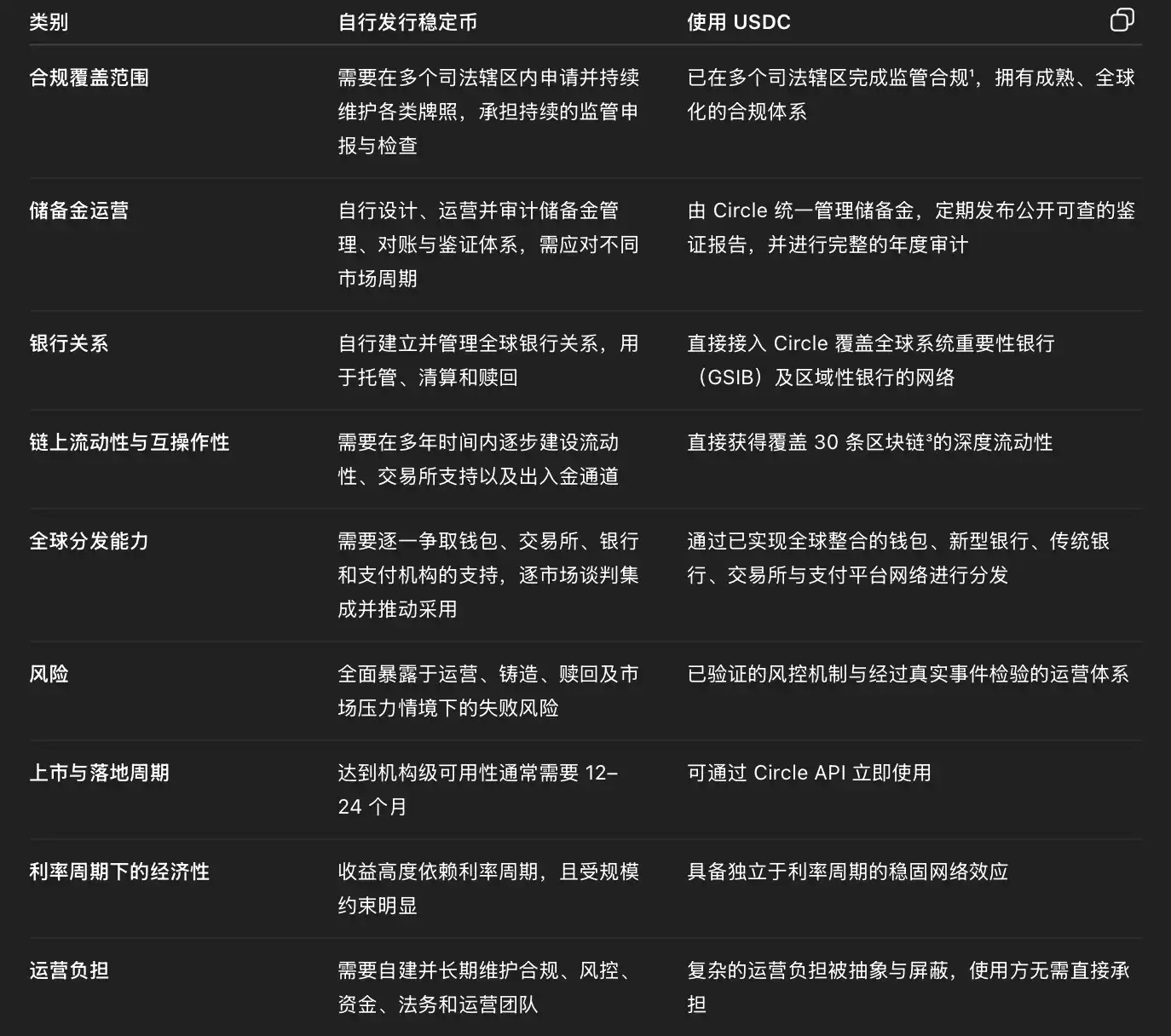
The Temptation of Shortcuts

Currently, a wide range of newcomers—from fintech companies and payment institutions to crypto projects—are exploring or directly launching their own stablecoins. The growth of the stablecoin market in 2025 reflects both the gradual clarity of the regulatory environment and rising institutional interest. But the reality is that, although hundreds of stablecoin projects have been launched, about 95% have never achieved lasting, global scale.

Some believe it is possible to replicate the same economic returns without bearing the heavy operational costs. The reality, however, is not so romantic. Whether issuing a stablecoin on your own or through a white-label service, you are entering an industry where trust, liquidity, and scale are matters of survival.

Sometimes, the cost of mistakes is measured in "trillions." According to media reports earlier this year, one issuer accidentally minted 300 trillion tokens due to an operational error. Although it was fixed within minutes, it was enough to make headlines. On another occasion, a well-known stablecoin briefly depegged during a period of extreme market volatility, again demonstrating that even minor infrastructure flaws can be amplified and transmitted under pressure.

These incidents serve as reminders that the viability of a stablecoin depends on operational rigor in high-pressure environments. Markets and policymakers are watching closely.

Trust Is the Real Network Effect

Anyone can create a token on a blockchain. In fact, thousands already exist—most minted in minutes and forgotten just as quickly. Even in the stablecoin niche, over 300 projects have been launched, but only a handful carry almost all real-world usage and value; the vast majority, about 95%, have never truly succeeded.

The difference lies not in technology but in scale and trust. The real challenge for stablecoins begins during the expansion phase: how to sustain liquidity, redeemability, compliance, and system availability as transaction volumes grow across different markets and cycles.

You can mint a token in minutes, but you cannot mint trust in minutes. Trust stems from transparency, scale, and consistent redeemability across market cycles, accumulating over time. This is why the stablecoin market has ultimately concentrated in the hands of a few issuers—and why, as of January 30, 2026, USDC's cumulative historical settlement volume has exceeded $60 trillion.

Rather Than Reinventing the Wheel, Choose Collaboration

For most businesses, the right question is not "How should we issue our own stablecoin?" but "How can we integrate stablecoins into our business to unlock new growth?"

With USDC and EURC, companies can today embed digital dollars and euros, gaining near-instant settlement, global reach, and interoperability across dozens of blockchains, without having to bear the complexities of reserve management and regulatory compliance themselves.

Writing the Next Chapter Together

The stablecoin industry is entering a new phase. Policymakers are establishing clearer rules, institutions are raising their standards, and the market is gradually converging on a simple consensus: trust, liquidity, and compliance are the real moats.

The goal is not to have more stablecoins but to have fewer and better ones—ones that can meet current demands with shared liquidity, transparent reserves, and proven performance across cycles.

For institutions formulating their stablecoin strategies, the first step should not be to decide "what to build" but "whom to build with." If you want stablecoins to empower your business but do not want to become a stablecoin issuer yourself, the time-tested choice is clear: talk to Circle and use USDC.


Domande pertinenti

QAccording to the article, what is the main reason why approximately 95% of stablecoin projects fail to achieve lasting, global scale?

AThe main reason is not a technical failure, but the immense operational challenge of scaling. This includes the inability to continuously maintain liquidity, redemption capabilities, regulatory compliance, and system availability across different markets and market cycles. Trust, which is built on transparency, scale, and consistent redeemability over time, is the true barrier to success that most projects cannot overcome.

QWhat key operational capabilities does the article state are required to run a trusted, regulated stablecoin?

AThe key operational capabilities include real-time reserve management across market cycles, daily reconciliation with multiple banking partners, undergoing independent audits, and fulfilling compliance and regulatory reporting across multiple jurisdictions. This requires building 24/7 systems for compliance, risk management, treasury operations, and liquidity, with clear escalation and resolution mechanisms for stress scenarios and a zero-tolerance policy for errors.

QWhat strategic question should a business ask itself before deciding to issue a stablecoin, as suggested by the Circle executive?

AThe business should ask itself: 'Do you simply want to use stablecoins for your business, or do you intend to go into the *business* of issuing a stablecoin?' This reframes the decision from a technical one to a strategic one, questioning whether issuing currency is core to its business model.

QWhat is the article's view on the proliferation of new, closed proprietary stablecoins from a system-wide perspective?

AThe article argues that each new, closed proprietary stablecoin further fragments liquidity and trust. Each issuer is duplicating the work of building reserves, compliance systems, and redemption channels, which ultimately weakens the overall depth and resilience that stablecoins rely on, especially during times of market stress.

QWhat alternative does the article propose for companies that want the benefits of stablecoins without the burden of issuing their own?

AThe article proposes that companies should integrate existing, large-scale stablecoins like USDC and EURC into their businesses. This allows them to gain access to near-instant settlement, global reach, and interoperability across dozens of blockchains without having to shoulder the complexities of reserve management and regulatory compliance themselves.

Letture associate

As Consensus Accelerates, What Are Young Investors Betting On?

Title: As Consensus Forms Faster, What Are Young Investors Betting On? In the rapid evolution of tech investment, a new generation of young investors is navigating a landscape where AI, robotics, commercial aerospace, and quantum computing are advancing simultaneously. Traditional investment logic based on financial models is giving way to a need for deep technical understanding and the ability to act before industry consensus forms. An analysis of trends from the "WAIC FUTURE TECH" list of young investment leaders reveals key shifts in focus. The first major trend is the movement of AI from the digital screen into the physical world. Investment is shifting from large language models and chatbots towards embodied AI, robotics, AI hardware, and edge computing. While demonstrations generate excitement, the real challenge lies in achieving scalable, reliable, and cost-effective delivery in complex real-world environments like factories and logistics. Success depends not just on algorithms but on the integration of sensors, actuators, and control systems. Second, the competitive focus for large models is moving beyond raw capability toward building an "intelligence flywheel." The goal is to create self-reinforcing systems where user interaction generates data, improving the model, which in turn enhances the user experience and attracts more engagement. Companies that successfully embed AI into workflows to create these closed-loop systems can build lasting value that isn't easily erased by the next model upgrade. Third, facing a potential bottleneck in high-quality human-generated data, investors are looking at new underlying technologies. Reinforcement learning and self-play, as demonstrated by AlphaGo Zero, offer paths for AI to generate its own experience. Scientific foundation models, which aim to build general AI capabilities for fields like life sciences and materials discovery, represent a non-consensus direction that could unlock new frontiers of knowledge and data. Finally, in deep-tech areas like quantum computing, commercial aerospace, and space-based infrastructure, patient capital is essential. These fields have long, uncertain development and validation cycles involving complex engineering, supply chains, and regulations. Investment here requires a long-term view, focusing on foundational team capabilities and the eventual emergence of market demand, even if commercial returns are distant. Collectively, these trends illustrate how young investors are adapting to a new era. They are learning to make earlier, technically-informed judgments, balance hype with real-world viability, and provide the patient capital needed to build the deep-tech foundations of the future.

marsbit15 min fa

As Consensus Accelerates, What Are Young Investors Betting On?

marsbit15 min fa

Can Japan Buy Growth with AI? Will the Bond Market Believe It?

Japan's cabinet has introduced the 2026 Basic Policy on Economic and Fiscal Management and Reform, shifting its primary fiscal target. The new framework moves away from the traditional annual primary balance goal and instead prioritizes a stable reduction of the debt-to-GDP ratio. This change is tied to a strategy of increased "responsible proactive fiscal" spending, aiming to boost long-term growth through investments in strategic sectors like AI, semiconductors, energy, and robotics. The government estimates total public and private investment in 62 key technologies could exceed 370 trillion yen by 2040. The market reaction has been mixed and cautious. While equity markets may respond to policy signals, bond markets are focused on fiscal credibility. Concerns center on whether the weakening of the clear primary balance anchor could lead to looser fiscal discipline. If investors doubt that these strategic investments will generate sufficient productivity gains, tax revenue, and nominal growth to outpace rising interest costs, they may demand higher yields on Japanese Government Bonds (JGBs). Recent volatility in the yen and JGB yields, with the 10-year yield briefly reaching 2.9%, reflects this skepticism. The success of this new framework hinges on two factors: whether Japan can achieve a nominal growth rate consistently higher than its long-term interest rates, and whether future budgets demonstrate disciplined control over bond issuance. The government's narrative is that strategic investment is essential to break Japan's cycle of low growth, aging, and labor shortages. However, the bond market will continuously assess the credibility of this plan, pricing the risk that it may represent fiscal expansion rather than a viable growth strategy.

marsbit52 min fa

Can Japan Buy Growth with AI? Will the Bond Market Believe It?

marsbit52 min fa

Misjudged A-Shares: Resilience, Expectations, and Confidence

China's A-share market recently faced selling pressure, especially in tech sectors, initially triggered by a global tech sell-off that began in South Korea. However, the article argues this is a case of "mistaken injury" and highlights the market's underlying resilience. This resilience stems from three main pillars: **1) Tech Sector Fundamentals:** Unlike Korea's market dominated by a few memory chip stocks, China's tech sector is diversified across computing, communications, electronics, and semiconductors, supported by dual narratives of global AI supply chains and domestic substitution. Core areas like optical modules and fiber optics continue to show strong earnings growth. **2) "National Team" Support:** State-backed institutions and large corporations have made significant market purchases and announced buybacks, providing liquidity and signaling confidence. This is seen as a stabilizing policy signal, often associated with market bottoms. **3) Broader Market Pillars:** Other major sectors are showing endogenous recovery momentum. Consumer stocks benefit from stabilizing CPI and signs of sector recovery (e.g., liquor price hikes). Cyclical sectors like aluminum have high earnings, potential price increases due to tight supply, and low valuations. The financial sector offers stable dividends and low valuations. The conclusion is that the sell-off was driven by external contagion, not a collapse in fundamentals. With strong policy support and recovering momentum across key sectors, the A-share market possesses the toughness to regain stability.

marsbit1 h fa

Misjudged A-Shares: Resilience, Expectations, and Confidence

marsbit1 h fa

Trading

Spot
活动图片




