Circle Releases Arc Network Whitepaper: Can the New Economic Mechanism Drive It to Become the "Clearing Coordination Layer" for Institutional-Grade Stablecoin Payments?

marsbitPubblicato 2026-05-13Pubblicato ultima volta 2026-05-13

Introduzione

Circle has released the whitepaper for its Arc Network, detailing plans for a new economic coordination layer using the proposed ARC token. Arc is a Layer 1 blockchain designed for enterprise-level stablecoin payments, featuring USDC as its native gas token, a high-performance consensus mechanism for instant transaction finality, and optional enterprise privacy features. Currently operating on a Proof-of-Authority (PoA) model, the network plans a future transition to a Proof-of-Stake (PoS) system. The ARC token is intended to serve as the network's native coordination asset, facilitating governance, enabling staking rewards, and managing fee mechanisms. User fees paid in stablecoins would be converted to ARC, with portions distributed as rewards and burned. The governance model will blend token-based voting with institutional oversight, especially for high-sensitivity matters like security and compliance. While positioning Arc as a potential settlement layer for institutional stablecoin payments, the whitepaper acknowledges challenges. These include the network's current centralization, the unfinished and potentially volatile ARC token economics, and the evolving global regulatory landscape for stablecoins. The development signals a broader industry trend where Web3 infrastructure competition is shifting from pure performance to factors like liquidity, compliance, and institutional-grade stability.

Original Author: Shirley Li, Researcher at Web3Caff Research

How to easily grasp the market hotspots, technological trends, ecosystem progress, and governance developments happening in the Web3 industry...? The "Market Pulse Analysis" column launched by Web3Caff Research delves into the front lines to explore and filter current hot events, providing value interpretation, commentary, and principle analysis. See through the phenomenon to grasp the essence, and follow us now to quickly capture the frontline market trends in Web3.

Compliance Notice: Stablecoins are virtual currencies (Tokens), and please be aware that issuing and participating in Token investment have varying degrees of regulatory requirements and restrictions in different countries and regions, especially in Mainland China where issuing Tokens may constitute "illegal securities issuance," and providing Token trading services or other cryptocurrency-related activities may also be considered "illegal financial activities" (Readers in Mainland China are strongly advised to read "Summary of Mainland China Laws and Regulations Related to Blockchain and Virtual Currency and Key Points"). The following content is only an objective analysis of the progress and market feasibility strategies of Arc Network, and aims to explore and analyze how application scenarios based on blockchain technology are developing responsibly within the global regulatory environment. Therefore, please do not use this information for related decision-making, and please strictly comply with the laws and regulations of your country and region, and refrain from participating in any illegal financial activities.

Stablecoins have long been a crucial component of the on-chain financial and economic system. Recently, with the rapid development of scenarios such as RWA and cross-border payments, their role is gradually evolving from a simple medium of exchange on-chain to an important value carrier connecting traditional finance and the on-chain economy within the scope of some countries and regions worldwide. Stablecoin payment has also become a new form of financial infrastructure.

Last May, Circle announced the launch of Arc, a Layer 1 public blockchain specifically designed for stablecoin payments and its supporting ecosystem, aiming to provide enterprises with a high-performance, predictable, and compliant entry point for enterprise-grade stablecoins. The emergence of Arc also has the potential to transform Circle's native stablecoin, USDC, from a single-function payment Token into a utility Token for a public chain. Previously, Circle had released the Arc Litepaper, introducing the operational logic of the blockchain at the product level, which Web3Caff Research also analyzed in detail:

As an L1 public chain, Arc has introduced the following innovations primarily around enterprise users:
  • USDC as the Native Gas Token: Arc first introduces USDC as the native Gas Token of the public chain to eliminate the impact of Token price volatility, making the prediction of interaction costs directly related to the base fee per unit of Gas. To further reduce volatility, Arc dynamically adjusts the current base fee using an Exponentially Weighted Moving Average (EWMA) of historical block utilization, avoiding sudden, sharp increases in fees due to sudden network congestion. Furthermore, when users use other payment stablecoins, Arc's Circle Paymaster will automatically use its native stablecoin to advance the interaction fees and deduct an equivalent value of other stablecoins from the user's account. This provides flexibility for multinational corporations and users in non-dollar regions, positioning Arc to potentially become a global, multi-currency financial settlement public chain.
  • High-Performance Consensus Design: In the on-chain context, because finality confirmation of interactions requires time, enterprises cannot immediately start processing an order, as there is a certain possibility that subsequent automated processing by a series of financial/business systems may need to be rolled back. Therefore, each transaction an enterprise makes carries a potential extra processing cost, which is unacceptable in actual enterprise operations. To address this, Arc employs the Malachite consensus mechanism (a variant of Tendermint Byzantine Fault Tolerance). Under this mechanism, once a payment is voted on and committed by two-thirds of the validators, it is instantly finalized and cannot be reversed. At the same time, Arc's validators are not anonymous staking nodes but a selected group of institutions with good reputations, capable of meeting compliance requirements across different global regulatory systems. In the future, Arc will also introduce multi-proposers, allowing multiple validators to generate block proposals in parallel within the same time window, which are then aggregated into a single block during the consensus phase. This will further enhance the payment system's throughput and reduce latency in financial processing.
  • Enterprise-Grade Privacy: To ensure that core enterprise business information is not leaked, Arc provides enterprises with optional privacy capabilities, to be implemented in phases. In the future, as secure technologies like Multi-Party Computation and Homomorphic Encryption mature, Arc will introduce more complex privacy settings on-chain, such as private order books, privatized financial strategies that automatically run as confidential on-chain contracts.

If you want to learn more about the operational logic of the Arc blockchain, we recommend reading: "Market Pulse Analysis: Circle Advances into the Public Chain Arena, Can Its L1 Network Arc Become the First Compliant Chain for Payment Stablecoins?".

Fast forward to May of this year, half a year after the Arc testnet went live, Circle has released the Arc blockchain whitepaper, further elaborating on the design logic of the ARC Token as the native coordination asset of the Arc network, and revealed that the Arc mainnet is expected to launch this summer.

As mentioned earlier, currently, the Arc network employs a Proof of Authority (PoA) mechanism, meaning a selected group of reputable institutional nodes are responsible for network validation and block production. However, this model carries certain centralization risks and is more suitable for the early launch phase of a project. As network adoption scales, the Arc network is likely to transition to a Proof of Stake (PoS) mechanism in the future, but USDC, being a stablecoin, is not suitable for staking. Therefore, Circle is considering introducing a new Token system—the ARC Token—to serve as the native coordination asset of the Arc network, responsible for coordinating the interests and actions of various participants (validators, developers, users, institutions, etc.) in the network.

According to the whitepaper design, ARC holders can participate in network governance voting based on their staked weight, collectively deciding on network fee rates, inflation rates, and burn logic. Additionally, they may gain certain rights related to protocol access and interaction in the future. However, the whitepaper also clearly states that Arc network's governance model will not fully adopt a DAO model and will retain institutional coordination mechanisms. High-sensitivity matters involving security response, compliance, validator node admission, and protocol upgrades will still be primarily managed by Circle and designated institutions in the network's early stages.

Simultaneously, the fees users pay using stablecoins on the Arc network will be automatically converted into ARC Tokens. A portion will be distributed as rewards to validators and stakers, while another portion will be burned. Compared to traditional public chains requiring users to directly hold the native Gas Token, this design may better align with the usage habits of institutions and enterprises.

For the Arc network, the application scope of the ARC Token may be further expanded in the future, for example, to be used for building dedicated transaction channels; coordinating and managing asset flows and data interoperability between different blockchains; supporting Circle Paymaster's multi-asset Gas scenarios, enabling users to pay network fees with different stablecoins, and so on.
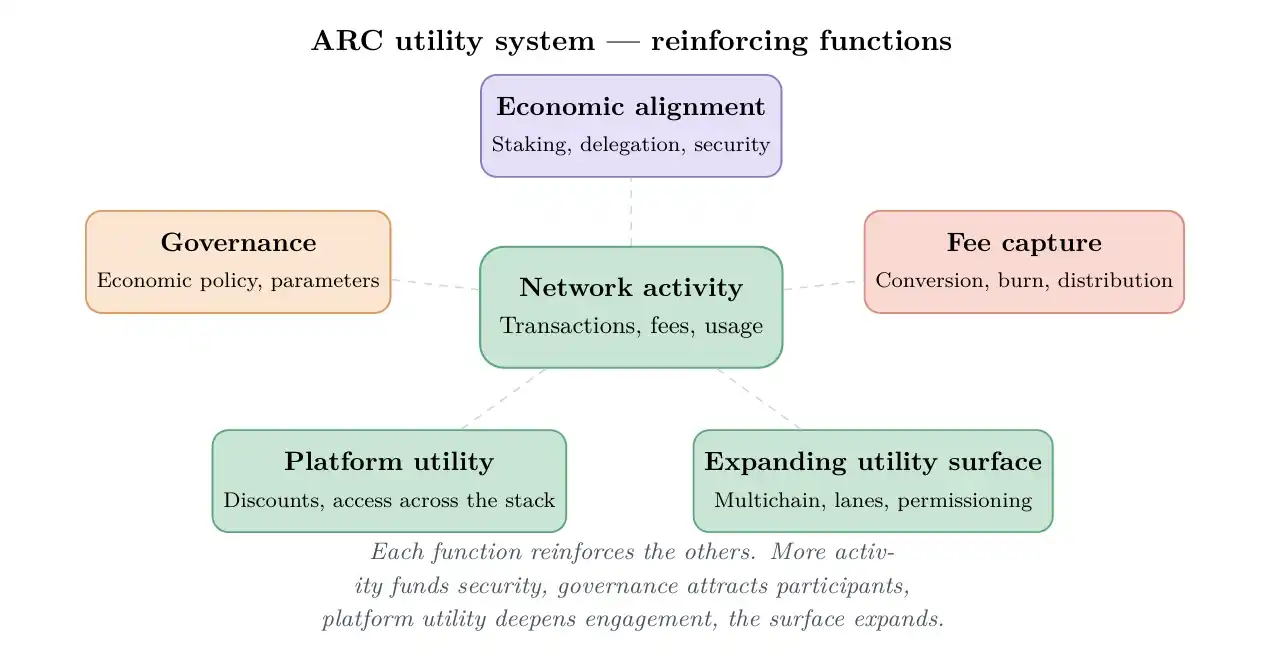
Image Source: ARC: The Native Asset of the Economic OS

However, it's important to note that the ARC Token system is currently still in the discussion and design phase and may undergo significant changes in the future. Furthermore, Circle has repeatedly emphasized that ARC itself is neither a security nor an investment product and does not represent any equity or right to profits.

On specialized blockchains like Arc Network, which are centered on stablecoin payments, large-scale economic activities often originate from banks, payment institutions, corporate users, and capital markets. As laws and regulations related to stablecoins, on-chain assets, and on-chain financial activities are being established and refined globally, the pathways for these institutions to participate in building on-chain infrastructure are becoming increasingly clear. This trend is also driving a shift in the competitive logic of Web3 infrastructure. The battle of public chains solely competing on network performance and transaction fees is becoming a thing of the past. Instead, network liquidity, compliance, stability, sustainability, and ecosystem scalability are becoming the new focal points of competition.

Of course, this transformation will not happen overnight, and the future development of Arc Network will still face several potential challenges.

For example, the current overall architecture of the Arc network still carries a strong centralization characteristic. Although Circle attempts to establish a longer-term economic coordination and governance mechanism for the network by introducing the ARC Token and gradually promote the network's evolution towards PoS, this system is still in the discussion phase and has not been officially implemented. Its specific governance structure and economic model remain highly uncertain. Simultaneously, the ARC Token mechanism itself will introduce some additional governance and security risks to the Arc network, such as whether the economic model design can match the real network needs? Could governance power become centralized again due to concentrated staking by large nodes? These questions await further discussion and optimization by the official team.

Furthermore, although stablecoin regulatory mechanisms are gradually being perfected, specific regulatory frameworks can vary significantly between different countries and regions. This means that Arc Network will need to continuously adapt to evolving compliance requirements in the future.

Currently, traditional public chains like Ethereum, Base, and Solana are actively expanding towards on-chain financial infrastructure, stablecoin payments, and institutional-grade applications. This can be seen as a signal of the changes sought by leading Web3 institutions, including Circle. However, who will ultimately succeed in building the next generation of global on-chain financial infrastructure remains to be observed continuously.

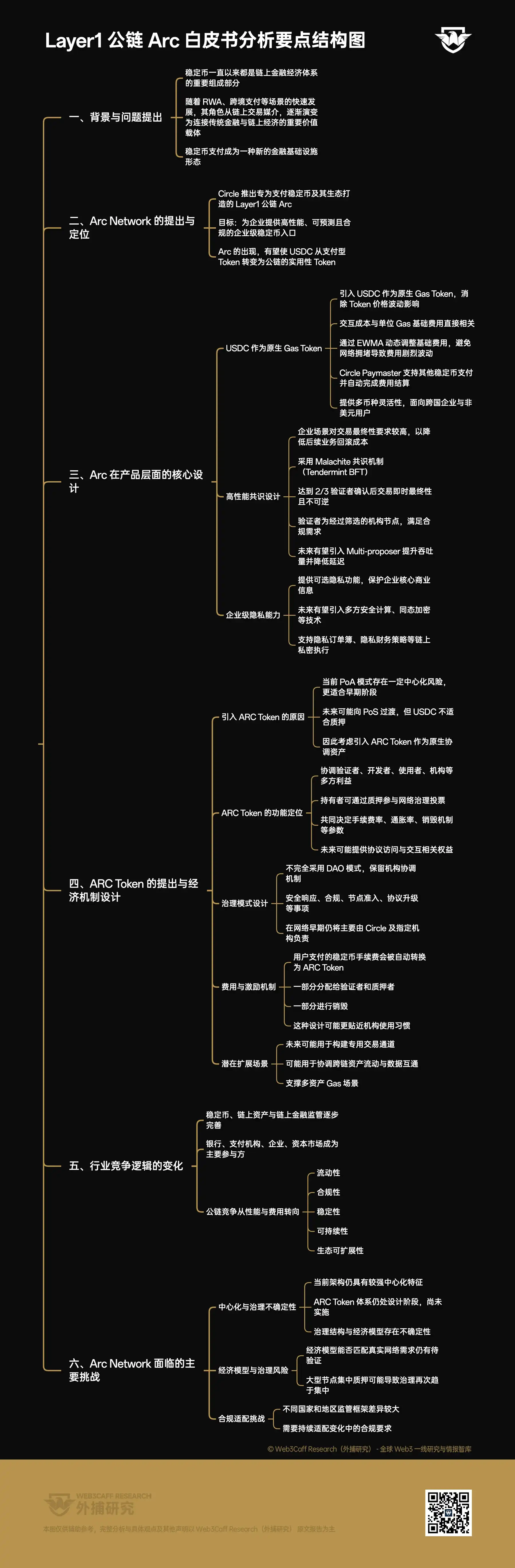
Key Points Diagram:
References:

[1] Introducing the ARC Whitepaper: Exploring Arc’s Native Coordination Asset

Disclaimer: This report is prepared by Web3Caff Research. The information contained herein is for reference only and does not constitute any prediction, investment advice, proposal, or offer. Investors should not rely on such information to purchase, sell any securities, cryptocurrencies, or adopt any investment strategy. The terminology used and views expressed in the report are intended to aid understanding of industry trends and promote responsible development in the Web3 and blockchain industry, and should not be interpreted as definitive legal opinions or the views of Web3Caff Research. The opinions reflected in the report are solely those of the author(s) as of the stated date, are independent of the position of Web3Caff Research, and may change following subsequent developments. The information and opinions contained in this report are derived from proprietary and non-proprietary sources that Web3Caff Research considers reliable and do not necessarily cover all data, nor is their accuracy guaranteed. Therefore, Web3Caff Research does not provide any warranty regarding their accuracy and reliability and shall not be liable for errors and omissions arising in any other manner (including liability to anyone for negligence). This report may contain "forward-looking" information, which may include forecasts and projections, and this article does not constitute a guarantee of any prediction. The decision to rely on the information contained in this report is entirely at the reader's discretion. This report is for informational purposes only and does not constitute investment advice, a proposal, or an offer to buy or sell any securities, cryptocurrencies, or adopt any investment strategy. Please strictly comply with the relevant laws and regulations of your country or region.


Domande pertinenti

QAccording to the article, what is the primary purpose of Circle's new ARC Token within the Arc Network?

AAccording to the article, the primary purpose of the ARC Token is to serve as Arc Network's native coordination asset. It is designed to coordinate the interests and behaviors of various network participants (such as validators, developers, and institutional users) by enabling governance voting on parameters like fee rates, inflation, and token burn mechanics. It is also intended to facilitate future features like dedicated transaction channels and support for multi-asset gas payments, while not being a security or investment product.

QWhat are the key technological innovations of the Arc blockchain mentioned for enterprise users?

AThe key technological innovations for enterprise users mentioned are: 1) Using USDC as the native gas token to eliminate volatility in transaction costs, with a dynamic fee adjustment mechanism (EWMA) to prevent sudden spikes. 2) The Malachite consensus mechanism (a type of Tendermint BFT) that provides instant finality for payments once confirmed by a 2/3 majority of validators. 3) Plans for implementing optional enterprise-grade privacy features, including future capabilities for private order books and financial strategies using secure computation technologies.

QWhy does Circle propose introducing a separate ARC Token instead of using USDC for staking in a potential future PoS system?

ACircle proposes introducing a separate ARC Token because USDC, as a stablecoin, is not suitable for staking in a Proof-of-Stake (PoS) system. The article explains that while Arc currently uses a Proof-of-Authority (PoA) model, it may transition to PoS as the network scales. USDC's stable value makes it ideal for payments and gas fees but not for the variable rewards and governance functions required in a staking-based security and coordination model, necessitating a dedicated token like ARC.

QWhat are some potential challenges facing the Arc Network's development, as outlined in the article?

AThe article outlines several potential challenges: 1) The current architecture has a strong centralized element, and the proposed ARC Token governance model is still in the design phase with significant uncertainty. 2) Risks related to the ARC Token's economic model, such as whether it can match real network demand and the potential for governance centralization if large validators accumulate significant stakes. 3) The need to continuously adapt to diverse and evolving regulatory frameworks for stablecoins across different countries and regions.

QHow does the article describe the shifting competitive landscape for Web3 infrastructure, particularly regarding chains like Arc?

AThe article describes a shift in the competitive landscape for Web3 infrastructure. It states that competition based solely on network performance and transaction fees is becoming outdated. For chains like Arc that focus on stablecoin payments and institutional use, the new competitive priorities are becoming network liquidity, compliance/regulation, stability, sustainability, and the extensibility of the ecosystem. This shift is driven by increasing institutional participation and the establishment of clearer global regulations for stablecoins and on-chain finance.

Letture associate

Blocked Its Own Treasure, WeChat AI Steps Up

Tencent's stock surged over 10% on June 2nd amid reports that WeChat, with 1.43 billion monthly users, is finalizing tests for a native AI Agent. The reported feature, accessible by swiping right from the main interface, allows users to issue commands in natural language. The AI then decomposes tasks and automatically calls upon relevant Mini Programs within WeChat to complete actions like ordering food, booking tickets, or making payments, creating a closed-loop service execution system. This strategic shift follows the internal conflict and subsequent "blocking" of Tencent's standalone AI app, Yuanbao, by WeChat for violating sharing rules during a 2026 Spring Festival promotion. The incident highlighted a lack of internal consensus and exposed the weakness of competing in the standalone AI assistant arena against rivals like ByteDance's Doubao (345M MAU) and Alibaba's Qianwen. The new WeChat AI Agent aims to leverage WeChat's unique assets—its massive user base, standardized Mini Program APIs, WeChat Pay, and identity system—to move from simple content generation to actual task execution. Analysts note this changes the competitive landscape from model benchmarks to which AI can connect to more real-world services. However, success depends on key variables: the capability of Tencent's underlying Hunyuan model, managing massive inference costs, and redesigning incentives for Mini Program developers whose traffic might be bypassed. The move is seen as an attempt to keep user service intent within WeChat's ecosystem as AI begins to redefine how users access services.

marsbit54 min fa

Blocked Its Own Treasure, WeChat AI Steps Up

marsbit54 min fa

ByteDance Adopts Arm CPUs, Jensen Huang: So Sad I Didn't Buy Arm

**Summary:** At Computex 2026, Arm CEO Rene Haas announced that ByteDance and Oracle have adopted Arm's self-designed Arm AGI data center CPU. The company expects significant revenue growth from this product, projecting $20 billion in demand for the 2027/2028 fiscal years. Haas noted that restricting AI-capable CPUs from the US to China is nearly impossible due to their widespread applications. Arm's stock has surged dramatically this year, notably rising 16% after NVIDIA's Arm-based Vera CPU and RTX Spark announcements. A highlight was the informal, humorous on-stage conversation between Haas and NVIDIA CEO Jensen Huang. Huang joked about NVIDIA's failed attempt to acquire Arm and playfully lamented selling his Arm shares. Both executives showed a clear sense of camaraderie and shared regret over the missed merger. Key technical topics were discussed: 1. **AI PC Design:** Huang explained NVIDIA's RTX Spark superchip (with a 20-core Arm CPU) is designed for future AI agents that will autonomously run and use tools on PCs, blending local and cloud processing. 2. **Agent vs. OS:** Huang emphasized the operating system remains crucial, as AI agents rely on its APIs and tools to function. 3. **Growth Constraints:** He identified the shift to "useful AI" that generates profitable tokens as a primary driver for immense, almost limitless, computational demand. Haas outlined Arm's strategy across PC and data centers. For PCs, Arm collaborates with partners like NVIDIA and MediaTek, offering its compute subsystem (CSS) for custom SoCs. In data centers, its Arm AGI CPU (built on TSMC's 3nm process) has gained major partners including OpenAI, Meta, and now ByteDance and Oracle. Arm presented a multi-year roadmap for its in-house CPU line. The article concludes that while GPUs dominated the AI training race, the explosion of AI agents is shifting significant focus to CPUs for inference, state management, and tool orchestration. The industry is trending towards vertical integration, with companies like cloud providers designing chips and chip/IP firms offering full solutions, all competing to deliver more efficient computing per watt.

marsbit1 h fa

ByteDance Adopts Arm CPUs, Jensen Huang: So Sad I Didn't Buy Arm

marsbit1 h fa

New Wall Street Play: Yen Shorts Still Adding, But Japan Stocks Don't Rely on Carry Trade Unwinding

On June 3rd, USD/JPY hit 160.44, its highest level since July 2024, while the Nikkei 225 surged past 68,000 points. Contrary to popular narratives of an imminent "carry trade unwind" akin to August 2024, data reveals a more complex picture. Speculative net short positions in yen futures have actually increased, reaching -114,667 contracts by late May, suggesting traders are doubling down rather than retreating. Meanwhile, Japan's Finance Ministry conducted its largest-ever single-round FX intervention (11.73 trillion yen) in April-May but failed to hold the 160 yen line. The Nikkei's rally is not driven by carry trade dynamics. Foreign investors are aggressively buying Japanese stocks, with net purchases in 2026 running nearly 16 times higher than 2025 levels. This inflow is concentrated in AI and semiconductor-related stocks like SoftBank and Socionext, fueled by positive sector outlooks, rather than being a flight from unwinding yen shorts. Furthermore, the Nikkei has continued climbing despite the Bank of Japan's (BOJ) rate hikes to 0.75%. This disconnect exists because the current equity boom is fueled by AI-driven foreign investment, not reliant on cheap yen funding. However, this relationship remains fragile. Should the BOJ hike rates further (e.g., to 1.0%) while dollar weakness increases carry trade costs, the trajectories of the yen and Japanese stocks could reconverge, potentially triggering volatility.

marsbit1 h fa

New Wall Street Play: Yen Shorts Still Adding, But Japan Stocks Don't Rely on Carry Trade Unwinding

marsbit1 h fa

Broadcom's Q3 Guidance Misses Expectations by $12 Billion, After-Hours Trading Plummets Over 13%, AI Narrative "Cooling"?

On June 3, Broadcom released record Q2 FY26 results with revenue of $22.19B, up 48% YoY, and AI chip sales of $10.8B, up 143%. Adjusted EPS of $2.44 beat estimates. However, its Q3 AI semiconductor revenue guidance of $16B, while up over 200% YoY, fell roughly $1.2B (7%) short of analyst consensus expectations of $17.2B. This miss, coupled with slightly weaker-than-expected software revenue, triggered a severe market reaction. CEO Hock Tan maintained the FY26 AI revenue outlook of over $100B but did not raise it, disappointing investors who had priced in more robust growth. The stock plummeted over 13% in after-hours trading, erasing roughly $270B in market cap. The sell-off extended to peers like Marvell. A key concern for markets, particularly for Chinese optical module suppliers, was Tan's comment that the contribution of AI networking (e.g., Ethernet switches, optical interconnect chips) to AI revenue, currently near 40%, is expected to normalize to around 30% over time, signaling a potential peak in growth for that segment. Despite the guidance shortfall, Tan reiterated that AI demand remains "insatiable" and reaffirmed the long-term target of exceeding $100B in AI revenue by FY27. The reaction highlights the heightened sensitivity and premium valuation placed on AI-exposed stocks, where anything less than stellar guidance can prompt significant profit-taking. The broader question is whether this represents a cooling AI narrative or a correction in overstretched valuations.

marsbit1 h fa

Broadcom's Q3 Guidance Misses Expectations by $12 Billion, After-Hours Trading Plummets Over 13%, AI Narrative "Cooling"?

marsbit1 h fa

Trading

Spot
Futures

Articoli Popolari

Come comprare LAYER

Benvenuto in HTX.com! Abbiamo reso l'acquisto di Solayer (LAYER) semplice e conveniente. Segui la nostra guida passo passo per intraprendere il tuo viaggio nel mondo delle criptovalute.Step 1: Crea il tuo Account HTXUsa la tua email o numero di telefono per registrarti il tuo account gratuito su HTX. Vivi un'esperienza facile e sblocca tutte le funzionalità,Crea il mio accountStep 2: Vai in Acquista crypto e seleziona il tuo metodo di pagamentoCarta di credito/debito: utilizza la tua Visa o Mastercard per acquistare immediatamente SolayerLAYER.Bilancio: Usa i fondi dal bilancio del tuo account HTX per fare trading senza problemi.Terze parti: abbiamo aggiunto metodi di pagamento molto utilizzati come Google Pay e Apple Pay per maggiore comodità.P2P: Fai trading direttamente con altri utenti HTX.Over-the-Counter (OTC): Offriamo servizi su misura e tassi di cambio competitivi per i trader.Step 3: Conserva Solayer (LAYER)Dopo aver acquistato Solayer (LAYER), conserva nel tuo account HTX. In alternativa, puoi inviare tramite trasferimento blockchain o scambiare per altre criptovalute.Step 4: Scambia Solayer (LAYER)Scambia facilmente Solayer (LAYER) nel mercato spot di HTX. Accedi al tuo account, seleziona la tua coppia di trading, esegui le tue operazioni e monitora in tempo reale. Offriamo un'esperienza user-friendly sia per chi ha appena iniziato che per i trader più esperti.

287 Totale visualizzazioniPubblicato il 2025.02.11Aggiornato il 2026.06.02

Come comprare LAYER

Discussioni

Benvenuto nella Community HTX. Qui puoi rimanere informato sugli ultimi sviluppi della piattaforma e accedere ad approfondimenti esperti sul mercato. Le opinioni degli utenti sul prezzo di LAYER LAYER sono presentate come di seguito.

活动图片