Circle moves toward privacy-focused stablecoin with USDCx project

cointelegraphPubblicato 2025-12-09Pubblicato ultima volta 2025-12-09

Introduzione

Circle is developing a privacy-enhanced version of its USDC stablecoin, called USDCx, in partnership with blockchain firm Aleo. Aimed at banking and enterprise users, USDCx will offer "banking-level privacy" by concealing transaction details onchain, while still allowing compliance with regulatory requests. This addresses a key hurdle for institutional adoption, as many financial firms hesitate to use public blockchains due to transparency concerns. The move comes amid growing corporate interest in stablecoins following the US GENIUS Act, with major players like Citigroup, JPMorgan, and Visa expanding their stablecoin initiatives. USDC and USDT currently dominate the dollar-pegged stablecoin market.

Stablecoin issuer Circle is developing a privacy-enhanced version of its US dollar-pegged USDC token, aiming to spur institutional adoption by offering greater confidentiality than traditional public blockchains allow.

The new stablecoin, called USDCx and targeting banking and enterprise users, is being built in partnership with the privacy-focused blockchain company Aleo, Fortune reported on Tuesday, citing Aleo co-founder Howard Wu.

Unlike most existing stablecoins, which have wallet addresses and transaction details fully visible onchain, USDCx is designed to provide “banking-level privacy.” Circle would still be able to provide a compliance record if law enforcement or regulators request information on specific transactions, according to the report.

The initiative aims to address a key hurdle for major financial institutions, many of which have been hesitant to utilize blockchain-based payment rails because their transaction flows would be publicly visible.
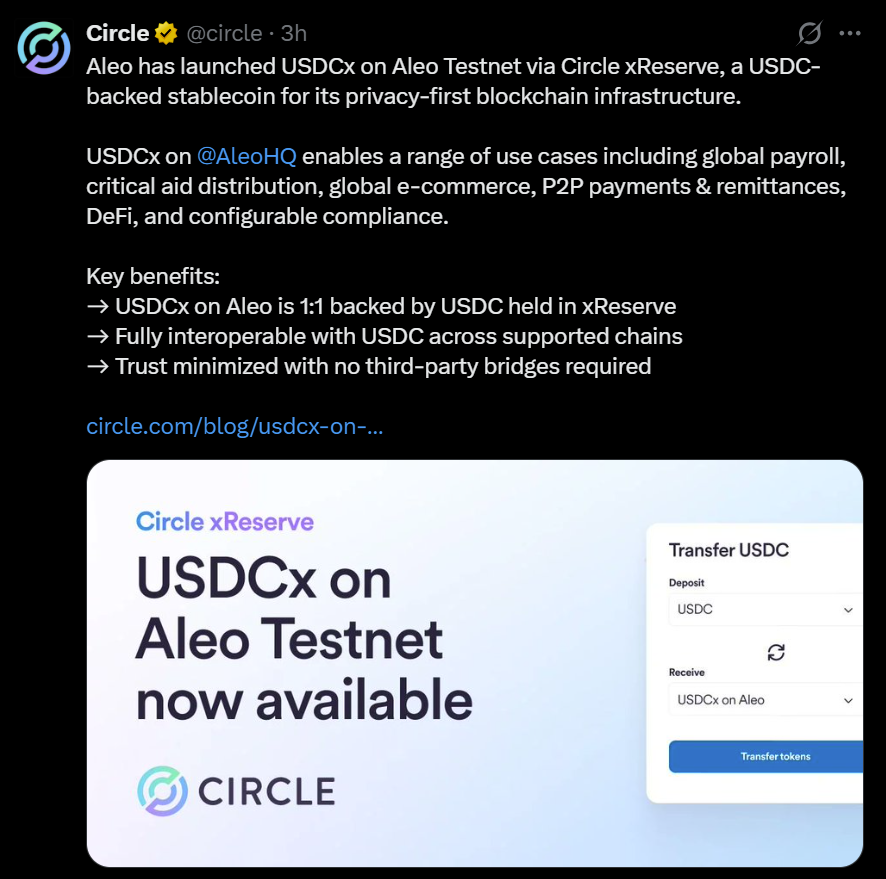
Source: Circle

Aleo has long argued that privacy is essential for the next phase of stablecoin adoption. In a May post, the company wrote that while transparency is often promoted as a core blockchain advantage, “it becomes a liability when dealing with sensitive, confidential payment data.”

Aleo isn’t the only company pushing for privacy in stablecoins. As Cointelegraph reported, digital asset infrastructure provider Taurus has developed a private smart-contract system for stablecoins, designed to enable anonymous transactions. This approach aims to boost the use of stable assets for intracompany payments and employee payrolls.

Related: Bank lobby is ‘panicking’ about yield-bearing stablecoins

Stablecoins take center stage in corporate America

Circle’s move into privacy-focused stable assets comes as more major institutions begin exploring stablecoins in the wake of the US GENIUS Act, the new regulatory framework governing US dollar–pegged tokens.

As Cointelegraph reported, a corporate stablecoin race is emerging in the wake of GENIUS. Citigroup has partnered with Coinbase to test stablecoin-based payment rails for its clients, while other Wall Street companies, including JPMorgan and Bank of America, are reportedly in the early stages of experimenting with similar technologies.

Global remittance provider Western Union is also building a digital asset settlement system on Solana, with plans to introduce a US Dollar Payment Token as part of its infrastructure overhaul. Meanwhile, global payments giant Visa has expanded its stablecoin offerings amid growing competition in the space.
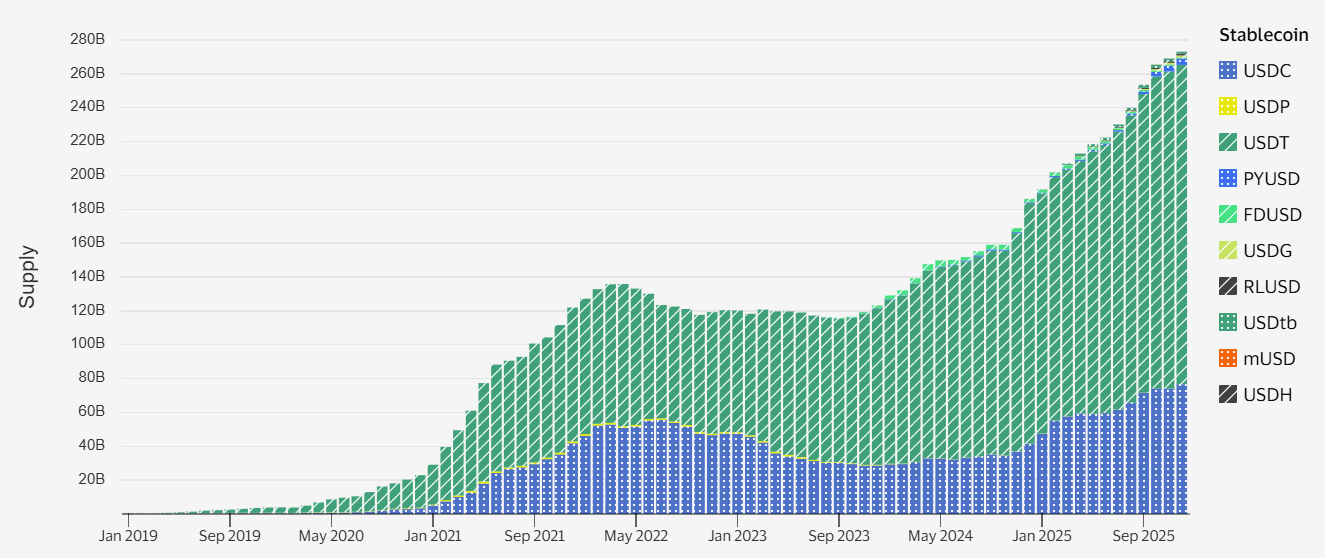
Average stablecoin supply by issuer. Source: Visa Onchain Analytics

The US dollar underpins the vast majority of global stablecoin activity. USDC (USDC) and Tether’s USDt (USDT) together account for roughly 85% of the market, while other dollar-linked tokens, including synthetic dollars and PayPal USD (PYUSD), also rank among the largest.

Related: Crypto Biz: Wall Street giants bet on stablecoins
Letture associate

Champion! Huobi HTX Tops the Industry with $583.7M Net Asset Inflow Over the Past 30 Days

In the competitive crypto industry, fund flows reveal true user trust. According to Defillama data on December 5, Huobi HTX recorded a net inflow of $583.7M over the past 30 days, ranking first among all centralized exchanges (CEXs). This reflects growing user confidence in the platform’s security, transparency, and product offerings. Huobi HTX has maintained steady growth in total assets and spot trading volume, forming a positive cycle of asset safety, user growth, and capital inflow. Key factors behind this performance include enhanced asset proof mechanisms—with 38 consecutive months of published Merkle Tree Proof of Reserves (PoR) and 100%+ reserve ratios for major assets—alongside improved C2C trading features such as a "100% compensation" policy and a streamlined user experience. The platform’s earn products, including Huobi Earn, also saw significant growth, with increases in both user participation and asset deposits for tokens like USDD, ETH, and TRX. Users are increasingly choosing Huobi HTX for its reliable yields, ease of use, and strong security measures during market volatility. As a long-established exchange founded in 2013, Huobi HTX has strengthened its compliance and risk management frameworks, reinforcing its reputation for safety and transparency. The net inflow milestone underscores its position as a trusted platform where users choose to securely store and grow their digital assets.

深潮7 min fa

Champion! Huobi HTX Tops the Industry with $583.7M Net Asset Inflow Over the Past 30 Days

深潮7 min fa

From 'Stablecoin First Stock' to 'Ankle Cut' in Stock Price: Why Circle Quickly Fell from the Spotlight into a Revaluation Cycle

From "Stablecoin Unicorn" to "Ankle-Cut" Stock Price: Why Circle Quickly Fell from Its Peak into a Revaluation Cycle Circle, the issuer of the USDC stablecoin, experienced a dramatic stock price decline shortly after its IPO in June, dropping from an initial peak of around $260 to approximately $88. This reflects a broader market shift from hype-driven optimism to a more rational reassessment of the stablecoin industry. Multiple factors contributed to this sharp correction. Initially, the stock was significantly overvalued due to market enthusiasm for the "first stablecoin stock" and the high-interest environment that boosted the appeal of its reserve-backed revenue model. As early investors took profits and sentiment cooled, a price correction was inevitable. Increased competition is also pressuring Circle. While USDC is the world's second-largest dollar stablecoin, it faces growing challenges from new stablecoin projects and digital dollar initiatives from traditional financial institutions. The sector is shifting from an oligopoly to intense competition, raising investor concerns about USDC's future growth certainty. Furthermore, macroeconomic interest rate trends pose a fundamental risk to Circle's business model. Its core revenue comes from interest earned on the cash and short-term U.S. Treasuries backing USDC. Expectations that the Federal Reserve may begin a rate-cutting cycle could directly compress this income. Rising operational and distribution costs further squeeze profitability. Analysts hold divergent views on Circle's future. Firms like Mizuho have turned bullish, upgrading the stock and suggesting the sell-off related to its post-IPO lockup expiration may have created a buying opportunity. They point to USDC's continued adoption by mainstream financial institutions. Conversely, analysts at firms like Susquehanna remain pessimistic, maintaining an "Underperform" rating. They warn that lower future interest rates and potential underperformance in USDC growth could continue to pressure the stock price and have lowered their price target. The upcoming end of the post-IPO lockup period, which restricts insiders from selling shares, has added near-term selling pressure, but this is viewed by some as a temporary overhang. Circle's recent Q3 earnings report, which beat expectations for both revenue and profit, shows that these fundamental concerns have not yet materialized, leaving the company's trajectory highly dependent on future interest rates and its ability to maintain and grow USDC's market share amidst fierce competition.

cointelegraph_中文8 min fa

From 'Stablecoin First Stock' to 'Ankle Cut' in Stock Price: Why Circle Quickly Fell from the Spotlight into a Revaluation Cycle

cointelegraph_中文8 min fa

Trading

Spot
Futures
活动图片