Circle gets Abu Dhabi greenlight amid UAE stablecoin and crypto push

cointelegraphPubblicato 2025-12-09Pubblicato ultima volta 2025-12-09

Introduzione

Circle has received regulatory approval from the Abu Dhabi Global Market (ADGM) to operate as a licensed Money Services Provider, expanding its presence in the UAE. The company also appointed Saeeda Jaffar as managing director for the Middle East and Africa. This move is part of a broader trend of crypto firms, including Tether, Ripple, and Binance, gaining regulatory clearance in Abu Dhabi. The UAE has been advancing its crypto regulatory framework, introducing rules for DeFi and Web3, while also enforcing stricter oversight on unlicensed crypto operations.

Stablecoin issuer Circle has secured regulatory approval to operate as a financial service provider in the Abu Dhabi International Financial Center, deepening its push into the United Arab Emirates.

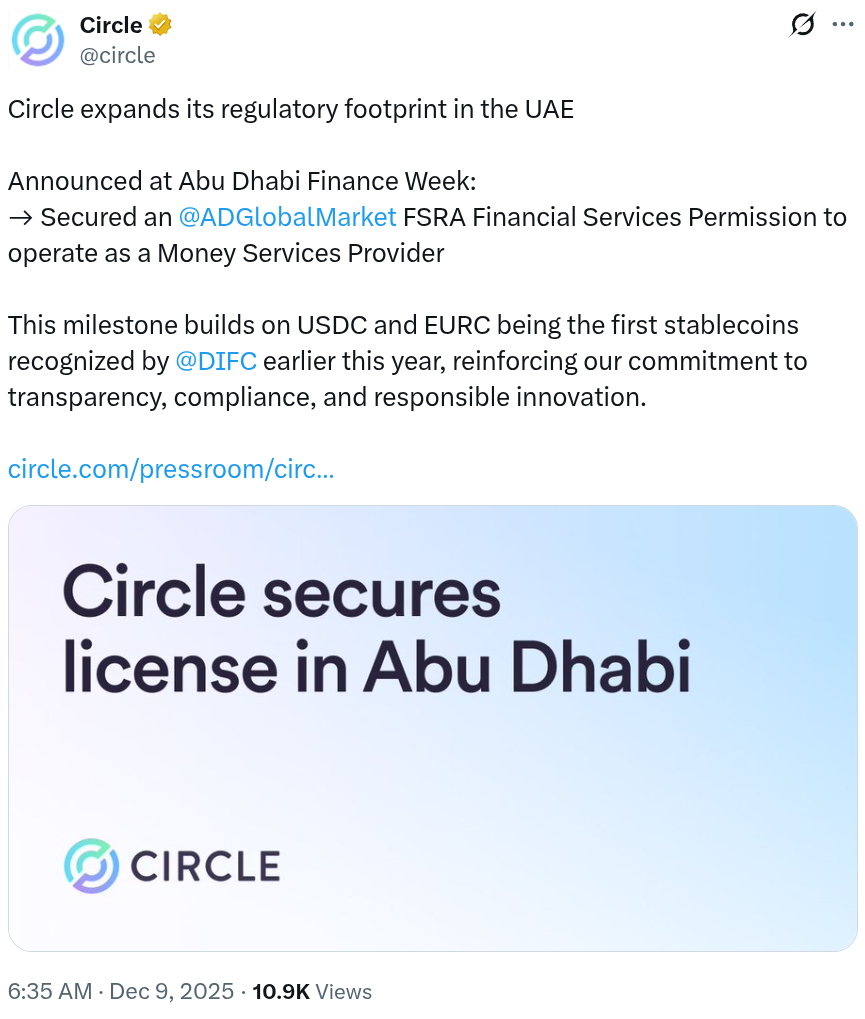
In an announcement Tuesday, Circle Internet Group said it received a Financial Services Permission license from the Financial Services Regulatory Authority of the Abu Dhabi Global Market (ADGM), the International Financial Centre of Abu Dhabi. This allows the stablecoin issuer to operate as a Money Services Provider in the IFC.

The USDC (USDC) issuer also appointed Saeeda Jaffar as its managing director for Circle Middle East and Africa. The new executive also serves as a senior vice president and group country manager for the Gulf Operation Council at Visa and will be tasked with developing the stablecoin issuer’s regional strategy and partnerships.

Circle co-founder, chairman and CEO Jeremy Allaire said that the relevant regulatory framework “sets a high bar for transparency, risk management, and consumer protection,” adding that those standards are needed if “trusted stablecoins” are going to support payments and finance at scale.
Source: Circle

Related: Abu Dhabi Investment Council triples stake in Bitcoin ETF in Q3: Report

Abu Dhabi awards a wave of licenses

The ADGM has recently awarded licenses for financial operations to a wave of crypto companies. Earlier this week, Tether’s USDt (USDT) — the largest stablecoin by circulation and Circle’s top competitor — secured a regulatory milestone in Abu Dhabi’s international financial center, as did Ripple’s dollar-pegged stablecoin Ripple USD at the end of November.

On Monday, crypto exchange Binance was granted three separate licenses from Abu Dhabi’s financial regulator, allowing it to operate its exchange, clearing house and broker-dealer services. This followed its competitor Bybit receiving regulatory approval in the UAE in early October.

Related: HSBC to bring tokenized deposits to US and UAE as stablecoin race heats up

UAE bets on crypto

The Central Bank of the UAE has been actively reviewing its cryptocurrency regulations. In November, it introduced rules for decentralized finance (DeFi) and the broader Web3 industry.

The newly-introduced Federal Decree Law No. 6 of 2025 brings DeFi platforms, related services and infrastructure providers under the scope of regulations if they enable payments, exchange, lending, custody, or investment services, with licenses now required. Local crypto lawyer Irina Heaver said that “DeFi projects can no longer avoid regulation by claiming they are just code.”

Heaver told Cointelegraph at the end of 2024 that during that year the country cemented its status as a global crypto hub.

In October 2024, the UAE exempted cryptocurrency transfers and conversions from value-added tax, just a month after Dubai’s digital asset regulator announced stricter rules on crypto marketing. Around the same time, local free economic zone Ras Al Khaimah Digital Assets Oasis was also working to introduce a legal framework for decentralized autonomous organizations.

Local regulators were also not shy about enforcing the rules, with Dubai’s Virtual Assets Regulatory Authority cracking down on seven unlicensed crypto businesses, issuing fines and cease-and-desist orders.

Magazine: Review: The Devil Takes Bitcoin, a wild history of Mt. Gox and Silk Road

Crypto di tendenza

Letture associate

PeaqOS and World ID Integrate ZK Proofs into Autonomous Robots

The integration of PeaqOS and World ID now allows autonomous machines to verify they are interacting with real, unique individuals without collecting names, photos, or other personal data. This update, available via robotic.sh, enables connected devices to directly request and verify World ID proofs. The system leverages zero-knowledge technology, letting a person prove they are human while maintaining the privacy of their identity. This addresses a key challenge for operators of delivery robots, shared machines, and autonomous systems: how to authenticate a user as genuine without relying on insecure PINs, pickup codes, or traditional identity checks that require personal data collection. Instead of obtaining identifying information, a device receives a cryptographic proof that the user is a real person. PeaqOS acts as a coordination layer, allowing devices to utilize World ID via decentralized identifiers and a device marketplace. A robot can request verification, receive a zero-knowledge proof, and register an auditable record of the interaction—all without exposing underlying personal data. The system also supports uniqueness verification, enabling machines to enforce rules like "one item per person" without maintaining user identity databases. A demonstrated use case involves autonomous medicine delivery: a patient verifies via the World App when placing an order, a pharmacist verifies before loading the medication, and the patient verifies again upon delivery so the robot can confirm the recipient is linked to the order before unlocking the compartment. Similarly, promotional robots could ensure one item per person, and shared vending machines could grant access to verified individuals without requiring accounts or personal data. This integration for PeaqOS-powered robots and devices minimizes the identity information collected or stored while allowing autonomous systems to confirm they are interacting with real humans.

cryptonews.ru34 min fa

PeaqOS and World ID Integrate ZK Proofs into Autonomous Robots

cryptonews.ru34 min fa

Trading

Spot

Articoli Popolari

Come comprare PUSH

Benvenuto in HTX.com! Abbiamo reso l'acquisto di Push Protocol (PUSH) semplice e conveniente. Segui la nostra guida passo passo per intraprendere il tuo viaggio nel mondo delle criptovalute.Step 1: Crea il tuo Account HTXUsa la tua email o numero di telefono per registrarti il tuo account gratuito su HTX. Vivi un'esperienza facile e sblocca tutte le funzionalità,Crea il mio accountStep 2: Vai in Acquista crypto e seleziona il tuo metodo di pagamentoCarta di credito/debito: utilizza la tua Visa o Mastercard per acquistare immediatamente Push ProtocolPUSH.Bilancio: Usa i fondi dal bilancio del tuo account HTX per fare trading senza problemi.Terze parti: abbiamo aggiunto metodi di pagamento molto utilizzati come Google Pay e Apple Pay per maggiore comodità.P2P: Fai trading direttamente con altri utenti HTX.Over-the-Counter (OTC): Offriamo servizi su misura e tassi di cambio competitivi per i trader.Step 3: Conserva Push Protocol (PUSH)Dopo aver acquistato Push Protocol (PUSH), conserva nel tuo account HTX. In alternativa, puoi inviare tramite trasferimento blockchain o scambiare per altre criptovalute.Step 4: Scambia Push Protocol (PUSH)Scambia facilmente Push Protocol (PUSH) nel mercato spot di HTX. Accedi al tuo account, seleziona la tua coppia di trading, esegui le tue operazioni e monitora in tempo reale. Offriamo un'esperienza user-friendly sia per chi ha appena iniziato che per i trader più esperti.

628 Totale visualizzazioniPubblicato il 2024.12.13Aggiornato il 2026.06.02

Come comprare PUSH

Discussioni

Benvenuto nella Community HTX. Qui puoi rimanere informato sugli ultimi sviluppi della piattaforma e accedere ad approfondimenti esperti sul mercato. Le opinioni degli utenti sul prezzo di PUSH PUSH sono presentate come di seguito.

活动图片