Circle: From Issuance to Infrastructure

链捕手Pubblicato 2026-05-19Pubblicato ultima volta 2026-05-19

Introduzione

Title: Circle: From Issuance to Infrastructure Circle, the issuer of the USDC stablecoin, is undergoing a strategic transformation from a single-product company dependent on reserve interest income to a vertically integrated, full-stack financial platform. Its primary revenue source, earnings from US Treasury reserves backing USDC, is under pressure from declining Federal Reserve interest rates. Furthermore, Circle pays out a significant portion (~60 cents per dollar earned) to partners like Coinbase for distribution and settlement, leading to value leakage. To address these challenges and capture more value across the payment stack, Circle announced three key initiatives in Q1 2026: 1. **Settlement Layer**: Launching its own Layer-1 blockchain, **Arc**. Designed for institutional use with configurable privacy and quantum-resistant architecture, Arc uses USDC as its native gas token, allowing Circle to capture transaction fees currently paid to other blockchains like Ethereum. 2. **Distribution Layer**: Expanding the **Circle Payments Network (CPN)**, which connects financial institutions directly to Circle, reducing reliance on third-party exchanges for USDC distribution and on/off-ramps. 3. **Application Layer**: Building infrastructure for an **AI agent economy**, including tools for agent wallets, nanopayments, and a marketplace. Circle aims to monetize the high volume of AI-driven microtransactions predominantly settled in USDC. This vertical integration strategy ...

Article Compiled By: Block unicorn

The company earned billions in interest income by holding the Treasury reserves backing its stablecoin and paid fees to other platforms for distributing and settling USDC throughout the payments ecosystem. For every dollar Circle earns, it pays about 60 cents to USDC partners. This was sustainable as long as margins were wide. But with low interest rates arriving, the USDC issuer lost too much profit. For most of its history, Circle had only one product: USDC.

In its recently released Q1 2026 earnings report, the USDC issuer announced several initiatives aimed at capturing more value within its operational scope. These included a $222 million presale for its native Layer-1 token ARC at a fully diluted valuation of $3 billion, the launch of AI agent infrastructure, and an expansion of its Circle Payments Network to enable banks to facilitate stablecoin payments by bypassing the volatility of digital assets. The achievements of the past few quarters will change this status quo.

Taken together, these moves signal Circle's attempt to transform from a single-layer company into a full-stack financial platform capable of operating and capturing value at multiple levels of the payments stack.

Today, I'll assess whether Circle can leverage vertical integration to offset the shrinkage of its yield business, which shrinks with each Federal Reserve interest rate cut.

The Disappearing Float

In Q1 2026, Circle's total revenue was $694 million, up 20% year-over-year. This growth was entirely due to an increase in the circulating stablecoin supply, with no improvement in USDC itself. The circulating stablecoin supply grew from $235 billion in March 2025 to $315 billion in March 2026, an increase of over 30%. Over the same period, USDC's market share declined by 62 basis points.

Circle faces a bigger problem. The era of low interest rates has arrived, with the Fed rate dropping from 4.5% a year ago to 3.75% now.

Although the average circulation of USDC increased 39% year-over-year in Q1 2026, Circle's reserve income only grew 17% to $653 million. This is because the average reserve rate fell 66 basis points year-over-year, from 4.16% in Q1 2025 to 3.50% in Q1 2026, significantly offsetting the growth mentioned above.

This is not a one-time phenomenon. Over the past four quarters, the gap between Circle's reserve income growth rate and USDC supply growth rate has been narrowing continuously.
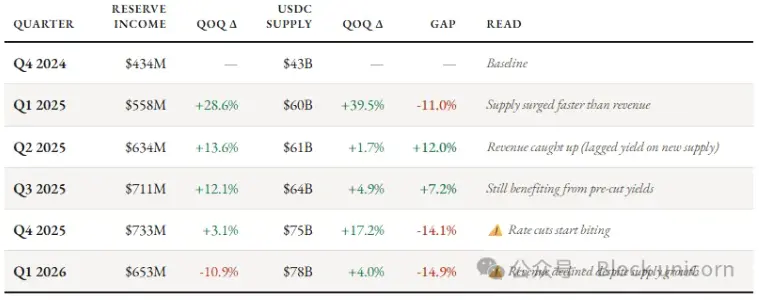
Circle's primary revenue source is not growing proportionally with its circulating stablecoin supply.

The company also faces a value leakage problem.

The 60 Cent Awakening

This means that for every dollar Circle earns, it pays over 60 cents to platforms that hold and distribute USDC. Of the $405 million in USDC distribution costs in Q1 2026, Circle paid $330 million (about 80%) to Coinbase alone. Out of $653 million in reserve income this quarter, Circle paid $405 million to partners for distribution and transaction costs.

In an industry where new players are constantly expanding and integrating across every layer of the tech stack, this is a significant amount of money left on the table.

All signs point to Circle facing reality. Interest rates keep falling, reducing its reserve income; distribution costs remain high, causing persistent value leakage; and Circle's core business remains a proxy for yield, whose value shrinks with each Fed rate cut. Under President Donald Trump, expectations for a dovish Fed stance have intensified.

What is Circle's response? The answer: vertical integration to capture more value across the business chain and reduce reliance on interest income.

To understand what Circle is building, consider what it currently owns.

The USDC issuer started at the bottom of the stablecoin stack—the issuance layer—and has spent years watching others capture value on every layer above it.
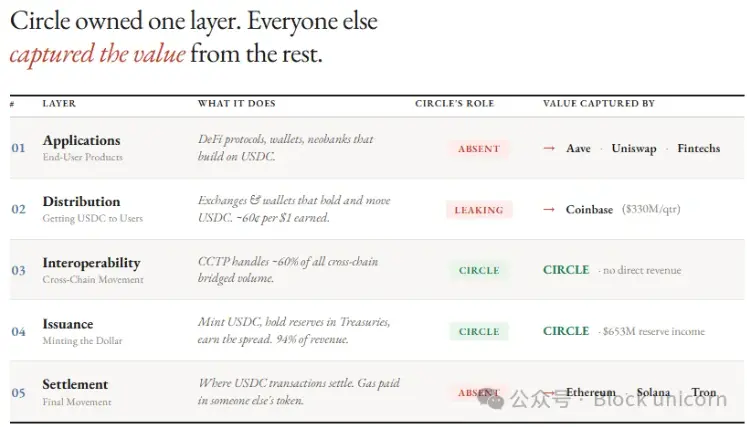
At the issuance layer, Circle issues USDC and EURC, holds US Treasury reserves via the Circl Reserve Fund managed by BlackRock, manages the 1:1 peg, and handles issuance and redemption via Circle Mint. 94% of its total revenue comes from government bond reserve yield.

Subsequently, Circle expanded into the interoperability layer with its Cross-Chain Transfer Protocol (CCTP), which transfers USDC between blockchains and handles about 60% of cross-chain bridging volume. Although this mechanism routes USDC between chains, CCTP itself runs on chains owned by others. Therefore, Circle cannot derive significant direct income from it.

All other layers in the stack belong to others.

The settlement system runs on Ethereum, Solana, and Tron. Every USDC transaction pays gas fees in other tokens (ETH, SOL, TRX), and Circle has no control over congestion, fees, or governance on these chains.

Distribution channels rely primarily on Coinbase, exchanges, and wallets. Circle must pay revenue shares, incentive program fees, and integration costs to get USDC into users' hands.

Third parties, such as DeFi protocols, fintechs, neobanks, and prediction markets, build the applications and products that use USDC. This means the end customer, whether retail or institutional, never has to interact directly with Circle.

This structure results in Circle keeping only 40 cents of every dollar it earns.

Taking Control of the Stack

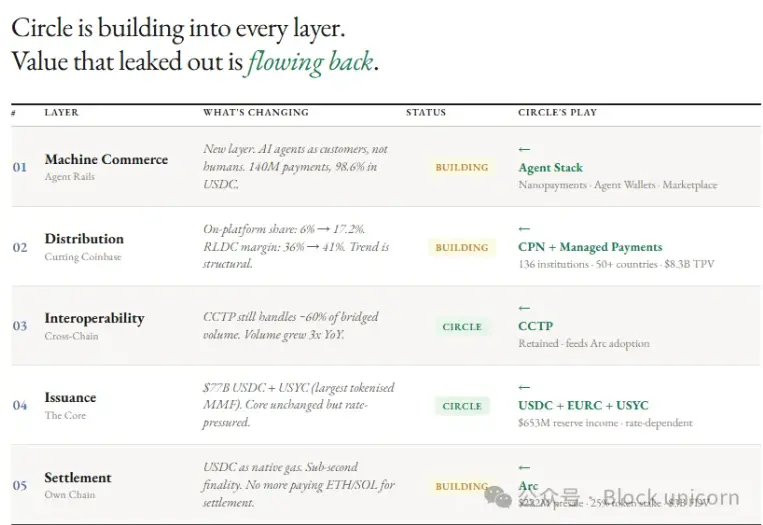
On May 11th, Circle announced three investment plans aimed at vertically integrating different layers of the business it did not previously own.

First is settlement. Circle owns the native Layer-1 blockchain Arc, designed to capture fees currently generated when USDC moves on blockchains like Ethereum, Solana, and Tron.

EVM-compatible Arc offers sub-second finality and uses USDC as its native gas fee token, with transaction costs around $0.001. To make its chain more attractive to institutional users, Circle offers configurable privacy and a quantum-resistant architecture. General-purpose chains like Ethereum and Solana are fully transparent and cannot provide the privacy needed for sensitive transactions like institutional payments.

Circle raised $222 million via an ARC token presale at a $3 billion valuation. This round was led by a $75 million funding round from a16z, with other investors including BlackRock, Apollo Global Management, Intercontinental Exchange (parent of NYSE), Standard Chartered, ARK Invest, SBI Group, IDG Capital, Bullish, and Haun Ventures.

Second is distribution. The Circle Payments Network (CPN) helps the USDC issuer reduce its reliance on Coinbase.

CPN connects financial institutions directly to Circle's network, allowing them to mint, redeem, and route USDC without going through an exchange. The network has 136 registered institutions (up 36% quarter-over-quarter), $8.3 billion in annualized transaction volume (up 17% quarter-over-quarter), and facilitates fiat payments in over 50 countries.

Consequently, the proportion of USDC based on Circle's own infrastructure nearly tripled, from about 6% a year ago to 17.2%. Even as reserve yields declined, the RLDC margin (revenue minus distribution and transaction costs as a percentage of revenue) steadily recovered from 38% in Q2 2025 to 41% in Q1 2026.

Circle has not yet commercialized CPN, prioritizing user growth over fees. But once commercialized, each additional dollar of CPN usage will generate usage-based revenue for Circle, independent of interest rates.

Third is the application layer. Through this third layer, Circle aims to capture ongoing value across the agent economy by charging small fees on large transactions executed by AI agents.

Circle is building a full agent economy through products like Agent Wallets, Nanopayments (supporting gas-free USDC transfers as low as $0.000001 [one-millionth of a dollar]), the Agent Marketplace (where agents can discover and pay for services), and Circle CLI (accelerating agent onboarding and wallet configuration).

How large is the market opportunity for agent payments? Last month, Circle's Head of Marketing, Peter Schroeder, posted that USDC accounted for 98.6% of the 140 million transactions completed by AI agents within nine months.
The Stack Race

Circle's expansion up the payments stack is not easy. Payments giant Stripe started at the top and gradually went deeper through a series of deals and product launches. Acquiring Bridge gave Stripe control over authorization, custody, forex, and issuing layers. Launching Tempo took Stripe into the settlement layer. Today, Stripe controls all seven payments layers, serving 5 million merchants.

Tether uses Plasma, incubated by the USDT issuer, as its settlement chain. However, Tether's regulatory oversight still lags behind USDC's.

Stripe dominates human-to-human transactions, while Tether leads in dollar transactions in emerging markets and crypto trading. Therefore, Circle is positioning itself in institutional settlement and machine-to-machine transactions, where regulatory credibility and programmable infrastructure may be more important than the checkout integrations Stripe dominates.

CRCL's Retort

Although Circle raised $222 million by preselling ARC tokens to institutional investors, the initial development funding for ARC actually came from CRCL's shareholders. Ironically, Circle's biggest challenge might be handling internal resistance.

What is the significance of the Arc token's value growth for a public company? I pointed out this issue last November.

"The nature of the native token will create some controversy in public markets. Why should the market acknowledge or value a native token that captures the value created by Arc and CPN, rather than letting that value flow back to Circle's P&L? Why should Circle's surplus fund a cost center that is not expected to return profits to shareholders? Existing shareholders will not tolerate this. Public market investors bought CRCL for its reserve yield. They are unlikely to stand by and watch a new asset absorb the value appreciation of the infrastructure they invested in."

How will Circle resolve this? Is a separate listing for Arc justified? Only in the first quarter after Arc's mainnet launch will we know the answer.

For now, Circle's long-term goal is to capture as much value as possible by expanding its presence across these layers. Every time USDC settles on Arc, Circle earns a settlement fee. When institutions transact via CPN, Circle will retain distribution profits. Finally, when agents transact via Nanopayments on Arc, Circle hopes to charge fees at that layer as well.

Domande pertinenti

QWhat is Circle's primary revenue source, and why is it under pressure?

ACircle's primary revenue source is the interest income from holding US Treasury reserves backing its USDC stablecoin, which accounted for 94% of its total revenue. This revenue is under pressure because the Federal Reserve has been lowering interest rates, reducing the yield on these reserves. In Q1 2026, the average reserve yield dropped to 3.50% from 4.16% a year earlier, significantly slowing revenue growth despite an increase in USDC circulation.

QWhat problem does Circle face with its distribution and transaction costs for USDC?

ACircle faces a significant value leakage problem with its distribution and transaction costs. In Q1 2026, it paid out $405 million (over 60 cents for every dollar of reserve revenue earned) to partners like Coinbase and other platforms for distributing and settling USDC. This high cost represents a major outflow of the value it generates.

QWhat three key initiatives did Circle announce to vertically integrate its business and capture more value?

ACircle announced three key initiatives to vertically integrate: 1) Launching its own Layer-1 blockchain called Arc, which uses USDC as its native gas token and aims to capture settlement fees. 2) Expanding its Circle Payments Network (CPN) to directly connect financial institutions and reduce reliance on distributors like Coinbase. 3) Building an AI agent economy infrastructure (including Agent Wallets, Nanopayments) to capture value from micro-transactions executed by AI agents on its network.

QHow does Circle's new Layer-1 blockchain, Arc, differ from general-purpose blockchains like Ethereum or Solana?

AArc differs from general-purpose blockchains like Ethereum or Solana by being specifically designed for institutional use. Key features include: EVM compatibility, sub-second finality, USDC as the native gas token (with fees around $0.001 per transaction), configurable privacy for sensitive transactions (unlike the fully transparent nature of Ethereum/Solana), and a quantum-resistant architecture.

QWhat potential internal conflict does Circle face regarding the development and value capture of its new Arc blockchain and token (ARC)?

AA potential internal conflict arises because Circle's publicly traded shareholders (CRCL) invested in the company primarily for its reserve yield business. The new Arc blockchain and its separate ARC token are designed to capture the future value generated by Circle's infrastructure (like settlement fees from Arc and CPN). Shareholders may resist this structure if the value flows to the ARC token holders instead of back to Circle's corporate profits and, by extension, to CRCL shareholders. The company will need to justify how this benefits its existing public shareholders.

Letture associate

From Gold to Bitcoin: Fixed Supply + Institutional Frenzy, Might It Repeat the 'Explosive' Price Trend?

"From Gold to Bitcoin: Fixed Supply and Institutional Frenzy May Lead to 'Explosive' Price Rally Analysts suggest Bitcoin's price action could mirror gold's over the past two decades, following the launch of spot Bitcoin ETFs. Gold ETFs, introduced in 2004, drove gold's price surge to a current market cap near $28 trillion. Both gold and Bitcoin are non-yielding stores of value, with prices driven purely by investor sentiment rather than cash flows or credit. Gold ETFs experienced dramatic cycles: explosive growth, painful drawdowns, and slow recoveries, with each cycle reaching higher peaks. Bitcoin ETFs, approved in early 2024, saw rapid institutional adoption but are now facing similar volatility. Recent warnings highlight the risk of significant ETF outflows disrupting the current rebound. BlackRock's IBIT, a leading Bitcoin ETF, has sold nearly 100,000 BTC to meet redemptions while still holding over 733,000. The core parallel is fixed supply: when demand surges, prices explode, but demand is often volatile and wave-like, not steady. Institutional interest, through ETFs and corporate adoption, remains a key support pillar, helping to cushion sell-offs. If Bitcoin captures even a fraction of gold's role as a store of value, its upside potential is immense, though the path will be marked by high volatility. For investors, focusing on long-term trends and managing risk is crucial as this 'price explosion' narrative unfolds."

Foresight News5 min fa

From Gold to Bitcoin: Fixed Supply + Institutional Frenzy, Might It Repeat the 'Explosive' Price Trend?

Foresight News5 min fa

Why Is AI Agent Shopping Hard to Popularize?

The article argues that the popular narrative of "AI agent shopping" – equipping AI with a wallet to autonomously handle purchases – is fundamentally flawed and oversimplifies the complexity of shopping. It deconstructs shopping into two core actions: **information retrieval** (standardized, easily automated) and **value judgment** (deeply subjective and human-centric). The narrative mistakenly assumes AI can fully handle both. Value judgment itself has two layers: **evaluation** (assessing options against criteria) and **demand definition** (setting the criteria, weights, and values). The latter is inherently human and dynamic, as preferences are not fixed but constructed during the decision-making process ("constructive preferences"). The real dividing line for automation is not product standardization, but whether the **act of choosing** itself holds experiential value. For mundane purchases (e.g., printer paper), full AI delegation works. For experiential goods (e.g., wine, furniture), the joy of selection is core to consumption, so AI should act as an assistant that narrows options, leaving the final choice to humans. The "AI wallet" concept confuses three separate elements: decision-making, execution, and fund custody. Current payment industry solutions (e.g., from Stripe, Mastercard, Google, Visa) show that limited, scoped payment authorization tokens are sufficient for most consumer scenarios, not full fund custody. The true use case for autonomous AI wallets is in **B2B procurement** and **machine-to-machine (M2M) settlements** for standardized, high-frequency, low-value transactions. The real bottlenecks for AI shopping are not payment technology, but **1) the lack of trusted data sources** (e.g., fake reviews, counterfeit goods) and **2) the impossibility of automating human demand definition**. The conclusion is that the focus should be on safely automating the assessment and filtering process while reserving for humans the rights to define their criteria and enjoy the final act of choice. For experiential goods, the platform's competitive advantage shifts to providing a superior selection experience.

Foresight News1 h fa

Why Is AI Agent Shopping Hard to Popularize?

Foresight News1 h fa

After Nine Months of Shorting, a Full Turn to Long: Renowned Trader Opens Bitcoin Positions Around 64K, Crypto Market Long-Short Divergence Intensifies

After nine months of being short, prominent crypto trader Doctor Profit has closed all his bearish positions and started buying Bitcoin near $64,000, signaling a complete bullish reversal. He argues that structural market changes—such as impending U.S. regulation (CLARITY Act) and institutional adoption via securities tokenization—are rewriting the traditional four-year cycle script, potentially bringing the market bottom forward from the widely expected September/October timeframe. This view finds some technical support from on-chain analyst gumsays, who notes a bullish divergence on Bitcoin's weekly chart has persisted for 147 days, nearing the 161-day duration seen before the 2022 cycle low. However, cycle researcher Jake Pahor presents a counter-argument based on historical data. Analyzing patterns since 2014, he identifies three common features of past bear market bottoms: a ~12-month duration from peak to trough, a sustained period of extreme fear (with a proprietary risk score below 20), and the price falling below Bitcoin's realized price (~$53,000 currently). The current cycle, only nine months from its October 2025 peak, meets none of these conditions. The debate highlights a market torn between "front-running" a potential early bottom driven by new fundamentals and waiting for confirmation through traditional on-chain and sentiment metrics. While Doctor Profit opts for aggressive buying, Pahor maintains a disciplined, tiered accumulation strategy, continuing weekly buys at current risk levels but reserving larger orders for if more extreme fear emerges.

marsbit1 h fa

After Nine Months of Shorting, a Full Turn to Long: Renowned Trader Opens Bitcoin Positions Around 64K, Crypto Market Long-Short Divergence Intensifies

marsbit1 h fa

Senior Trader's Confession: How to Trade Market's False Expectations?

Veteran trader's case study: trading the market's "wrong expectations". This trade centered on a textbook "expectation error" after a weak CPI report. While the market initially priced in broad monetary easing (sending Nasdaq to 30,060), the crucial 30-year real yield hit a 20-year high. This signaled a fractured transmission mechanism: short-term rates eased, but long-term funding costs (vital for tech valuations) refused to fall. The trader executed five short positions on the Nasdaq (NQ) as it fell from 30,060 to 28,768. The core methodology: don't just trade the data, but analyze the market's implied causal chain and identify where it breaks. In this case, the chain was: Weak CPI → Policy Easing → Lower Long-Term Funding Costs → NQ Valuation Expansion. The break occurred between policy easing and long-term rates. The "veto variable" – long-term real yields – refused to confirm the bullish narrative. Trades were structured around "fast variables" (price) temporarily repairing while "slow variables" (funding conditions) remained broken. The article outlines a repeatable framework: 1) Map the market's implied causal chain. 2) Identify the veto variable. 3) Observe if it rejects the narrative. 4) Enter when price still follows the old script. 5) Choose the cleanest asset expression (e.g., short NQ, not broad S&P). 6) Define both invalidation and fulfillment exit conditions. The key insight: Alpha often comes not from an information edge, but from a "reaction function edge" – recognizing when the market is applying an outdated causal logic to new data. The critical question: What causal chain is the market's first reaction relying on, and is that chain still valid today?

marsbit1 h fa

Senior Trader's Confession: How to Trade Market's False Expectations?

marsbit1 h fa

Trading

Spot
活动图片