Circle: From Issuance to Infrastructure

marsbitPubblicato 2026-05-19Pubblicato ultima volta 2026-05-19

Introduzione

Title: Circle: From Issuance to Infrastructure Circle, the issuer of the USDC stablecoin, is undergoing a strategic transformation to reduce its dependence on interest income from reserve holdings, which is declining due to falling interest rates. Historically, Circle's revenue came primarily from the yield on US Treasury reserves backing USDC. However, it also paid significant fees (approximately 60 cents of every dollar earned) to partners like Coinbase for distributing and settling USDC. To capture more value across the financial stack, Circle is vertically integrating into three new layers: 1. **Settlement Layer:** It is launching **Arc**, a native Layer-1 blockchain. Arc, which uses USDC as its gas token, aims to capture transaction fees currently paid to other blockchains (like Ethereum and Solana) and offers features like privacy for institutional payments. 2. **Distribution Layer:** The **Circle Payments Network (CPN)** connects financial institutions directly to Circle, reducing reliance on exchanges like Coinbase. While not yet monetized, CPN growth has improved Circle's margins. 3. **Application Layer:** Circle is building an **AI Agent Economy** infrastructure with products like Agent Wallets and Nanopayments. The goal is to capture fees from high-volume, automated transactions executed by AI agents, a market where USDC already dominates. These moves represent Circle's shift from a single-product company (USDC issuance) to a full-stack financial platform....

Article compiled by: Block unicorn

The company has earned billions in interest income by holding Treasury reserves as collateral for its stablecoin, and pays fees to other platforms for distributing and settling USDC throughout the payment system. For every dollar Circle earns, it pays out about 60 cents to its USDC partners. As long as the profit margin was large enough, it could afford this cost. But with the arrival of a low-interest-rate environment, the USDC issuer lost too much profit. For most of its existence, Circle had only one product: USDC.

In its recently released Q1 2026 earnings report, the USDC issuer announced several initiatives aimed at enhancing the value captured within its operational scope. These include: a $222 million presale for its native Layer-1 token ARC at a fully diluted valuation of $30 billion; the launch of AI agent infrastructure; and the expansion of its Circle Payments Network, enabling banks to facilitate stablecoin payments by bypassing the volatility of digital assets. However, achievements from the past few quarters will change this status quo.

In summary, these moves signal Circle's attempt to transform from a single-layer company into a full-stack financial platform capable of operating and capturing value across multiple layers of the payment stack.

Today, I will assess whether Circle can use vertical integration to offset the erosion of its yield-generating business, which shrinks with every Federal Reserve rate cut.

The Vanishing Float

In Q1 2026, Circle's total revenue was $694 million, a 20% year-over-year increase. This growth was entirely due to the expansion of stablecoin circulation, with no improvement from USDC itself. The circulating stablecoin supply grew from $235 billion in March 2025 to $315 billion in March 2026, an increase of over 30%. During the same period, USDC's market share declined by 62 basis points.

Circle faces a bigger problem. The era of low interest rates has arrived, with the Fed rate dropping from 4.5% a year ago to the current 3.75%.

Despite a 39% year-over-year increase in the average circulating supply of USDC through Q1 2026, Circle's reserve income only grew 17% year-over-year to $653 million. This is because the average reserve yield decreased by 66 basis points year-over-year, dropping from 4.16% in Q1 2025 to 3.50% in Q1 2026, significantly offsetting the aforementioned growth.

This is not a one-time phenomenon. The gap between Circle's reserve revenue growth rate and USDC supply growth rate has been narrowing for the past four quarters.
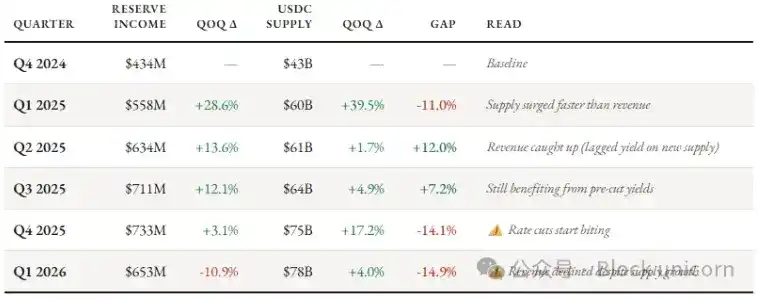
Circle's primary revenue source is not growing proportionally with its circulating stablecoin supply.

The company also faces a value leakage problem.

The 60-Cent Wake-Up Call

This means the cost of platforms holding and distributing USDC exceeds 60 cents per dollar earned. Of the $405 million in distribution and transaction costs paid by Circle in Q1 2026, approximately $330 million (about 80%) went to Coinbase. Out of the quarter's $653 million in reserve income, Circle paid $405 million to partners for distribution and transaction costs.

In an industry where new players are constantly emerging and integrating across all layers of the tech stack, this is a massive amount of money left on the table.

At this point, the signs are clear that Circle should face reality. Interest rates keep falling, dragging down its reserve income; distribution costs remain high, causing constant value leakage; and Circle's core business remains a proxy for yield, shrinking in value with each Fed rate cut. Under the leadership of U.S. President Donald Trump, market expectations for a dovish Fed are growing stronger.

What is Circle's response? The answer: capture more value across the entire business chain through vertical integration and reduce reliance on interest rate income.

To understand what Circle is building, consider what it currently possesses.

The USDC issuer started at the bottom layer of the stablecoin stack—the issuance layer—and for years watched others capture value at every layer above it.
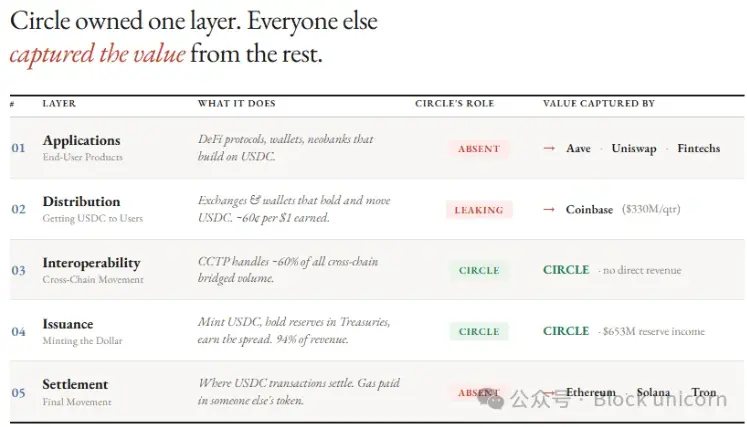
At the issuance layer, Circle issues USDC and EURC, holds U.S. Treasury reserves via the BlackRock-managed Circle Reserve Fund, manages the 1:1 peg, and handles issuance and redemption through Circle Mint. 94% of its total revenue comes from government bond reserve yields.

Subsequently, Circle expanded into the interoperability layer via its Cross-Chain Transfer Protocol (CCTP), which transfers USDC between blockchains and handles about 60% of cross-chain bridging volume. Although this mechanism routes USDC across chains, CCTP itself runs on chains owned by others. Therefore, Circle cannot derive significant direct revenue from it.

All other layers in the stack belong to others.

Settlement systems run on Ethereum, Solana, and Tron. Every USDC transaction pays gas fees in other tokens (ETH, SOL, TRX), and Circle has no control over congestion, fees, or governance on these chains.

Distribution channels rely heavily on Coinbase, exchanges, and wallets. Circle must pay revenue shares, incentive program fees, and integration costs to get USDC into users' hands.

Third parties, such as DeFi protocols, fintech companies, neo-banks, and prediction markets, build applications and products that use USDC. This means end customers, whether retail or institutional, do not need to transact directly with Circle.

This structure results in Circle capturing only about 40 cents of every dollar it generates.

Controlling the Stack

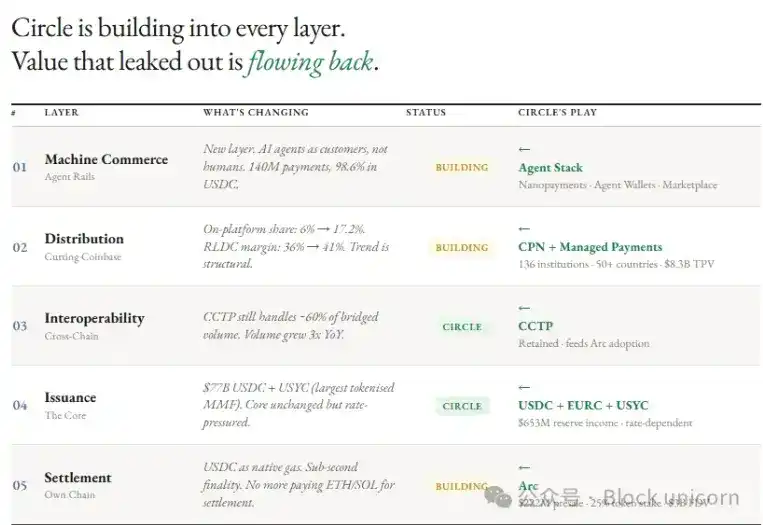
On May 11, Circle announced three investment plans aimed at vertically integrating different layers of the business it previously did not own.

First, settlement. Circle owns the native Layer-1 blockchain, Arc, designed to capture the fees currently generated when USDC is transferred on chains like Ethereum, Solana, and Tron.

The EVM-compatible Arc offers sub-second finality and uses USDC as its native gas fee token, with each transaction costing about $0.001. To make its chain more attractive to institutional users, Circle offers configurable privacy and quantum-resistant architecture. In contrast, general-purpose public chains like Ethereum and Solana are completely transparent and cannot provide privacy for sensitive transactions like institutional payments.

Circle raised $222 million through an ARC token presale, reaching a $3 billion valuation. This funding round was led by a $75 million investment from a16z, with other investors including BlackRock, Apollo Global Management, Intercontinental Exchange (owner of the NYSE), Standard Chartered, ARK Invest, SBI Group, IDG Capital, Bullish, and Haun Ventures.

Second, distribution. The Circle Payments Network (CPN) helps the USDC issuer reduce its dependence on Coinbase.

CPN connects financial institutions directly to Circle's network, enabling them to mint, redeem, and route USDC without going through exchanges. The network has 136 registered institutions (up 36% quarter-over-quarter), an annualized transaction volume of $8.3 billion (up 17% quarter-over-quarter), and facilitates fiat payments in over 50 countries.

Consequently, the percentage of USDC based on Circle's own infrastructure nearly tripled, from about 6% a year ago to 17.2%. Even with declining reserve yields, the RLDC margin (revenue minus distribution and transaction costs as a percentage of revenue) steadily recovered from 38% in Q2 2025 to 41% in Q1 2026.

Circle has not yet commercialized CPN, prioritizing user growth over charging fees. But once commercialized, for every additional dollar of CPN usage, Circle will gain usage-based revenue, independent of interest rates.

Third is the application layer. Through products like Agent Wallets, Nanopayments (supporting gas-free USDC transfers as low as $0.000001 [one millionth of a dollar]), Agent Marketplace (where agents can discover and pay for services), and Circle CLI (accelerating agent registration and wallet configuration), Circle is building a full agent economy.

Through this third layer, Circle aims to capture ongoing value across the agent economy by charging small fees on high-volume transactions executed by AI agents.

How big is the market opportunity for agent payments? Last month, Circle's Head of Marketing, Peter Schroeder, posted that USDC accounted for 98.6% of the 140 million transactions completed by AI agents within nine months.
The Stack Race

Circle's expansion into the payment stack is not easy. The payment giant Stripe started at the top and worked its way down through a series of acquisitions and product launches. Acquiring Bridge gave Stripe control over authorization, custody, forex, and card issuance layers. Launching Tempo brought Stripe into the settlement layer. Today, Stripe controls all seven payment layers, serving 5 million merchants.

Tether uses Plasma, incubated by the USDT issuer, as its settlement chain. However, Tether's regulatory scrutiny still falls short of USDC's.

Stripe dominates human-to-human transactions, while Tether leads in dollar transactions in emerging markets and crypto trading. Therefore, Circle is positioning itself in institutional settlement and machine-to-machine transactions, where regulatory credibility and programmable infrastructure may be more critical than the checkout integrations Stripe dominates.

CRCL's Fight Back

Although Circle raised $222 million by preselling ARC tokens to institutional investors, the initial development funding for ARC actually came from CRCL shareholders. Ironically, the biggest resistance Circle may face is internal.

What does the appreciation of the Arc token mean for a public company? I pointed out this issue last November.

"The nature of the native token will cause some controversy in public markets. Why should the market recognize or value a native token that captures the value created by Arc and CPN, instead of having that value flow back to Circle's P&L? Why should Circle's surplus be used to fund a cost center not expected to return profits to shareholders? Existing shareholders would never tolerate this. Public market investors bought CRCL for its reserve yield. They are unlikely to watch a new asset absorb the appreciation from the infrastructure they invested in."

How will Circle resolve this? Is a separate listing for Arc justified? We will only know the answer after Arc's mainnet launches and its first quarter of operation.

For now, Circle's long-term goal is to capture as much value as possible by expanding its reach across these layers. Every time USDC settles on Arc, Circle earns settlement fees. When institutions transact through CPN, Circle retains the distribution profits. Finally, when agents transact via Nanopayments on Arc, Circle also hopes to capture fees at that layer.


Domande pertinenti

QWhat is the primary challenge that Circle faces with its main revenue source as described in the article?

ACircle's primary challenge is the shrinking yield from its reserve income. This is because its main revenue source comes from interest earned on US Treasury bonds held as collateral for USDC. As the Federal Reserve lowers interest rates, Circle's yield decreases. Furthermore, its revenue growth is not keeping pace with the growth in its stablecoin supply (USDC circulation), which exacerbates the problem.

QAccording to the article, what strategy is Circle implementing to capture more value and reduce its dependence on interest rate income?

ACircle is pursuing a strategy of vertical integration across the payment technology stack. This involves expanding into and controlling layers it previously did not own, specifically in settlement (with its native Arc blockchain), distribution (with the Circle Payments Network, CPN), and the application layer (with its AI agent infrastructure). This allows Circle to capture fees and value at multiple points in the transaction flow rather than just at the issuance layer.

QWhat are the three key announcements made by Circle on May 11th as part of its vertical integration efforts?

AOn May 11th, Circle announced three key initiatives: 1. The native Layer-1 blockchain 'Arc' for settlement, which uses USDC as its native gas token. 2. The expansion of the 'Circle Payments Network (CPN)' to reduce reliance on partners like Coinbase for distribution. 3. The development of its 'AI agent infrastructure' (Agent Wallets, Nanopayments, Agent Marketplace) to capture value from transactions executed by AI agents.

QHow does the article describe the potential internal conflict for Circle regarding the development of its Arc blockchain and ARC token?

AThe article points out a potential internal conflict for Circle, a publicly traded company. The conflict arises from the fact that the value created by the Arc blockchain and the CPN might be captured by the ARC token rather than flowing back to Circle's core business and its shareholders (who invested in CRCL stock). Public market investors bought CRCL primarily for its reserve income yield and may not tolerate company resources being used to fund a new asset (ARC) that does not directly return profits to them.

QHow is Circle positioning itself to compete with existing giants like Stripe and Tether in the payments space?

ACircle is positioning itself in the specific niches of 'institutional settlement' and 'machine-to-machine transactions'. It aims to leverage its regulatory credibility (compared to Tether) and programmable, privacy-focused infrastructure (like the Arc blockchain) to serve these markets. This is a different focus from Stripe, which dominates human-to-human merchant checkouts, and Tether, which leads in emerging market dollar trading and crypto trading.

Letture associate

When Hyperliquid Steals Solana's 'Internet Capital Market' Script

The article "When Hyperliquid Steals Solana's 'Internet Capital Markets' Playbook" discusses Solana's struggles to maintain its "internet capital markets" narrative by 2026. Despite its initial success as a high-performance "Ethereum killer," SOL's price has underperformed, dropping significantly compared to other major cryptocurrencies. Solana's vision of a global, on-chain trading network for all assets is being challenged not primarily by Ethereum, but by Hyperliquid. Hyperliquid, evolving from a perpetual contracts platform into a dedicated financial infrastructure Layer 1, has become a major beneficiary of the shift of derivatives trading from centralized exchanges to on-chain. The article argues that for high-frequency financial trading, a specialized, performance-focused chain like Hyperliquid may be more suitable than a general-purpose ecosystem like Solana. Further compounding Solana's issues was a major $200+ million exploit on its key perpetual protocol, Drift, in April, which damaged market confidence. In response, Solana founder Anatoly Yakovenko heavily promoted the protocol Phoenix as a replacement, boosting its visibility but not its trading volume, which remains far behind leading platforms. Solana supporters have launched a public critique of Hyperliquid's decentralization, pointing to its limited validators and closed-source code. Critics, however, note Solana's own declining validator count and centralization metrics. This strategy has also caused internal friction, with developers of other Solana protocols expressing discontent over the foundation's perceived favoritism towards Phoenix. The conclusion is that Hyperliquid's rise represents a challenge to the "general-purpose blockchain" narrative, proving that the core of a capital market might be a specialized trading engine rather than a broad ecosystem. If Solana cannot regain dominance in derivatives, it risks remaining a "meme coin paradise" while its grand "internet capital markets" ambition slips away.

marsbit21 min fa

When Hyperliquid Steals Solana's 'Internet Capital Market' Script

marsbit21 min fa

When Hyperliquid Steals Solana's 'Internet Capital Markets' Playbook

The article discusses how Solana's grand vision of becoming an "Internet Capital Markets" platform is facing significant challenges in 2026, primarily from the unexpected rise of Hyperliquid. Solana's performance has weakened, with its token SOL experiencing the largest price decline among major cryptocurrencies. Its core narrative of building a global, chain-based marketplace for all assets is under pressure both internally and externally. Hyperliquid, originally a perpetual futures exchange, has evolved into a dedicated Layer 1 financial infrastructure network. Its focused, trading-centric approach is attracting capital and challenging the assumption that a "general-purpose" ecosystem like Solana is necessary for a capital market. Hyperliquid's success suggests that for high-frequency trading, superior performance, liquidity, and user experience may be more critical than a broad application ecosystem. Internally, Solana's strategy suffered a blow from a major hack on the Drift Protocol in April, resulting in over $200 million in losses. In response, Solana founder Anatoly Yakovenko has heavily promoted Phoenix as a new decentralized perpetual futures platform on Solana. While this boosted Phoenix's visibility, its trading volume remains far behind leading platforms. Solana's community has launched a rhetorical attack against Hyperliquid, questioning its decentralization due to its limited validator set and closed-source code. Critics, however, point out Solana's own decreasing validator count and increasing centralization of stake. This focus on "decentralization metrics" has also caused internal friction, with other Solana ecosystem developers expressing discontent over the foundation's perceived favoritism towards Phoenix. The article concludes that the rise of Hyperliquid represents a challenge to the "general-purpose blockchain" narrative, proving that an efficient trading engine might be more central to a capital market than a vast ecosystem. If Solana cannot regain dominance in the derivatives space, it risks remaining a "meme coin paradise" rather than achieving its ambition of hosting global assets.

链捕手29 min fa

When Hyperliquid Steals Solana's 'Internet Capital Markets' Playbook

链捕手29 min fa

Samsung Bets on Mobile HBM: AI Moves from Cloud to Palm, a New Frontier in Semiconductor Investment?

Samsung is betting on bringing high-bandwidth memory (HBM) technology from servers to mobile devices, aiming to enable powerful on-device AI features in smartphones and tablets. This move is driven by the booming AI market, where HBM demand from data centers has fueled Samsung's record profits, with HBM4 already in mass production. By integrating mobile HBM, Samsung seeks to transform user AI experiences—making tasks like image generation and real-time translation faster, seamless, and more private by processing data locally. Strategically, this allows Samsung to leverage its vertical integration in memory, advanced packaging, and Exynos processors to differentiate its Galaxy devices against competitors like Apple and Qualcomm. It also opens a new consumer growth avenue, reducing reliance on volatile server HBM demand alone. The initiative is expected to benefit the broader supply chain, boosting demand for advanced packaging materials, thermal solutions, and other components. While promising, risks include potential delays in mobile HBM mass production beyond 2027, high initial costs, and the cyclical nature of the memory market. Nonetheless, Samsung's push signals a broader industry shift toward hybrid cloud-edge AI computing, positioning it as a key player in defining the future of AI-powered devices and presenting a potential long-term investment theme in semiconductors.

marsbit39 min fa

Samsung Bets on Mobile HBM: AI Moves from Cloud to Palm, a New Frontier in Semiconductor Investment?

marsbit39 min fa

Trillion-Dollar Banking Giant Adjusts Portfolio: Buys XRP Heavily, Clears Out Solana

In a significant portfolio rebalancing move, Italian banking giant Intesa Sanpaolo, with $1.1 trillion in assets, has made a notable shift in its cryptocurrency holdings. According to disclosures from Q4 2025 to Q1 2026, the bank's total crypto exposure surged from $100 million to approximately $235 million. The most striking action was its first-time establishment of an XRP position, investing around $18 million through the Grayscale XRP Trust. This marks a milestone as one of the first major European banks to adopt XRP via a regulated investment vehicle. This move is part of a broader, systematic digital asset strategy. The bank also substantially increased its Bitcoin exposure via ETFs and initiated its first Ethereum investment through a staking trust. In a contrasting strategic pivot, Intesa Sanpaolo drastically reduced its Solana holdings by over 99%, nearly exiting its position in a Bitwise Solana staking ETF. This shift is interpreted as reflecting a institutional preference for assets perceived with lower regulatory and operational risk, especially following Solana's network stability issues and improved clarity for XRP after its legal settlements. The bank's actions highlight key drivers for institutional adoption: clearer regulations, the availability of compliant ETF products, and the search for portfolio diversification. This trend signifies crypto's evolving status from a niche experiment to a recognized component of mainstream asset allocation, with institutions favoring gradual, regulated entry points over direct token ownership.

marsbit1 h fa

Trillion-Dollar Banking Giant Adjusts Portfolio: Buys XRP Heavily, Clears Out Solana

marsbit1 h fa

Base Native Leveraged Prediction Market OmenX Officially Launches on Mainnet

Base-native leveraged prediction market platform OmenX has officially launched on mainnet. It currently supports up to 5x leverage, with plans to increase to 10x based on platform liquidity and market conditions. Unlike traditional prediction markets where users fully collateralize YES/NO positions and wait for settlement, OmenX aims to create a trading platform-like experience. Users can open leveraged positions on event outcomes, and actively trade, adjust, or hedge these positions before the event concludes for greater capital efficiency. Alongside the mainnet launch, OmenX introduced a "Hedge-to-Earn" campaign targeting existing users of other prediction markets (initially Polymarket). This initiative allows users to claim incentives or hedging benefits on OmenX based on their existing positions, aiming to introduce them to leveraged trading and active risk management. OmenX positions itself as a derivatives trading platform for prediction market assets. The team believes that as platforms like Polymarket mainstream prediction markets, event outcomes are becoming a new tradable asset class. The next phase of demand will focus on leverage, liquidity, and advanced trading tools. Post-launch, OmenX plans to expand supported market types, optimize liquidity, and develop APIs and additional trading tools. The team is also in discussions with investors and partners to secure resources for further development.

链捕手1 h fa

Base Native Leveraged Prediction Market OmenX Officially Launches on Mainnet

链捕手1 h fa

Trading

Spot
Futures
活动图片