Charles Hoskinson Blasts Ripple For Backing Bill That Could Crush Competition

bitcoinistPubblicato 2026-03-31Pubblicato ultima volta 2026-03-31

Introduzione

Cardano founder Charles Hoskinson has sharply criticized Ripple and its CEO Brad Garlinghouse for supporting proposed U.S. legislation that would classify most new tokens as securities by default. Hoskinson argues this approach would harm competition, protect established players like Ripple through exemptions, and remove legal protections for DeFi and open-source developers. He warns the bill replicates the SEC’s aggressive regulatory stance and could expose software creators to unreasonable liability. Hoskinson also addressed the XRP community, clarifying that his criticism targets Ripple’s lobbying—not the token itself—and contrasted Ripple’s “mammoth premine” with Cardano’s more distributed token distribution.

Cardano founder Charles Hoskinson used a lengthy weekly livestream to level one of his sharpest recent attacks at Ripple, arguing that the company is backing legislation that could entrench incumbents, weaken DeFi protections, and make it harder for new crypto projects to compete.

The core of Hoskinson’s complaint was not aimed at XRP holders, but at what he described as Ripple’s policy posture in Washington and the behavior of CEO Brad Garlinghouse. In Hoskinson’s telling, Ripple is pushing for rules that would classify new tokens as securities by default while benefiting from carve-outs that would leave larger, established players in a stronger position.

Hoskinson Takes Aim At Ripple Over Competition Fight

Hoskinson said Garlinghouse was “trying to pass a bill that makes everything by default a security until proven otherwise,” calling that framework a non-starter for the broader market. He argued that such an approach would effectively recreate the kind of regulatory pressure that former SEC Chair Gary Gensler brought to the sector, only this time through legislation supported by industry actors rather than enforcement alone.

“He’s trying to pass a bill that makes everything by default a security until proven otherwise, which was the treatment Gary Gensler inflicted on his own ecosystem,” Hoskinson said. “It’s a non-starter, because he knows that he’s going to get an exemption and it reduces competition. So, [expletive] the whole industry. It’s bad behavior.”

That argument sat at the center of a wider rant about market structure, lobbying, and what Hoskinson sees as crypto’s growing willingness to trade open competition for regulatory protection. He said he had already laid out “four different attack vectors” the SEC could use if such a bill were enacted, and warned that the damage would not stop with token issuers.

According to Hoskinson, the proposal would also leave open-source developers exposed by stripping out protections for DeFi builders. “The bill also removed all developer protections for DeFi developers,” he said. “Who takes care of the Tornado Cash people and these other people writing open-source software? We can’t live in a space where you have transitive unlimited liability.”

He extended that point with one of the livestream’s longer analogies, arguing that holding software developers liable for downstream use of their code would amount to a category error. “You write code and people you’ve never met use that code in places you’ve never been to and you’re held absolutely liable for that,” Hoskinson said. “That’s equivalent to you writing a book, someone reads the book and murders somebody based on a character in your book and then you get charged with murder. It’s basically the same thing.”

Hoskinson also took aim at what he described as the XRP community’s reflexive defense of Ripple whenever he criticizes the company. He said there is “no path for people to listen to the content” of his argument because any criticism of Garlinghouse is treated as an attack on XRP itself. He pushed back on that framing by noting that he publicly supported Ripple when the SEC sued the company years ago, but said that did not obligate him to back its current lobbying goals.

“Guys, I did support you when you got sued by the Securities Exchange Commission,” he said. “There’s videos of me. You can pull them up from years ago where I said it was the wrong decision.”

From there, Hoskinson shifted into one of crypto’s oldest fault lines: token distribution. He argued that Ripple had no need for outside help in its legal fight because the organization “gave themselves a mammoth premine,” saying the company already had the resources to defend itself and pursue acquisitions. He contrasted that with Cardano, saying, “I didn’t give myself 70% of the ADA supply.”

At press time, XRP traded at $1.35.
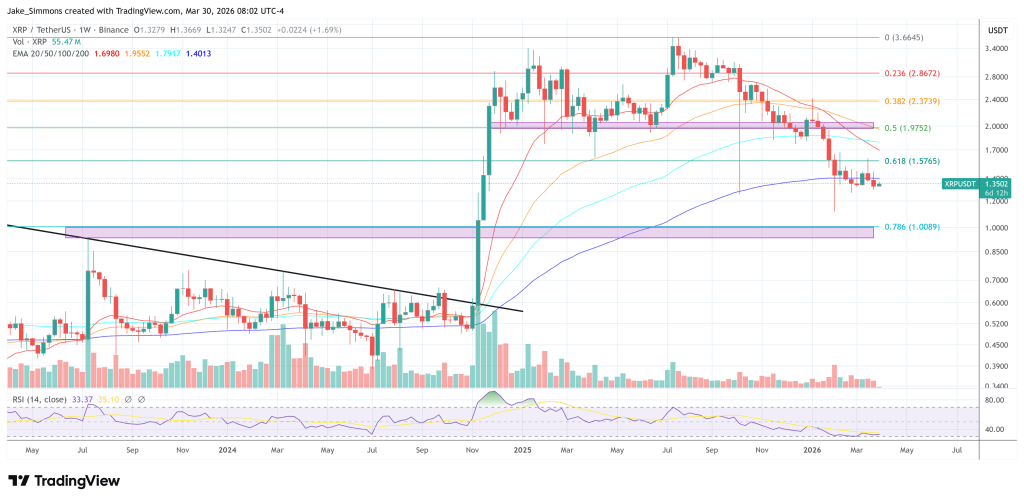
XRP falls below the 200-week EMA again, 1-week chart | Source: XRPUSDT on TradingView.com

Domande pertinenti

QWhat is Charles Hoskinson's main criticism against Ripple in this article?

ACharles Hoskinson criticizes Ripple for backing legislation that would classify new tokens as securities by default, which he believes would entrench incumbents, weaken DeFi protections, reduce competition, and benefit established players like Ripple through exemptions.

QAccording to Hoskinson, what negative consequences would the proposed bill have for DeFi developers?

AHoskinson states the bill would remove developer protections for DeFi builders, exposing open-source developers to 'transitive unlimited liability' where they could be held liable for how others use their code, similar to holding an author responsible if someone committed murder after reading their book.

QHow does Hoskinson contrast Cardano's token distribution with Ripple's?

AHoskinson contrasts the two by stating that Ripple 'gave themselves a mammoth premine' of XRP, giving them ample resources, while emphasizing 'I didn't give myself 70% of the ADA supply' for Cardano.

QWhat does Hoskinson say about the XRP community's response to his criticism of Ripple?

AHoskinson says the XRP community has a reflexive defense mechanism where any criticism of Ripple CEO Brad Garlinghouse is treated as an attack on XRP itself, making it difficult for people to actually listen to the content of his arguments.

QWhat historical support does Hoskinson mention he provided to Ripple, and how does it relate to his current stance?

AHoskinson mentions he publicly supported Ripple years ago when the SEC sued the company, calling it 'the wrong decision,' but clarifies that this past support does not obligate him to back Ripple's current lobbying efforts for what he considers anti-competitive legislation.

Letture associate

Stuck Polymarket: The Real Test After Riding the Traffic Boom Has Arrived

Polymarket, a leading prediction market platform, is facing significant technical challenges as its growth outpaces its current infrastructure on Polygon. Users are experiencing laggy transactions, unresponsive orders, and delayed confirmations, severely impacting the trading experience. In response, DeFi Engineering VP Josh Stevens outlined a comprehensive engineering overhaul. The plan includes reducing on-chain data delays, fixing order cancellation issues, rebuilding the central limit order book (CLOB), improving website performance, and developing a unified SDK and API. A major revelation was the ongoing "chain migration," indicating a potential move away from Polygon. The core issue is that Polymarket has evolved from a simple prediction market into a high-frequency trading platform, making Polygon's limitations—such as block space, gas fees, and block time—a ceiling for further growth. The migration is not just a simple chain switch but a fundamental rebuild of its trading system to support more complex products like perpetual contracts (Perps). This announcement has sparked competition among chains like Solana, Sui, and Algorand, all vying to host Polymarket. For Polygon, losing this key application, which contributes significantly to its gas fee revenue, would be a major setback. The real test for Polymarket is no longer attracting users but proving it can provide a stable, reliable trading environment that retains them.

Odaily星球日报9 min fa

Stuck Polymarket: The Real Test After Riding the Traffic Boom Has Arrived

Odaily星球日报9 min fa

Lowering Expectations for BTC's Next Bull Market

The author, Alex Xu, explains his decision to significantly reduce his Bitcoin holdings (from full to ~30% of his portfolio) during the current bull cycle, citing a lowered long-term outlook for BTC's price appreciation in the next cycle. He outlines six key reasons for this reduced expectation: 1. **Diminished Growth Drivers:** The narrative of exponential user adoption has largely played out with institutional ETF adoption. The next major growth phase—adoption by sovereign national reserves or central banks—seems unlikely in the near future. 2. **Personal Opportunity Cost:** More attractive investment opportunities have emerged in other assets, such as undervalued companies. 3. **Industry-Wide Contraction:** The broader crypto industry is struggling, with most Web3 business models (SocialFi, GameFi, DePIN) failing. This overall萧条 (depression) reduces the fundamental demand and consensus for Bitcoin. 4. **Strain on Major Buyer:** MicroStrategy, a major corporate buyer of BTC, faces rising financing expenses for its debt, which could slow its purchasing rate and create significant marginal pressure on the market. 5. **Increased Competition from Gold:** The emergence of "tokenized gold" has closed the functional gap (portability, divisibility) between physical gold and Bitcoin, offering a strong competitor in the non-sovereign store-of-value space. 6. **Security Budget Concerns:** The block reward halving continues to exacerbate the long-standing issue of funding Bitcoin's network security, with new fee source explorations like Ordinals and L2s largely failing. The author's decision to hold a significant (though reduced) position reflects a cautious, not bearish, outlook. He remains open to increasing his exposure if the fundamental reasons for his skepticism change or if new positive catalysts emerge.

marsbit47 min fa

Lowering Expectations for BTC's Next Bull Market

marsbit47 min fa

Can Iran 'Control' the Strait of Hormuz?

Iran has announced a comprehensive plan to assert control over the strategic Strait of Hormuz, a critical global oil shipping chokepoint. The proposed measures include requiring all vessels to obtain Iranian permission for passage, imposing fees for security, environmental protection, and navigation management—preferably paid in Iranian rials—and absolutely banning Israeli ships. Vessels from countries deemed hostile by Iran’s top security bodies may also be barred. Analysts suggest Iran’s motives are multifaceted: increasing pressure on the U.S. and Israel by leveraging control over oil transit to influence global prices and inflation; creating a new revenue stream, potentially exceeding $7.7 billion annually, to counter Western sanctions and support postwar reconstruction; and using transit permissions as bargaining chips in future negotiations, notably with the U.S. However, the plan faces significant practical and diplomatic challenges. Enforcing comprehensive interception and fee collection in the busy waterway, patrolled by international military forces, would be difficult. The U.S. has already countering with a blockade of Iranian ports and threats to intercept any ship paying fees, potentially strangling Iran’s oil exports and fee revenue. Broad international opposition, led by European and Gulf states, and legal controversies further complicate implementation. The proposal may ultimately serve more as a negotiating tactic than a feasible policy, with its execution remaining highly uncertain.

marsbit1 h fa

Can Iran 'Control' the Strait of Hormuz?

marsbit1 h fa

Trading

Spot
Futures
活动图片





