Charles Hoskinson Blasts Ripple For Backing Bill That Could Crush Competition

bitcoinistPubblicato 2026-03-31Pubblicato ultima volta 2026-03-31

Introduzione

Cardano founder Charles Hoskinson has sharply criticized Ripple and its CEO Brad Garlinghouse for supporting proposed U.S. legislation that would classify most new tokens as securities by default. Hoskinson argues this approach would harm competition, protect established players like Ripple through exemptions, and remove legal protections for DeFi and open-source developers. He warns the bill replicates the SEC’s aggressive regulatory stance and could expose software creators to unreasonable liability. Hoskinson also addressed the XRP community, clarifying that his criticism targets Ripple’s lobbying—not the token itself—and contrasted Ripple’s “mammoth premine” with Cardano’s more distributed token distribution.

Cardano founder Charles Hoskinson used a lengthy weekly livestream to level one of his sharpest recent attacks at Ripple, arguing that the company is backing legislation that could entrench incumbents, weaken DeFi protections, and make it harder for new crypto projects to compete.

The core of Hoskinson’s complaint was not aimed at XRP holders, but at what he described as Ripple’s policy posture in Washington and the behavior of CEO Brad Garlinghouse. In Hoskinson’s telling, Ripple is pushing for rules that would classify new tokens as securities by default while benefiting from carve-outs that would leave larger, established players in a stronger position.

Hoskinson Takes Aim At Ripple Over Competition Fight

Hoskinson said Garlinghouse was “trying to pass a bill that makes everything by default a security until proven otherwise,” calling that framework a non-starter for the broader market. He argued that such an approach would effectively recreate the kind of regulatory pressure that former SEC Chair Gary Gensler brought to the sector, only this time through legislation supported by industry actors rather than enforcement alone.

“He’s trying to pass a bill that makes everything by default a security until proven otherwise, which was the treatment Gary Gensler inflicted on his own ecosystem,” Hoskinson said. “It’s a non-starter, because he knows that he’s going to get an exemption and it reduces competition. So, [expletive] the whole industry. It’s bad behavior.”

That argument sat at the center of a wider rant about market structure, lobbying, and what Hoskinson sees as crypto’s growing willingness to trade open competition for regulatory protection. He said he had already laid out “four different attack vectors” the SEC could use if such a bill were enacted, and warned that the damage would not stop with token issuers.

According to Hoskinson, the proposal would also leave open-source developers exposed by stripping out protections for DeFi builders. “The bill also removed all developer protections for DeFi developers,” he said. “Who takes care of the Tornado Cash people and these other people writing open-source software? We can’t live in a space where you have transitive unlimited liability.”

He extended that point with one of the livestream’s longer analogies, arguing that holding software developers liable for downstream use of their code would amount to a category error. “You write code and people you’ve never met use that code in places you’ve never been to and you’re held absolutely liable for that,” Hoskinson said. “That’s equivalent to you writing a book, someone reads the book and murders somebody based on a character in your book and then you get charged with murder. It’s basically the same thing.”

Hoskinson also took aim at what he described as the XRP community’s reflexive defense of Ripple whenever he criticizes the company. He said there is “no path for people to listen to the content” of his argument because any criticism of Garlinghouse is treated as an attack on XRP itself. He pushed back on that framing by noting that he publicly supported Ripple when the SEC sued the company years ago, but said that did not obligate him to back its current lobbying goals.

“Guys, I did support you when you got sued by the Securities Exchange Commission,” he said. “There’s videos of me. You can pull them up from years ago where I said it was the wrong decision.”

From there, Hoskinson shifted into one of crypto’s oldest fault lines: token distribution. He argued that Ripple had no need for outside help in its legal fight because the organization “gave themselves a mammoth premine,” saying the company already had the resources to defend itself and pursue acquisitions. He contrasted that with Cardano, saying, “I didn’t give myself 70% of the ADA supply.”

At press time, XRP traded at $1.35.
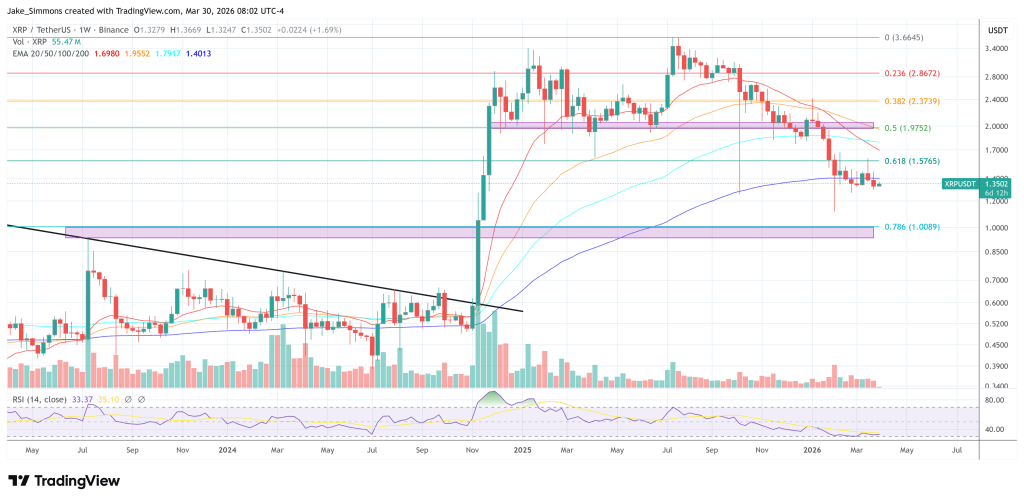
XRP falls below the 200-week EMA again, 1-week chart | Source: XRPUSDT on TradingView.com

Domande pertinenti

QWhat is Charles Hoskinson's main criticism against Ripple in this article?

ACharles Hoskinson criticizes Ripple for backing legislation that would classify new tokens as securities by default, which he believes would entrench incumbents, weaken DeFi protections, reduce competition, and benefit established players like Ripple through exemptions.

QAccording to Hoskinson, what negative consequences would the proposed bill have for DeFi developers?

AHoskinson states the bill would remove developer protections for DeFi builders, exposing open-source developers to 'transitive unlimited liability' where they could be held liable for how others use their code, similar to holding an author responsible if someone committed murder after reading their book.

QHow does Hoskinson contrast Cardano's token distribution with Ripple's?

AHoskinson contrasts the two by stating that Ripple 'gave themselves a mammoth premine' of XRP, giving them ample resources, while emphasizing 'I didn't give myself 70% of the ADA supply' for Cardano.

QWhat does Hoskinson say about the XRP community's response to his criticism of Ripple?

AHoskinson says the XRP community has a reflexive defense mechanism where any criticism of Ripple CEO Brad Garlinghouse is treated as an attack on XRP itself, making it difficult for people to actually listen to the content of his arguments.

QWhat historical support does Hoskinson mention he provided to Ripple, and how does it relate to his current stance?

AHoskinson mentions he publicly supported Ripple years ago when the SEC sued the company, calling it 'the wrong decision,' but clarifies that this past support does not obligate him to back Ripple's current lobbying efforts for what he considers anti-competitive legislation.

Letture associate

Microsoft is Afraid of Being Marginalized by AI Giants

Microsoft, once the defining force of the PC era, now faces a familiar challenge in the AI age: the risk of being relegated to a profitable but invisible infrastructure provider. This anxiety was laid bare at Build 2026, where CEO Satya Nadella unveiled a major strategic pivot. The catalyst was a quiet April agreement that dissolved Microsoft's exclusive licensing and cloud-hosting deal with OpenAI, its once-vital partner. This erased Microsoft's key AI moat. With OpenAI and Anthropic defining AI applications and gaining enterprise traction—even within Microsoft's own ranks—Nadella had to answer: without exclusivity, what is Microsoft's role? The answer was a suite of seven in-house AI models, a developer-focused AI workstation (Surface RTX Spark Dev Box), and, most crucially, the Agent 365 platform for enterprise AI governance. The models, notably targeting Anthropic's strengths in coding and enterprise, signal a defensive move. However, the broader strategy is to make the models themselves less decisive. Financially, Microsoft's AI revenue is strong, driven largely by Azure running others' models. Yet its user-facing products like Copilot show weak penetration and engagement. Microsoft earns infrastructure money but lacks direct user mindshare. Nadella's core fear is being "hollowed out." As OpenAI and Anthropic prepare for IPOs and gain financial independence, they may build their own infrastructure, threatening Azure's lucrative AI revenue stream. Microsoft's window is to entrench itself deeper: not as the model creator, but as the indispensable platform for securely deploying, managing, and governing all AI models within the enterprise through Agent 365. Build 2026 revealed Microsoft's bet: in the AI era, the ultimate power lies not in any single model, but in the enterprise "operating system" that controls them. Nadella is determined to ensure Microsoft is the driver of this new era, not just a passenger.

marsbit11 min fa

Microsoft is Afraid of Being Marginalized by AI Giants

marsbit11 min fa

CPU, Quietly Returning to the Center of the AI Computing Power Stage

Over the past three years, AI computing power narratives have been dominated by GPUs. However, starting in 2026, this story began to shift. While training large models remains GPU-intensive, the rapid growth of inference and AI agent workloads, which require high levels of task orchestration, concurrency, and data flow management, has highlighted a renewed critical role for CPUs. These are tasks GPUs are not designed to handle. Intel's recent launch of the Xeon 6+ processor, built on its Intel 18A process and featuring up to 288 efficiency cores (E-cores), exemplifies this strategic pivot. It is positioned not as a mere companion to GPUs but as the essential "control plane" for AI infrastructure, optimized for high-density, energy-efficient, and high-throughput workloads characteristic of AI agents and inference. This "CPU resurgence" is not about CPUs outperforming GPUs in raw computation. It reflects a systemic bottleneck: as AI scales from training single models to deploying countless intelligent agents, the demand for coordination and data handling surges. Major cloud providers are also developing their own high-density ARM-based server CPUs for similar workloads. However, Intel's success with this strategy faces significant challenges. Competition includes NVIDIA's integrated CPU-GPU solutions, the expanding adoption of cloud vendors' in-house ARM CPUs, and the crucial market test of Intel's 18A manufacturing process against rivals like TSMC's N2. In conclusion, CPUs are indeed reclaiming a central, though redefined, role in AI compute—managing the complex orchestration that enables massive-scale AI deployment. While the trend is clear, which company will ultimately lead this CPU resurgence remains an open question to be decided in the data centers of 2027 and beyond.

marsbit32 min fa

CPU, Quietly Returning to the Center of the AI Computing Power Stage

marsbit32 min fa

Trading

Spot
Futures
活动图片