Chainalysis estimates $457B in taxable crypto activity, says CARF misses most

cointelegraphPubblicato 2026-08-26Pubblicato ultima volta 2026-08-26

Introduzione

A Chainalysis report estimates that potentially taxable onchain cryptocurrency activity reached at least $457 billion globally in 2025, with the U.S. accounting for $112.6 billion. The Organisation for Economic Co-operation and Development’s (OECD) Crypto-Asset Reporting Framework (CARF), which began data collection in 2026 across 48 jurisdictions, is designed to capture transaction data from crypto intermediaries. However, Chainalysis finds CARF covers only 14% of the identified onchain taxable activity. The remaining 86%, including decentralized exchange trading, peer-to-peer transfers, and onchain income, falls outside CARF's scope as it largely targets centralized service providers. Experts note that decentralized finance (DeFi) activities remain outside the reporting perimeter due to the lack of centralized operators, though this may change as regulators develop new rules.

Potentially taxable onchain crypto activity reached at least $457 billion globally in 2025, while international reporting rules may capture only a fraction of it, according to a new Chainalysis report.

The US accounted for an estimated $112.6 billion of the total, while North America led all regions with $134.6 billion, followed by the European Union at $125.1 billion.

The estimates include realized gains, income from activities such as mining, staking and lending, and crypto-denominated payments across six major blockchains, but exclude trading and other activity conducted within centralized exchanges.

Chainalysis said transactions covered by the Organisation for Economic Co-operation and Development’s (OECD) Crypto-Asset Reporting Framework (CARF) account for just 14% of the onchain taxable activity it identified. The remaining 86% includes activity on decentralized exchanges, peer-to-peer transfers, onchain income streams and payments.

CARF, developed by the OECD in 2022, requires covered crypto service providers to report customer transaction data to tax authorities.
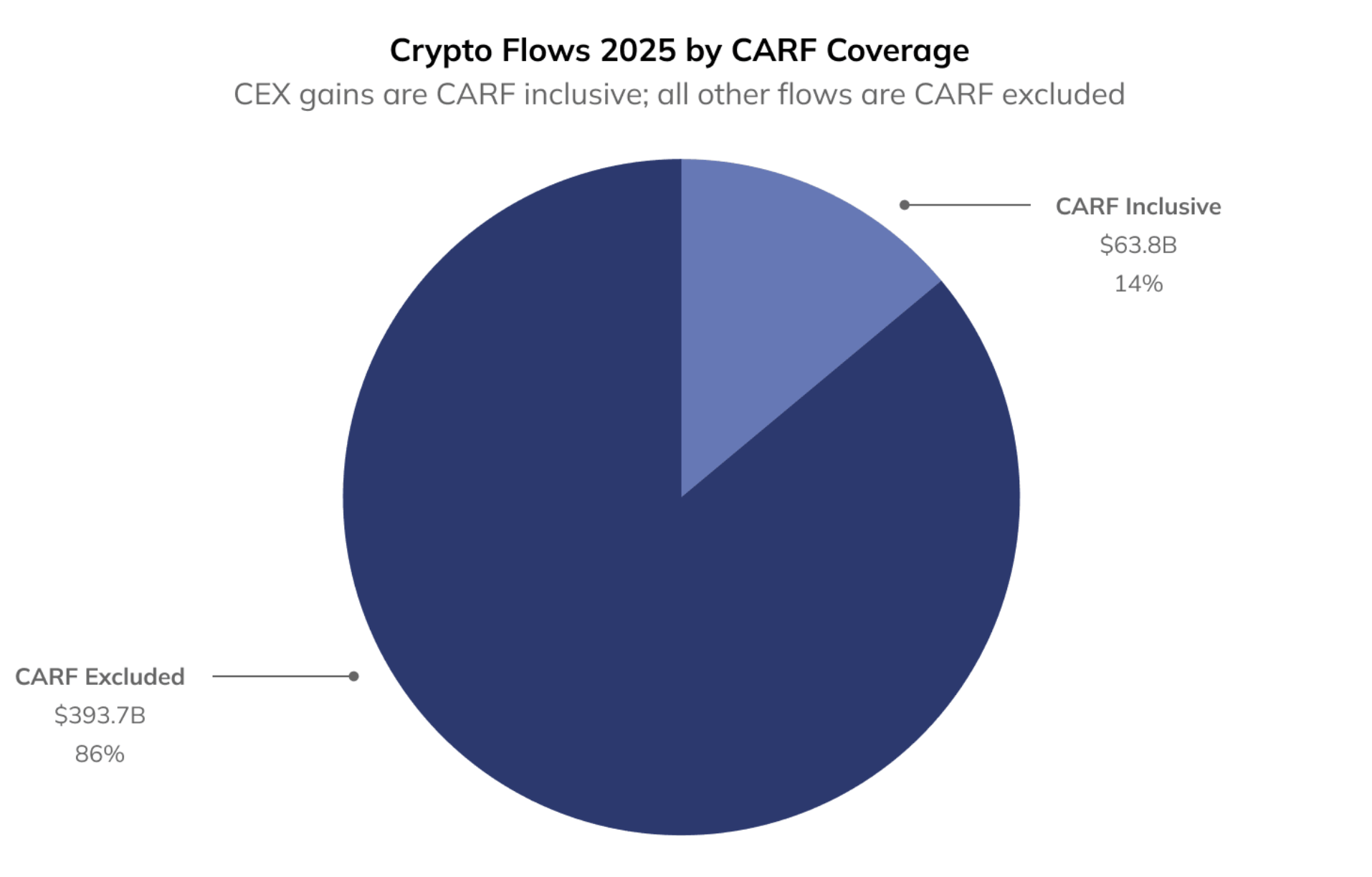
CARF covers only 14% of potentially taxable onchain crypto activity.
Source: Chainalysis

Related: Chainalysis sues US over $95M ICE contract with TRM Labs

CARF’s limits on onchain tax reporting

CARF data collection began on Jan. 1, 2026, in 48 jurisdictions, including the United Kingdom and European Union, requiring covered crypto platforms to collect additional customer and tax residency information.

Under CARF, in-scope crypto providers collect customer and tax residency information and report transaction data to domestic tax authorities, which can then share that information across borders.
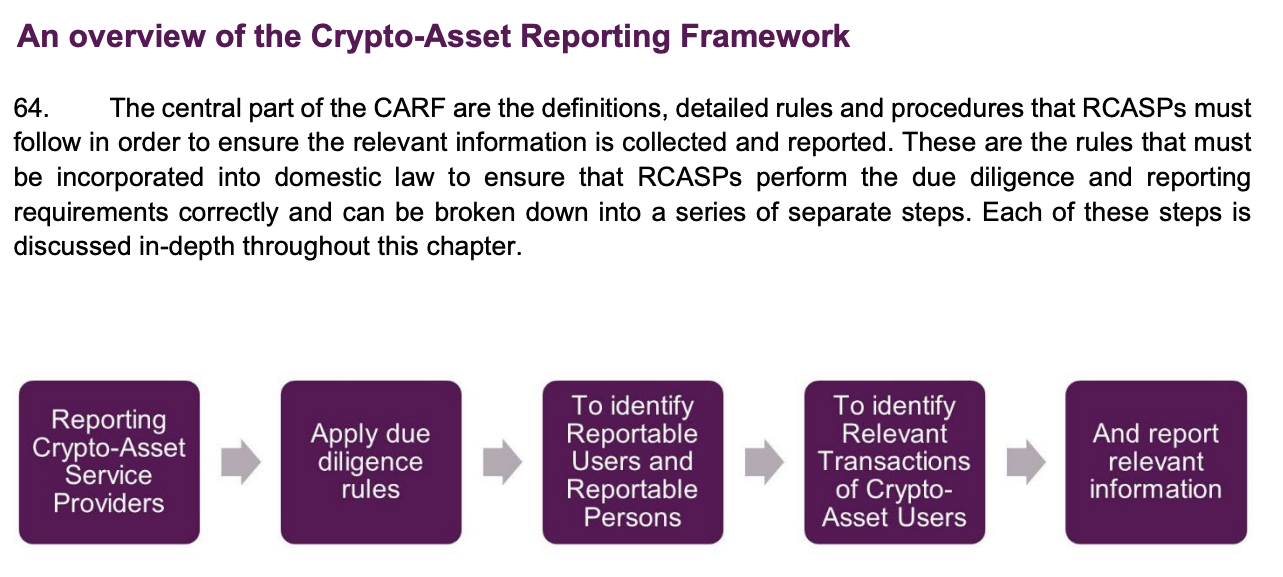
CARF framework. Source: OECD

CARF’s focus on crypto intermediaries also helps explain the gaps highlighted by Chainalysis. Colby Mangels, a former OECD adviser who worked on CARF, told Cointelegraph in January that the framework was designed around intermediaries that facilitate crypto transactions as a business.

Much of decentralized finance therefore remains outside the reporting perimeter, as there may be no centralized operator or custodial relationship on which to impose reporting requirements.

That could change as regulators develop rules for decentralized platforms. Mangels said tax authorities are watching developments in anti-money laundering regulation, including efforts to determine when DeFi platforms or their operators should be treated as regulated crypto service providers.

Magazine: SEC’s proposed crypto rules probably won’t spark new ICO boom

Domande pertinenti

QAccording to the Chainalysis report, how much potentially taxable onchain crypto activity was estimated globally in 2025?

APotentially taxable onchain crypto activity was estimated to be at least $457 billion globally in 2025.

QWhat percentage of the identified onchain taxable activity is covered by the OECD's Crypto-Asset Reporting Framework (CARF)?

AAccording to Chainalysis, the transactions covered by the OECD's Crypto-Asset Reporting Framework (CARF) account for just 14% of the identified onchain taxable activity.

QWhat major categories of taxable activity were included in Chainalysis's $457 billion estimate?

AThe estimates included realized gains, income from activities such as mining, staking and lending, and crypto-denominated payments across six major blockchains. It excluded trading and other activity conducted within centralized exchanges.

QWhich region had the highest estimated amount of potentially taxable onchain crypto activity according to the report?

ANorth America led all regions with an estimated $134.6 billion in potentially taxable onchain crypto activity.

QWhy does much of decentralized finance (DeFi) activity remain outside the reporting perimeter of CARF?

AMuch of decentralized finance (DeFi) remains outside CARF's reporting perimeter because there may be no centralized operator or custodial relationship on which to impose reporting requirements, as the framework is designed around intermediaries that facilitate crypto transactions as a business.

Letture associate

The Pioneer of AI Boomerang Job-Hopping: No Ph.D., Fought Over by Top AI Labs in Silicon Valley

"AI's Boomerang Hire: The Unconventional Career of Barret Zoph Who is known as the first practitioner of 'boomerang hiring' in AI? Barret Zoph, now a Research VP at Google DeepMind, has an unconventional resume: former Senior Research Scientist at Google Brain, former VP of Post-Training Research at OpenAI, former co-founder/CTO of Thinking Machines Lab, former OpenAI Codex commercialization lead—all without a PhD. Zoph's career began at Google Brain in 2016 after his USC bachelor's degree. He co-authored the seminal "Neural Architecture Search with Reinforcement Learning," helping pioneer the NAS field. His later work included co-authoring the Switch Transformer, a key model for trillion-parameter scale training. He joined OpenAI in 2022, rising to VP focusing on reinforcement learning for post-training—a crucial step in aligning models like ChatGPT. USC later listed him among alumni who "paved the path for ChatGPT." In 2025, he co-founded Thinking Machines Lab with ex-OpenAI CTO Mira Murati but left under controversial circumstances less than a year later, returning briefly to OpenAI before his final move back to Google in 2026. His hiring coincides with significant talent churn at Google DeepMind. Data shows DeepMind's senior talent inflow/outflow ratio has sharply declined from 12:1 in 2023 to 2:1 in 2026, meaning for every two hires, one leaves—a stark contrast to Anthropic (22:1) and OpenAI (5.7:1). Key departures include founders and Nobel laureates moving to rivals. This fluid, sports-like transfer market for elite AI researchers is driven not just by pay but by competitive positioning, pre-IPO equity at startups, and concerns over shifting research priorities at large firms like Google as they focus more on commercial products like Gemini."

marsbit30 min fa

The Pioneer of AI Boomerang Job-Hopping: No Ph.D., Fought Over by Top AI Labs in Silicon Valley

marsbit30 min fa

Bitcoin Stabilizes at $80,000, How Do Institutions and Smart Money View the Future Market?

Bitcoin has consolidated around the $80,000 level following a record-breaking weekly dollar gain, pushing the price up 23.5% from August 17-23. Market focus is now on whether it can decisively overcome a significant resistance cluster between $81,000 and $86,000. This zone represents a critical supply wall, containing nearly 8% of the circulating supply and the average cost basis for major US spot Bitcoin ETFs. Analysis from Glassnode indicates the recent rally was fueled by substantial spot buying, evidenced by ETF inflows and declining exchange balances, rather than excessive leverage. Futures open interest has decreased, with cash/stablecoin margins dominating. While US ETF flows remain a key bullish driver, the market faces a crucial test. A successful break above the $81k-$82k resistance and the 50-week moving average (approx. $81,081) could signal a broader trend reversal. Failure may lead to a retracement toward the $75,000 support level. Institutional views are mixed but generally cautious. CryptoQuant highlights potential seasonal weakness in September, while CoinShares sees a likely trading range, requiring weaker jobs data for a sustained push toward $100k. K33 Research draws parallels to past cycle starts, and Bitwise suggests the bottoming process is advanced. Overall, the market is at a pivotal point, with the battle around $80k determining the near-term direction.

marsbit45 min fa

Bitcoin Stabilizes at $80,000, How Do Institutions and Smart Money View the Future Market?

marsbit45 min fa

Trading

Spot
活动图片