CFTC warns on prediction market insider trading as volumes hit $75B in Q1

ambcryptoPubblicato 2026-04-01Pubblicato ultima volta 2026-04-01

Introduzione

The U.S. Commodity Futures Trading Commission (CFTC) has warned that insider trading laws apply to prediction markets, countering the belief that such activity operates in a regulatory gray area. A senior official stated the CFTC will aggressively pursue cases involving misuse of material non-public information, emphasizing that prediction market contracts fall under existing anti-fraud provisions. The regulator also highlighted exchanges' responsibilities to maintain surveillance systems and avoid listing easily manipulated contracts. This comes as prediction market trading volume surged to $75 billion in Q1 2026, up dramatically from $330 million in Q1 2024, driven by event-based trading on political, economic, and sports outcomes. The CFTC outlined enforcement priorities including insider trading, market manipulation, and retail fraud, while also introducing a new cooperation framework for self-reporting firms.

The U.S. derivatives regulator is sharpening its stance on prediction markets just as the sector sees explosive growth.

In remarks delivered on 31 March, a senior official at the Commodity Futures Trading Commission said insider trading laws do apply to prediction markets, pushing back against a growing narrative that such activity exists in a regulatory gray area.

The agency signaled that it will “aggressively detect, investigate, and prosecute” insider trading involving the misuse of material non-public information.

Insider trading rules extend to event contracts

The CFTC’s enforcement division emphasized that prediction market contracts fall under existing anti-fraud provisions of U.S. commodities law.

That includes trading based on misappropriated information obtained through a breach of duty, a framework commonly known as the “misappropriation theory.”

The remarks directly challenge a widely circulated belief across social media and parts of the crypto industry that insider trading is either permissible or inevitable in prediction markets.

Instead, the agency made clear that such conduct can constitute fraud under the Commodity Exchange Act, particularly when confidential information is used improperly.

Exchanges face growing compliance pressure

The warning was not limited to individual traders.

The CFTC also highlighted the role of exchanges, noting that platforms must maintain surveillance systems, enforce fair trading practices, and avoid listing contracts susceptible to manipulation.

The regulator highlighted risks in certain event-based contracts, including those tied to individual actions or outcomes, where access to non-public information could distort pricing.

Record growth brings regulatory focus

The renewed scrutiny comes as prediction markets scale rapidly.

Data from CryptoRank and DeFiLlama shows total trading volume across platforms such as Polymarket and Kalshi reached $75 billion in Q1 2026, up sharply from just $330 million in Q1 2024.
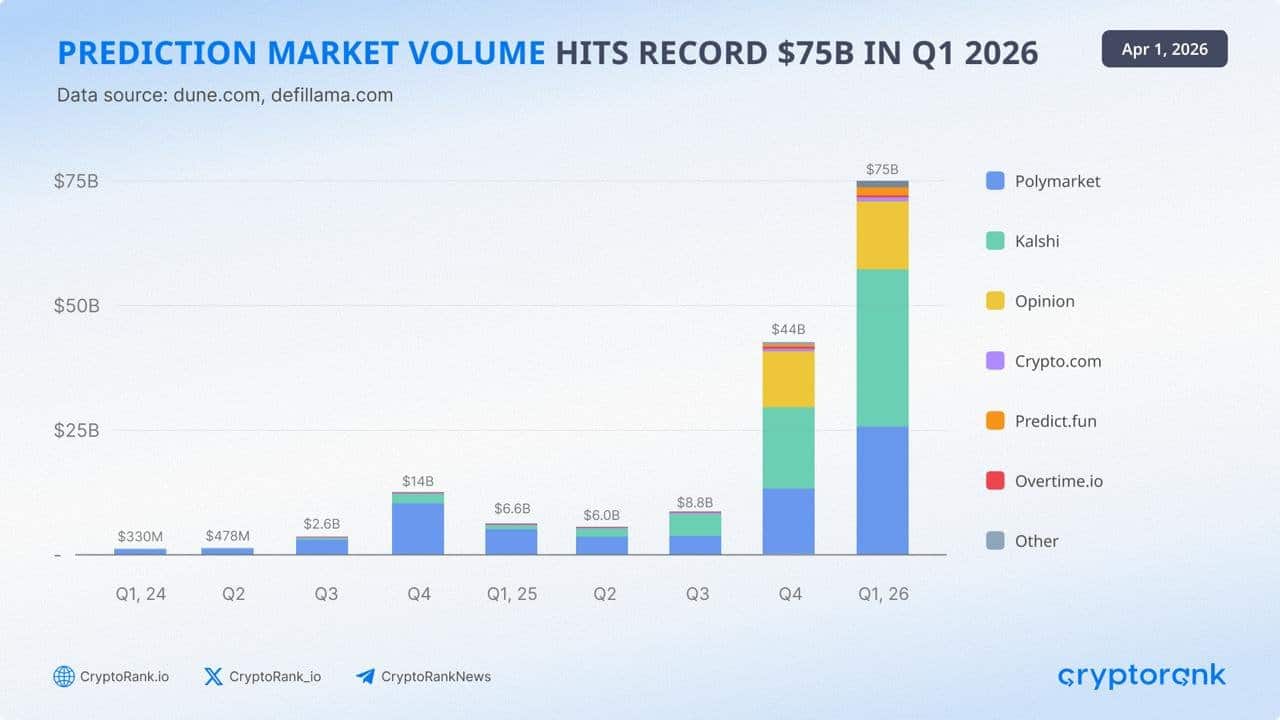
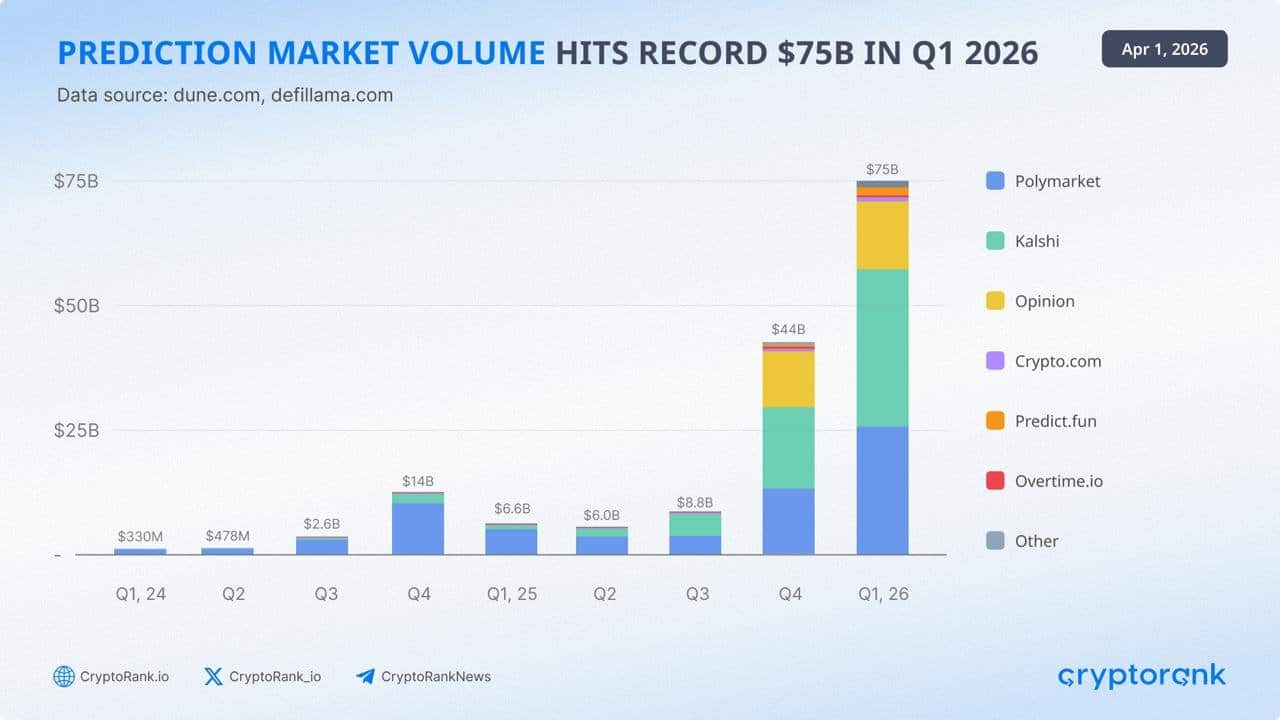
Source: CryptoRank

The growth reflects increasing demand for event-based trading across political outcomes, macroeconomic indicators, and sports markets.

But with that expansion has come rising concern over market integrity, particularly around insider information and potential manipulation.

A shift in enforcement approach

The CFTC also outlined a broader shift in its enforcement approach.

While signaling an end to so-called “regulation by enforcement,” the agency identified five core priorities: insider trading, market manipulation, disruptive trading practices, retail fraud, and willful violations of AML and KYC rules.

At the same time, it plans to introduce a new cooperation framework that could offer declinations for firms that self-report, fully cooperate, and remediate misconduct.


Final Summary

  • Prediction markets have grown rapidly to $75 billion in quarterly volume, drawing increased regulatory scrutiny over insider-trading risks.
  • The CFTC has made clear that insider trading laws apply to these markets, signaling more active enforcement as the sector grows.


Domande pertinenti

QWhat is the CFTC's stance on insider trading in prediction markets according to the article?

AThe CFTC has made clear that insider trading laws apply to prediction markets, and it will 'aggressively detect, investigate, and prosecute' such activity, particularly the misuse of material non-public information.

QWhat was the total trading volume for prediction markets in Q1 2026, and how does it compare to Q1 2024?

AThe total trading volume across prediction market platforms reached $75 billion in Q1 2026, which is a sharp increase from just $330 million in Q1 2024.

QBesides individual traders, who else did the CFTC warn about compliance in its remarks?

AThe CFTC also warned exchanges, highlighting that platforms must maintain surveillance systems, enforce fair trading practices, and avoid listing contracts that are susceptible to manipulation.

QWhat legal framework did the CFTC's enforcement division say prediction market contracts fall under?

AThe CFTC's enforcement division emphasized that prediction market contracts fall under the existing anti-fraud provisions of U.S. commodities law.

QWhat are the five core enforcement priorities the CFTC identified?

AThe five core enforcement priorities identified by the CFTC are: insider trading, market manipulation, disruptive trading practices, retail fraud, and willful violations of AML and KYC rules.

Letture associate

Within Strategy's Framework, STRC's Dividend Yield Remains at 12% as Share Price Stays Below Par Value

Michael Saylor, Executive Chairman of Strategy (MSTR), confirmed that the dividend rate for its STRC perpetual preferred shares will remain at 12.00% through August 2026. The rate has increased from 9% at its July 2025 launch to the current high via a "ratchet" mechanism, which permanently raises the rate by 0.5% whenever the share price falls below $95. This mechanism is intended to push the price back toward its $100 par value and support Strategy's "at-the-market" (ATM) program for issuing new shares to fund Bitcoin purchases. However, the mechanism has not worked as intended. STRC shares closed at $89.46 on July 31, remaining about 10-11% below par value despite the record-high dividend. Competition from rival Strive's higher-yielding SATA securities has pressured demand. The persistent discount has forced Strategy to suspend new STRC issuances via its ATM program, limiting this funding channel for Bitcoin acquisitions. STRC's struggles reflect Bitcoin's own volatility, as the preferred shares historically move in tandem. Analysts have warned the ratchet structure carries long-term, one-way risk. A law firm is investigating Strategy's ability to maintain dividend payments if Bitcoin's price stays low. Retail investors own roughly 83% of outstanding STRC shares, a group seen as prone to panic selling during downturns. In response, Strategy has established financial reserves, including a liquidity cushion covering about 26 months of dividend/interest obligations, and a $2 billion share buyback program alongside a Bitcoin monetization framework, though the company emphasized it is not obligated to sell any Bitcoin.

cryptonews.ru26 min fa

Within Strategy's Framework, STRC's Dividend Yield Remains at 12% as Share Price Stays Below Par Value

cryptonews.ru26 min fa

Analyst: Bitcoin's Price Will Drop to $60k in August, Then Rebound to $70k

Financial analyst Andrey Poroshin has provided a new forecast for Bitcoin's price dynamics in August. Poroshin, an analyst at the Bitbanker exchange, expects the cryptocurrency market to experience a downturn this month, with prices retesting the $60,000 level due to a lack of supportive macroeconomic catalysts. He noted that the recent US Federal Reserve decision to hold interest rates did not significantly impact the market, while inflation remains above the 2% target. Poroshin stated that Bitcoin is ending July under pressure from moderate volatility and a lack of new macroeconomic stimuli, leading to continued market caution. According to his base scenario, Bitcoin will drop to a range of $60,000 to $62,000 before recovering to $70,000. He pointed out that even $70,000 remains below the cost of mining in the US, which has prompted some miners to shift towards AI data center operations. Poroshin cited the winding down of BitMEX's operations as a potential catalyst for a price rebound, suggesting the exit of weaker players often coincides with market reversals and reduced short-term selling pressure. He believes Bitcoin is currently less susceptible to geopolitical shocks, such as the Iran-US conflict, and does not expect significant market changes in August related to the pending CLARITY Act. Looking ahead, Poroshin forecasts that September will bring more active price fluctuations driven by potential Fed rate decisions and possible discussions or approval of the CLARITY Act.

cryptonews.ru26 min fa

Analyst: Bitcoin's Price Will Drop to $60k in August, Then Rebound to $70k

cryptonews.ru26 min fa

Trading

Spot
活动图片




