Author: Yang Chen, Wall Street News
An unexpected decline in Cerebras Systems' hardware sales has exposed the instability of its chip product sales, although strong growth in its cloud computing business has partially cushioned market concerns.
Cerebras' Q2 2026 financial results, announced on Wednesday, show the company's GAAP revenue grew 74% year-over-year to $180.1 million. Revenue under the company's core metric reached $210 million, a 103% year-over-year increase.
Hardware revenue for Q2 was $54.1 million, down 23% year-over-year, while cloud computing and other service revenue surged to $126.0 million, a 281% year-over-year increase.
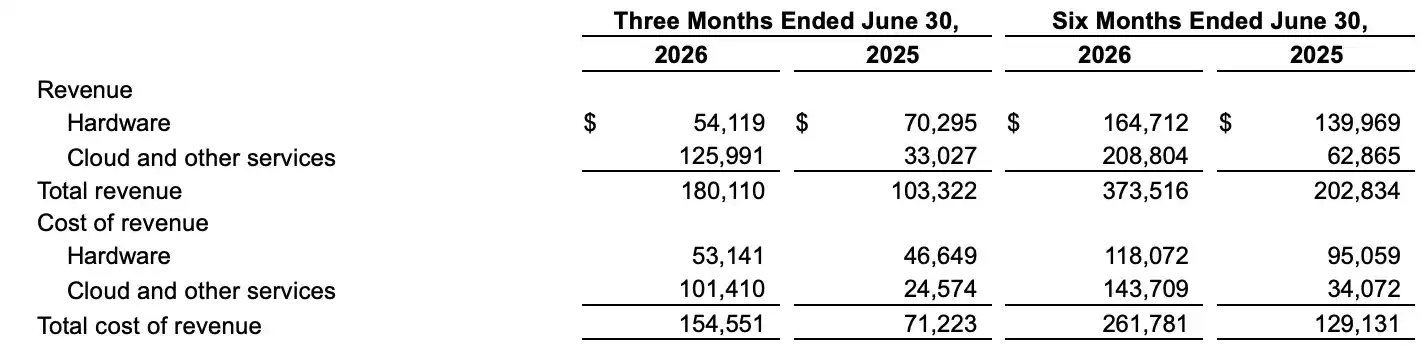
This outcome also revealed a shift in Cerebras' business model: cloud computing business has now surpassed hardware, becoming the company's largest revenue source. Cerebras CEO Andrew Feldman stated that hardware business growth will be "lumpy," which is inherent to the nature of the business.
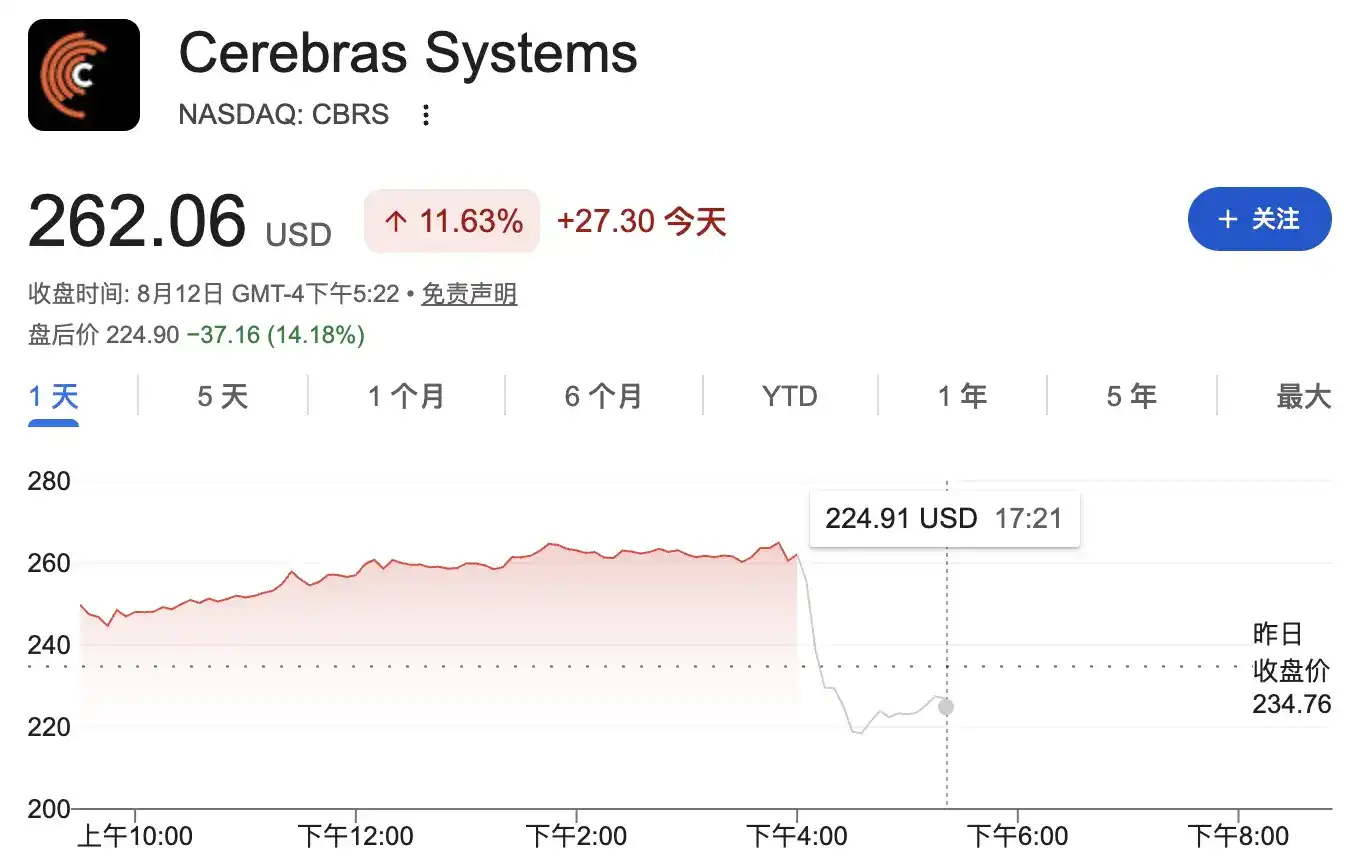
Cerebras stock plunged up to 17% in after-hours trading, having closed up 11.6% on Wednesday.
Hardware Revenue Unexpectedly Declines, Cloud Business Becomes Biggest Highlight
In terms of business structure, the most notable change in Q2 for Cerebras is the contrast between hardware and cloud business.
The financial report shows Q2 hardware revenue dropped from $70.3 million a year ago to $54.1 million, a 23% decline. Meanwhile, cloud computing and other service revenue jumped from $33.0 million to $126.0 million, a 281% increase. Under the core metric, cloud and other service revenue was $127.7 million, a 287% year-over-year rise.
This signifies that Cerebras is no longer merely a chip company relying on selling AI computing systems for revenue. As customers like OpenAI expand AI inference computing demand, the company is increasingly providing computing power services through the cloud, generating more income from this segment.
Cerebras CEO Andrew Feldman stated the company will maintain a "dual-track" model of hardware and data center services, saying, "We want to meet customers where they are growing fastest."
However, the decline in hardware business remains the core issue drawing market attention. Cerebras has consistently positioned its wafer-scale engine (WSE) as a challenger to Nvidia's GPUs, and the drop in hardware sales suggests this business has not yet established a stable, linear growth trajectory.
Feldman noted that the hardware business is inherently volatile.

Guidance Exceeds Expectations
Despite the hardware business decline, Cerebras' future guidance is notably stronger than market expectations.
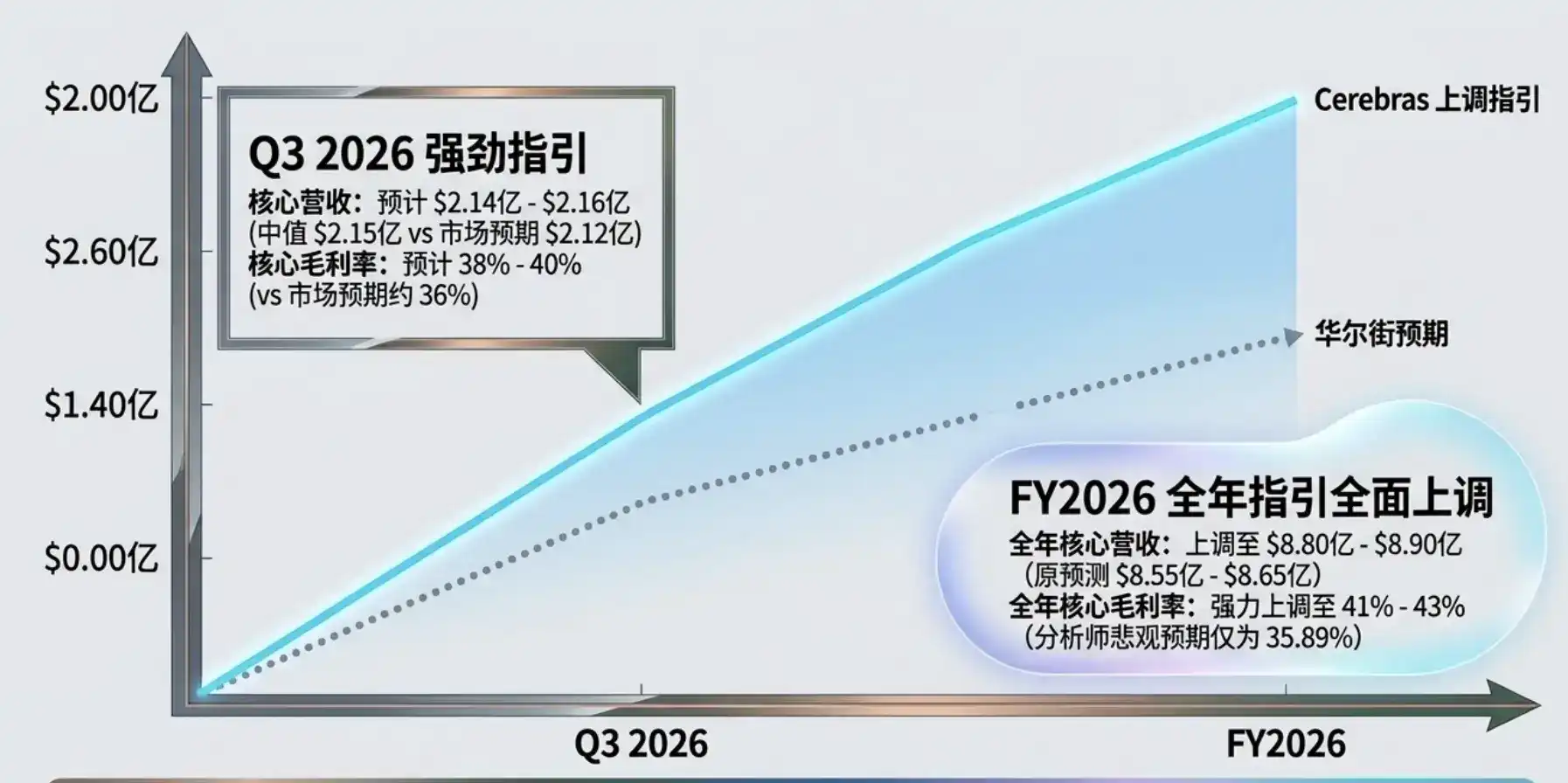
The company expects Q3 core revenue to be approximately $214 million to $216 million, with a midpoint of $215 million, above the market consensus of $212 million; core gross margin is forecasted between 38% to 40%, also higher than the market's roughly 36% expectation.
Full-year guidance was also raised. Cerebras expects 2026 core revenue of $880 million to $890 million, up from the previous forecast of $855 million to $865 million.
Full-year core gross margin is projected between 41% to 43%, up from 38% to 41%, whereas analysts previously expected Cerebras' full-year adjusted gross margin to be only 35.89%.
In other words, from a future performance guidance perspective, the figures provided by Cerebras are significantly better than market expectations; however, looking at the current quarter's business structure, the unexpected decline in hardware revenue serves as a warning bell for investors.
The company's report shows Q2 core total revenue was $209.9 million, a 103% year-over-year increase; core gross margin reached 40.6%, up approximately 9.4 percentage points from the same period last year. Core net loss significantly narrowed to $6.908 million from $40.5 million a year ago.
Why Did the Stock Still Plunge After Hours?
The market's reaction to the earnings report indicates investors are not only focused on whether Cerebras can exceed next quarter's revenue expectations but are also reassessing the quality and sustainability of the company's growth.
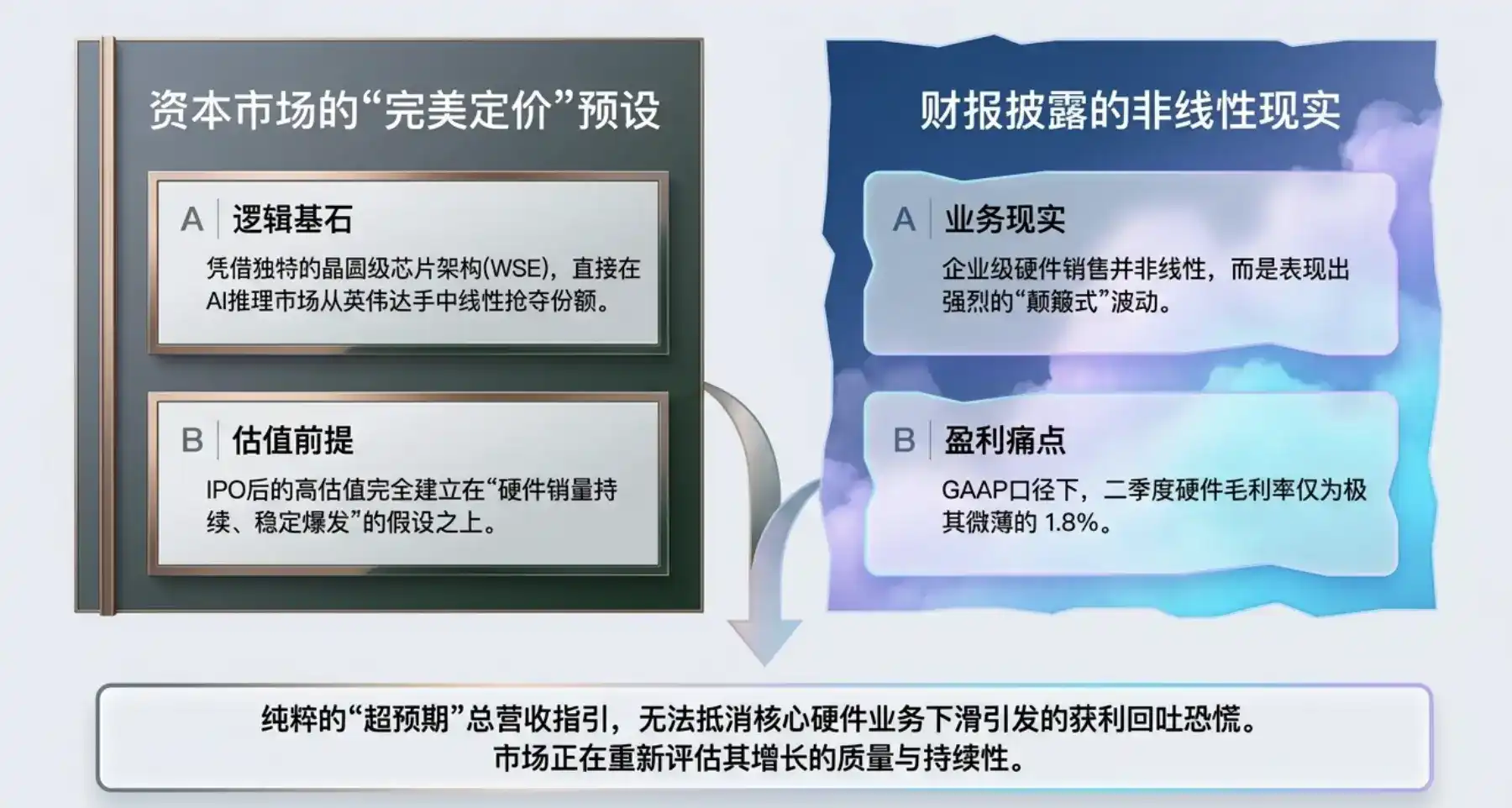
Cerebras' stock has experienced significant gains since its IPO, with the market previously betting it could capture market share in the AI inference market from Nvidia with its unique wafer-scale chip architecture. Therefore, when hardware revenue dropped 23% year-over-year, even with rapid cloud business growth and raised full-year guidance, it easily triggered profit-taking.
This suggests that the market's valuation of Cerebras already incorporates relatively high growth expectations. Merely "exceeding expectations" in guidance may not be enough to offset the concerns arising from the decline in the core hardware business.
Particularly noteworthy is that the company's Q2 GAAP hardware gross margin was only 1.8%, although under the core metric it reached 38.8%.
The report shows Cerebras made adjustments for customer warrant amortization, stock-based compensation, and data center expenses for its core metrics, resulting in significant differences between GAAP and core figures.
AI Inference Demand Becomes Cerebras' Growth Core
Cerebras is currently betting on the AI inference market.
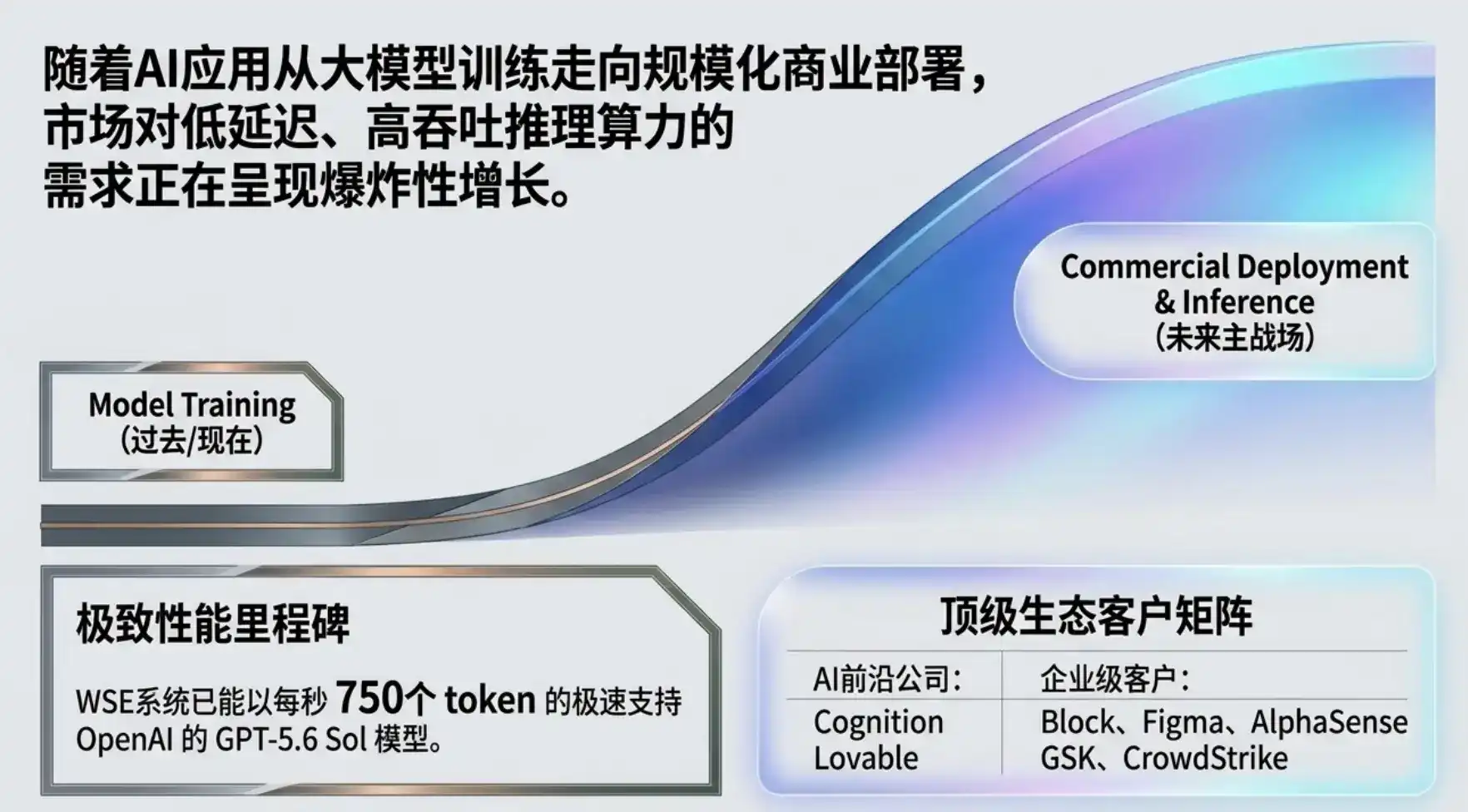
Compared to training large models, inference occurs after users send requests to AI applications like chatbots. As AI applications move from model training to large-scale commercial deployment, demand for low-latency, high-throughput inference computing power is rapidly increasing.
Cerebras' core product, the WSE, adopts a wafer-scale architecture, integrating massive computing resources onto a single large chip. The company believes this architecture can reduce data transfer between numerous chips in traditional GPU systems and improve AI inference speed.
The company stated that its systems can now support OpenAI's GPT-5.6 Sol at speeds of 750 tokens per second, and it is developing disaggregated inference solutions in collaboration with AMD, expected to enter production in Q4 2026. Concurrently, the company plans to introduce related technology into AWS's Amazon Bedrock in Q1 2027.
Cerebras also noted that it has signed new cloud computing capacity agreements with clients including AI programming companies Cognition and Lovable, and already serves customers like Block, Figma, AlphaSense, GSK, and CrowdStrike.
Not Using HBM Provides Cost and Supply Chain Advantage
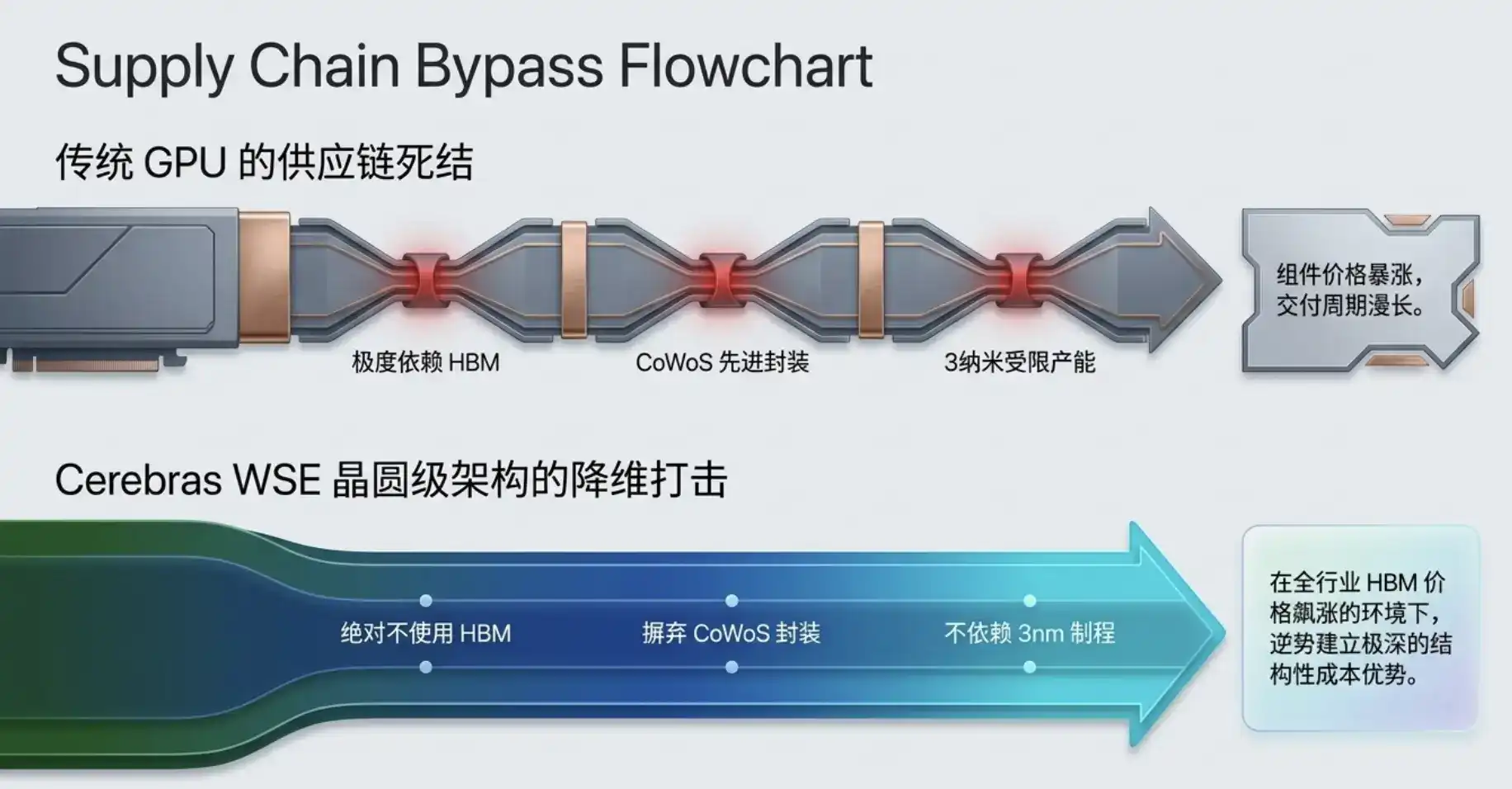
In an AI chip industry generally affected by tight supply and rising prices of high-bandwidth memory (HBM), Cerebras is also attempting to leverage its architecture for cost advantages.
The company stated that its wafer-scale architecture does not rely on HBM, nor does it use CoWoS advanced packaging or 3nm process technology, all of which are currently constrained segments in the AI chip supply chain.
Feldman said that the significant price increase of Nvidia's AI chips is related to rising HBM costs, and since Cerebras does not use HBM, it may gain certain advantages in an environment of rising component prices.
However, whether this advantage can ultimately translate into sustained hardware sales growth still requires further verification. The year-over-year decline in hardware revenue precisely indicates that Cerebras still faces challenges in converting technological advantages into stable commercial revenue.
Holding $25.4 Billion in Remaining Orders, Next Phase Key Lies in Delivery Capability
Cerebras' greatest confidence currently comes from massive orders and capital reserves.
As of the end of June, the company's remaining performance obligations reached $25.4 billion, indicating a substantial scale of future contracted but yet-to-be-recognized revenue. The company stated it plans to achieve over threefold revenue growth by 2027.
Concurrently, the company raised approximately $6.4 billion in its IPO this year. As of the end of June, it held about $8.6 billion in cash, cash equivalents, restricted cash, and short-term investments, with an additional $850 million debt financing capacity.
To fulfill these orders, the company is rapidly expanding production capacity.
Cerebras stated that 2026 manufacturing capacity will expand more than tenfold, and it has already added production lines at Flex, Sanmina, and Rocket EMS; as of the end of June, the company had signed, was constructing, or already had operational data center capacity exceeding 600MW planned for delivery by the end of 2027.