Ceasefire Indefinitely Extended, How Long Will the US-Iran Conflict Continue to Be a Tug-of-War?

marsbitPubblicato 2026-04-22Pubblicato ultima volta 2026-04-22

Introduzione

President Trump has indefinitely extended the ceasefire with Iran while maintaining a naval blockade of the Strait of Hormuz, stating the truce will last until Iran presents a new proposal and negotiations conclude. The decision follows the collapse of planned peace talks after Iranian representatives refused to attend, calling U.S. conditions unacceptable. Iran has not requested the extension and maintains a firm stance, keeping the strait closed as long as the blockade persists. The prolonged standoff has heightened global market volatility, with oil prices rising sharply. Despite the temporary truce, the lack of a clear diplomatic framework and mutual distrust suggest the situation remains a fragile, unstable equilibrium, with risks of escalation persisting.

Original Title: Trump Extends Iran Ceasefire, Blockade as Peace Talks Stumble

Original Author: Courtney Subramanian and Jennifer A Dlouhy,Bloomberg

Original Compilation: Peggy,BlockBeats

Editor's Note: US President Donald Trump announced an indefinite extension of the ceasefire with Iran just before the agreement was set to expire, while continuing the maritime blockade of the Strait of Hormuz. Trump stated that the US would extend the ceasefire until Iran submits a new proposal, "and regardless of the outcome, until the negotiations conclude"; he also emphasized that without this blockade, "it would be impossible to reach any agreement with Iran."

From a strategic perspective, the US is attempting through the combination of "extending the ceasefire + maintaining the blockade" to avoid an immediate escalation into full-scale war while continuing to pressure Iran to make concessions on nuclear issues and negotiation terms. However, Iran has neither accepted the negotiation conditions nor proactively requested an extension of the ceasefire. Instead, it has maintained a firm response in terms of energy exports and military posture, leading to a stalemate between the two sides on the core issues of "whether to negotiate and how to negotiate."

More notably, this confrontation has begun to spill over into global markets. As a critical channel for global energy transportation, the blockade and repeated reopening of the Strait of Hormuz have not only intensified oil price volatility but also amplified uncertainties in the energy and shipping systems. In the short term, the ceasefire extension provides a certain buffer for the market; but in the medium to long term, in the absence of a clear negotiation structure and basic mutual trust, this passively extended ceasefire resembles a fragile balance that could be broken at any time.

As diplomatic paths continue to be blocked and military deterrence intensifies, the next phase of this conflict will depend on whether the two sides return to the negotiating table or slide toward more intense confrontation.

Below is the original text:

US President Donald Trump announced an indefinite extension of the ceasefire with Iran just before the agreement was set to expire; meanwhile, the US continues to maintain a maritime blockade of the Strait of Hormuz after the collapse of the originally planned peace talks between the two sides.

Trump stated on his social platform Truth Social that Pakistan, as the mediator, requested the US to postpone launching a new round of strikes. The US will extend the ceasefire deadline until Iran submits a new proposal and "regardless of the outcome, until the negotiations conclude." In another post, he also stated that without this blockade, "it would be impossible to reach any agreement with Iran—unless we blow up the rest of their country, including their leaders!"

US Vice President JD Vance was originally scheduled to travel to Pakistan to restart negotiations with Iran, but representatives from Tehran refused to attend, stating that the conditions proposed by the US were "unacceptable." Iran's semi-official Tasnim News Agency stated that there is currently "no realistic possibility" for Iran to participate in negotiations.

A White House official confirmed in a statement that the Vice President's scheduled trip on Tuesday will not take place.

This statement contrasts sharply with Donald Trump's remarks earlier that day. At the time, he stated in an interview with CNBC that if Iran did not meet his conditions, "I expect bombing to occur," and claimed that the US military "is eager and ready to act at any time." In a phone interview on Monday, Trump also stated that if an agreement was not reached, it was "highly unlikely" that he would extend the current ceasefire.

Driven by the news of the ceasefire extension, oil prices rose for the second consecutive day. After accumulating a nearly 9% increase over the previous two trading sessions, Brent crude price is currently around $98 per barrel. In January of this year, oil prices once fell below $60, and in March, they reached a high of $119.50. The average retail price of gasoline in the US is currently about $4 per gallon, compared to about $3 before the war broke out on February 28.

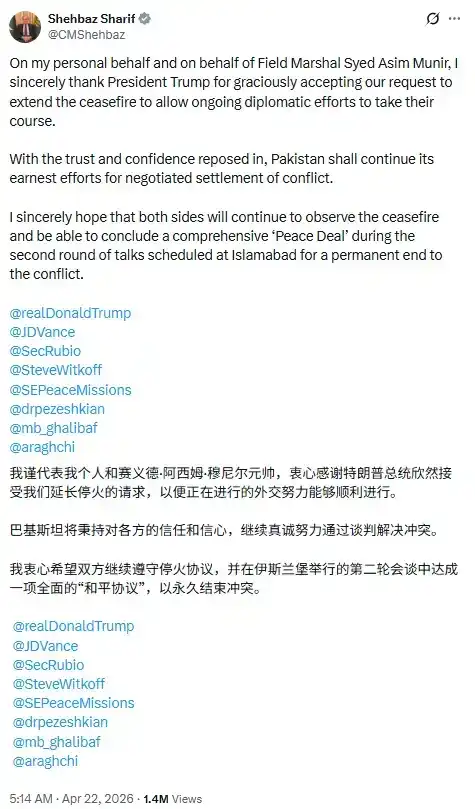
Pakistani Prime Minister Shehbaz Sharif thanked Trump for extending the ceasefire in a statement, "buying time for ongoing diplomatic efforts to proceed smoothly."
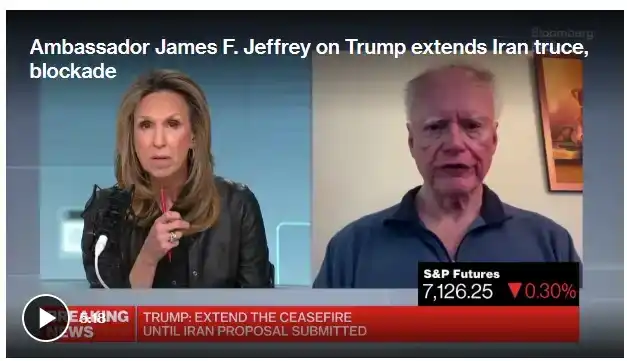
Former US Deputy National Security Advisor and current Philip Solondz Distinguished Fellow at the Washington Institute, James F. Jeffrey, appeared on 'Bloomberg Businessweek Daily' to discuss the ceasefire extension and engaged in a dialogue with hosts Carol Massar and Tim Stenovec.

He posted on platform X: "I sincerely hope both sides will continue to abide by the ceasefire agreement and reach a comprehensive 'peace agreement' in the second round of negotiations in Islamabad, thereby achieving a permanent end to the conflict."
Senior Iranian officials had not responded to Donald Trump's statement by nighttime Tehran time. Iran's semi-official Tasnim News Agency, quoting unnamed sources, stated that Iran did not request an extension of the ceasefire. Simultaneously, the media outlet stated that as long as the US maintains the maritime blockade, Iran will not reopen the Strait of Hormuz.

Iran's semi-official Fars News Agency quoted a statement from the military stating that the Iranian armed forces "are in a state of full combat readiness, with fingers on the trigger."

Security personnel guard a checkpoint near the Serena Hotel in Islamabad on April 22. Photo: Aamir Qureshi / AFP / Getty Images.

These developments mark the latest round of back-and-forth between Washington and Tehran since April 7, when the two sides announced a two-week ceasefire. Since then, the two sides have continuously publicly disputed the terms of the agreement and alternately closed and reopened the Strait of Hormuz. Before the war, about one-fifth of the world's oil and liquefied natural gas exports passed through this strait.

According to data intelligence company Vortexa, at least two fully loaded Iranian oil tankers have sailed out of the Persian Gulf this week and breached the US blockade. The company's data also shows that Iran still has the capacity to export oil, with at least 34 oil tankers and gas carriers related to Iran passing through the Strait of Hormuz and navigating past the naval blockade.

The British Navy stated on Wednesday that an Iranian gunboat fired upon a container ship near the Strait of Hormuz, causing "serious damage" to its bridge, but fortunately, there were no casualties.
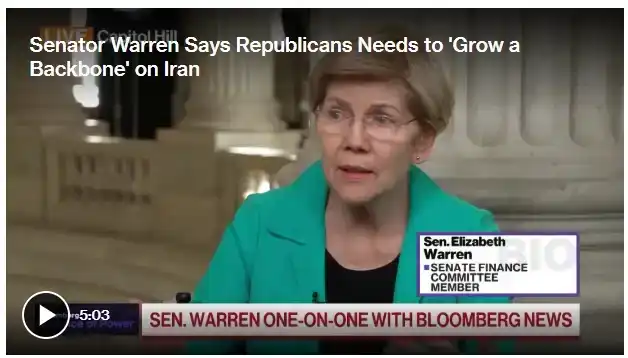
US Democratic Senator Elizabeth Warren from Massachusetts criticized President Donald Trump for lacking a clear plan regarding the Iran conflict. Warren expressed these views on the 'Balance of Power: Evening Edition' program.

The UK and France are convening military planners from over 30 countries for a two-day summit to discuss how to ensure the Strait of Hormuz remains open. British Prime Minister Keir Starmer and French President Emmanuel Macron have been leading the coordination of a plan aimed at keeping the strait open after the Iran war ends, though they have rejected Trump's request for allies to use force to reopen the Strait of Hormuz.

After the initial ceasefire was announced, a round of negotiations took place between the US and Iran but ended in failure. US officials stated that Iran was unwilling to accept restrictions on its nuclear program; while the Iranian side stated that the US had put forward a series of demands that it could not accept.

Iranian Parliament Speaker Mohammad Bagher Ghalibaf Source: AFP / Getty Images

Iranian Parliament Speaker Mohammad Bagher Ghalibaf, who led the Tehran delegation in the first round of negotiations, stated on Monday that Iran would not "accept negotiations under the shadow of threat."

Although the ceasefire extension may soothe investor sentiment in the short term, the path to a lasting agreement to end the war remains fraught with uncertainty. This conflict, now in its eighth week, has resulted in thousands of deaths, triggered a global energy crisis, and increased pressure on both sides to find an "exit path."

Donald Trump demands that Iran abandon its pursuit of nuclear weapons and hand over its nuclear materials. Tehran denies having any such intentions and refuses to hand over its enriched uranium.

Alex Vatanka, a senior fellow at the Middle East Institute, stated that Trump has somewhat "painted himself into a corner" because he does not actually want to return to military conflict.

"He made a strategic mistake in thinking that raising his voice and increasing pressure on the Iranians would work," Vatanka said. "This approach doesn't work with this regime. Quiet pressure often works better than public pressure."

Original link

Domande pertinenti

QWhat did President Trump announce regarding the ceasefire with Iran and the blockade of the Strait of Hormuz?

APresident Trump announced an indefinite extension of the ceasefire with Iran and the continuation of the maritime blockade of the Strait of Hormuz.

QWhy did the planned peace talks between the U.S. and Iran fail to proceed?

AThe talks failed because Iran refused to attend, stating that the conditions proposed by the U.S. were 'unacceptable'.

QHow has the situation in the Strait of Hormuz affected global oil markets?

AThe blockade and repeated closures of the Strait of Hormuz have increased oil price volatility and amplified uncertainty in energy and shipping systems, causing Brent crude prices to rise.

QWhat is Iran's current stance on negotiations and the U.S. blockade?

AIran has maintained a hardline response, refusing to negotiate under threat and stating it will not reopen the Strait of Hormuz as long as the U.S. maintains its maritime blockade.

QWhat are the key demands the U.S. has made of Iran in this conflict?

AThe U.S. has demanded that Iran abandon its pursuit of nuclear weapons and hand over its nuclear materials, specifically its enriched uranium.

Letture associate

55TB to 28TB? The Rumor and Panic Behind Rubin's Memory Being Halved

Title: 55TB to 28TB? The Rumor and Panic Behind the Potential Halving of Rubin's Memory. On June 4th, a report from SemiAnalysis suggested NVIDIA's next-gen Vera Rubin NVL72 AI rack may ship with roughly 28TB of SOCAMM DRAM per rack instead of the anticipated 55TB, primarily using 96GB modules. This sparked a market panic, causing Micron's stock to drop over 10% on fears of halved memory demand. However, the article argues this panic is misguided for several key reasons. First, SOCAMM modules are socketed and upgradeable, not soldered. Lower initial configuration doesn't mean permanent demand loss. Second, the primary driver is a severe 2026 LPDDR5X supply shortage, not diminished need. NVIDIA is likely prioritizing rack shipments with available components. Third, with fixed total LPDDR5X supply, using less per rack could allow NVIDIA to ship *more* racks, not necessarily reducing overall memory orders. Micron's sharp drop was also attributed to a broader semiconductor sell-off triggered by Broadcom's earnings, with the SemiAnalysis report providing a convenient narrative for profit-taking after Micron's massive rally. In summary: the report on lower default configurations is likely accurate, but interpreting it as a demand collapse is wrong. The real risk for Micron lies in its reportedly minimal HBM4 share for Rubin, not in potentially flexible SOCAMM demand. The sell-off appears more like a correction amplified by coinciding negative catalysts.

marsbit16 min fa

55TB to 28TB? The Rumor and Panic Behind Rubin's Memory Being Halved

marsbit16 min fa

Exclusive from Yingke | Tang Wenbin's 'Yuanli Lingji' Merges with Logistics Robotics Company, and Secures Investment from Zhipu, SenseTime, Jieyue, and Others

Exclusive report: Embodied AI company "Yuanli Lingji" recently completed a new round of financing from major AI model firms including Zhipu AI, Stepfun, and SenseTime, alongside continued investments from industrial backers like Huaqin and SAIC Hengxu. Founded in March 2025 by Tang Wenbin, former co-founder and CTO of Megvii, Yuanli Lingji is a general-purpose embodied AI model company. In a notable move, the company has merged with logistics robotics firm "Atomix" (formerly known as Yuanli Juhe) through a share acquisition. Atomix, which originated from Megvii's logistics robotics business led by Tang in 2016 and was spun off in July 2024, has grown to become the world's second-largest supplier of pallet shuttle robots, with annual revenue nearing 1 billion RMB and over 500 projects globally for clients like Uniqlo and CATL. This merger aims to break the industry's "data deadlock" by combining Atomix's extensive real-world operational data from more than 20 countries with Yuanli Lingji's model training capabilities. The company's embodied AI model "DM0" utilizes a cross-domain training approach, integrating internet semantics, autonomous driving rules, and robotics data to achieve hardware-agnostic, precise manipulation even with a compact 2.4B parameter size. The collective investment from key AI players and the strategic merger signal a shift in the competitive landscape, as major model companies pivot from language tokens to physical actions ("from Token to Action"). The industry is entering a consolidation phase where hardware, AI models, data, and application scenarios converge to scale embodied intelligence, a trend mirrored by recent moves from giants like ByteDance and Skild AI.

marsbit24 min fa

Exclusive from Yingke | Tang Wenbin's 'Yuanli Lingji' Merges with Logistics Robotics Company, and Secures Investment from Zhipu, SenseTime, Jieyue, and Others

marsbit24 min fa

U.S. Stock Market Trends: Dow Hits New High, Nasdaq Falls, Whom Did Broadcom's Slap Wake Up?

U.S. Stocks Split: Dow Hits Record High as Nasdaq Slips; Broadcom's Plunge Sparks Rotation On June 4, the U.S. stock market saw a sharp divergence. The Dow Jones surged 875 points (+1.73%) to a record high of 51,561.93, while the Nasdaq Composite edged down 0.09%. The S&P 500 rose 0.41%. The primary catalyst was a sharp sell-off in AI-related chip stocks, led by Broadcom (AVGO). Despite reporting a 143% year-over-year jump in AI semiconductor revenue to $10.8 billion, the company's shares plunged about 14%. This was triggered by its maintained long-term AI revenue target, which failed to meet heightened expectations for a stock that had gained 55% this quarter and traded at a high P/E ratio. The slide dragged down the broader semiconductor sector and the technology板块. Conversely, money rotated into sectors like Healthcare (+3.14%), Financials (+2.67%), and Real Estate (+1.87%). UnitedHealth and Goldman Sachs were major contributors to the Dow's gains. The rotation was attributed to a search for value outside overheated tech names and a slight dip in Treasury yields. In other major news, SpaceX confirmed its IPO for June 12, targeting a record $75 billion raise at a ~$1.75 trillion valuation. Additionally, initial jobless claims rose to a four-month high, adding nuance to the labor market narrative ahead of the key May non-farm payrolls report. The day's action signaled that while the AI growth story remains intact, excessive valuations are prompting a market reassessment. Funds are moving, at least temporarily, from high-flying tech to more defensive and value-oriented sectors. The sustainability of this rotation hinges on upcoming economic data, particularly the jobs report, and the market's absorption of the massive SpaceX IPO.

marsbit27 min fa

U.S. Stock Market Trends: Dow Hits New High, Nasdaq Falls, Whom Did Broadcom's Slap Wake Up?

marsbit27 min fa

From 'Old Dogs' to 'New Darlings': How AI is Revaluing Old Infrastructure, from Dell to Nokia

"Old Dogs" Become AI's New Darlings: Revaluing Legacy Infrastructure The AI investment narrative is shifting. Beyond the spotlight on core chipmakers like Nvidia, a new wave of interest is rising for legacy tech companies—Dell, HPE, Nokia, Cisco, Corning, Western Digital—once labeled as slow-growth, outdated stories. This resurgence stems from AI's evolution from model development to real-world deployment, creating massive demand for physical infrastructure. As AI moves into data center construction and enterprise adoption, the focus turns to who can actually build and deliver complex systems. These established players hold decades of experience in supply chains, integration, networking, and enterprise delivery—assets now critical for scaling AI. The revaluation can be grouped into three key infrastructure areas: 1. **Servers & Integration (e.g., Dell, HPE):** They are becoming essential system integrators, transforming GPUs into full-scale AI servers with networking, power, and cooling, then delivering them to clients. Strong recent earnings and AI-specific revenue/order growth for Dell and HPE underscore this shift. 2. **Networking & Connectivity (e.g., Corning, Nokia, Cisco):** As AI clusters grow, high-speed data transfer becomes paramount. Corning benefits from fiber demand for data center links, Nokia is exploring AI-integrated wireless networks (AI-RAN), and Cisco sees surging orders for data center switches—all critical for efficient AI operations. 3. **Storage (e.g., Western Digital, Seagate):** The AI data explosion requires vast capacity. Beyond high-speed memory (HBM), there's growing need for high-capacity HDDs to store training data, logs, video, and cold/archival data cost-effectively. This revaluation, however, is not a blanket endorsement. True reassessment requires concrete proof: AI-driven orders and revenue growth, upward revisions to company guidance, and sustainable improvements in profit quality, not just top-line sales. In essence, AI is not turning all old tech firms into high-growth stocks; it is selectively re-pricing the "old assets" of companies that are mission-critical for building the new AI infrastructure, transforming their legacy capabilities into renewed growth engines.

marsbit35 min fa

From 'Old Dogs' to 'New Darlings': How AI is Revaluing Old Infrastructure, from Dell to Nokia

marsbit35 min fa

Trading

Spot
Futures

Articoli Popolari

Come comprare WAR

Benvenuto in HTX.com! Abbiamo reso l'acquisto di WAR (WAR) semplice e conveniente. Segui la nostra guida passo passo per intraprendere il tuo viaggio nel mondo delle criptovalute.Step 1: Crea il tuo Account HTXUsa la tua email o numero di telefono per registrarti il tuo account gratuito su HTX. Vivi un'esperienza facile e sblocca tutte le funzionalità,Crea il mio accountStep 2: Vai in Acquista crypto e seleziona il tuo metodo di pagamentoCarta di credito/debito: utilizza la tua Visa o Mastercard per acquistare immediatamente WARWAR.Bilancio: Usa i fondi dal bilancio del tuo account HTX per fare trading senza problemi.Terze parti: abbiamo aggiunto metodi di pagamento molto utilizzati come Google Pay e Apple Pay per maggiore comodità.P2P: Fai trading direttamente con altri utenti HTX.Over-the-Counter (OTC): Offriamo servizi su misura e tassi di cambio competitivi per i trader.Step 3: Conserva WAR (WAR)Dopo aver acquistato WAR (WAR), conserva nel tuo account HTX. In alternativa, puoi inviare tramite trasferimento blockchain o scambiare per altre criptovalute.Step 4: Scambia WAR (WAR)Scambia facilmente WAR (WAR) nel mercato spot di HTX. Accedi al tuo account, seleziona la tua coppia di trading, esegui le tue operazioni e monitora in tempo reale. Offriamo un'esperienza user-friendly sia per chi ha appena iniziato che per i trader più esperti.

199 Totale visualizzazioniPubblicato il 2024.12.11Aggiornato il 2026.06.02

Come comprare WAR

Discussioni

Benvenuto nella Community HTX. Qui puoi rimanere informato sugli ultimi sviluppi della piattaforma e accedere ad approfondimenti esperti sul mercato. Le opinioni degli utenti sul prezzo di WAR WAR sono presentate come di seguito.

活动图片