Cardano Leadership Structure Comes Under Scrutiny, Clouding Its Future – See Why

bitcoinistPubblicato 2026-04-20Pubblicato ultima volta 2026-04-20

Introduzione

Cardano is recognized as one of the most decentralized blockchains, yet recent criticism highlights its lack of clear leadership. Analyst Cardano Yoda argues that despite the introduction of on-chain governance—which involves DReps (governance decision-makers) and Pentad (leadership and execution)—the network remains centralized in practice. While DReps control treasury spending, they lack coordination and strategic direction, relying instead on founding entities like IOG, the Cardano Foundation, and EMURGO. This creates fragmented leadership and accountability issues. Yoda suggests that DReps should evolve into a more coordinated body, possibly through a board or DAOs, to define strategy and improve governance effectiveness. Enhanced cooperation between DReps, founding entities, and Intersect is essential for Cardano’s future leadership clarity and operational unity.

In the dynamic blockchain sector, the Cardano network is being flagged as the most decentralized blockchain by several crypto analysts, with security being a major part of this assertion. However, the highly decentralized network has been called out for its lack of clear leadership.

Unclear Cardano Leadership Raises Concerns In The Ecosystem

Recently, a fresh debate has been raised around the Cardano network, particularly involving its leadership state. A crypto pundit and ADA enthusiast, Cardano Yoda, argues that the leading network is lacking clear leadership. Once again, the focus is on how Cardano strikes a compromise between decentralization and the requirement for unified leadership.

The pundit stated that in the past, the network was centered around the IOGs, the Cardano Foundation, and EMURGO, and its founder, Charles Hoskinson, was considered the leader. However, after the introduction of on-chain governance, the model evolved, breaking into two parts. These include DReps (governance decision-making) and Pentad (leadership and execution), which go hand-in-hand to produce a unified platform.

While DReps decide on Treasury spending, they also grant legitimacy to the strategy that Pentad offers because DReps are not coordinated. Since they cannot define the strategy and prioritize, on-chain governance is still dependent on the founding entities, indicating that the network remains strongly centralized in leadership and execution. These entities can offer their experience, knowledge, and expertise, but DReps will set the path from the ground up.
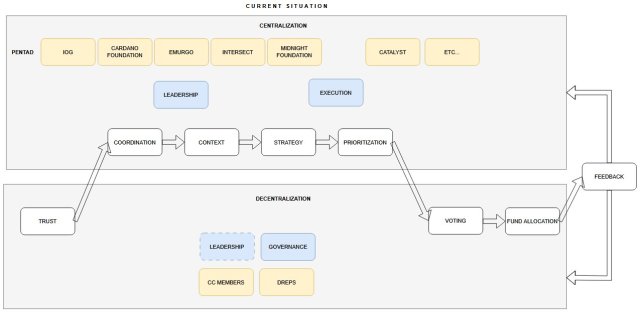
Source: Chart from Cardano Yoda on X

A strong player is intersect as it plays the role of coordinator, particularly preparing the budget framework process. Meanwhile, intersect is required to balance the role of facilitator and leader because it may not want to be a leader. However, being a leader means taking on responsibilities.

According to Yoda, on-chain governance is not the same as leadership, and Cardano does not have one. The issue is that it is difficult, if not impossible, to decentralize leadership and execution. A leader bears responsibility, which is diluted somewhere between Pentad and DReps, causing a fragmented network.

Despite this, Yoda still believes that leadership should not be dismissed because of decentralization. In the meantime, there may be a struggle for leadership, as new leaders may be born, or it might remain the same.

An Ideal Direction For Leadership

After carefully analyzing the Cardano network, Yoda claims that the logical direction for leadership is toward DReps because they have a stronger position and must be coordinated. With the emergence of a DReps board, they are expected to take responsibility for treasury spending, defining strategy, and prioritizing.

By using DAOs, DReps can be involved in the process of an effective execution. This is because they are responsible for supporting builders, ecosystem growth, innovation, marketing, and open-source activities, among others.

To have clear leadership, a more robust layer of cooperation between DReps, founding entities, and Intersect is required. However, this can only be built by a clearly defined coordination layer between DReps and sub-DAOs. Meanwhile, to create a dialogue between DReps and founding entities, the governance system must evolve.

Currently, communication is carried out through on-chain proposals, and may result in a rejected proposal regarding Summit and TOKEN2049 due to the diverse views of DReps and founding entities. Although it may not be easy, the goal remains finding a consensus on the future functioning because governance needs to be more effective.

ADA trading at $0.24 on the 1D chart | Source: ADAUSDT on Tradingview.com

Domande pertinenti

QWhat is the main concern raised about the Cardano network in the article?

AThe main concern is that despite being highly decentralized, the Cardano network lacks clear leadership, creating a fragmented system and raising questions about its future direction.

QAccording to the article, what are the two key parts of Cardano's governance model after the introduction of on-chain governance?

AThe two key parts are DReps (governance decision-making) and Pentad (leadership and execution).

QWhy does the article suggest that on-chain governance does not equate to leadership for Cardano?

ABecause leadership involves taking responsibility, which is currently diluted between Pentad and the uncoordinated DReps, making it difficult to decentralize leadership and execution effectively.

QWhat role does the entity 'Intersect' play in the Cardano ecosystem, as described in the article?

AIntersect acts as a coordinator, primarily in preparing the budget framework process, and is required to balance the roles of facilitator and leader.

QWhat does the article propose as the ideal direction for leadership to address Cardano's current issues?

AThe ideal direction is for leadership to move towards the DReps, who should be coordinated through a board to take responsibility for treasury spending, strategy, and prioritization, potentially using DAOs for effective execution.

Letture associate

TechFlow Intelligence Bureau: Chip Stocks Lose Trillions in a Single Day, Bitcoin Falls Below $60,000, US-Iran Conflict Escalates

**Daily Tech & Markets Roundup: AI Advances, Market Turmoil, and Geopolitical Tensions** **AI / LLMs**: Anthropic's internal report on AI self-improvement sparked serious discussions about Recursive Self-Improvement (RSI). Meanwhile, debate continues on AI coding tools after Claude was accused of introducing bugs into the rsync codebase. In positive news, DeepSeek V4 Flash impressed in local deployment tests, and GitHub Copilot now supports custom endpoints for local models. A surprising research turn suggests removing chain-of-thought prompting can sometimes improve LLM performance. **Crypto / Web3**: Bitcoin plunged below $60,000, with its RSI hitting levels last seen during the COVID-19 crash, driven by strong U.S. jobs data reviving interest rate hike fears. Discussions highlight Ethereum DeFi's continued lack of a smooth consumer payment layer. **Chips / Hardware**: Chip stocks suffered a massive sell-off, with the Philadelphia Semiconductor Index posting its worst single-day drop in six years, erasing over a trillion dollars in value. Marvell, Micron, AMD, and Intel were among the biggest losers. **Tech Companies**: A leaked Microsoft document revealing goals to make Copilot "addictive" drew criticism. LinkedIn founder Reid Hoffman left Microsoft's board to focus full-time on his AI agent startup, Manus. Google was revealed to be paying SpaceX $920 million monthly for AI training compute. **Markets & Macro**: A blowout U.S. jobs report (172k vs. 80k expected) crushed hopes for near-term rate cuts, sending Treasury yields soaring and triggering a broad market sell-off. CEOs from Kraft, McDonald's, and Whirlpool simultaneously warned U.S. consumers are exhausting their savings. **Geopolitics**: U.S.-Iran tensions escalated with missile/drone interceptions and U.S. strikes on Iranian radar sites, keeping the critical Strait of Hormuz largely closed since late February and posing ongoing oil supply risks. **The Bottom Line**: The strong jobs data acted as a single trigger for correlated sell-offs across equities, crypto, and chips. Underlying the volatility is a stark contradiction between robust employment data and warnings of consumer weakness, alongside geopolitical risks that could reignite inflation, leaving markets to price in a fraught macro outlook with no clear "soft landing" path.

marsbit30 min fa

TechFlow Intelligence Bureau: Chip Stocks Lose Trillions in a Single Day, Bitcoin Falls Below $60,000, US-Iran Conflict Escalates

marsbit30 min fa

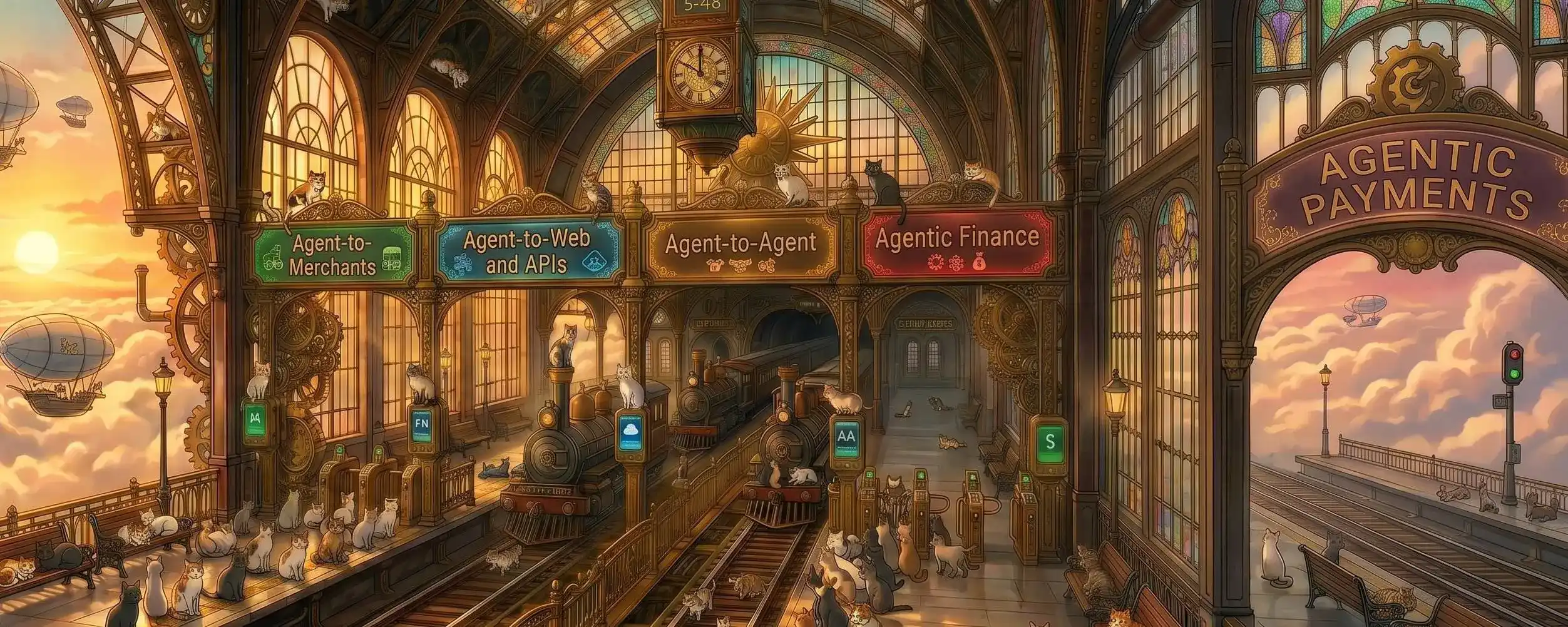
It Took Me a Year to See the Bitter Truth About Agent Payments

After a year building infrastructure for the Agent economy, engaging with major players like Stripe, Visa, and Coinbase, the author shares a sobering analysis of the current state of Agent payments. The core finding is a stark lack of genuine, immediate demand across most envisioned use cases. The article breaks down four key market segments: 1. **Agent-to-Merchant (Consumer Shopping):** For most product categories (e.g., clothing, electronics), conversational AI shopping is a step backwards from visual e-commerce interfaces. While agents excel at understanding needs, they can't replace side-by-side product comparison. Real merchant interest is defensive "Agent Engine Optimization," not driven by current customer demand. Potential exists for high-frequency, low-decision purchases (like food delivery) or navigating complex store UIs, but these require massive B2C distribution channels dominated by giants like Amazon. 2. **Agent-to-API (Developer Services):** Developers already have subscriptions and billing relationships for APIs (compute, data). Prepaid balances solve micro-payment issues for low transaction volumes. A deeper structural problem is that major SaaS vendors' business models rely on enterprise contracts, resisting granular pay-per-call pricing. While protocols like MPP and x402 serve the long tail of niche services, this market is small and developers are historically low-willingness-to-pay. 3. **Agent-to-Agent:** This remains largely theoretical with minimal transaction volume. While it represents a long-term bet on a fundamentally new transaction infrastructure (sub-second, micro-penny to million-dollar, multi-party settlements), it does not constitute a present market. 4. **Agent-to-Finance:** This is the only category with existing, paying demand. Integrating AI into financial workflows (trading, portfolio management) is a natural evolution and enables new capabilities like autonomous rebalancing. However, competition favors established, regulated institutions. The "real problem" is not moving money between agents, but the broader challenge of **coordination**—orchestrating work between agents and humans, verifying outcomes, and settling results. Payment is just one component of settlement, which is itself part of coordination. Companies that solve the coordination layer will subsume payment, not the other way around. While well-funded incumbents build defensively for a long-term future, startups must find where the market is today—which, for the author's team, lies outside these four categories in an area of real, growing, and underserved activity.

marsbit1 h fa

It Took Me a Year to See the Bitter Truth About Agent Payments

marsbit1 h fa

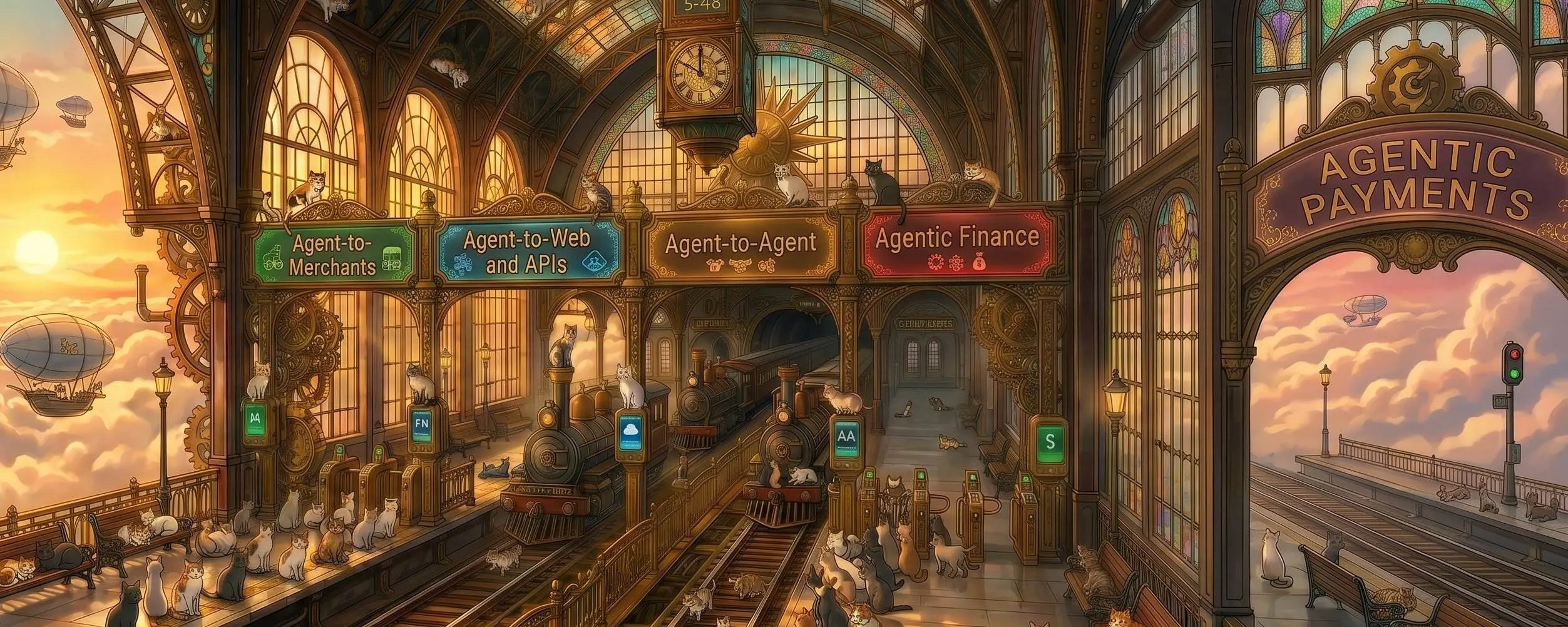
It Took Me a Year to See the Hard Truth About Agent Payments

**Title: It Took Me a Year to See the Hard Truth About Agent Payments** Over the past year, I've worked on infrastructure for the Agent economy, engaging with major players like Stripe, Visa, Coinbase, and numerous startups. The findings reveal a stark reality: genuine, widespread demand for Agent-based payments does not yet exist. **Key Observations:** * **Agent-to-Merchant (Shopping):** The user experience for AI shopping often falls short, especially for visual product discovery. While AI excels at understanding needs, conversational interfaces can't yet replace browsing and comparing multiple products visually. Current merchant interest is largely defensive ("Agent Engine Optimization") for a future that hasn't arrived. High-frequency, low-friction purchases (like food delivery) are potential fits, but lack open APIs and face high AI inference costs. Simpler, more affordable, or cross-language interactions for complex UIs are a niche opportunity but require massive consumer distribution to scale. * **Agent-to-API (Developer Tools):** Developer payment needs for APIs (computing, data, models) are already met through subscriptions and prepaid credits. The core challenge is not payment friction but supplier economics: most large SaaS providers prefer enterprise contracts over micropayments for API calls. Protocols like MPP and x402 suit the long-tail of smaller services but cater to a developer market historically reluctant to pay for these tools. Major infrastructure needs at the top of the stack are already being addressed. * **Agent-to-Agent (Machine Commerce):** This is a long-term vision with almost no current transaction volume. While a future with high-speed, high-frequency, multi-party machine-to-machine transactions would require novel infrastructure, it remains theoretical. The market is not here yet. * **Agent-to-Finance:** This is the only category with clear, present demand. Financial professionals and DeFi users already pay for tools, and AI augmentation is a natural evolution. Autonomous AI agents can enable entirely new financial strategies. However, competition is fierce from established, regulated incumbents who can more easily layer AI onto their existing products. **The Core Insight:** Companies, especially giants with long time horizons, are building defensively for a potential future of mass machine commerce. For them, early investment is a low-cost hedge. For startups, the current market reality is different. The primary challenge isn't just moving money between agents (payments). The larger, unsolved problem is **orchestration** – coordinating work between agents and humans, verifying outcomes, and then settling. Payment is just a part of settlement, which is just a part of orchestration. Companies that solve the orchestration problem will subsume payments, not the other way around. After a year of building, we see the real, growing, and underserved market opportunity lies in this broader domain of orchestration.

链捕手1 h fa

It Took Me a Year to See the Hard Truth About Agent Payments

链捕手1 h fa

Claude Opus 4.8 Finds a $4.5 Billion Bug: The AI Era is Mass-Producing Hackers

A researcher discovered a critical "infinite mint" vulnerability in the Zcash cryptocurrency's Orchard protocol using Claude Opus 4.8, leading to a swift fix but also a 50% market drop, erasing billions in value. This incident highlights a new era where powerful, accessible AI models are dramatically lowering the barrier to finding software vulnerabilities. Previously, the security community feared specialized models like Claude Mythos Preview, capable of finding decades-old zero-day exploits. The Zcash case, however, involved a publicly available, general-purpose model. This shift makes advanced security auditing—and attack capabilities—accessible to far more people, not just experts. The mass democratization of vulnerability discovery brings a dual challenge: a flood of low-quality, AI-generated false reports that overwhelm maintainers, and the real, rapid uncovering of deep, dangerous bugs. Open-source projects, often understaffed and unfunded, are particularly vulnerable to this "attention DDoS." The article cites examples like curl shutting down its bug bounty program due to the unsustainable workload. Our perceived digital safety has often been luck, relying on the high cost and effort required to find deeply hidden flaws in complex systems, as seen with historical vulnerabilities like Heartbleed or Baron Samedit. AI changes this cost structure, effectively "mass-producing flashlights" to illuminate every corner of our codebase. While large companies operate extensive security chains involving external white-hat hackers and massive defensive operations, the global cybersecurity workforce faces a severe shortage, especially of experienced personnel capable of analyzing complex threats and coordinating fixes. The core dilemma emerges: AI makes *finding* bugs cheap and scalable, but *fixing* them remains a slow, expensive, and human-intensive process. The article concludes that AI won't destroy the internet but acts as a bright light, revealing that our digital existence is not inherently secure but is precariously maintained by ongoing human effort. The true cost in the AI era may not be discovery, but whether there will be enough people left willing and able to do the hard work of repair.

marsbit2 h fa

Claude Opus 4.8 Finds a $4.5 Billion Bug: The AI Era is Mass-Producing Hackers

marsbit2 h fa

Trading

Spot
Futures

Articoli Popolari

Come comprare ADA

Benvenuto in HTX.com! Abbiamo reso l'acquisto di Cardano (ADA) semplice e conveniente. Segui la nostra guida passo passo per intraprendere il tuo viaggio nel mondo delle criptovalute.Step 1: Crea il tuo Account HTXUsa la tua email o numero di telefono per registrarti il tuo account gratuito su HTX. Vivi un'esperienza facile e sblocca tutte le funzionalità,Crea il mio accountStep 2: Vai in Acquista crypto e seleziona il tuo metodo di pagamentoCarta di credito/debito: utilizza la tua Visa o Mastercard per acquistare immediatamente CardanoADA.Bilancio: Usa i fondi dal bilancio del tuo account HTX per fare trading senza problemi.Terze parti: abbiamo aggiunto metodi di pagamento molto utilizzati come Google Pay e Apple Pay per maggiore comodità.P2P: Fai trading direttamente con altri utenti HTX.Over-the-Counter (OTC): Offriamo servizi su misura e tassi di cambio competitivi per i trader.Step 3: Conserva Cardano (ADA)Dopo aver acquistato Cardano (ADA), conserva nel tuo account HTX. In alternativa, puoi inviare tramite trasferimento blockchain o scambiare per altre criptovalute.Step 4: Scambia Cardano (ADA)Scambia facilmente Cardano (ADA) nel mercato spot di HTX. Accedi al tuo account, seleziona la tua coppia di trading, esegui le tue operazioni e monitora in tempo reale. Offriamo un'esperienza user-friendly sia per chi ha appena iniziato che per i trader più esperti.

1.3k Totale visualizzazioniPubblicato il 2024.12.10Aggiornato il 2026.06.02

Come comprare ADA

Discussioni

Benvenuto nella Community HTX. Qui puoi rimanere informato sugli ultimi sviluppi della piattaforma e accedere ad approfondimenti esperti sul mercato. Le opinioni degli utenti sul prezzo di ADA ADA sono presentate come di seguito.

活动图片