Cardano Founder Sounds Alarm Over New US Crypto Bill

bitcoinistPubblicato 2026-03-03Pubblicato ultima volta 2026-03-03

Introduzione

Cardano founder Charles Hoskinson strongly opposes the new U.S. crypto market structure bill, H.R. 3633, arguing it would harm innovation by classifying new digital assets as securities by default. He warns that the bill would force projects to undergo a difficult process to prove decentralization and potentially never escape securities classification. Hoskinson claims the SEC could exploit vague language to delay or block projects indefinitely, stifling new development in the U.S. and protecting older networks. He calls for a principles-based rewrite that modernizes securities laws and limits regulatory overreach, instead of a bill he believes enshrines the SEC's aggressive enforcement approach.

Cardano founder Charles Hoskinson is urging the crypto industry to take a harder look at H.R. 3633, arguing that the market structure bill could lock future US token projects into securities status rather than provide the regulatory clarity its backers promise. His criticism goes beyond process: Hoskinson says the bill, as written, could protect legacy networks while making it far harder for new crypto projects to launch and grow inside the United States.

Cardano Founder Issues A Stark Warning

In a video published March 2, the Cardano founder framed the dispute partly as a direct response to Ripple CEO Brad Garlinghouse’s view that a flawed bill is still preferable to no bill. Hoskinson rejected that outright. “A bad bill is not better than no bill,” he said. “You start from a principles-based approach. You don’t make everything a security by default, and you upgrade modernized securities laws so that’s not so bad.”

His core objection is that the Clarity Act would treat newly launched digital assets as securities first, then require them to convince the SEC they qualify to “graduate” into commodity status once their networks are sufficiently decentralized. In Hoskinson’s reading, that framework would have captured XRP, Cardano and Ethereum at launch. The difference, he argued, is that older networks may ultimately be grandfathered in, while future projects would face a regulatory maze from day one.

Hoskinson repeatedly returned to the same question: what, in practice, stops the SEC from keeping a token classified as a security indefinitely? “If it starts as a security, what stops them from keeping it as a security forever?” he asked. “And are we really sure that we can trust that to rulemaking that has yet to happen by people who have yet to be appointed by agencies that spent the last four [expletive] years suing everybody and throwing everybody in prison?”

From there, he laid out a series of what he called “attack vectors” that an adversarial SEC could use in rulemaking. One involved procedural delays around filing completeness, where the agency could keep resetting the clock with deficiency notices. Another focused on the bill’s undefined treatment of “common control,” which he said could let regulators interpret open-source coordination itself as evidence of centralized management.

He also argued that proving decentralization could become impossible if issuers were required to identify beneficial owners across pseudonymous wallet systems or rely on compliance categories the SEC has not even created.

The broad point was that the bill may look workable in statute but become punitive in implementation. “A bad bill enshrines into law every single thing Gary Gensler was trying to do to the industry,” Hoskinson said. “A bad bill through rulemaking allows the SEC to arbitrarily and capriciously kill every new project in the United States. A bad bill exposes all DeFi developers to personal liability.”

He also argued the current political fight in Washington is not really about the bill’s structure at all. According to Hoskinson, the real holdup is stablecoin yield, not developer protections, DeFi coverage or the SEC-CFTC split. In his telling, that leaves the industry in a strange place: a bill marketed as market structure reform, but one that “doesn’t cover the core of what’s going on in the industry right now.”

Hoskinson’s preferred alternative is a principles-based rewrite that modernizes securities law itself, builds blockchain-native disclosure rails, explicitly protects developers and DeFi, and limits how much discretion regulators can exercise in later rulemaking. Otherwise, he warned, the practical result may be simple: established networks survive, while the next generation of US crypto projects builds offshore first and only tries to enter the American market years later.

At press time, Cardano traded at $0.2692.
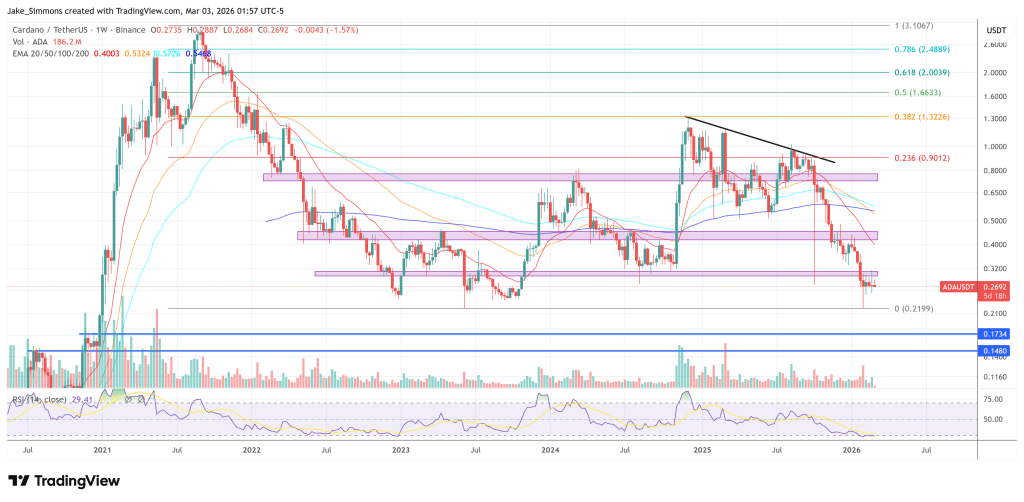
ADA hovers below key resistance, 1-week chart | Source: ADAUSDT on TradingView.com

Domande pertinenti

QWhat is Charles Hoskinson's main criticism of the H.R. 3633 crypto bill?

AHis main criticism is that the bill would treat newly launched digital assets as securities by default, forcing them to prove to the SEC that they qualify to 'graduate' into commodity status. He argues this creates a punitive regulatory maze for new projects while potentially grandfathering in older networks.

QAccording to Hoskinson, what is the real political holdup in Washington regarding crypto legislation?

AHe argues that the real holdup is not about the bill's market structure, but specifically about the issue of stablecoin yield, rather than developer protections, DeFi coverage, or the SEC-CFTC jurisdictional split.

QWhat specific 'attack vectors' does Hoskinson suggest an adversarial SEC could use under the proposed bill?

AHe suggests the SEC could use procedural delays by resetting the clock with deficiency notices on filing completeness and could exploit the bill's undefined treatment of 'common control' to interpret open-source coordination as evidence of centralized management.

QWhat is Hoskinson's preferred alternative to the current H.R. 3633 bill?

AHis preferred alternative is a principles-based rewrite that modernizes securities law itself, builds blockchain-native disclosure systems, explicitly protects developers and DeFi, and limits the discretion regulators have in future rulemaking.

QWhat does Hoskinson warn will be the practical result for the US crypto industry if this 'bad bill' passes?

AHe warns that established networks may survive, but the next generation of US crypto projects will be forced to build offshore first and only attempt to enter the American market years later, stifling innovation within the country.

Letture associate

Trading

Spot
Futures

Articoli Popolari

Come comprare ADA

Benvenuto in HTX.com! Abbiamo reso l'acquisto di Cardano (ADA) semplice e conveniente. Segui la nostra guida passo passo per intraprendere il tuo viaggio nel mondo delle criptovalute.Step 1: Crea il tuo Account HTXUsa la tua email o numero di telefono per registrarti il tuo account gratuito su HTX. Vivi un'esperienza facile e sblocca tutte le funzionalità,Crea il mio accountStep 2: Vai in Acquista crypto e seleziona il tuo metodo di pagamentoCarta di credito/debito: utilizza la tua Visa o Mastercard per acquistare immediatamente CardanoADA.Bilancio: Usa i fondi dal bilancio del tuo account HTX per fare trading senza problemi.Terze parti: abbiamo aggiunto metodi di pagamento molto utilizzati come Google Pay e Apple Pay per maggiore comodità.P2P: Fai trading direttamente con altri utenti HTX.Over-the-Counter (OTC): Offriamo servizi su misura e tassi di cambio competitivi per i trader.Step 3: Conserva Cardano (ADA)Dopo aver acquistato Cardano (ADA), conserva nel tuo account HTX. In alternativa, puoi inviare tramite trasferimento blockchain o scambiare per altre criptovalute.Step 4: Scambia Cardano (ADA)Scambia facilmente Cardano (ADA) nel mercato spot di HTX. Accedi al tuo account, seleziona la tua coppia di trading, esegui le tue operazioni e monitora in tempo reale. Offriamo un'esperienza user-friendly sia per chi ha appena iniziato che per i trader più esperti.

1.1k Totale visualizzazioniPubblicato il 2024.12.10Aggiornato il 2025.03.21

Come comprare ADA

Discussioni

Benvenuto nella Community HTX. Qui puoi rimanere informato sugli ultimi sviluppi della piattaforma e accedere ad approfondimenti esperti sul mercato. Le opinioni degli utenti sul prezzo di ADA ADA sono presentate come di seguito.

活动图片













