Cardano Founder Sounds Alarm Over New US Crypto Bill

bitcoinistPubblicato 2026-03-03Pubblicato ultima volta 2026-03-03

Introduzione

Cardano founder Charles Hoskinson strongly opposes the new U.S. crypto market structure bill, H.R. 3633, arguing it would harm innovation by classifying new digital assets as securities by default. He warns that the bill would force projects to undergo a difficult process to prove decentralization and potentially never escape securities classification. Hoskinson claims the SEC could exploit vague language to delay or block projects indefinitely, stifling new development in the U.S. and protecting older networks. He calls for a principles-based rewrite that modernizes securities laws and limits regulatory overreach, instead of a bill he believes enshrines the SEC's aggressive enforcement approach.

Cardano founder Charles Hoskinson is urging the crypto industry to take a harder look at H.R. 3633, arguing that the market structure bill could lock future US token projects into securities status rather than provide the regulatory clarity its backers promise. His criticism goes beyond process: Hoskinson says the bill, as written, could protect legacy networks while making it far harder for new crypto projects to launch and grow inside the United States.

Cardano Founder Issues A Stark Warning

In a video published March 2, the Cardano founder framed the dispute partly as a direct response to Ripple CEO Brad Garlinghouse’s view that a flawed bill is still preferable to no bill. Hoskinson rejected that outright. “A bad bill is not better than no bill,” he said. “You start from a principles-based approach. You don’t make everything a security by default, and you upgrade modernized securities laws so that’s not so bad.”

His core objection is that the Clarity Act would treat newly launched digital assets as securities first, then require them to convince the SEC they qualify to “graduate” into commodity status once their networks are sufficiently decentralized. In Hoskinson’s reading, that framework would have captured XRP, Cardano and Ethereum at launch. The difference, he argued, is that older networks may ultimately be grandfathered in, while future projects would face a regulatory maze from day one.

Hoskinson repeatedly returned to the same question: what, in practice, stops the SEC from keeping a token classified as a security indefinitely? “If it starts as a security, what stops them from keeping it as a security forever?” he asked. “And are we really sure that we can trust that to rulemaking that has yet to happen by people who have yet to be appointed by agencies that spent the last four [expletive] years suing everybody and throwing everybody in prison?”

From there, he laid out a series of what he called “attack vectors” that an adversarial SEC could use in rulemaking. One involved procedural delays around filing completeness, where the agency could keep resetting the clock with deficiency notices. Another focused on the bill’s undefined treatment of “common control,” which he said could let regulators interpret open-source coordination itself as evidence of centralized management.

He also argued that proving decentralization could become impossible if issuers were required to identify beneficial owners across pseudonymous wallet systems or rely on compliance categories the SEC has not even created.

The broad point was that the bill may look workable in statute but become punitive in implementation. “A bad bill enshrines into law every single thing Gary Gensler was trying to do to the industry,” Hoskinson said. “A bad bill through rulemaking allows the SEC to arbitrarily and capriciously kill every new project in the United States. A bad bill exposes all DeFi developers to personal liability.”

He also argued the current political fight in Washington is not really about the bill’s structure at all. According to Hoskinson, the real holdup is stablecoin yield, not developer protections, DeFi coverage or the SEC-CFTC split. In his telling, that leaves the industry in a strange place: a bill marketed as market structure reform, but one that “doesn’t cover the core of what’s going on in the industry right now.”

Hoskinson’s preferred alternative is a principles-based rewrite that modernizes securities law itself, builds blockchain-native disclosure rails, explicitly protects developers and DeFi, and limits how much discretion regulators can exercise in later rulemaking. Otherwise, he warned, the practical result may be simple: established networks survive, while the next generation of US crypto projects builds offshore first and only tries to enter the American market years later.

At press time, Cardano traded at $0.2692.
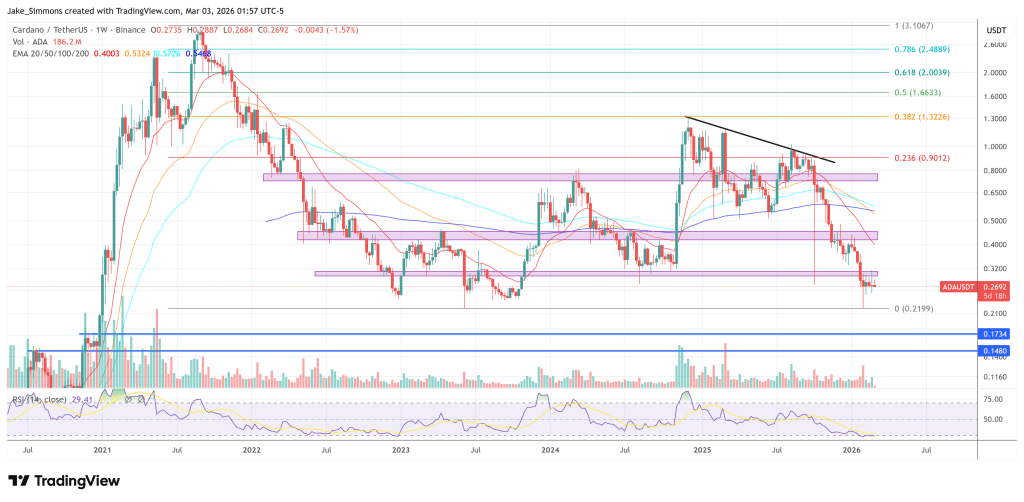
ADA hovers below key resistance, 1-week chart | Source: ADAUSDT on TradingView.com

Domande pertinenti

QWhat is Charles Hoskinson's main criticism of the H.R. 3633 crypto bill?

AHis main criticism is that the bill would treat newly launched digital assets as securities by default, forcing them to prove to the SEC that they qualify to 'graduate' into commodity status. He argues this creates a punitive regulatory maze for new projects while potentially grandfathering in older networks.

QAccording to Hoskinson, what is the real political holdup in Washington regarding crypto legislation?

AHe argues that the real holdup is not about the bill's market structure, but specifically about the issue of stablecoin yield, rather than developer protections, DeFi coverage, or the SEC-CFTC jurisdictional split.

QWhat specific 'attack vectors' does Hoskinson suggest an adversarial SEC could use under the proposed bill?

AHe suggests the SEC could use procedural delays by resetting the clock with deficiency notices on filing completeness and could exploit the bill's undefined treatment of 'common control' to interpret open-source coordination as evidence of centralized management.

QWhat is Hoskinson's preferred alternative to the current H.R. 3633 bill?

AHis preferred alternative is a principles-based rewrite that modernizes securities law itself, builds blockchain-native disclosure systems, explicitly protects developers and DeFi, and limits the discretion regulators have in future rulemaking.

QWhat does Hoskinson warn will be the practical result for the US crypto industry if this 'bad bill' passes?

AHe warns that established networks may survive, but the next generation of US crypto projects will be forced to build offshore first and only attempt to enter the American market years later, stifling innovation within the country.

Letture associate

$292 Million KelpDAO Cross-Chain Bridge Hack: Who Should Foot the Bill?

On April 18, 2026, an attacker stole 116,500 rsETH (worth ~$292M) from KelpDAO’s cross-chain bridge in 46 minutes—the largest DeFi exploit of 2026. The stolen assets were deposited into Aave V3 as collateral, causing $177–200M in bad debt and triggering a cascade of losses across nine DeFi protocols. Aave’s TVL dropped by ~$6B overnight. This legal analysis argues that KelpDAO and LayerZero Labs share concurrent liability, with fault apportioned 60%/40%. KelpDAO negligently configured its bridge with a 1-of-1 decentralized verifier network (DVN)—a single point of failure—despite LayerZero’s explicit recommendation of a 2-of-3 setup. LayerZero, which operated the compromised DVN, failed to secure its RPC infrastructure against a known poisoning attack vector. Both protocols’ terms of service cap liability at $200 (KelpDAO) or $50 (LayerZero), but these limits are likely unenforceable due to unconscionability, gross negligence exceptions, and potential securities law invalidation (if rsETH is deemed a security under the Howey test). Aave’s governance also faces fiduciary duty claims for raising rsETH’s loan-to-value ratio to 93%—far above competitors’ 72–75%—without adequately assessing bridge risks, amplifying the systemic fallout. Practical recovery targets include LayerZero Labs (a registered Canadian entity), KelpDAO’s founders, auditors, and identifiable Aave governance delegates. The incident underscores escalating legal risks for DeFi protocols, infrastructure providers, and governance participants.

marsbit32 min fa

$292 Million KelpDAO Cross-Chain Bridge Hack: Who Should Foot the Bill?

marsbit32 min fa

Insider Trading in War: 5 People Involved, the Highest Earner Was Arrested

On April 24, the U.S. Department of Justice arrested U.S. Army Special Forces Staff Sergeant Gannon Ken Van Dyke for insider trading related to the capture of Venezuelan President Nicolás Maduro on January 3. Van Dyke allegedly profited over $400,000 by placing bets on a prediction market, Polymarket, using insider knowledge of the covert operation. According to the indictment, Van Dyke registered an account (0x31a5) on December 26 and made a series of bets predicting Maduro’s capture and U.S. military involvement in Venezuela. He withdrew most of his funds on the day of the operation and attempted to obscure his tracks by transferring assets through crypto and brokerage accounts. This case marks the first time the DOJ has prosecuted insider trading on Polymarket. PolyBeats had previously identified five suspicious accounts, including Van Dyke’s—the highest earner—in January. The other accounts, with profits ranging from $34,000 to $145,000, remain under unofficial scrutiny but have not been charged. Their lower profits, indirect access to information, and unclear legal boundaries may complicate prosecution. Polymarket has since strengthened its market integrity rules, explicitly prohibiting trading based on confidential or insider information. Van Dyke’s arrest, nearly four months after his trades, signals increased regulatory attention and the persistent traceability of blockchain-based transactions.

marsbit34 min fa

Insider Trading in War: 5 People Involved, the Highest Earner Was Arrested

marsbit34 min fa

Bitwise: Bullish on Bitcoin's Performance in the Second Half of the Year, AI and Regulation Will Spark a New Altcoin Season

Bitwise CIO Matt Hougan and Research Lead Ryan Rasmussen express strong bullish sentiment on Bitcoin's long-term prospects, suggesting that its $1 million price target may be too conservative. They argue Bitcoin serves a dual role: as digital gold and a potential global settlement asset, especially amid declining trust in traditional monetary systems. Despite a weak Q1 2026 where nearly all crypto assets and prices saw double-digit declines, the analysts remain optimistic due to strong forward-looking catalysts, including institutional adoption via Bitcoin ETFs from major firms like Morgan Stanley and Goldman Sachs. Geopolitical instability, such as Iran’s mention of using Bitcoin for international payments, increases the value of Bitcoin’s “out-of-the-money call option” as a non-political, global settlement currency. This enhances its appeal beyond a mere store of value. . Additionally, Hougan highlights that a clearer regulatory token framework under current SEC leadership, combined with AI efficiency gains and high-performance blockchains, could fuel a new “altseason” by late 2026. This may lead to a wave of legitimate, value-capturing token projects, unlike the earlier ICO boom. . Bitwise also announced an Avalanche ETF, citing its unique architecture and rapid growth in real-world asset (RWA) tokenization, which has surged 10x to nearly $30 billion in two years. The firm believes Layer 1 blockchains are still early in their growth cycle, with significant potential ahead.

marsbit1 h fa

Bitwise: Bullish on Bitcoin's Performance in the Second Half of the Year, AI and Regulation Will Spark a New Altcoin Season

marsbit1 h fa

Trading

Spot
Futures

Articoli Popolari

Come comprare ADA

Benvenuto in HTX.com! Abbiamo reso l'acquisto di Cardano (ADA) semplice e conveniente. Segui la nostra guida passo passo per intraprendere il tuo viaggio nel mondo delle criptovalute.Step 1: Crea il tuo Account HTXUsa la tua email o numero di telefono per registrarti il tuo account gratuito su HTX. Vivi un'esperienza facile e sblocca tutte le funzionalità,Crea il mio accountStep 2: Vai in Acquista crypto e seleziona il tuo metodo di pagamentoCarta di credito/debito: utilizza la tua Visa o Mastercard per acquistare immediatamente CardanoADA.Bilancio: Usa i fondi dal bilancio del tuo account HTX per fare trading senza problemi.Terze parti: abbiamo aggiunto metodi di pagamento molto utilizzati come Google Pay e Apple Pay per maggiore comodità.P2P: Fai trading direttamente con altri utenti HTX.Over-the-Counter (OTC): Offriamo servizi su misura e tassi di cambio competitivi per i trader.Step 3: Conserva Cardano (ADA)Dopo aver acquistato Cardano (ADA), conserva nel tuo account HTX. In alternativa, puoi inviare tramite trasferimento blockchain o scambiare per altre criptovalute.Step 4: Scambia Cardano (ADA)Scambia facilmente Cardano (ADA) nel mercato spot di HTX. Accedi al tuo account, seleziona la tua coppia di trading, esegui le tue operazioni e monitora in tempo reale. Offriamo un'esperienza user-friendly sia per chi ha appena iniziato che per i trader più esperti.

1.1k Totale visualizzazioniPubblicato il 2024.12.10Aggiornato il 2025.03.21

Come comprare ADA

Discussioni

Benvenuto nella Community HTX. Qui puoi rimanere informato sugli ultimi sviluppi della piattaforma e accedere ad approfondimenti esperti sul mercato. Le opinioni degli utenti sul prezzo di ADA ADA sono presentate come di seguito.

活动图片