Cardano Founder Hoskinson Signals Reset For 2026, Not An Exit

bitcoinistPubblicato 2026-01-01Pubblicato ultima volta 2026-01-01

Introduzione

Charles Hoskinson, founder of Cardano, has announced a significant shift in his public engagement for 2026, clarifying it is not an exit from the cryptocurrency space. He stated he is stepping back from day-to-day activity on X (Twitter), which he has "outgrown," to reduce the "weaponization" of his persona, which he sees as a liability for Cardano and its privacy-focused protocol, Midnight. Instead, he will focus on long-form writing, AMAs, and new media formats to maintain community connection with less toxicity. Hoskinson emphasized a return to "deep focus" on product development, including working on a zkVM specification, adding privacy to intents, and chain abstraction. His primary goal is to build scalable technology, targeting a billion users and a trillion dollars in transactions on Midnight by 2030. He also cited personal changes, intending to travel less after 260 days on the road in 2025, prioritize health, and spend more time at his ranch. He concluded with a critique on price obsession, stating, "If all you can think about is the price, you’ve already lost."

Charles Hoskinson rang in 2026 from his Wyoming ranch with a message that sounded, at first blush, like an exit. It wasn’t. The Cardano founder said he is “not leaving the cryptocurrency space,” but he is walking away from day-to-day life on X and retooling how he shows up publicly, arguing that his visibility has become a liability for Cardano and Midnight adoption.

Cardano Founder Plans To Move Into The Background

Hoskinson opened the New Year’s livestream titled “Happy New Year and Farewell” with a post-mortem on 2025, framing it as a year in which parts of the industry chased success faster than it built systems capable of delivering on crypto’s broader promises. In his telling, the space “lost our way” by letting incentives and spectacle override first principles.

He was also explicit about what the “farewell” refers to and what it does not. “So, to get this right off the bat, I’m not leaving the cryptocurrency space,” Hoskinson said. “I’m cognizant and aware that every single time I make a live stream or I say something, it gets misconstrued. So, let’s just definitively put that on the table. I’m not going anywhere. I’m not leaving.”

Instead, he described a strategic retreat from hyper-online discourse, claiming that the “weaponization” of his persona creates a barrier for would-be users who might otherwise participate in Cardano or Midnight.

The problem, he argued, is that public perception increasingly substitutes for product evaluation: “We don’t ask what it do. We ask who made it... If we hate them, what that thing is is evil and wrong. If we love them, what that thing is must be good.”

The clearest operational change is his decision to step back from X entirely. “I’ve outgrown X,” he said. “So it’s my farewell to that platform and I’ll turn it over to curators and AI. It’ll go into silent mode for probably a few weeks to a few months as we build up that infrastructure because I have more important things to do, but I’m going to uninstall the app and never think of it again.”

Hoskinson said he plans to focus instead on “long form writing,” AMAs, livestreams, and experimenting with new media formats, floating Twitch as one possible outlet. The goal, as he framed it, is to preserve community connection while reducing the surface area for what he described as increasingly hostile, toxic cycles during down markets.

Beyond the social pivot, Hoskinson emphasized a shift into “deep focus,” saying he has returned to a level of product specificity he hasn’t had “in a very long time.” He cited drafting a “specification for a zkVM,” working on “adding privacy to intents,” and thinking through “chain abstraction” and the roles across “application and permission and solver and settlement” layers.

He repeatedly anchored that renewed focus to scale targets, explicitly tying his 2026 mindset to Midnight’s longer-term arc. “Every day I wake up and I ask, ‘How do I build something a million people can use?’ And then I ask, ‘How do I build something a billion people can use?’” he said, adding that he has been thinking through what it would take for Midnight to reach “a billion users and a trillion dollars of transactions on the platform by 2030.”

Personal Changes For 2026

Hoskinson also made the personal operational changes unusually concrete. He said he traveled “more than 260 days” in 2025, averaged “only five and a half hours of sleep a night,” and described that pace as unsustainable. After Japan and Hong Kong, he said, he intends to travel less and spend more time at his ranch or farm, focusing on health, reading, and calmer reflection.

The closing stretch blended motivation with ecosystem-specific claims about the year ahead: he said “we finally launched Midnight,” pointed to RealFi efforts that “gave out a million loans over the last 18 months” in Uganda and Kenya, and framed 2026 as the year “Leios ships,” “Hydra gets good,” and Cardano’s “decentralized governance becomes hardened” as the community gains “full agency.”

But he also delivered a blunt cultural critique that doubles as a signal to his audience about what he wants his next chapter to optimize for. “If all you can think about is the price, you’ve already lost,” Hoskinson said. “Even if it goes up, you’ve lost. Not just at crypto, but at life.”

At press time, ADA traded at $0.34.
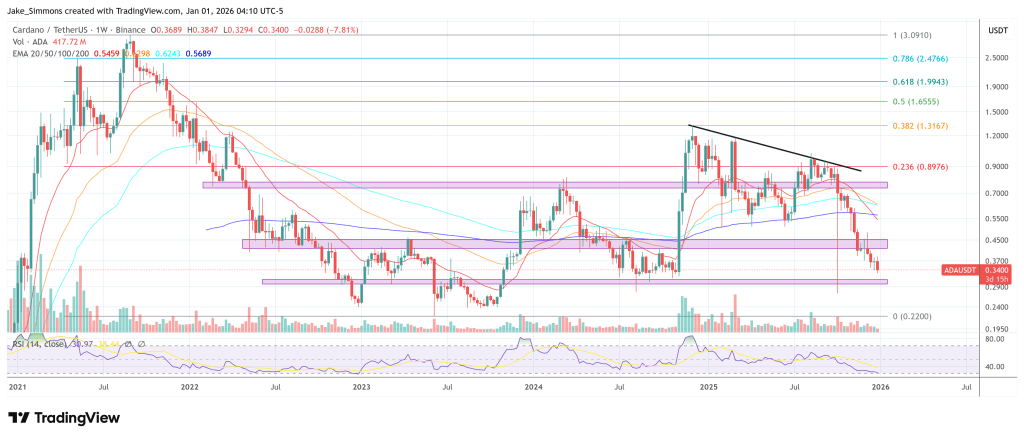
ADA almost lost its entire late-2024 gains, 1-week chart | Source: ADAUSDT on TradingView.com

Domande pertinenti

QWhat did Charles Hoskinson announce regarding his future role in the cryptocurrency space and his presence on social media?

ACharles Hoskinson announced that he is not leaving the cryptocurrency space but is stepping back from day-to-day activity on X (Twitter) and retooling his public presence. He stated that his visibility has become a liability for Cardano and Midnight adoption, and he plans to move into the background.

QWhat specific operational change did Hoskinson mention regarding his use of the platform X?

AHoskinson stated that he is stepping back from X entirely, uninstalling the app, and turning the account over to curators and AI. It will go into silent mode for a few weeks to months while they build the infrastructure, as he has outgrown the platform.

QWhat new focus did Hoskinson outline for his work in 2026?

AHoskinson emphasized a shift into 'deep focus' on product development, including drafting a specification for a zkVM, working on adding privacy to intents, and thinking through chain abstraction and the roles across application, permission, solver, and settlement layers.

QWhat personal changes did Hoskinson say he would make to his lifestyle in 2026?

AHe plans to travel less after being on the road for more than 260 days in 2025, spend more time at his ranch or farm, focus on his health, get more sleep (after averaging only 5.5 hours per night), and engage in reading and calmer reflection.

QWhat large-scale user and transaction goals did Hoskinson set for Midnight by 2030?

AHoskinson stated that he is focused on building something that a billion people can use, with the goal for Midnight to reach 'a billion users and a trillion dollars of transactions on the platform by 2030'.

Letture associate

Near Returns to the AI Stage: Transformation into a Public Chain Due to 'Payroll Difficulties,' Agent and Privacy Emerge as New Growth Narratives

NEAR Returns to AI Origins: From Payroll Struggles to Blockchain, Now Focusing on AI Agents and Privacy NEAR Protocol's journey began not with grand blockchain ambitions, but from a practical hurdle: its AI startup founders, including Transformer paper co-author Illia Polosukhin, couldn't efficiently pay international developers in 2017. This led them to pivot and build a high-performance, scalable blockchain. After years navigating various crypto narratives like sharding and cross-chain interoperability, NEAR is now leveraging its AI roots to re-enter the AI arena. A key driver is its "NEAR Intents" layer, which abstracts complex cross-chain transactions. Users simply state their goal (e.g., swap BTC for ETH), and a solver network finds the optimal route. This system has processed over $20B in cross-chain volume, generating significant fee revenue. A major growth area is private transactions via "Confidential Intents/Swaps," which hide trade details until settlement to protect against MEV and front-running. Remarkably, private swaps recently accounted for over 40% of NEAR's transaction volume, highlighting strong demand but also potential regulatory scrutiny. With its AI-founder pedigree, NEAR is positioning itself at the intersection of blockchain, AI agents, and privacy, aiming to become infrastructure for the emerging agent economy while navigating the challenges of its rapid adoption.

marsbit1 h fa

Near Returns to the AI Stage: Transformation into a Public Chain Due to 'Payroll Difficulties,' Agent and Privacy Emerge as New Growth Narratives

marsbit1 h fa

From Ethereum to AI's 'CROPS': What Exactly is This Set of 'Slow Variables' That Vitalik Repeatedly Emphasizes?

In recent discussions, Vitalik Buterin has frequently emphasized the concept of "CROPS," a framework defining core values for Ethereum's development. CROPS stands for Censorship Resistance, Capture Resistance, Open Source, Privacy, and Security. Initially outlined in the Ethereum Foundation's "EF Mandate," it represents a commitment to user sovereignty, ensuring that the network resists external control, remains open, protects privacy, and prioritizes security. The relevance of CROPS extends beyond Ethereum's foundational principles, becoming crucial in the context of AI integration. As AI agents begin handling wallet operations and automated transactions, the risk increases that users may cede control over their digital assets, privacy, and intentions to centralized AI service providers. A "CROPS AI" would therefore emphasize local execution where possible, privacy-preserving remote model calls (e.g., using zero-knowledge proofs), and transparent, verifiable processes to maintain user agency. Vitalik highlights a significant convergence between "CROPS Ethereum access layer" and "CROPS AI." Both address the same fundamental challenge: how users can access powerful services—be it blockchain data via RPCs or AI models—without exposing sensitive information or relinquishing ultimate control. This intersection points toward a future digital entry point that is more private, secure, and user-controlled. Ultimately, CROPS is not merely an abstract ideal but a practical guidepost. It steers development—from protocol resilience and wallet design to AI agent safety—towards a future where users retain self-sovereignty even as digital systems grow more complex and powerful. In an era of accelerating AI adoption, these "slow variables" of censorship resistance, openness, privacy, and security may define Ethereum's enduring value.

marsbit1 h fa

From Ethereum to AI's 'CROPS': What Exactly is This Set of 'Slow Variables' That Vitalik Repeatedly Emphasizes?

marsbit1 h fa

Silicon Valley 'Startup Guru' Steve Hoffman: Web3 + AI Could Be a Trap

Silicon Valley investor and "Godfather of Startups" Steve Hoffman warns that combining Web3 with AI is likely a trap, not a promising venture. In an interview, Hoffman argues that while AI is a foundational technology touching all industries, Web3 adds complexity, friction, and regulatory risk without solving mainstream consumer or business needs. He advises founders to focus on deep, specialized applications where startups can out-iterate giants, rather than on generic features easily replicated by large tech companies. Hoffman observes that Silicon Valley will lead foundational AI research, while China excels at rapid, large-scale application and commercialization, particularly in robotics. He stresses that AI-driven autonomous agents capable of collaborative, multi-step tasks are 2-4 years away, which will cause significant job displacement. The solution is not to slow AI but to redesign business models around human-AI collaboration and reform social systems like education and retraining. For startups, Hoffman recommends focusing on vertical, expertise-heavy domains to build defensibility. He sees major opportunities in AI fraud detection and cybersecurity. Key founder mindsets include systemic thinking over feature-focus, relentless customer centricity, building adaptive teams, and deeply understanding AI's capabilities and limits. Hoffman is also leading a non-profit initiative to establish university centers aimed at training future leaders in responsible, human-value-aligned AI innovation.

marsbit2 h fa

Silicon Valley 'Startup Guru' Steve Hoffman: Web3 + AI Could Be a Trap

marsbit2 h fa

Token Inefficient, Economy Tokenless

The article "Tokens Aren't Economical, Economics Aren't Tokenized" analyzes a pivotal shift in the AI industry from a technology-driven narrative to one dominated by capital efficiency. It highlights two concurrent trends: a severe capital shortage due to the exorbitant and recurring costs of compute (e.g., OpenAI's high burn rate) and a wave of corporate spin-offs where major tech companies are separating their AI units (like Kuaishou's Kling and Baidu's Kunlunxin). The core argument is that AI's "anti-internet" business model, where user growth increases costs rather than profits, has created a disconnect between high valuations and actual cash flow. Spin-offs address this by allowing AI assets to be valued independently. Within a parent company, they are seen as cost centers, but as standalone entities, they are priced based on their growth potential and scarcity in the primary market, leading to massive valuation premiums (e.g., Kling's estimated value tripling post-spin-off). The industry is at an inflection point, moving from "model worship" to "value realization." The competition is evolving from a pure compute (GPU) race to a broader focus on systemic efficiency and full-stack engineering (involving CPUs and orchestration) to achieve viable commercialization. The year 2026 is framed as a critical moment where the industry must definitively answer how to economically translate AI capability into tangible business value, reshaping the sector's future power structure.

marsbit3 h fa

Token Inefficient, Economy Tokenless

marsbit3 h fa

Trading

Spot
Futures

Articoli Popolari

Come comprare ADA

Benvenuto in HTX.com! Abbiamo reso l'acquisto di Cardano (ADA) semplice e conveniente. Segui la nostra guida passo passo per intraprendere il tuo viaggio nel mondo delle criptovalute.Step 1: Crea il tuo Account HTXUsa la tua email o numero di telefono per registrarti il tuo account gratuito su HTX. Vivi un'esperienza facile e sblocca tutte le funzionalità,Crea il mio accountStep 2: Vai in Acquista crypto e seleziona il tuo metodo di pagamentoCarta di credito/debito: utilizza la tua Visa o Mastercard per acquistare immediatamente CardanoADA.Bilancio: Usa i fondi dal bilancio del tuo account HTX per fare trading senza problemi.Terze parti: abbiamo aggiunto metodi di pagamento molto utilizzati come Google Pay e Apple Pay per maggiore comodità.P2P: Fai trading direttamente con altri utenti HTX.Over-the-Counter (OTC): Offriamo servizi su misura e tassi di cambio competitivi per i trader.Step 3: Conserva Cardano (ADA)Dopo aver acquistato Cardano (ADA), conserva nel tuo account HTX. In alternativa, puoi inviare tramite trasferimento blockchain o scambiare per altre criptovalute.Step 4: Scambia Cardano (ADA)Scambia facilmente Cardano (ADA) nel mercato spot di HTX. Accedi al tuo account, seleziona la tua coppia di trading, esegui le tue operazioni e monitora in tempo reale. Offriamo un'esperienza user-friendly sia per chi ha appena iniziato che per i trader più esperti.

1.3k Totale visualizzazioniPubblicato il 2024.12.10Aggiornato il 2026.06.02

Come comprare ADA

Discussioni

Benvenuto nella Community HTX. Qui puoi rimanere informato sugli ultimi sviluppi della piattaforma e accedere ad approfondimenti esperti sul mercato. Le opinioni degli utenti sul prezzo di ADA ADA sono presentate come di seguito.

活动图片