Cardano Foundation Reaches First Milestone In New Governance Roadmap

bitcoinistPubblicato 2026-01-22Pubblicato ultima volta 2026-01-22

Introduzione

Cardano Foundation has reached the first milestone in its updated governance roadmap by delegating an additional 220 million ADA to 11 community representatives (DReps) focused on Adoption and Operations. This brings the Foundation’s total delegation to community DReps to 360 million ADA. The move aims to decentralize governance by shifting voting power toward representatives with expertise in real-world adoption, business acumen, and network operations—not just technical development. The Foundation also announced it will self-delegate its remaining 171 million ADA stake instead of leaving it passive, reducing its overall voting power by 43 million ADA. The delegations were made without conditions or voting instructions, emphasizing trust in the DReps' decision-making and encouraging healthy dissent as a feature of decentralized governance.

The Cardano Foundation said it has hit the first milestone in its updated governance roadmap, expanding delegation to a new set of community representatives as the ecosystem leans further into on-chain decision-making. The move matters because it shifts meaningful voting weight toward delegated representatives (DReps) whose mandates emphasize adoption and day-to-day network operations rather than purely technical development.

Cardano Foundation Expands DRep Delegation

In a post on X and an accompanying blog update, the Foundation said it has delegated an additional 220 million ADA to 11 selected DReps, roughly 20 million ADA each, focused on the pillars of Adoption and Operations. The Foundation framed the step as a continuation of earlier delegations to “Developer & Builder DReps,” and said the new allocation brings total delegation to community DReps to 360 million ADA.

Alongside the additional community delegation, the Foundation said it is revising how it handles its remaining stake in governance. “Rather than leaving a portion of our funds on auto-abstain as initially planned, we will self-delegate the remaining balance (approximately 171 million ADA),” the Foundation wrote. “While this exceeds our initial estimate, it ensures no ADA remains passive and still results in a net reduction of our overall voting power by approximately 43 million ADA, with the clear majority of our holdings now empowering community DReps.”

The Foundation emphasized that the delegations are intended to distribute voting power without imposing direction. “This delegation is not a blind bet, rather it’s a show of trust in a proven history of sound decision-making,” it said. “As always, it’s also a show of good faith: These new delegations come without any expectation regarding voting outcomes. We will not direct these DReps on how to vote, nor will we provide a voting manual.”

That posture, explicitly accepting dissent from its own views, was positioned as a feature rather than a risk. The Foundation said it expects “differing opinions” between the newly selected DReps and the Foundation itself, describing that divergence as evidence of “a healthy, decentralized governance system.”

The Foundation’s rationale for targeting adoption and operations reads as a governance design choice: broaden the expertise mix beyond protocol engineering. “To build a resilient governance system, we need more than just technical expertise—We need business acumen and operational stability,” it wrote, arguing that Adoption DReps can represent real-world utility, onboarding, and enterprise needs, while Operations DReps reflect the practical constraints faced by stake pool operators, toolmakers, and infrastructure providers.

In the published list, the Adoption cohort includes figures tied to community growth and product-building across the ecosystem, from regional community leadership to DeFi and stablecoin infrastructure, while the Operations cohort highlights long-running infrastructure roles such as block explorer analytics, stake pool operations, and SPO tooling.

The Foundation said all eleven delegations were completed in a single on-chain transaction, linking to the Cardano Explorer entry, and noted the delegations are effective immediately. It also encouraged the broader community to “follow and interact with these DReps,” including engaging with their voting rationales and participating in governance actions.

At press time, Cardano traded at $0.3549.
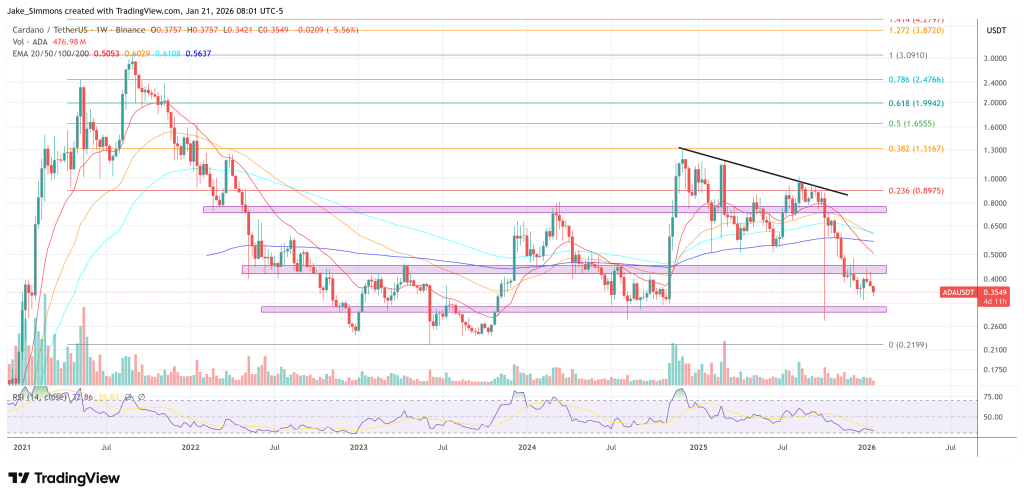
Cardano hovers below key resistance, 1-week chart | Source: ADAUSDT on TradingView.com

Domande pertinenti

QWhat is the first milestone achieved by the Cardano Foundation in its updated governance roadmap?

AThe Cardano Foundation has expanded delegation to a new set of community representatives (DReps) focused on Adoption and Operations, shifting meaningful voting weight towards them.

QHow much ADA was delegated to the 11 selected DReps, and what was the focus of these DReps?

AThe Foundation delegated an additional 220 million ADA, roughly 20 million ADA each, to 11 DReps focused on the pillars of Adoption and Operations.

QWhat change did the Foundation make regarding its remaining stake in governance, and what was the result?

ARather than leaving a portion of funds on auto-abstain, the Foundation self-delegated its remaining balance of approximately 171 million ADA, resulting in a net reduction of its overall voting power by about 43 million ADA.

QHow does the Foundation view differing opinions between itself and the newly selected DReps?

AThe Foundation views differing opinions as evidence of a healthy, decentralized governance system, considering it a feature rather than a risk.

QWhat rationale did the Foundation provide for targeting Adoption and Operations DReps specifically?

AThe Foundation stated that building a resilient governance system requires more than technical expertise; it needs business acumen and operational stability, with Adoption DReps representing real-world utility and enterprise needs, and Operations DReps reflecting practical constraints of stake pool operators and infrastructure providers.

Letture associate

Polymarket's "2028 Presidential Election" Volume King Is... LeBron James???

An article from Odaily Planet Daily, authored by Azuma, discusses a peculiar phenomenon observed on the prediction market platform Polymarket regarding the "2028 US Presidential Election" event. Despite having a real-time probability of less than 1%, unlikely candidates such as NBA star LeBron James (with $48.41 million in trading volume), celebrity Kim Kardashian ($33.84 million), and even ineligible figures like Elon Musk ($23.14 million) and New York City Mayor Zohran Mamdani ($18.39 million) account for approximately 70% of the total trading volume. In contrast, high-probability candidates like Vice President JD Vance ($10.58 million), California Governor Gavin Newsom ($15.71 million), and Secretary of State Marco Rubio ($9.32 million) have significantly lower trading activity. The article explains that this counterintuitive trend is not driven by irrational speculation but by rational strategies. Polymarket offers a 4% annualized holding reward for certain markets, including the 2028 election, to maintain long-term pricing accuracy. This yield exceeds the current 5-year US Treasury rate (3.98%), attracting large investors ("whales") to hold "NO" shares on low-probability candidates for risk-free returns. Additionally, some users utilize a platform feature that allows converting a set of "NO" shares into corresponding "YES" shares for better liquidity or pricing efficiency, rather than directly buying "YES" shares for their preferred candidates. Thus, the seemingly absurd trading activity is strategically motivated.

marsbit1 h fa

Polymarket's "2028 Presidential Election" Volume King Is... LeBron James???

marsbit1 h fa

Dialogue with ViaBTC CEO Yang Haipo: Is the Essence of Blockchain a Libertarian Experiment?

"ViaBTC CEO Yang Haipo: Blockchain as a Hardcore Libertarian Experiment" In a deep-dive interview, ViaBTC CEO Yang Haipo reframes the essence of blockchain, arguing it is not merely a new technology or infrastructure but a hardcore libertarian experiment. This experiment, born from the 2008 financial crisis and decades of cypherpunk ideology, tests a fundamental question: to what extent can freedom and self-organization exist without centralized trust? The discussion highlights the experiment's verified outcomes. On one hand, it has proven its core value of censorship resistance, providing critical financial lifelines for entities like WikiLeaks and individuals in hyperinflationary or sanctioned countries via tools like stablecoins. However, Yang points out a key paradox: the most successful product, USDT, is itself a centralized compromise, showing users prioritize a less-controlled pipeline over pure decentralization. On the other hand, the experiment has exposed the severe costs of this freedom—a "dark forest" without safeguards. Events like the collapses of LUNA, Celsius, and FTX, resulting in massive wealth destruction and prison sentences for founders, underscore the system's fragility and the inherent risks of an unregulated environment. Yang observes that despite decentralized protocols, human nature inevitably recreates centralized power structures, speculative frenzies, and narrative-driven cycles (from ICOs to Meme coins), where emotion and belonging often trump technological substance. Looking forward, he believes blockchain's future is significant but niche. Its real value lies in serving specific, real-world needs for financial sovereignty and bypassing traditional controls, not as a universal infrastructure replacing all centralized systems. For the average participant, Yang's crucial advice is to cultivate independent judgment. True freedom is not holding a crypto wallet, but possessing a mind resilient to groupthink and narrative hype in a high-risk, often irrational market.

marsbit1 h fa

Dialogue with ViaBTC CEO Yang Haipo: Is the Essence of Blockchain a Libertarian Experiment?

marsbit1 h fa

Trading

Spot
Futures

Articoli Popolari

Come comprare ADA

Benvenuto in HTX.com! Abbiamo reso l'acquisto di Cardano (ADA) semplice e conveniente. Segui la nostra guida passo passo per intraprendere il tuo viaggio nel mondo delle criptovalute.Step 1: Crea il tuo Account HTXUsa la tua email o numero di telefono per registrarti il tuo account gratuito su HTX. Vivi un'esperienza facile e sblocca tutte le funzionalità,Crea il mio accountStep 2: Vai in Acquista crypto e seleziona il tuo metodo di pagamentoCarta di credito/debito: utilizza la tua Visa o Mastercard per acquistare immediatamente CardanoADA.Bilancio: Usa i fondi dal bilancio del tuo account HTX per fare trading senza problemi.Terze parti: abbiamo aggiunto metodi di pagamento molto utilizzati come Google Pay e Apple Pay per maggiore comodità.P2P: Fai trading direttamente con altri utenti HTX.Over-the-Counter (OTC): Offriamo servizi su misura e tassi di cambio competitivi per i trader.Step 3: Conserva Cardano (ADA)Dopo aver acquistato Cardano (ADA), conserva nel tuo account HTX. In alternativa, puoi inviare tramite trasferimento blockchain o scambiare per altre criptovalute.Step 4: Scambia Cardano (ADA)Scambia facilmente Cardano (ADA) nel mercato spot di HTX. Accedi al tuo account, seleziona la tua coppia di trading, esegui le tue operazioni e monitora in tempo reale. Offriamo un'esperienza user-friendly sia per chi ha appena iniziato che per i trader più esperti.

1.1k Totale visualizzazioniPubblicato il 2024.12.10Aggiornato il 2025.03.21

Come comprare ADA

Discussioni

Benvenuto nella Community HTX. Qui puoi rimanere informato sugli ultimi sviluppi della piattaforma e accedere ad approfondimenti esperti sul mercato. Le opinioni degli utenti sul prezzo di ADA ADA sono presentate come di seguito.

活动图片