Capital Outflow, Long-Short Balance: Ethena's Ebb Reveals a Rare Signal

比推Pubblicato 2026-03-09Pubblicato ultima volta 2026-03-09

Introduzione

The cryptocurrency market has been in a risk-off mode for months. Ethena, a key player in crypto basis trading, has seen its deployed capital—acting as a proxy for excess long demand—plummet to $791 million, just 71% of its 2025 low and 12.9% of its previous peak. This sharp decline reflects a rare market structure where active longs and active shorts are nearly balanced, a historically unstable condition. Ethena’s business model involves taking the short side of perpetual swaps against leveraged long traders, earning funding rates. The drastic reduction in its deployed capital—down over 60% in a month despite relatively stable Bitcoin prices—suggests either unprofitable basis trades are being unwound or increased hedging activity (e.g., VCs and projects hedging small-cap token exposure) is crowding out opportunistic basis traders like Ethena. Perpetual futures, central to crypto leverage, require a 1:1 match between longs and shorts. The current equilibrium indicates exceptionally low speculative long interest and a rise in structural short hedging. This balance is fragile and unlikely to persist, potentially leading to increased volatility. Ethena’s retreat serves as a clear signal of shifting risk appetite and crowded hedging strategies in crypto markets.

Author: @SoskaKyle

Compiled by: AididiaoJP, Foresight News

Original Title: What Warning Does Ethena's "Capital Ebb" Bring to the Crypto Market?


The cryptocurrency market has been in "risk-off mode" for several months. During this time, I have been sorting through various market data, trying to find signs of improvement. In this article, I will start with the market structure of perpetual contracts, combine it with data from Ethena's transparent dashboard, and discuss the market's current risk appetite.

Simply put, the capital currently "deployed" by Ethena has dropped to a multi-year low, only 71% of the low point in 2025. This is not to say that Ethena itself has any problems, but rather reflects the true state of the entire market. Currently, the number of active shorts and active longs in the market is almost equal, which is a very rare situation in the crypto space. Historically, this balance has been difficult to maintain for long.

The cryptocurrency market has always been known for its high price volatility and heavy use of leverage. I previously wrote a research article on BitMEX, specifically analyzing the 100x perpetual contracts it launched back then.

From the BitMEX era to now, cryptocurrency futures have become the highest-volume product in the circle, typically 5 to 20 times the trading volume of the spot market. Since perpetual contracts are the main venue for retail investors to add leverage, watching perpetual contracts is the right way to understand the risk appetite for cryptocurrencies.

The company Ethena, in particular, provides us with a unique perspective on the derivatives market. As shown in the figure below, Ethena engages in "carry trades" for cryptocurrencies. The strategy is simple: when traders want to go long, Ethena acts as their counterparty—going short. Then, Ethena buys the exact same amount of spot assets as it has shorted. It can be understood that Ethena provides "leverage" as a service. Traders want to add leverage to bet on price increases but lack funds; Ethena has funds but does not want to take directional risk. Therefore, traders use perpetual contracts to "borrow" funds from Ethena to add leverage, paying a certain basis and funding rate.
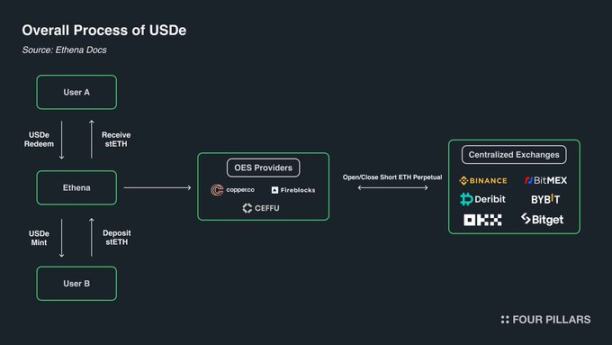
(Image source: docs.ethena.fi / 4pillars)

The mechanism of perpetual contracts dictates that every long position must correspond to a short position, always in a 1:1 ratio. Every contract in the market represents a funding payment agreement between the long and short sides. The exchange's role is to matchmake, ensuring that both the long and short sides of each contract have sufficient margin. The matrix below shows the four possible outcomes of exchange matching.
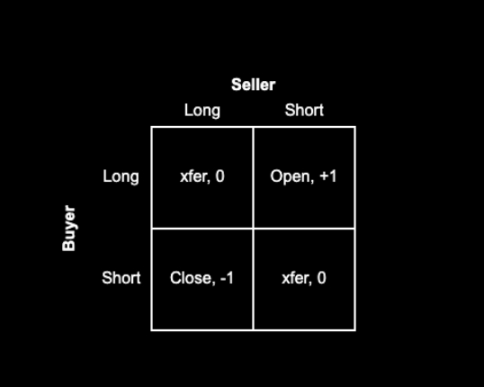
Perpetual Contract Matching Logic Matrix

Every trade has a buyer and a seller. If the buyer and seller were both originally long, or both short, the exchange only needs to transfer the contract from one party to the other; this does not increase or decrease the total number of contracts in the market. If the buyer wants to go long and the seller wants to go short, the exchange must generate a new contract, making the buyer the long and the seller the short, thus increasing the total number of contracts in the market by 1. Conversely, if the seller wants to close their long position and the buyer wants to close their short position, the exchange can "unbind" these two from their old contracts and cancel both contracts, reducing the total number of contracts in the market by 1.

So, in a normal market, who holds these contracts? I think they can basically be divided into the following four types of people:

  • 【Longs】 Active longs. Those who want to go long, betting on price increases. They are risk-preferential, and their willingness to enter the market depends entirely on their confidence in the market.

  • 【Shorts】 Active shorts / Hedgers.

  • a. Those who directly short the asset.

  • b. Those hedging with structured products. For example, some VCs or employees paid in company tokens may want to lock in the current price to hedge against the risk of price drops when tokens unlock in the future. Also, market makers or trading firms like Cumberland and Wintermute might help hedge for some illiquid projects (e.g., Monad) by shorting highly correlated major coins like Bitcoin and Ethereum to indirectly hedge the risk of their small-cap holdings. Projects like Neutrl specialize in such trades.

  • 【Arbitrage Shorts】 Basis traders (including Ethena and similar institutions). They are opportunists, not interested in betting on direction. When there are too many people wanting to go long and not enough wanting to go short, they step in to act as the counterparty, earning the basis and funding rate. Their capital scale can be adjusted flexibly.

  • 【Mixed Arbitrage】 Perp-perp arbitrageurs. They hold both long and short positions in perpetual contracts simultaneously, seeking small price differences between different exchanges or different perpetual contracts. At any time, their long and short positions are perfectly matched; they do not bet on direction.

Because perpetual long and short positions must match 1:1, we can derive a formula:

Active Longs + Arbitrageurs' Longs = Active Shorts + Basis Traders' Shorts + Arbitrageurs' Shorts

At the same time, the nature of arbitrageurs dictates that:

Arbitrageurs' Longs = Arbitrageurs' Shorts

Substituting the second equation into the first and canceling out the arbitrageurs' positions on both sides gives:

Active Longs = Active Shorts + Basis Traders' Shorts

Ethena's business happens to be a good representative of the "Basis Traders' Shorts." By observing its data, we can get a rough idea of the power gap between active longs and active shorts.

The chart below shows the "Cash" and "Deployed Capital" parts from Ethena's published balance sheet, from December 27, 2024, to March 7, 2026:
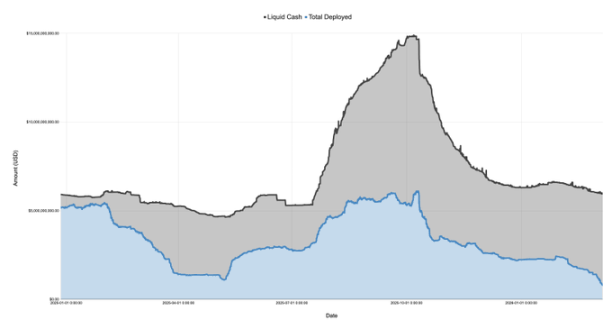
In January 2025, with the launch of the Trump coin TRUMP, market sentiment turned sharply negative, entering "risk-off" mode. This was followed by tariff discussions and then the "Liberation Day" in April, with the market declining all the way. During this period, Ethena's "deployed" capital plummeted from over $5 billion to just $1.1 billion, a drop of more than 75%!

Remember, Ethena's deployed capital can be seen as an indicator of "excess long demand" in the market. Although Ethena is not the only one doing this, its size is significant (sometimes accounting for 25% of the total open interest on Binance and Bybit). As long as they have idle funds, they will theoretically meet the unmet long demand in the market. So this data tells us that by April 2025, although the total potential demand may not have fallen by 75%, the "net long demand" remaining after "active shorts" filled their part did indeed plummet substantially.

The chart below shows the proportional changes in the deployed capital of Ethena's balance sheet, as well as the low and high points of 2025.
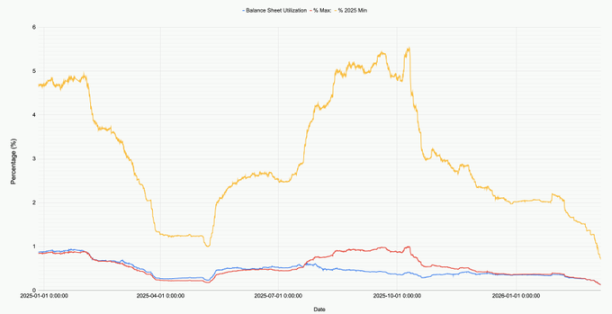
Look at now (March 9, 2026): Ethena's total deployed capital across all markets (BTC, ETH, SOL, BNB, XRP, HYPE) is only about $791 million. This number is 71% of the low point in 2025 and only 12.9% of the high point before October 10, 2025. Again, this is absolutely not Ethena's own failure, but a reflection of the market's real demand: the willingness to go long is truly at a historical low.
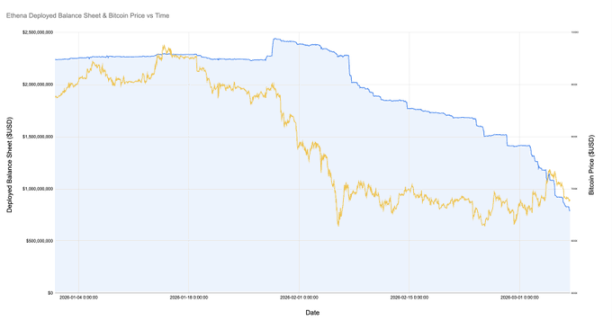
It is particularly noteworthy that just recently (February 8, 2026), when Bitcoin fell to $60,000, Ethena's deployed capital was still over $2 billion. In just one month, this number plummeted by 60%!

The chart below zooms in on the relationship between Ethena's deployed capital and the Bitcoin price since January this year.

Since Bitcoin fell to $60k, Ethena's basis positions have shrunk from over $2 billion to less than $800 million, a drop of over 60%. Interestingly, the price itself hasn't moved much during this time. Why is this? There could be several reasons:

  • The basis positions established during the February crash, while possibly still profitable, became unsustainable as the basis turned unfavorable (even negative) and funding rates also turned negative, so they were gradually closed.

  • Active shorts and hedging positions increased, and these participants are less price-sensitive (e.g., they must sell to lock in profits), crowding out opportunistic basis traders like Ethena.

  • There are fewer people wanting to add long leverage.
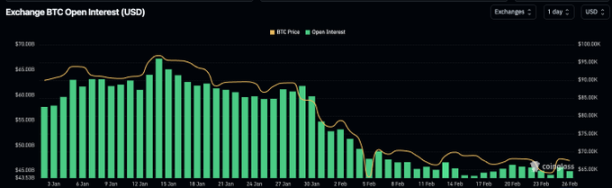
Personally, I think it's mainly the first two reasons; the third has little impact. Look at the chart above: during the period when Ethena was closing positions, the total open interest for Bitcoin (and other major coins) remained quite stable. At the same time, funding rates were negative for a long time, with SOL's cumulative funding rate on some exchanges even negative. This indicates that there are indeed more people in the market wanting to short or hedge.

If I had to guess the underlying reason, I think it might be that small and medium-sized crypto companies and VCs are having a hard time now. Think about those small-cap projects, like Eigen, Grass, Monad, etc.—there are hundreds, even thousands. Each project has dozens of VCs behind it, and the projects themselves have treasuries and employees to support. VCs need to control losses and lock in profits to report to LPs; projects need to preserve cash flow and avoid layoffs. In this situation, everyone is trying to squeeze blood from a stone. A natural method is to use some structured products to short a basket of highly correlated major coins to hedge the risk of their small-cap holdings. This strategy might be getting crowded now.

We can also see some signs, such as times when ETH suddenly surges, causing a large number of mid- and small-cap coins to soar along with it. This might be caused by these hedging positions closing, leading to a "short squeeze." The fact that basis traders like Ethena are being crowded out is itself evidence of this strategy's crowding.

Regardless of the specific reason, one thing is certain: In the crypto space, the strength of active longs and active shorts is almost balanced, perhaps for the first time. Of course, no one says this cannot become the new normal, but referring to the historical experience of other financial markets, this delicate balance is usually difficult to sustain.


Twitter:https://twitter.com/BitpushNewsCN

Bitpush TG Discussion Group:https://t.me/BitPushCommunity

Bitpush TG Subscription: https://t.me/bitpush

Original link:https://www.bitpush.news/articles/7618108

Domande pertinenti

QWhat does the sharp decline in Ethena's deployed capital indicate about the current cryptocurrency market?

AThe sharp decline in Ethena's deployed capital to a multi-year low, just 71% of the 2025 low point, indicates extremely weak risk appetite and a significant reduction in net long demand in the market. It reflects that active shorts and active longs are nearly balanced, a rare situation in crypto.

QAccording to the article, what role does Ethena play in the perpetual futures market?

AEthena acts as a basis trader or 'carry trader,' providing leverage as a service. It takes the opposite side of traders who want to go long, shorting the asset and buying an equivalent amount of spot. It profits from the basis and funding rates paid by leveraged long traders.

QWhat is the significance of the formula: Active Longs = Active Shorts + Basis Traders' Short Positions?

AThis formula, derived from the mandatory 1:1 matching of perpetual contracts, shows that the amount of aggressive bullish speculation (active longs) is equal to the sum of aggressive bearish speculation/hedging (active shorts) and the opportunistic short positions from basis traders like Ethena. It's a key identity for understanding market structure.

QWhat are the potential reasons cited for the rapid 60% drop in Ethena's positions from February to March 2026, despite stable Bitcoin prices?

AThe potential reasons are: 1) Previously profitable basis positions became unsustainable as the basis turned negative and funding rates remained negative, leading to unwinding. 2) An increase in price-insensitive active shorts and hedging activity from VCs and projects, crowding out opportunistic basis traders like Ethena. A decrease in leveraged long demand was considered a lesser factor.

QWhat does the article suggest might be causing the increased hedging activity and crowded short strategies?

AThe article suggests that smaller crypto companies and VCs, facing financial pressure from numerous small-cap projects (e.g., Eigen, Grass, Monad), are increasingly using structured products to short a basket of correlated major coins (like BTC, ETH) to hedge the risk of their illiquid, smaller holdings. This has become a crowded trade.

Letture associate

Trading

Spot
Futures

Articoli Popolari

Cosa è $S$

Comprendere SPERO: Una Panoramica Completa Introduzione a SPERO Mentre il panorama dell'innovazione continua a evolversi, l'emergere delle tecnologie web3 e dei progetti di criptovaluta gioca un ruolo fondamentale nel plasmare il futuro digitale. Un progetto che ha attirato l'attenzione in questo campo dinamico è SPERO, denotato come SPERO,$$s$. Questo articolo mira a raccogliere e presentare informazioni dettagliate su SPERO, per aiutare gli appassionati e gli investitori a comprendere le sue basi, obiettivi e innovazioni nei domini web3 e crypto. Che cos'è SPERO,$$s$? SPERO,$$s$ è un progetto unico all'interno dello spazio crypto che cerca di sfruttare i principi della decentralizzazione e della tecnologia blockchain per creare un ecosistema che promuove l'impegno, l'utilità e l'inclusione finanziaria. Il progetto è progettato per facilitare interazioni peer-to-peer in modi nuovi, fornendo agli utenti soluzioni e servizi finanziari innovativi. Al suo interno, SPERO,$$s$ mira a responsabilizzare gli individui fornendo strumenti e piattaforme che migliorano l'esperienza dell'utente nello spazio delle criptovalute. Questo include la possibilità di metodi di transazione più flessibili, la promozione di iniziative guidate dalla comunità e la creazione di percorsi per opportunità finanziarie attraverso applicazioni decentralizzate (dApps). La visione sottostante di SPERO,$$s$ ruota attorno all'inclusività, cercando di colmare le lacune all'interno della finanza tradizionale mentre sfrutta i vantaggi della tecnologia blockchain. Chi è il Creatore di SPERO,$$s$? L'identità del creatore di SPERO,$$s$ rimane piuttosto oscura, poiché ci sono risorse pubblicamente disponibili limitate che forniscono informazioni dettagliate sul suo fondatore o fondatori. Questa mancanza di trasparenza può derivare dall'impegno del progetto per la decentralizzazione—un ethos che molti progetti web3 condividono, dando priorità ai contributi collettivi rispetto al riconoscimento individuale. Centrando le discussioni attorno alla comunità e ai suoi obiettivi collettivi, SPERO,$$s$ incarna l'essenza dell'empowerment senza mettere in evidenza individui specifici. Pertanto, comprendere l'etica e la missione di SPERO rimane più importante che identificare un creatore singolo. Chi sono gli Investitori di SPERO,$$s$? SPERO,$$s$ è supportato da una varietà di investitori che vanno dai capitalisti di rischio agli investitori angelici dedicati a promuovere l'innovazione nel settore crypto. Il focus di questi investitori generalmente si allinea con la missione di SPERO—dando priorità a progetti che promettono avanzamenti tecnologici sociali, inclusività finanziaria e governance decentralizzata. Queste fondazioni di investitori sono tipicamente interessate a progetti che non solo offrono prodotti innovativi, ma contribuiscono anche positivamente alla comunità blockchain e ai suoi ecosistemi. Il supporto di questi investitori rafforza SPERO,$$s$ come un concorrente degno di nota nel dominio in rapida evoluzione dei progetti crypto. Come Funziona SPERO,$$s$? SPERO,$$s$ impiega un framework multifunzionale che lo distingue dai progetti di criptovaluta convenzionali. Ecco alcune delle caratteristiche chiave che sottolineano la sua unicità e innovazione: Governance Decentralizzata: SPERO,$$s$ integra modelli di governance decentralizzati, responsabilizzando gli utenti a partecipare attivamente ai processi decisionali riguardanti il futuro del progetto. Questo approccio favorisce un senso di proprietà e responsabilità tra i membri della comunità. Utilità del Token: SPERO,$$s$ utilizza il proprio token di criptovaluta, progettato per servire varie funzioni all'interno dell'ecosistema. Questi token abilitano transazioni, premi e la facilitazione dei servizi offerti sulla piattaforma, migliorando l'impegno e l'utilità complessivi. Architettura Stratificata: L'architettura tecnica di SPERO,$$s$ supporta la modularità e la scalabilità, consentendo un'integrazione fluida di funzionalità e applicazioni aggiuntive man mano che il progetto evolve. Questa adattabilità è fondamentale per mantenere la rilevanza nel panorama crypto in continua evoluzione. Coinvolgimento della Comunità: Il progetto enfatizza iniziative guidate dalla comunità, impiegando meccanismi che incentivano la collaborazione e il feedback. Nutrendo una comunità forte, SPERO,$$s$ può affrontare meglio le esigenze degli utenti e adattarsi alle tendenze di mercato. Focus sull'Inclusione: Offrendo basse commissioni di transazione e interfacce user-friendly, SPERO,$$s$ mira ad attrarre una base utenti diversificata, inclusi individui che potrebbero non aver precedentemente interagito nello spazio crypto. Questo impegno per l'inclusione si allinea con la sua missione generale di empowerment attraverso l'accessibilità. Cronologia di SPERO,$$s$ Comprendere la storia di un progetto fornisce preziose intuizioni sulla sua traiettoria di sviluppo e sui traguardi. Di seguito è riportata una cronologia suggerita che mappa eventi significativi nell'evoluzione di SPERO,$$s$: Fase di Concettualizzazione e Ideazione: Le idee iniziali che formano la base di SPERO,$$s$ sono state concepite, allineandosi strettamente con i principi di decentralizzazione e focus sulla comunità all'interno dell'industria blockchain. Lancio del Whitepaper del Progetto: Dopo la fase concettuale, è stato rilasciato un whitepaper completo che dettaglia la visione, gli obiettivi e l'infrastruttura tecnologica di SPERO,$$s$ per suscitare interesse e feedback dalla comunità. Costruzione della Comunità e Prime Interazioni: Sono stati effettuati sforzi attivi di outreach per costruire una comunità di early adopters e potenziali investitori, facilitando discussioni attorno agli obiettivi del progetto e ottenendo supporto. Evento di Generazione del Token: SPERO,$$s$ ha condotto un evento di generazione del token (TGE) per distribuire i propri token nativi ai primi sostenitori e stabilire una liquidità iniziale all'interno dell'ecosistema. Lancio della Prima dApp: La prima applicazione decentralizzata (dApp) associata a SPERO,$$s$ è stata attivata, consentendo agli utenti di interagire con le funzionalità principali della piattaforma. Sviluppo Continuo e Partnership: Aggiornamenti e miglioramenti continui alle offerte del progetto, inclusi partnership strategiche con altri attori nello spazio blockchain, hanno plasmato SPERO,$$s$ in un concorrente competitivo e in evoluzione nel mercato crypto. Conclusione SPERO,$$s$ rappresenta una testimonianza del potenziale del web3 e delle criptovalute di rivoluzionare i sistemi finanziari e responsabilizzare gli individui. Con un impegno per la governance decentralizzata, il coinvolgimento della comunità e funzionalità progettate in modo innovativo, apre la strada verso un panorama finanziario più inclusivo. Come per qualsiasi investimento nello spazio crypto in rapida evoluzione, si incoraggiano potenziali investitori e utenti a ricercare approfonditamente e a impegnarsi in modo riflessivo con gli sviluppi in corso all'interno di SPERO,$$s$. Il progetto mostra lo spirito innovativo dell'industria crypto, invitando a ulteriori esplorazioni delle sue innumerevoli possibilità. Mentre il percorso di SPERO,$$s$ è ancora in fase di sviluppo, i suoi principi fondamentali potrebbero effettivamente influenzare il futuro di come interagiamo con la tecnologia, la finanza e tra di noi in ecosistemi digitali interconnessi.

75 Totale visualizzazioniPubblicato il 2024.12.17Aggiornato il 2024.12.17

Cosa è $S$

Cosa è AGENT S

Agent S: Il Futuro dell'Interazione Autonoma in Web3 Introduzione Nel panorama in continua evoluzione di Web3 e criptovalute, le innovazioni stanno costantemente ridefinendo il modo in cui gli individui interagiscono con le piattaforme digitali. Uno di questi progetti pionieristici, Agent S, promette di rivoluzionare l'interazione uomo-computer attraverso il suo framework agentico aperto. Aprendo la strada a interazioni autonome, Agent S mira a semplificare compiti complessi, offrendo applicazioni trasformative nell'intelligenza artificiale (AI). Questa esplorazione dettagliata approfondirà le complessità del progetto, le sue caratteristiche uniche e le implicazioni per il dominio delle criptovalute. Cos'è Agent S? Agent S si presenta come un innovativo framework agentico aperto, progettato specificamente per affrontare tre sfide fondamentali nell'automazione dei compiti informatici: Acquisizione di Conoscenze Specifiche del Dominio: Il framework apprende in modo intelligente da varie fonti di conoscenza esterne ed esperienze interne. Questo approccio duale gli consente di costruire un ricco repository di conoscenze specifiche del dominio, migliorando le sue prestazioni nell'esecuzione dei compiti. Pianificazione su Lungo Orizzonte di Compiti: Agent S impiega una pianificazione gerarchica potenziata dall'esperienza, un approccio strategico che facilita la suddivisione e l'esecuzione efficiente di compiti complessi. Questa caratteristica migliora significativamente la sua capacità di gestire più sottocompiti in modo efficiente ed efficace. Gestione di Interfacce Dinamiche e Non Uniformi: Il progetto introduce l'Interfaccia Agente-Computer (ACI), una soluzione innovativa che migliora l'interazione tra agenti e utenti. Utilizzando Modelli Linguistici Multimodali di Grandi Dimensioni (MLLM), Agent S può navigare e manipolare senza sforzo diverse interfacce grafiche utente. Attraverso queste caratteristiche pionieristiche, Agent S fornisce un framework robusto che affronta le complessità coinvolte nell'automazione dell'interazione umana con le macchine, preparando il terreno per innumerevoli applicazioni nell'AI e oltre. Chi è il Creatore di Agent S? Sebbene il concetto di Agent S sia fondamentalmente innovativo, informazioni specifiche sul suo creatore rimangono elusive. Il creatore è attualmente sconosciuto, il che evidenzia sia la fase embrionale del progetto sia la scelta strategica di mantenere i membri fondatori sotto anonimato. Indipendentemente dall'anonimato, l'attenzione rimane sulle capacità e sul potenziale del framework. Chi sono gli Investitori di Agent S? Poiché Agent S è relativamente nuovo nell'ecosistema crittografico, informazioni dettagliate riguardanti i suoi investitori e sostenitori finanziari non sono documentate esplicitamente. La mancanza di approfondimenti pubblicamente disponibili sulle fondazioni di investimento o sulle organizzazioni che supportano il progetto solleva interrogativi sulla sua struttura di finanziamento e sulla roadmap di sviluppo. Comprendere il supporto è cruciale per valutare la sostenibilità del progetto e il suo potenziale impatto sul mercato. Come Funziona Agent S? Al centro di Agent S si trova una tecnologia all'avanguardia che gli consente di funzionare efficacemente in contesti diversi. Il suo modello operativo è costruito attorno a diverse caratteristiche chiave: Interazione Uomo-Computer Simile a Quella Umana: Il framework offre una pianificazione AI avanzata, cercando di rendere le interazioni con i computer più intuitive. Mimando il comportamento umano nell'esecuzione dei compiti, promette di elevare le esperienze degli utenti. Memoria Narrativa: Utilizzata per sfruttare esperienze di alto livello, Agent S utilizza la memoria narrativa per tenere traccia delle storie dei compiti, migliorando così i suoi processi decisionali. Memoria Episodica: Questa caratteristica fornisce agli utenti una guida passo-passo, consentendo al framework di offrire supporto contestuale mentre i compiti si sviluppano. Supporto per OpenACI: Con la capacità di funzionare localmente, Agent S consente agli utenti di mantenere il controllo sulle proprie interazioni e flussi di lavoro, allineandosi con l'etica decentralizzata di Web3. Facile Integrazione con API Esterne: La sua versatilità e compatibilità con varie piattaforme AI garantiscono che Agent S possa adattarsi senza problemi agli ecosistemi tecnologici esistenti, rendendolo una scelta attraente per sviluppatori e organizzazioni. Queste funzionalità contribuiscono collettivamente alla posizione unica di Agent S all'interno dello spazio crittografico, poiché automatizza compiti complessi e multi-fase con un intervento umano minimo. Man mano che il progetto evolve, le sue potenziali applicazioni in Web3 potrebbero ridefinire il modo in cui si svolgono le interazioni digitali. Cronologia di Agent S Lo sviluppo e le tappe di Agent S possono essere riassunti in una cronologia che evidenzia i suoi eventi significativi: 27 Settembre 2024: Il concetto di Agent S è stato lanciato in un documento di ricerca completo intitolato “Un Framework Agentico Aperto che Usa i Computer Come un Umano”, mostrando le basi per il progetto. 10 Ottobre 2024: Il documento di ricerca è stato reso pubblicamente disponibile su arXiv, offrendo un'esplorazione approfondita del framework e della sua valutazione delle prestazioni basata sul benchmark OSWorld. 12 Ottobre 2024: È stata rilasciata una presentazione video, fornendo un'idea visiva delle capacità e delle caratteristiche di Agent S, coinvolgendo ulteriormente potenziali utenti e investitori. Questi indicatori nella cronologia non solo illustrano i progressi di Agent S, ma indicano anche il suo impegno per la trasparenza e il coinvolgimento della comunità. Punti Chiave su Agent S Man mano che il framework Agent S continua a evolversi, diversi attributi chiave si distinguono, sottolineando la sua natura innovativa e il potenziale: Framework Innovativo: Progettato per fornire un uso intuitivo dei computer simile all'interazione umana, Agent S porta un approccio nuovo all'automazione dei compiti. Interazione Autonoma: La capacità di interagire autonomamente con i computer attraverso GUI segna un passo avanti verso soluzioni informatiche più intelligenti ed efficienti. Automazione di Compiti Complessi: Con la sua metodologia robusta, può automatizzare compiti complessi e multi-fase, rendendo i processi più veloci e meno soggetti a errori. Miglioramento Continuo: I meccanismi di apprendimento consentono ad Agent S di migliorare dalle esperienze passate, migliorando continuamente le sue prestazioni e la sua efficacia. Versatilità: La sua adattabilità attraverso diversi ambienti operativi come OSWorld e WindowsAgentArena garantisce che possa servire un'ampia gamma di applicazioni. Man mano che Agent S si posiziona nel panorama di Web3 e delle criptovalute, il suo potenziale per migliorare le capacità di interazione e automatizzare i processi segna un significativo avanzamento nelle tecnologie AI. Attraverso il suo framework innovativo, Agent S esemplifica il futuro delle interazioni digitali, promettendo un'esperienza più fluida ed efficiente per gli utenti in vari settori. Conclusione Agent S rappresenta un audace passo avanti nell'unione tra AI e Web3, con la capacità di ridefinire il modo in cui interagiamo con la tecnologia. Sebbene sia ancora nelle sue fasi iniziali, le possibilità per la sua applicazione sono vaste e coinvolgenti. Attraverso il suo framework completo che affronta sfide critiche, Agent S mira a portare le interazioni autonome al centro dell'esperienza digitale. Man mano che ci addentriamo nei regni delle criptovalute e della decentralizzazione, progetti come Agent S giocheranno senza dubbio un ruolo cruciale nel plasmare il futuro della tecnologia e della collaborazione uomo-computer.

432 Totale visualizzazioniPubblicato il 2025.01.14Aggiornato il 2025.01.14

Cosa è AGENT S

Come comprare S

Benvenuto in HTX.com! Abbiamo reso l'acquisto di Sonic (S) semplice e conveniente. Segui la nostra guida passo passo per intraprendere il tuo viaggio nel mondo delle criptovalute.Step 1: Crea il tuo Account HTXUsa la tua email o numero di telefono per registrarti il tuo account gratuito su HTX. Vivi un'esperienza facile e sblocca tutte le funzionalità,Crea il mio accountStep 2: Vai in Acquista crypto e seleziona il tuo metodo di pagamentoCarta di credito/debito: utilizza la tua Visa o Mastercard per acquistare immediatamente SonicS.Bilancio: Usa i fondi dal bilancio del tuo account HTX per fare trading senza problemi.Terze parti: abbiamo aggiunto metodi di pagamento molto utilizzati come Google Pay e Apple Pay per maggiore comodità.P2P: Fai trading direttamente con altri utenti HTX.Over-the-Counter (OTC): Offriamo servizi su misura e tassi di cambio competitivi per i trader.Step 3: Conserva Sonic (S)Dopo aver acquistato Sonic (S), conserva nel tuo account HTX. In alternativa, puoi inviare tramite trasferimento blockchain o scambiare per altre criptovalute.Step 4: Scambia Sonic (S)Scambia facilmente Sonic (S) nel mercato spot di HTX. Accedi al tuo account, seleziona la tua coppia di trading, esegui le tue operazioni e monitora in tempo reale. Offriamo un'esperienza user-friendly sia per chi ha appena iniziato che per i trader più esperti.

849 Totale visualizzazioniPubblicato il 2025.01.15Aggiornato il 2025.03.21

Come comprare S

Discussioni

Benvenuto nella Community HTX. Qui puoi rimanere informato sugli ultimi sviluppi della piattaforma e accedere ad approfondimenti esperti sul mercato. Le opinioni degli utenti sul prezzo di S S sono presentate come di seguito.

活动图片