Canopy Introduces ‘Progressive Autonomy’: A New Framework That Makes Launching a Blockchain Easy

TheNewsCryptoPubblicato 2025-12-15Pubblicato ultima volta 2025-12-15

Introduzione

Canopy has introduced "Progressive Autonomy," a new framework designed to simplify blockchain deployment while preserving long-term sovereignty and value capture. This model allows developers to launch a sub-chain secured by Canopy’s validator network, customize it as it grows, and eventually graduate to a fully independent Layer 1 (L1) without rewriting core infrastructure or assembling a costly security budget. The framework addresses the limitations of both L2 rollups, which often sacrifice decentralization and value retention, and traditional L1s, which require significant time, capital, and engineering effort. With shared restaked security from a network of professional validators, projects can launch quickly without relying on token inflation or external security markets. Canopy’s VM-less architecture also supports development in any language and allows execution environment customization. When ready, projects can transition to a sovereign L1, retaining their history, state, and economics while gaining full control over governance and performance. The Betanet is already live with support from leading validators, and mainnet launch is planned for 2026.

Florida, USA, [15 December 2025] Canopy, the company building a next-gen Layer 1 (L1) framework with the simplicity of a Layer 2 (L2), introduces Progressive Autonomy, a new deployment model built to make launching a blockchain dramatically easier while preserving full long-term sovereignty and value capture. The framework provides developers with a complete lifecycle: teams can launch as a sub-chain secured by Canopy’s validator network, customize their chain as it matures, and graduate to an independent L1 without rewriting core infrastructure or assembling a costly security budget.

Progressive Autonomy debuts at a time when the limitations of both L2 rollups and traditional L1 development increasingly constrain teams. Rollups have made deployment simple, but at the cost of centralized sequencers, governance-only tokens, fragmentation, and ecosystems that struggle to retain value.

Sovereign L1s remain the only architecture that consistently captures long-term economics, but building one typically requires over a year of engineering, substantial upfront capital, and custom consensus development. Overall, this clunky and expensive process forces builders to make early trade-offs: either prioritize ease and sacrifice ownership, or pursue sovereignty at prohibitive cost.

Adam Liposky, CEO of Canopy, said:

“Teams were forced into a false choice between simplicity and sovereignty, so we built Canopy to remove that trade off. Sovereignty should mean developers control their network economics and capture value on their own rails. Progressive Autonomy lets teams launch fast, retain long term ownership of their chain, and build toward a future of hundreds of specialized sovereign sub chains owned by the communities behind them.”

The Progressive Autonomy model eliminates the compromises, ensuring that all chains launched on Canopy inherit shared restaked security from a growing network of professional validators, including more than 20 top-tier operators who already joined the platform’s Betanet. This gives new chains protection from day one, without relying on token inflation or external security markets.

Validator sharing removes the need for early-stage projects to assemble and incentivize their own validator sets. This reduces both the time it takes to launch and the operational complexity that’s associated with the process. Canopy’s VM-less architecture enables developers to build in any language and tailor their execution environment as their application scales, without touching consensus or modifying the underlying network.
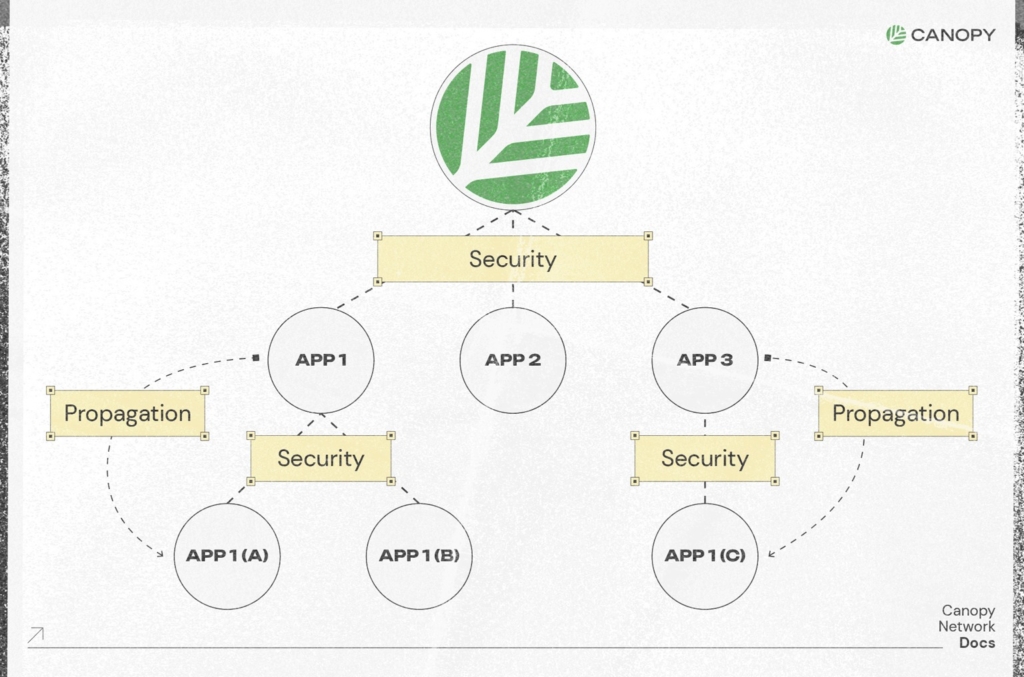
When a project is ready, it can detach from Canopy’s shared security and transition into a full sovereign L1, carrying its history, state, community, and economics with it. The upgrade path preserves continuity for users and developers while granting teams complete control over governance, performance, and value capture. Canopy positions this as a structural shift for the industry. Rather than choosing between an L1 or an L2 at the start, teams can now naturally evolve from incubation to independence as their needs grow.

Andrew Nguyen, Co-Founder and CTO of Canopy, said:

“Progressive Autonomy allows developers to focus entirely on building useful, high-performing applications instead of wrestling with infrastructure. Our goal was to take the security and operational burdens away from the traditional L1 creation and make them completely invisible. When sovereignty becomes accessible, the entire ecosystem will expand and benefit mutually.”

Canopy’s Betanet is already live and supported by leading validators including PierTwo, Stakely, Rhino, Lavender Five, Nodes.Guru, Kingnode, Easy2Stake, and others, signalling early momentum for the shared security approach. The full mainnet launch is planned for 2026, following more than 18 months of development across the core protocol and supporting infrastructure.

About Canopy Network

Canopy makes launching a sovereign blockchain as simple as spinning up an app. Teams can deploy in days, own their network economics, and connect across chains without bridges or wrapped assets. Powered by NestBFT and layerless mesh security, Canopy provides shared protection and built in atomic swaps for every chain on the network. Developers get predictable costs, fast deployment templates, and interoperability from day one.
Website | Twitter/X | Discord | Github


Crypto di tendenza

Letture associate

Global Stock Market's Storm Center: South Korea's Stock Market De-leveraging Is Largely Complete

Storm's Eye: South Korean Market De-leveraging Nears Completion The recent sharp correction in South Korean equities, with the KOSPI index dropping 32% from its June high, has been a key trigger for global tech stock volatility. The core driver was not a fundamental shift but a forced de-leveraging process within the market's unique structure, which is now largely complete. Two main leverage channels amplified the sell-off: 1. **Leveraged ETFs:** Their size, proportionally four times larger than in the U.S., peaked near $50 billion. Their mandatory daily rebalancing mechanism created a vicious cycle of "price drop → forced selling → further drop." Approximately 75% of this excess has been unwound, shrinking to $26 billion, with regulatory curbs now blocking new inflows. 2. **Hedge Fund Leverage:** Using swaps to magnify exposure, hedge funds saw their net long positioning fall by over 50% from peak levels. The most intense phase of this institutional de-leveraging is over. In contrast, **retail margin debt** poses minimal systemic risk. At 0.5% of market cap, it is far lower than in the U.S. or China, lacks automatic triggers, and is concentrated in smaller stocks. The conclusion: the high-leverage structures most prone to "chain-reaction selling" have been substantially cleared. The market is transitioning from a liquidity-driven crash to one priced more on fundamentals. The article argues that the AI trend—centered on Korean memory chips—remains intact. This episode represents a painful but necessary clearing of crowded trades, not the end of the AI revolution. For investors, the key question is conviction in the long-term AI direction; if the trend is real, current volatility is a cost of entry, not a terminal risk.

链捕手2 h fa

Global Stock Market's Storm Center: South Korea's Stock Market De-leveraging Is Largely Complete

链捕手2 h fa

Trading

Spot

Articoli Popolari

Come comprare O

Benvenuto in HTX.com! Abbiamo reso l'acquisto di O1 exchange (O) semplice e conveniente. Segui la nostra guida passo passo per intraprendere il tuo viaggio nel mondo delle criptovalute.Step 1: Crea il tuo Account HTXUsa la tua email o numero di telefono per registrarti il tuo account gratuito su HTX. Vivi un'esperienza facile e sblocca tutte le funzionalità,Crea il mio accountStep 2: Vai in Acquista crypto e seleziona il tuo metodo di pagamentoCarta di credito/debito: utilizza la tua Visa o Mastercard per acquistare immediatamente O1 exchangeO.Bilancio: Usa i fondi dal bilancio del tuo account HTX per fare trading senza problemi.Terze parti: abbiamo aggiunto metodi di pagamento molto utilizzati come Google Pay e Apple Pay per maggiore comodità.P2P: Fai trading direttamente con altri utenti HTX.Over-the-Counter (OTC): Offriamo servizi su misura e tassi di cambio competitivi per i trader.Step 3: Conserva O1 exchange (O)Dopo aver acquistato O1 exchange (O), conserva nel tuo account HTX. In alternativa, puoi inviare tramite trasferimento blockchain o scambiare per altre criptovalute.Step 4: Scambia O1 exchange (O)Scambia facilmente O1 exchange (O) nel mercato spot di HTX. Accedi al tuo account, seleziona la tua coppia di trading, esegui le tue operazioni e monitora in tempo reale. Offriamo un'esperienza user-friendly sia per chi ha appena iniziato che per i trader più esperti.

151 Totale visualizzazioniPubblicato il 2026.06.19Aggiornato il 2026.06.29

Come comprare O

Come comprare PROS

Benvenuto in HTX.com! Abbiamo reso l'acquisto di Pharos (PROS) semplice e conveniente. Segui la nostra guida passo passo per intraprendere il tuo viaggio nel mondo delle criptovalute.Step 1: Crea il tuo Account HTXUsa la tua email o numero di telefono per registrarti il tuo account gratuito su HTX. Vivi un'esperienza facile e sblocca tutte le funzionalità,Crea il mio accountStep 2: Vai in Acquista crypto e seleziona il tuo metodo di pagamentoCarta di credito/debito: utilizza la tua Visa o Mastercard per acquistare immediatamente PharosPROS.Bilancio: Usa i fondi dal bilancio del tuo account HTX per fare trading senza problemi.Terze parti: abbiamo aggiunto metodi di pagamento molto utilizzati come Google Pay e Apple Pay per maggiore comodità.P2P: Fai trading direttamente con altri utenti HTX.Over-the-Counter (OTC): Offriamo servizi su misura e tassi di cambio competitivi per i trader.Step 3: Conserva Pharos (PROS)Dopo aver acquistato Pharos (PROS), conserva nel tuo account HTX. In alternativa, puoi inviare tramite trasferimento blockchain o scambiare per altre criptovalute.Step 4: Scambia Pharos (PROS)Scambia facilmente Pharos (PROS) nel mercato spot di HTX. Accedi al tuo account, seleziona la tua coppia di trading, esegui le tue operazioni e monitora in tempo reale. Offriamo un'esperienza user-friendly sia per chi ha appena iniziato che per i trader più esperti.

145 Totale visualizzazioniPubblicato il 2026.06.22Aggiornato il 2026.06.29

Come comprare PROS

Cosa è VERONA

I. Introduzione al Progetto VERONA è una blockchain costruita per tutti, ovunque attraverso l'astrazione della catena. Utilizzando il suo livello di astrazione generalizzato, VERONA si distingue integrando funzionalità blockchain complesse, come conti, firme e interoperabilità, direttamente a livello di protocollo. Questo approccio consente di interagire con le applicazioni blockchain senza la necessità di comprendere le tecnologie sottostanti.1) Informazioni di Base Nome:VERONA(VERONA)III. Link Correlati Link al sito ufficiale:https://xion.burnt.com/ Whitepaper:https://xion.burnt.com/whitepaper.pdf Esploratori:https://explorer.burnt.com/ Social Media: https://x.com/burnt_xion Nota: L'introduzione al progetto proviene dai materiali pubblicati o forniti dal team ufficiale del progetto, che è solo a scopo di riferimento e non costituisce consulenza per investimenti. HTX non si assume responsabilità per eventuali perdite dirette o indirette risultanti.

163 Totale visualizzazioniPubblicato il 2026.06.22Aggiornato il 2026.06.22

Cosa è VERONA

Discussioni

Benvenuto nella Community HTX. Qui puoi rimanere informato sugli ultimi sviluppi della piattaforma e accedere ad approfondimenti esperti sul mercato. Le opinioni degli utenti sul prezzo di A A sono presentate come di seguito.

活动图片