Can the Solana Foundation and Google's Collaboration on Pay.sh Bridge the Payment Link Between Web2 and Web3 in the Agent Economy?

marsbitPubblicato 2026-05-12Pubblicato ultima volta 2026-05-12

Introduzione

Solana Foundation, in collaboration with Google Cloud, has launched Pay.sh, a payment gateway designed to bridge the gap between AI agents and enterprise-grade service infrastructure. The initiative aims to solve a key bottleneck in the "agent economy": existing payment systems are ill-suited for autonomous AI agents. Traditional methods like credit cards require human verification, while newer on-chain protocols like x402 and MPP create a separate, Web3-native system that raises barriers for service providers. Pay.sh functions as a universal payment layer. It allows users to fund a Solana wallet via credit card or stablecoin, which then acts as an identity and payment proxy for AI agents. When an agent needs to access a paid API service (e.g., Google Cloud, Alibaba Cloud), Pay.sh handles the transaction seamlessly. It leverages the HTTP 402 status code ("Payment Required") to initiate payments, intelligently choosing between one-time transfers (x402-style) or session-based authorizations (MPC-style) based on the service's billing model. This spares agents from manual account registration and API key management. A key feature for service providers is low integration effort. They can adopt Pay.sh by providing a declarative configuration file, enabling features like tiered pricing, free tiers, and automatic revenue splitting to multiple addresses (e.g., for royalties, cloud costs). Providers can also list their APIs in a central Pay Skill Registry for agent discovery. The co...

Original Author: Hendrix, Researcher, Web3Caff Research

How to easily grasp the market hotspots, technological trends, ecological progress, and governance dynamics happening in the Web3 industry...? The "Market Pulse Analysis" column launched by Web3Caff Research will delve into the front lines to explore and filter current hot events, providing value interpretation, commentary, and principle analysis. See the essence through the phenomenon. Follow us now to quickly capture the front-line market trends in Web3.

As AI agents' capabilities continue to strengthen and cover an increasing number of end-to-end tasks, building payment systems for agents has become a necessary change for traditional merchants and service providers. However, existing solutions have their own limitations: traditional payment systems, such as credit cards and third-party payment platforms, were originally designed for real human users, requiring complex identity verification, risk assessment, etc., which are not suitable for agents. Emerging agent payment protocols, such as x402 (promoted by Coinbase) and MPP (the Machine Payment Protocol developed by Tempo and Stripe), are like building separate portals, entirely constructed for on-chain payments, processed on-chain and secured by on-chain verification. Service providers need to build a different payment system besides traditional payment channels, increasing the barrier to entry. Traditional payment solutions and emerging agent payment protocols are like two parallel lanes that are not well integrated. This limits the services agents can autonomously purchase, typically to Web3-friendly ranges, hindering the large-scale connection of workflows. To address this, the Solana Foundation and Google Cloud jointly launched Pay.sh, positioned as a "payment gateway between agents and enterprise-grade service infrastructure" to complete the final step in enabling agents to call more services.

Compliance Note: The following content is merely an objective analysis of Pay.sh, its technical principles, and design rules. It does not constitute any proposal or offer. Please do not make related decisions based on this information and strictly adhere to the laws and regulations of your country or region (readers from Mainland China are strongly advised to read Mainland China's Relevant Laws and Regulations on Blockchain and Virtual Currency Arrangement and Key Points), and do not participate in any financial behaviors prohibited by the laws and regulations of your country or region.

Pay.sh allows users to quickly top up a Solana wallet via credit card or stablecoin. Subsequently, the Solana wallet can act as the identity and payment account proxy for agents in the Web2 resource world. When an agent needs to call a service, there is no need to register an account or enter an API key. The Pay.sh gateway will declare the agent's legitimate identity, similar to Google's identity system, allowing the agent to use a unified account identity to purchase development resources like Google Cloud and Alibaba Cloud that were previously difficult to access.
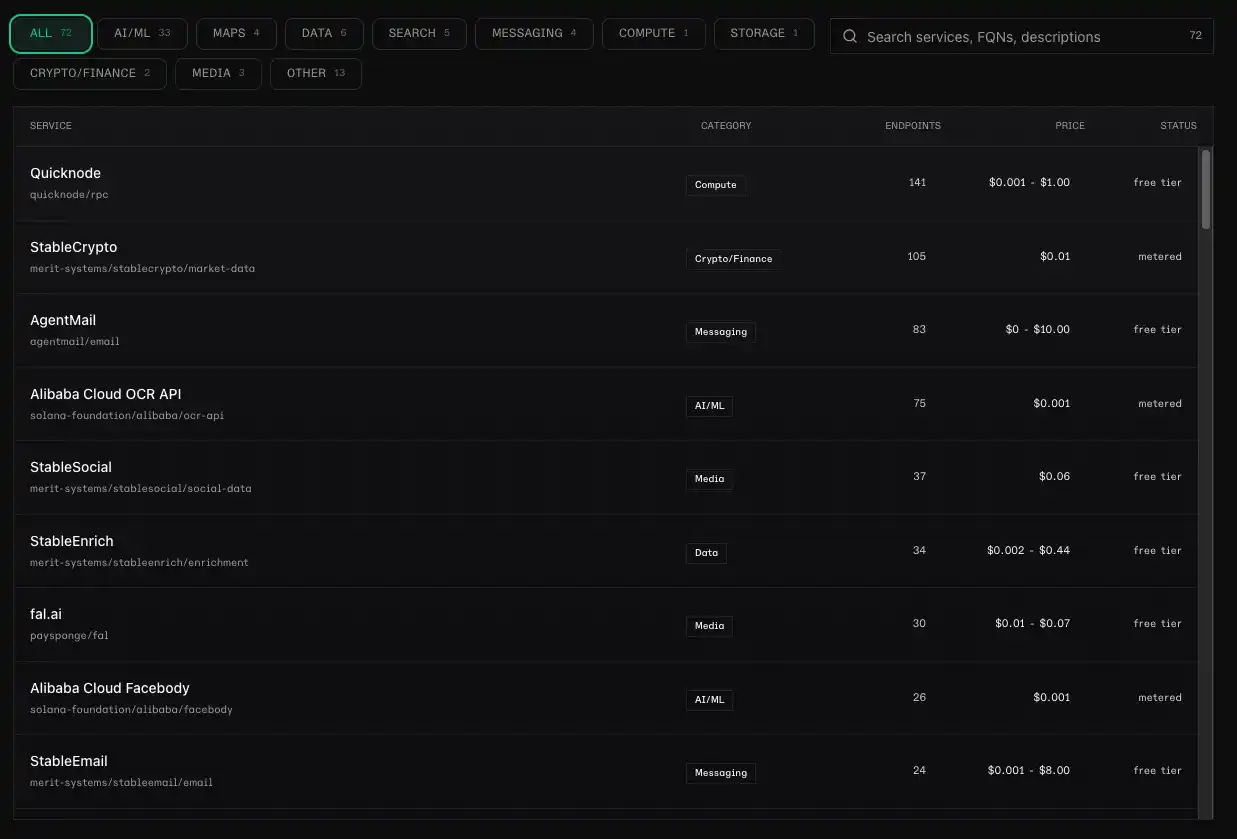
Currently supported API services by Pay.sh Source: Project official website

The payment flow of Pay.sh is similar to the recently popular x402 protocol, both built on the HTTP 402 status code: when an agent discovers an external service that needs to be called, it makes a request for the paid resource. The server returns status code 402 (Payment Required), along with payment details, including payment amount, pricing plan, recipient address, payment validity period, etc. Pay.sh parses this content and initiates an authorization request to the wallet. After the wallet completes the payment and generates a payment proof, Pay.sh carries the proof and initiates the service request again to obtain a normal response. However, to cover various API usage scenarios, Pay.sh is compatible with both x402 and MPP payment logics: when the server returns status code 402, Pay.sh further determines the target service's payment method. For one-time data access (payment grants one-time access) or usage-based access (payment grants a fixed amount of access), Pay.sh constructs a one-time fixed-amount transfer and broadcasts it on-chain. For continuous billing or session-based billing (unified bill for usage paid at once), Pay.sh supports the session authorization token introduced by the MPP (Machine Payment Protocol), writing the budget cap into the authorization and sending it back to the server. The agent can then repeatedly call a certain service within a short time, avoiding frequent similar authorization requests. Pay.sh updates the remaining balance with each call and automatically re-initiates session authorization when the balance is depleted or the service expires. Pay.sh automatically selects the more appropriate payment rail based on the target service's requirements, potentially reducing usage and management costs. Pay.sh also ensures the wallet remains securely stored locally, requesting user confirmation only when payment is needed. When information is returned, Pay.sh distinguishes between data and instructions. All external content returned by the service provider (including titles, body text, and API descriptions) is treated by Pay.sh as untrusted input. The agent must not directly execute instructions returned by the service provider to prevent malicious prompt injection or other attacks.

The biggest advantage of Pay.sh is that it provides a gateway for service providers to easily deploy. Service providers can integrate the payment gateway into their service network without significant modifications to their payment pathways or APIs. By simply providing a declarative file specifying payment-related parameters, service providers can adapt to various complex usage scenarios. For example, by defining routing rules, agents can use a service for free up to a certain limit, with charges applied beyond that quota, or even implement tiered pricing (different prices for different usage levels). Additionally, Pay.sh offers payment splitting functionality. The fees received by the service provider can be automatically sent to multiple addresses, e.g., 2% for data royalty fees, 5% for cloud costs, and the remainder for their own operations. Service providers only need to define different percentages or amounts when setting up the receiving addresses to achieve multi-account settlement at once. After registration, service providers can publish their API service data to the Pay Skill Registry, where agents can discover and select suitable API services by querying the registry.

Pay.sh itself is not a competitor to x402 and MPP. While the x402 and MPP protocols strive to make on-chain agent payments more reliable, Pay.sh aims to bridge the Web2 and Web3 payment ecosystems, providing agents with corresponding identities for resource acquisition. An agent's wallet serves as both identity and payment method. It no longer needs to register accounts on service provider websites to obtain services (currently, some providers might treat agents imitating human registration as a violation). Furthermore, Pay.sh's collaboration with Google enables API proxy and traffic scheduling for agents to be completed on Google Cloud, ensuring access control and log compliance, keeping agent behavior within reasonable bounds. Pay.sh can provide a curated service directory and pricing discovery. Agents do not need to randomly discover services in an unprotected network environment. It can leverage both x402 and MPP payment methods. The service process can meet enterprise compliance requirements on Google Cloud. These aspects complement the agent payment capabilities that the singular payment channels of x402 and MPP cannot cover, while also opening an entry point for agent commerce to flow into Web3. Additionally, Pay.sh can complete the final payment step for multiple agent commerce protocols launched by Google, such as A2A (Agent2Agent Protocol) for agent communication and task delegation, AP2 (Agent Payments Protocol) for compliance verification, and UCP (Universal Commerce Protocol) for service discovery and execution. Pay.sh is responsible for the final, seamless settlement of service value. The emergence of Pay.sh also simultaneously perfects the Web2 agent commerce cycle, becoming the convergence point for value flow between the two worlds. This step also represents an upgrade opportunity for the Solana public chain ecosystem itself. In the x402 protocol environment, there are numerous shell APIs, where service providers might violate the original service provider's terms and resell their services, such as maliciously scraping and reselling data from database websites or encapsulating and reselling large model APIs to others. Agents in such an environment have no way to distinguish between authorized services and malicious, spam services. Through the Pay.sh payment gateway and Google's collaboration, agents using services via Pay.sh are expected to have reduced potential risks. The launch of Pay.sh marks the Solana public chain stepping in to provide endorsement and infrastructure support for agent payments. This can not only attract more Web2 payment traffic to Solana itself but also further enhance the capabilities and accelerate the adoption of Solana wallets.

However, Pay.sh is currently far from being a perfect payment gateway solution. Pay.sh's service provider registry currently lacks admission mechanisms and decentralized verification mechanisms, making it still difficult to effectively distinguish between unauthorized third-party shell services and malicious services. Agents run a significant risk of connecting to counterfeit services, potentially causing losses for users. Moreover, since Pay.sh itself does not design the underlying payment protocols, the security of the payment process relies more on the design of those underlying protocols. This introduces uncontrollable external risks to Pay.sh and could also lead to potential payment failures due to insufficient adaptation to different protocols. From the service provider's perspective, despite Google's platform endorsement, API suppliers in different countries and regions might still hesitate to adopt the services provided by Pay.sh due to compliance requirements related to data privacy management inherent to their services and payment compliance requirements. This could not only limit the number of service providers using Pay.sh but might also require Pay.sh to make more compliance efforts in the future. Nonetheless, the launch of Pay.sh marks a step forward in the fusion and practical implementation of Web2 and Web3 for agent payment infrastructure. On-chain wallets will have the opportunity to become the endorsement for agents participating in diverse tasks. Therefore, we can continue to observe the subsequent development of Pay.sh.

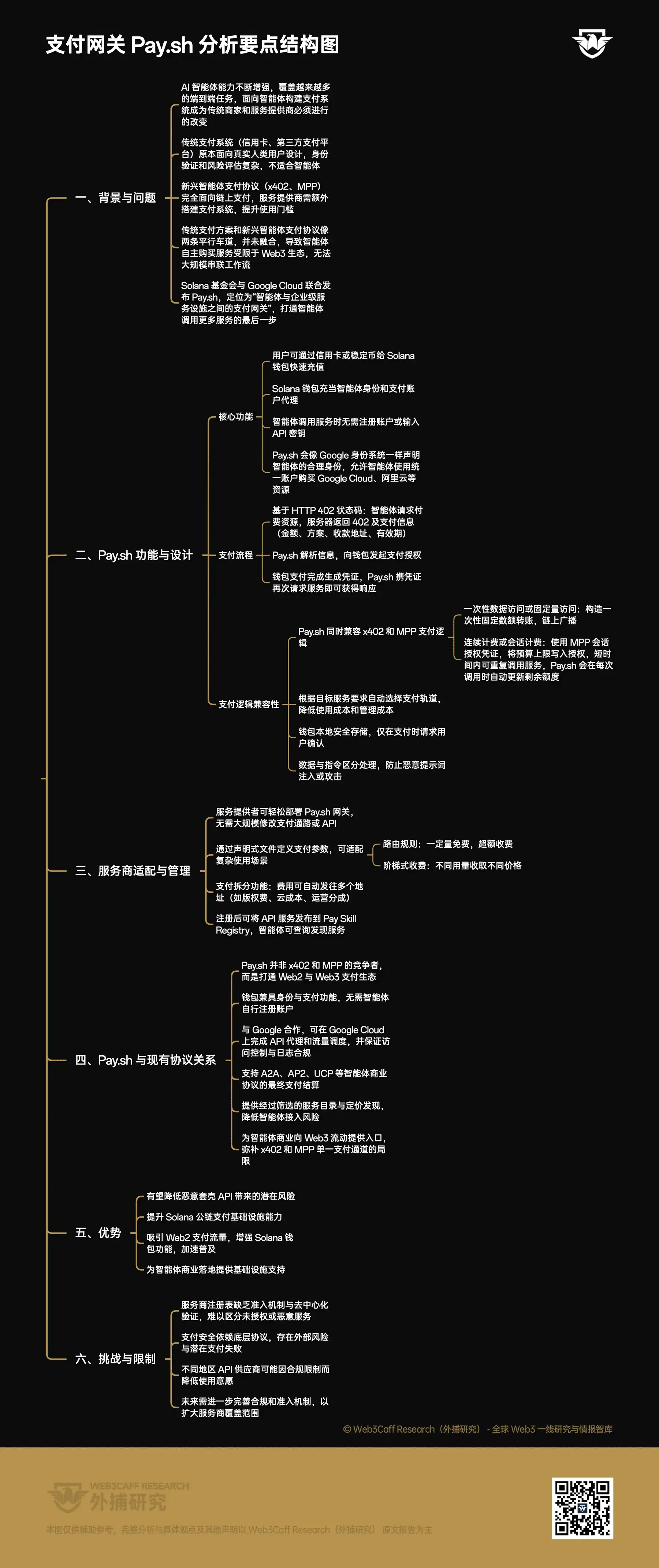
Key Points Structure Diagram:
Disclaimer: This report is compiled by Web3Caff Research. The information contained herein is for reference only and does not constitute any prediction, investment advice, proposal, or offer. Investors should not rely on such information to purchase, sell any securities, cryptocurrencies, or adopt any investment strategy. The terminology used and views expressed in this report are intended to help understand industry trends and promote the responsible development of the Web3, including the blockchain industry, and should not be interpreted as definitive legal opinions or the views of Web3Caff Research. The opinions in this report reflect only the personal views of the author as of the stated date, are independent of the position of Web3Caff Research, and may change following subsequent circumstances. The information and opinions contained in this report come from proprietary and non-proprietary sources that Web3Caff Research considers reliable, do not necessarily cover all data, and do not guarantee their accuracy. Therefore, Web3Caff Research makes no guarantee of their accuracy or reliability in any form and assumes no responsibility for errors and omissions arising in any other way (including liability to any person arising from negligence). This report may contain "forward-looking" information, which may include predictions and forecasts. This article does not constitute a guarantee of any prediction. Whether to rely on the information contained in this report is entirely up to the reader's discretion. This report is for reference only and does not constitute investment advice, a proposal, or an offer to buy or sell any securities, cryptocurrencies, or adopt any investment strategy. Please strictly comply with the relevant laws and regulations of your country or region.


Domande pertinenti

QWhat is the primary purpose of Pay.sh as introduced by the Solana Foundation and Google Cloud?

AThe primary purpose of Pay.sh is to act as a 'payment gateway between intelligent agents and enterprise-grade service infrastructure,' aiming to bridge the payment gap between Web2 and Web3 for intelligent agents. It allows agents to pay for services (like Google Cloud or Alibaba Cloud resources) using a Solana wallet funded by credit cards or stablecoins, without needing separate accounts or API keys for each service.

QHow does the Pay.sh payment process fundamentally work when an intelligent agent requests a paid service?

AWhen an intelligent agent requests a paid service, the server responds with an HTTP 402 status code (Payment Required), which includes payment details. Pay.sh parses this information, requests authorization from the user's wallet, and processes the payment. Once payment is confirmed, Pay.sh resends the request with a payment proof to access the service. It adapts its payment logic, supporting both one-time payments (akin to x402 protocol) and session-based billing with budget limits (akin to MPP protocol).

QWhat key advantage does Pay.sh offer to service providers who want to accept payments from intelligent agents?

APay.sh offers service providers an easily deployable gateway that requires minimal changes to their existing payment systems or APIs. By providing a declarative file defining payment parameters, providers can support complex billing scenarios (e.g., free tiers, usage-based or tiered pricing) and automatic payment splitting to multiple addresses. They can also list their APIs in the Pay Skill Registry for agents to discover.

QWhat role does the collaboration with Google Cloud play in the Pay.sh system, according to the article?

AThe collaboration with Google Cloud allows Pay.sh to handle API proxying and traffic routing on Google's infrastructure. This ensures compliance with access control, logging, and enterprise regulations, keeping agent behavior within legitimate bounds. It also helps integrate Pay.sh as the final payment settlement layer within Google's broader suite of agent commerce protocols (like A2A, AP2, UCP).

QWhat are some of the current limitations or challenges facing Pay.sh mentioned in the article?

ACurrent limitations include: 1) Its service registry lacks rigorous vetting and decentralized verification, making it hard to distinguish authorized services from unauthorized or malicious ones. 2) Payment security relies on underlying protocols (x402, MPP), introducing external risks and potential payment failures due to integration issues. 3) Service providers in different regions may hesitate to adopt Pay.sh due to data privacy regulations and payment compliance concerns, potentially limiting its growth and requiring further compliance efforts.

Letture associate

SpaceX, OpenAI, Anthropic: The Three AI Giants Racing for IPO, Which One Is Worth Betting On?

SpaceX, OpenAI, and Anthropic are poised for historic IPOs within weeks, potentially raising a combined $180 billion—a sum exceeding the entire internet bubble's fundraising. The hosts of the Limitless Podcast argue this isn't just individual company financing but an unprecedented capital concentration for AI infrastructure, driven by an insatiable need for compute, data centers, power, and chips. SpaceX's IPO is notable for reportedly changing market index rules to allow faster inclusion, potentially funneling trillions in passive retirement funds into its stock, despite its unproven space-based data center business model. In contrast, Anthropic demonstrates explosive growth, with ARR reportedly hitting $45 billion and approaching profitability, fueled by strong enterprise adoption of products like Claude Code. Google's separate $80 billion raise highlights the immense capital pressure, even for giants. The discussion acknowledges bubble risks but leans optimistic. The hosts contend the massive spending is building essential physical infrastructure for the next technological era. A key bottleneck isn't capital but the real-world limits of chip manufacturing and construction speed. As long as demand for AI compute outstrips supply, this investment cycle represents a foundational build-out rather than a purely financial bubble. All three companies are seen as foundational bets on the future, with Anthropic often cited as the most immediately compelling due to its proven revenue trajectory.

marsbit1 h fa

SpaceX, OpenAI, Anthropic: The Three AI Giants Racing for IPO, Which One Is Worth Betting On?

marsbit1 h fa

From 'Old Guys' to 'New Favorites': How AI Is Revaluing Old Infrastructure from Dell to Nokia?

From "Vintage Tech" to "New AI Darlings": How AI Revalues Old Infrastructure One year ago, tech giants like Dell, Nokia, Cisco, and Western Data were seen as slow-growth, low-valuation stories, far from the AI spotlight dominated by players like Nvidia. Now, these legacy tech stocks are gaining market attention, sparking debate on whether this is genuine industry revaluation or a temporary narrative. As AI moves from model parameters to real-world data centers, the market is recognizing companies with proven delivery and infrastructure capabilities. This shift marks a change in the AI investment thesis: from pure model and GPU focus to the complex systems engineering required for deployment. Companies like Dell, HPE, and Corning are being revalued not for being "sexy" AI innovators, but for their decades of accumulated expertise in supply chains, enterprise delivery, and infrastructure—assets that have become critical in the AI buildout phase. The revaluation is unfolding across three key infrastructure lines: 1. **Servers & System Integration:** Dell and HPE are emerging as crucial system integrators or "general contractors" for AI data centers, translating GPU orders into complete, deployable server racks integrated with power, cooling, and networking. 2. **Networking & Connectivity:** AI's scale demands robust high-speed connections. Corning (fiber optics), Nokia (AI-RAN, 6G), and Cisco (data center switches) are gaining importance for enabling efficient data transfer within and between AI clusters. 3. **Storage:** Beyond high-speed memory (HBM/DRAM), the AI data explosion is driving demand for high-capacity hard drives (HDDs) from companies like Western Digital and Seagate to handle training data, logs, and cold storage cost-effectively. For this revaluation to be substantive and not just a narrative, three criteria are key: 1) Concrete AI-related order and revenue growth (e.g., Dell's AI server sales), 2) Upward revisions to company financial guidance, and 3) Sustainable improvements in profit quality, not just top-line revenue spikes. In essence, AI's transition to a real construction phase is re-pricing "old assets" against "new demand." The opportunity, however, is selective. Only those legacy firms that are demonstrably integrated into the capital expenditure chains of data center and enterprise AI deployment are likely to experience a true "logic re-rating" rather than just a temporary valuation bounce.

marsbit1 h fa

From 'Old Guys' to 'New Favorites': How AI Is Revaluing Old Infrastructure from Dell to Nokia?

marsbit1 h fa

The Merger of Codex and ChatGPT Marks the Beginning of a Major Reshuffle in Programming Tools

OpenAI is shifting its strategic focus from ChatGPT to Codex, merging them along with the browser tool Atlas into a unified desktop super-app. This move signals an internal belief that Codex, originally a programming tool, represents the next evolution of AI more than conversational models like ChatGPT. Over the past year, Codex's weekly active users have surged past 5 million. The key distinction is that while ChatGPT answers questions, Codex executes tasks. Enterprises increasingly value this ability to get work done over simply receiving advice. Consequently, Codex is attracting professionals beyond developers, including analysts, bankers, marketers, and product managers. OpenAI's reorganization and increased investment in Codex stem from recognizing that the future of AI competition lies in execution capabilities, not just conversation. The company is launching role-specific plugins (e.g., for data analysis, sales, design) to transform Codex into a broad knowledge work platform that automates and redefines white-collar workflows. Beyond being a tool, Codex reflects OpenAI's ambition to redefine software. New features like "Sites"—which generates interactive websites from documents—and collaborative "Annotations" aim to create a paradigm where the AI understands the goal and handles the tools and steps, functioning more like a digital colleague than traditional software. The ultimate goal is a unified experience where the user cares only about the completed task.

marsbit1 h fa

The Merger of Codex and ChatGPT Marks the Beginning of a Major Reshuffle in Programming Tools

marsbit1 h fa

Interpreting Investment Opportunities in the Age of Great Navigation, Invesco Great Wall Fund Releases '2026 Report on Chinese Enterprises Going Global'

Invesco Great Wall Fund has released its "2026 China Corporate Globalization Report," titled "The 'Great Navigation Era' of Chinese Enterprises." The report analyzes the new trends and investment opportunities as Chinese companies expand globally, moving from simple product exports to comprehensive overseas operations involving services, branding, and local production. Driven by factors like trade friction, the pursuit of higher profit margins abroad, and policy support, globalization is becoming essential for Chinese companies. The report outlines an evolution: from early product export ("Globalization 1.0") to the current "Globalization 2.0," characterized by overseas capacity, capital goods investment, consumer brand expansion, and service exports. Chinese firms' competitive advantages are highlighted, including a vast engineer talent pool, low-cost and robust infrastructure, and complete industrial clusters. Specific sectors with significant出海 potential are identified: * **Capital Goods** (e.g., engineering machinery, power equipment): Benefiting from global demand, especially in Belt & Road markets and the AI-driven power grid upgrade cycle. * **Consumer Brands**: Transitioning from cost to brand advantage, leveraging供应链 efficiency. * **Technology & Innovation**: Including AI applications, optical modules within global tech supply chains, and new energy vehicles focusing on local production. * **Pharmaceuticals**: Chinese biotech firms are becoming preferred partners for global pharma, with potential for breakthrough drugs in areas like oncology and weight loss. The report concludes that corporate globalization represents a sustained, core theme for China's capital markets, though companies must navigate challenges like geopolitics and localization.

marsbit1 h fa

Interpreting Investment Opportunities in the Age of Great Navigation, Invesco Great Wall Fund Releases '2026 Report on Chinese Enterprises Going Global'

marsbit1 h fa

Trading

Spot
Futures

Articoli Popolari

Come comprare LINK

Benvenuto in HTX.com! Abbiamo reso l'acquisto di ChainLink (LINK) semplice e conveniente. Segui la nostra guida passo passo per intraprendere il tuo viaggio nel mondo delle criptovalute.Step 1: Crea il tuo Account HTXUsa la tua email o numero di telefono per registrarti il tuo account gratuito su HTX. Vivi un'esperienza facile e sblocca tutte le funzionalità,Crea il mio accountStep 2: Vai in Acquista crypto e seleziona il tuo metodo di pagamentoCarta di credito/debito: utilizza la tua Visa o Mastercard per acquistare immediatamente ChainLinkLINK.Bilancio: Usa i fondi dal bilancio del tuo account HTX per fare trading senza problemi.Terze parti: abbiamo aggiunto metodi di pagamento molto utilizzati come Google Pay e Apple Pay per maggiore comodità.P2P: Fai trading direttamente con altri utenti HTX.Over-the-Counter (OTC): Offriamo servizi su misura e tassi di cambio competitivi per i trader.Step 3: Conserva ChainLink (LINK)Dopo aver acquistato ChainLink (LINK), conserva nel tuo account HTX. In alternativa, puoi inviare tramite trasferimento blockchain o scambiare per altre criptovalute.Step 4: Scambia ChainLink (LINK)Scambia facilmente ChainLink (LINK) nel mercato spot di HTX. Accedi al tuo account, seleziona la tua coppia di trading, esegui le tue operazioni e monitora in tempo reale. Offriamo un'esperienza user-friendly sia per chi ha appena iniziato che per i trader più esperti.

835 Totale visualizzazioniPubblicato il 2024.12.13Aggiornato il 2026.06.02

Come comprare LINK

Discussioni

Benvenuto nella Community HTX. Qui puoi rimanere informato sugli ultimi sviluppi della piattaforma e accedere ad approfondimenti esperti sul mercato. Le opinioni degli utenti sul prezzo di LINK LINK sono presentate come di seguito.

活动图片