Can panic wallets stop a wrench? Why crypto’s next security debate is physical

cointelegraphPubblicato 2025-12-08Pubblicato ultima volta 2025-12-08

Introduzione

In Val-d’Oise, France, a crypto entrepreneur’s father was kidnapped, adding to a growing list of over 225 verified physical attacks on digital asset holders. Jameson Lopp, Casa’s chief security officer, reports a 169% surge in such attacks in 2025, correlating with Bitcoin bull markets and OTC trading spikes. While not unique to crypto, these "wrench attacks" are driving innovation in "panic wallets" with duress triggers—features like balance wiping, decoy wallets, or biometric alerts. However, their effectiveness is unproven, and attackers often assume hidden funds even after compliance. The US leads in absolute cases, but per-capita risk is higher in the UAE and Iceland. About 25% of incidents involve home invasions aided by leaked KYC data, while 23% are kidnappings. Two-thirds of attacks succeed, though 60% of perpetrators are caught. Builders like Haven are creating biometric, multi-party custody systems to resist coercion, but Lopp warns that over-reliance on custodians risks centralizing Bitcoin and undermining its decentralized ethos. Ultimately, the best defense remains social discretion: avoiding public association with crypto holdings. The real vulnerability isn’t weak wallets—it’s being targeted in the first place.

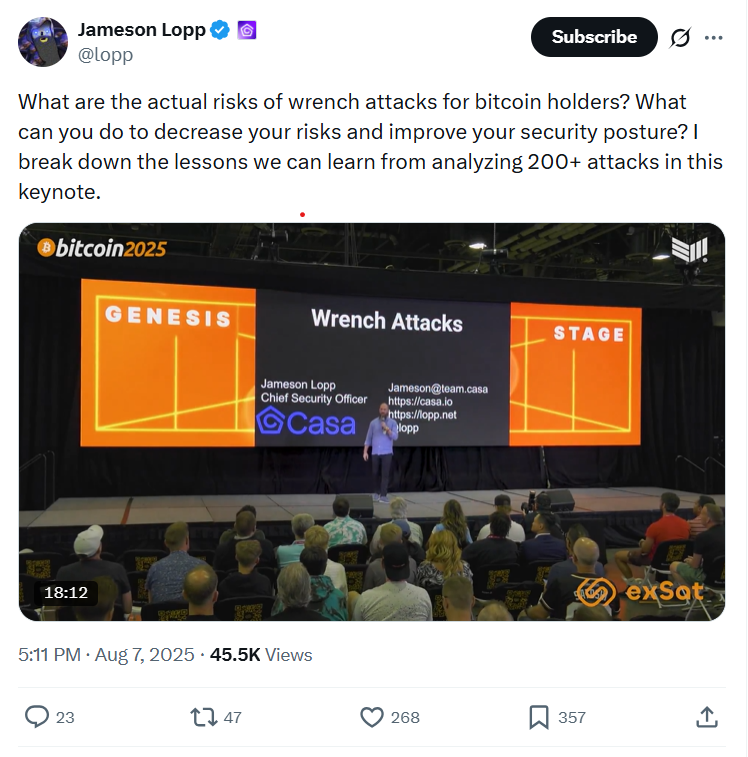
On Dec. 1 in Val‐d’Oise, France, the father of a Dubai‐based crypto entrepreneur was kidnapped off the street; another entry in Jameson Lopp’s directory of 225‐plus verified physical attacks on digital asset holders.

The database Lopp, the chief security officer at Bitcoin wallet Casa, has maintained for six years, shows the pace of coercion rising fast, with a 169% jump in reported physical attacks in 2025.

The risk itself isn’t unique to crypto: gold brokers, luxury resellers, even cash couriers have faced the same basic weapon for centuries (violence). What’s new is that digital assets are now being stolen face‐to‐face.

The shift is fueling a new arms race in wallet design. “Panic wallets” with duress triggers that can instantly wipe balances, send false decoys, or call for help with a subtle biometric gesture.

The idea sounds elegant until you add a wrench. As Lopp told Cointelegraph, “Ultimately, use of duress wallets relies upon speculation about the attacker, and you can’t possibly know their motivations and knowledge.”

The data behind the fear

Lopp’s findings suggest wrench attacks follow market cycles. They rise during bull runs and periods of intense over‐the‐counter (OTC) trading, when large deals move off exchanges. The US leads in absolute cases, although the per-capita risk is higher in the United Arab Emirates and Iceland.
Source: Jameson Lopp

About a quarter of incidents are home invasions, often aided by leaked Know Your Customer (KYC) data (as Lopp laments, “Kill Your Customer”), or public‐records doxing. Another 23% are kidnappings. Two‐thirds of attacks succeed, and roughly 60% of known perpetrators are caught.

The trend line correlates roughly with Bitcoin’s (BTC) price chart. Each retail mania pulls new money and new targets into public view, and criminals chase return on investment like everyone else.

Related: Crypto user attacked in France over Ledger hardware wallet — Report

Testing the panic gesture

If digital self‐defense is evolving, it’s doing so without evidence. “There’s not much we can definitively state about the effectiveness of duress wallets/triggers, because we have so little data,” Lopp points out.

Related: Bitcoin ’wrench attacks’ on track to double its worst year

He’s aware of one victim who tried a decoy wallet and failed to convince the assailant, and another who complied immediately but was still tortured for hours because the thief assumed hidden reserves.

The builders fighting back

Matthew Jones, co-founder of Haven, learned the hard way. While attempting a 25 BTC trade in Amsterdam, his counterpart fled with a waiting van. His photos helped Europol trace the gang across Europe; none were ever caught.

He’s since turned that experience into a product: a biometric, multi‐party custody system built on “continuous authentication without identity exposure.”

Haven’s biometric wallet locks transfers behind a live facial scan stored only on the user’s device. Large transactions, above $1,000, require real‐time confirmation from a secondary verifier, such as a spouse or partner.

Changing that contact imposes a 24‐hour wait, making on‐the‐spot coercion nearly useless. Jones says, “It’s about having the cash in your wallet stolen, rather than your bank accounts emptied. So it’s about deciding what your risk tolerance is and deciding on an amount.”

Related: Are seed-phrase-free crypto wallets the key to mass self-custody? Expert weighs in

The custody dilemma

As physical coercion rises and privacy rules such as the Organization for Economic Cooperation and Development’s Crypto-Asset Reporting Framework tighten, even veteran Bitcoiners are reevaluating self‐custody. Some now prefer custodianship to personal risk.

Lopp calls that outcome catastrophic: “If enough people decide that Bitcoin self-custody is too dangerous to undertake, this will create massive centralization and systemic risk to the entire system. It’s a battle I’ve been fighting against for a decade.”

It exposes the paradox at the heart of crypto security in 2025: every safeguard, from stricter KYC databases to offchain biometrics, narrows anonymity while widening the attack surface. The frontier problem isn’t smart‐contract exploits anymore; it’s data exposure and fear.

Related: The case for a ‘non-mandatory KYC’ model — Interview with Toobit

What actually works

For all the innovation, the simplest protection remains social discretion. Lopp advises, “The most effective thing that a Bitcoiner can do to reduce their wrench attack risk is very difficult: don’t talk about Bitcoin, at least not while using your real name or face.”

As hardware wallets learn panic modes and regulators demand more visible ownership, the only defenses that scale may be cultural. Most wrench attacks succeed because the victim can be found, not because their wallet can be broken.

Magazine: 2026 is the year of pragmatic privacy in crypto — Canton, Zcash and more

Letture associate

How Many Tokens Away Is Yang Zhilin from the 'Moon Chasing the Light'?

The article explores the intense competition between two leading Chinese AI companies, DeepSeek and Kimi (Moon Dark Side), and the mounting pressure on Yang Zhilin, the founder of Kimi. While DeepSeek re-emerged after 15 months of silence with its powerful V4 model—boasting 1.6 trillion parameters and low-cost, long-context capabilities—Kimi has been focusing on long-context processing and multi-agent systems with its K2.6 model. Yang faces a threefold challenge: technological rivalry, commercialization pressure, and investor expectations. Despite Kimi’s high valuation (reaching $18 billion), its revenue heavily relies on a single product with low paid conversion rates, while DeepSeek’s strategic silence and open-source influence have strengthened its market position and valuation prospects, now targeting over $20 billion. Both companies reflect broader trends in China’s AI ecosystem: Kimi aims for global influence through open-source contributions and agent-based advancements, while DeepSeek prioritizes foundational innovation and hardware independence, notably shifting to Huawei’s chips. Their competition is seen as vital for China’s AI progress, with the gap between top Chinese and U.S. models narrowing to just 2.7% on the Elo rating scale. Ultimately, the article argues that this rivalry, though anxiety-inducing for leaders like Zhilin, is essential for driving innovation and solidifying China’s role in the global AI landscape.

marsbit12 h fa

How Many Tokens Away Is Yang Zhilin from the 'Moon Chasing the Light'?

marsbit12 h fa

Trading

Spot
Futures

Articoli Popolari

Cosa è WL

I. Introduzione al ProgettoWorldLand è una L2 o side chain di Ethereum, progettata come una soluzione dal basso verso l'alto per migliorare l'ecosistema di Ethereum.II. Informazioni sul Token1) Informazioni di BaseNome del token: WL (WorldLand)III. Link CorrelatiSito web:https://worldland.foundation/Esploratori:https://bscscan.com/address/0x8aaB31fbc69C92fa53f600910Cf0f215531F8239Social:https://x.com/WorldLand_space Nota: L'introduzione al progetto proviene dai materiali pubblicati o forniti dal team ufficiale del progetto, che sono solo a scopo di riferimento e non costituiscono consulenza per gli investimenti. HTX non si assume alcuna responsabilità per eventuali perdite dirette o indirette risultanti.

297 Totale visualizzazioniPubblicato il 2026.03.28Aggiornato il 2026.03.28

Cosa è WL

Come comprare WL

Benvenuto in HTX.com! Abbiamo reso l'acquisto di WorldLand (WL) semplice e conveniente. Segui la nostra guida passo passo per intraprendere il tuo viaggio nel mondo delle criptovalute.Step 1: Crea il tuo Account HTXUsa la tua email o numero di telefono per registrarti il tuo account gratuito su HTX. Vivi un'esperienza facile e sblocca tutte le funzionalità,Crea il mio accountStep 2: Vai in Acquista crypto e seleziona il tuo metodo di pagamentoCarta di credito/debito: utilizza la tua Visa o Mastercard per acquistare immediatamente WorldLandWL.Bilancio: Usa i fondi dal bilancio del tuo account HTX per fare trading senza problemi.Terze parti: abbiamo aggiunto metodi di pagamento molto utilizzati come Google Pay e Apple Pay per maggiore comodità.P2P: Fai trading direttamente con altri utenti HTX.Over-the-Counter (OTC): Offriamo servizi su misura e tassi di cambio competitivi per i trader.Step 3: Conserva WorldLand (WL)Dopo aver acquistato WorldLand (WL), conserva nel tuo account HTX. In alternativa, puoi inviare tramite trasferimento blockchain o scambiare per altre criptovalute.Step 4: Scambia WorldLand (WL)Scambia facilmente WorldLand (WL) nel mercato spot di HTX. Accedi al tuo account, seleziona la tua coppia di trading, esegui le tue operazioni e monitora in tempo reale. Offriamo un'esperienza user-friendly sia per chi ha appena iniziato che per i trader più esperti.

221 Totale visualizzazioniPubblicato il 2026.03.28Aggiornato il 2026.03.28

Come comprare WL

Come comprare BASED

Benvenuto in HTX.com! Abbiamo reso l'acquisto di Based (BASED) semplice e conveniente. Segui la nostra guida passo passo per intraprendere il tuo viaggio nel mondo delle criptovalute.Step 1: Crea il tuo Account HTXUsa la tua email o numero di telefono per registrarti il tuo account gratuito su HTX. Vivi un'esperienza facile e sblocca tutte le funzionalità,Crea il mio accountStep 2: Vai in Acquista crypto e seleziona il tuo metodo di pagamentoCarta di credito/debito: utilizza la tua Visa o Mastercard per acquistare immediatamente BasedBASED.Bilancio: Usa i fondi dal bilancio del tuo account HTX per fare trading senza problemi.Terze parti: abbiamo aggiunto metodi di pagamento molto utilizzati come Google Pay e Apple Pay per maggiore comodità.P2P: Fai trading direttamente con altri utenti HTX.Over-the-Counter (OTC): Offriamo servizi su misura e tassi di cambio competitivi per i trader.Step 3: Conserva Based (BASED)Dopo aver acquistato Based (BASED), conserva nel tuo account HTX. In alternativa, puoi inviare tramite trasferimento blockchain o scambiare per altre criptovalute.Step 4: Scambia Based (BASED)Scambia facilmente Based (BASED) nel mercato spot di HTX. Accedi al tuo account, seleziona la tua coppia di trading, esegui le tue operazioni e monitora in tempo reale. Offriamo un'esperienza user-friendly sia per chi ha appena iniziato che per i trader più esperti.

460 Totale visualizzazioniPubblicato il 2026.03.30Aggiornato il 2026.03.30

Come comprare BASED

Discussioni

Benvenuto nella Community HTX. Qui puoi rimanere informato sugli ultimi sviluppi della piattaforma e accedere ad approfondimenti esperti sul mercato. Le opinioni degli utenti sul prezzo di A A sono presentate come di seguito.

活动图片