Bybit Regains Ground In 2025 After Historic Hack, CoinGecko Finds

bitcoinistPubblicato 2026-01-30Pubblicato ultima volta 2026-01-30

Introduzione

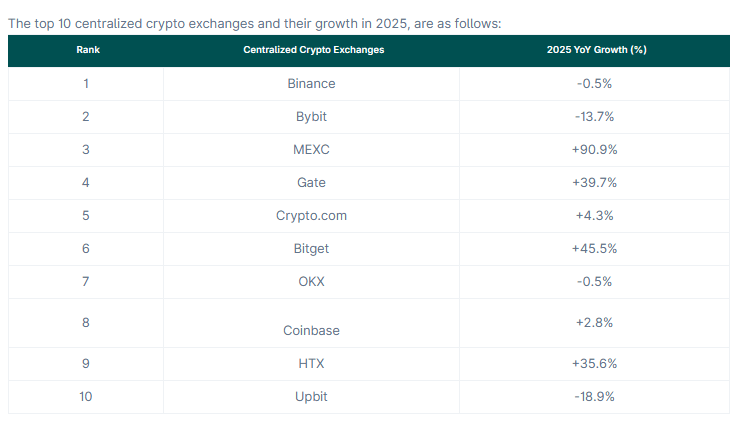
Bybit made a significant recovery in 2025, handling $1.5 trillion in trades and capturing 8% market share despite a historic $1.5 billion hack in February. The exchange's decision to keep withdrawals open and cover user losses helped rebuild trust and maintain liquidity. CEO Ben Zhou's public reassurances and transparent communication were key to its comeback. Overall, trading volumes rose across major exchanges, with MEXC seeing 90% growth due to zero-fee promotions. Binance remained the largest exchange with $7.3 trillion in volume, despite a slight 0.5% decline.

Bybit’s return to heavy trading was one of the stranger comeback stories of last year. Reports say the exchange moved back toward the top of the leaderboard after a massive security breach, and traders kept coming. That did not happen by accident. Quick decisions and public reassurances played a big role.

Bybit Bounces Back

According to CoinGecko, Bybit handled $1.5 trillion in trades during 2025 and ended the year with about 8% of total market share.

That is a solid showing given what happened in February, when attackers made off with $1.5 billion worth of Ether after finding a hole in the exchange’s cold wallet setup.

The theft has been linked to North Korean actors by several sources, and it stands as one of the largest losses in crypto history.

Many firms that face breaches do not recover. Reports note nearly eight out of 10 projects hit by hacks never fully bounce back.

Bybit’s choice to keep withdrawals open and to honor user balances changed the math. That move reduced panic and kept liquidity flowing.
Market Movers And Volume Gains

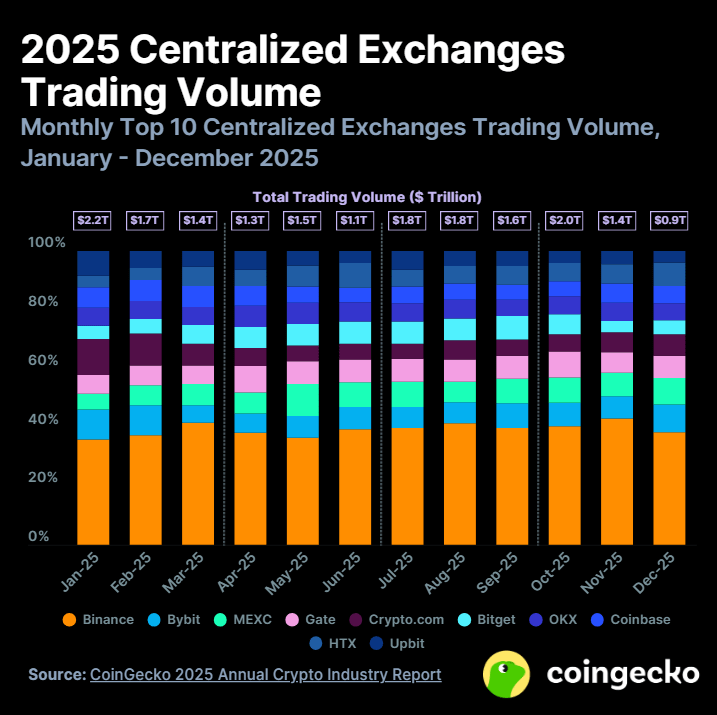
Trading volumes rose across multiple venues in 2025. CoinGecko’s research points out that six of the top 10 exchanges grew their yearly volume, and the total extra trades equaled about $1.3 trillion.

MEXC jumped sharply, reportedly rising 90% over the prior year, a gain blamed largely on aggressive zero-fee spot trading that pulled in high-frequency traders and new retail users.

Bullish price action for Bitcoin and several altcoins also pushed activity up; several coins reached fresh all-time highs during the year, which always sparks more trading and more headlines. For some platforms, promotions and fee policies had more immediate effect than brand reputation.

BTCUSD currently trading at $82,654. Chart: TradingView

How Bybit Handled The Crisis

The exchange’s leadership was visible. Ben Zhou, Bybit’s CEO, addressed customers on camera and promised the platform would cover losses and secure additional liquidity quickly.

Some of those promises were acted on behind the scenes, where external support was arranged to shore up funds.

Trust was not rebuilt overnight. It was rebuilt in small steps, transaction by transaction, and in public statements that reassured users their capital was safe.

The combination of keeping services running and having clear communication changed investor behavior.
Source: Coingecko

Binance And Rival Trends

Binance stayed the largest by a wide margin, with CoinGecko estimating about $7.3 trillion in annual volume. That massive figure hides a small drop from the prior year — a 0.5% decline — which analysts tied to a major liquidation event on October 10 that rattled markets.

Still, Binance’s user base was said to be over 300 million, and its ecosystem handles a vast range of products beyond spot trading.

Featured image from Pexels, chart from TradingView

Domande pertinenti

QWhat was the total trading volume handled by Bybit in 2025, according to CoinGecko?

ABybit handled $1.5 trillion in trades during 2025.

QWhat key action did Bybit take to reduce panic and maintain liquidity after the hack?

ABybit chose to keep withdrawals open and honor user balances, which reduced panic and kept liquidity flowing.

QWhich exchange saw a 90% increase in yearly volume, and what was the primary reason for this growth?

AMEXC jumped 90% over the prior year, a gain largely attributed to its aggressive zero-fee spot trading that attracted high-frequency traders and new retail users.

QHow did Bybit's CEO, Ben Zhou, respond to the security breach crisis?

ABen Zhou addressed customers on camera, promising that the platform would cover losses and secure additional liquidity quickly.

QWhat was Binance's estimated annual trading volume in 2025, and what minor change did it experience from the prior year?

ACoinGecko estimated Binance's annual volume at about $7.3 trillion, which represented a small 0.5% decline from the prior year.

Letture associate

The Value Distribution of Stablecoins

**Summary: The Value Distribution of Stablecoins** The article argues that stablecoins are evolving from mere trading tools into broader channels for dollar access. It divides the stablecoin ecosystem into four layers to analyze how value is distributed: 1. **Issuance Layer:** Mints stablecoins, holds reserve assets, and captures the spread between reserve yield and user costs (e.g., Tether, Circle). This layer currently earns the largest profit margin. 2. **Infrastructure Layer:** Connects stablecoins to the traditional financial system, handling fiat on/off-ramps, banking integration, compliance (KYC/AML), and asset management (e.g., Bridge, BVNK). This is the "unglamorous" but critical work, building the essential bridges between crypto and real-world finance. 3. **Acquiring/Distribution Layer:** Integrates stablecoins into merchant systems, manages payment flows, and provides enterprise financial software (e.g., Stripe, Coinbase). They act as the access point for businesses. 4. **Application Layer:** The end-users and businesses that ultimately use stablecoins for payments, settlements, or as a store of value. They benefit from convenience but have little pricing power. The core thesis is that while the issuance layer currently dominates profits, the often-overlooked **infrastructure layer holds significant long-term potential**. The real challenge and barrier to mass adoption is not the on-chain transfer of stablecoins (which is simple), but the complex "last mile" integration into existing business workflows, banking systems, and regulatory frameworks across different countries. Companies in this layer are currently in a "land grab" phase, investing heavily to build networks, secure bank partnerships, and establish compliance pathways. While their position is currently pressured by the profitable issuers above and distribution platforms below, the article suggests that if stablecoins become a default financial rail for businesses, the infrastructure providers who have done the hard work of integration will ultimately gain strong pricing power and become entrenched, essential players.

marsbit3 h fa

The Value Distribution of Stablecoins

marsbit3 h fa

The Value Distribution of Stablecoins

The Value Distribution of Stablecoins The article argues that stablecoins are evolving from a mere trading tool into a broad "dollar channel." It analyzes the industry's value chain through four layers: 1. **Issuance Layer (e.g., Tether, Circle):** The top layer that mints stablecoins, holds reserve assets, and captures the thickest interest rate spread. 2. **Infrastructure Layer (e.g., Bridge, BVNK):** Connects stablecoins to the traditional financial system, handling critical but complex "dirty work" like fiat on/off-ramps, banking integration, compliance (KYC/AML), and cross-border settlement. 3. **Acquiring/Distribution Layer (e.g., Stripe, Coinbase):** Embeds stablecoins into merchant systems, manages payment flows, and integrates with enterprise software. 4. **Application Layer:** End-users and businesses that ultimately use stablecoins for payments, settlement, or storing value. The author posits that while the issuance layer currently captures the most profit, the most overlooked and potentially critical layer is infrastructure. The core challenge for stablecoin adoption isn't the on-chain transfer (which is simple), but bridging the gap between blockchain and the real-world financial system. This involves solving practical problems for businesses: fiat conversion, reconciliation, tax handling, and user onboarding. Infrastructure companies are currently in a difficult "land-grab" phase—building networks, securing banking relationships, and achieving compliance country-by-country. They face pressure from both the profitable issuance layer above and distribution platforms below. However, the author suggests this layer is building a crucial moat. Once stablecoins become a default business rail, the infrastructure players who have done the hard work of integration may gain significant, durable value and pricing power.

链捕手3 h fa

The Value Distribution of Stablecoins

链捕手3 h fa

How to Do Research Well: Deliberately Practice the Real Skills That Matter

No one truly teaches you how to do research. You're often given a desk, a pre-selected problem, and vague instructions to "create something new." Consequently, many people reverse-engineer the job based on visible outputs—papers, posts, announcements—learning only how to *appear* like a researcher rather than how to *become* one. True research capability is built from stacking small, trainable skills, nearly all of which can be developed through deliberate practice. **Pick Your Own Problem:** Most researchers absorb problems from advisors or trends, lacking the underlying reasoning. Choosing a problem you genuinely care about, as John Schulman advises, leads to original work. Develop "taste" like a muscle: predict experiment outcomes, guess paper results from methods, and track which findings remain important over time. **Upgrade Your Inputs:** Relying on shared reading lists (arXiv hot lists, filtered group chats) leads to unoriginal conclusions. Undervalued old literature often holds crucial insights (e.g., MoE, LSTM, backpropagation). Richard Sutton's "The Bitter Lesson" or Claude Shannon's 1952 talk on creative thinking are more predictive than lengthy modern surveys. Breadth matters as much as depth: draw from neuroscience, mechanism design, hardware knowledge, and honest statistics. Read papers directly, especially appendices and limitations sections. **Write Everything Down:** As Paul Graham noted, writing exposes flaws in seemingly mature ideas. Writing is the cheapest defense against self-deception. Following Feynman's principle, Darwin programmatically wrote down facts contradicting his theory to combat memory bias. Maintain a detailed log of hypotheses, setups, predictions, results, and updated understandings. Reviewing past logs fosters essential humility.

marsbit6 h fa

How to Do Research Well: Deliberately Practice the Real Skills That Matter

marsbit6 h fa

Trading

Spot
Futures

Articoli Popolari

Come comprare ONE

Benvenuto in HTX.com! Abbiamo reso l'acquisto di Harmony (ONE) semplice e conveniente. Segui la nostra guida passo passo per intraprendere il tuo viaggio nel mondo delle criptovalute.Step 1: Crea il tuo Account HTXUsa la tua email o numero di telefono per registrarti il tuo account gratuito su HTX. Vivi un'esperienza facile e sblocca tutte le funzionalità,Crea il mio accountStep 2: Vai in Acquista crypto e seleziona il tuo metodo di pagamentoCarta di credito/debito: utilizza la tua Visa o Mastercard per acquistare immediatamente HarmonyONE.Bilancio: Usa i fondi dal bilancio del tuo account HTX per fare trading senza problemi.Terze parti: abbiamo aggiunto metodi di pagamento molto utilizzati come Google Pay e Apple Pay per maggiore comodità.P2P: Fai trading direttamente con altri utenti HTX.Over-the-Counter (OTC): Offriamo servizi su misura e tassi di cambio competitivi per i trader.Step 3: Conserva Harmony (ONE)Dopo aver acquistato Harmony (ONE), conserva nel tuo account HTX. In alternativa, puoi inviare tramite trasferimento blockchain o scambiare per altre criptovalute.Step 4: Scambia Harmony (ONE)Scambia facilmente Harmony (ONE) nel mercato spot di HTX. Accedi al tuo account, seleziona la tua coppia di trading, esegui le tue operazioni e monitora in tempo reale. Offriamo un'esperienza user-friendly sia per chi ha appena iniziato che per i trader più esperti.

325 Totale visualizzazioniPubblicato il 2024.12.12Aggiornato il 2026.06.02

Come comprare ONE

Discussioni

Benvenuto nella Community HTX. Qui puoi rimanere informato sugli ultimi sviluppi della piattaforma e accedere ad approfondimenti esperti sul mercato. Le opinioni degli utenti sul prezzo di ONE ONE sono presentate come di seguito.

活动图片