Bybit Pay Integrates With Yape and Plin to Enable Crypto Payments Across Peru

TheNewsCryptoPubblicato 2026-01-15Pubblicato ultima volta 2026-01-15

Introduzione

Bybit Pay, the payment service of the world’s second-largest crypto exchange, has integrated with Yape and Plin—two of Peru’s most widely used digital payment platforms. This integration enables millions of users in Peru to make everyday transactions using cryptocurrencies such as USDT, USDC, BTC, and ETH, which are instantly converted to Peruvian Sol (PEN). Customers can pay via Yape QR codes or Plin phone-number transfers both online and at local merchants, benefiting from fast settlement and enhanced security. The move supports Peru’s growing digital economy, where over 50% of adults use mobile wallets. To celebrate the launch, Bybit is offering incentives including a 50% discount voucher for new users and cashback rewards for existing customers.

Yape and Plin, two of the most widely used digital payment systems in Peru, have seamlessly integrated with Bybit Pay, which has been launched by Bybit, the second-largest cryptocurrency exchange in the world based on trading volume. Millions of users of digital wallets in Peru now have access to real-world cryptocurrency payment capabilities thanks to this expansion, which is another significant step in connecting conventional banking with the Latin American digital economy.

Boosting the Digital-First Economy in Peru

The usage of digital wallets has increased dramatically in Peru in recent years; in 2024, Yape and Plin will each have around 14 million users. Bybit Pay’s most recent integration combines the innovation of digital assets with the familiarity of Peru’s most trusted payment methods, allowing Peruvian customers to make cryptocurrency-backed payments both online and at local merchants using their existing Plin phone-number transfers and Yape QR codes.

Yape handled 54% of in-person transactions and PLIN handled 34% in 2024, placing Bybit Pay at the center of Peru’s quickly developing cashless economy. According to research, more than 50% of Peruvian adults use digital wallets that are based on their phones.

Using the extensive local networks of Plin and Yape, Bybit Pay customers in Peru can now:

  • Use QR codes to make payments: To instantly pay with cryptocurrencies at participating retailers around the country, use your current Yape QR code.
  • Money Transfer using Phone Number: Use crypto holdings to support safe Plin phone number transfers.
  • Use Digital Assets to Shop: Access payments at actual retail stores as well as online.
  • Enjoy Fast Settlement: Take advantage of improved security and almost instantaneous transaction confirmation.

Several cryptocurrencies, such as USDT, USDC, BTC, ETH, and other significant digital assets, are supported in Peru by the platform, which instantly converts them for smooth Peruvian Sol (PEN) transactions.
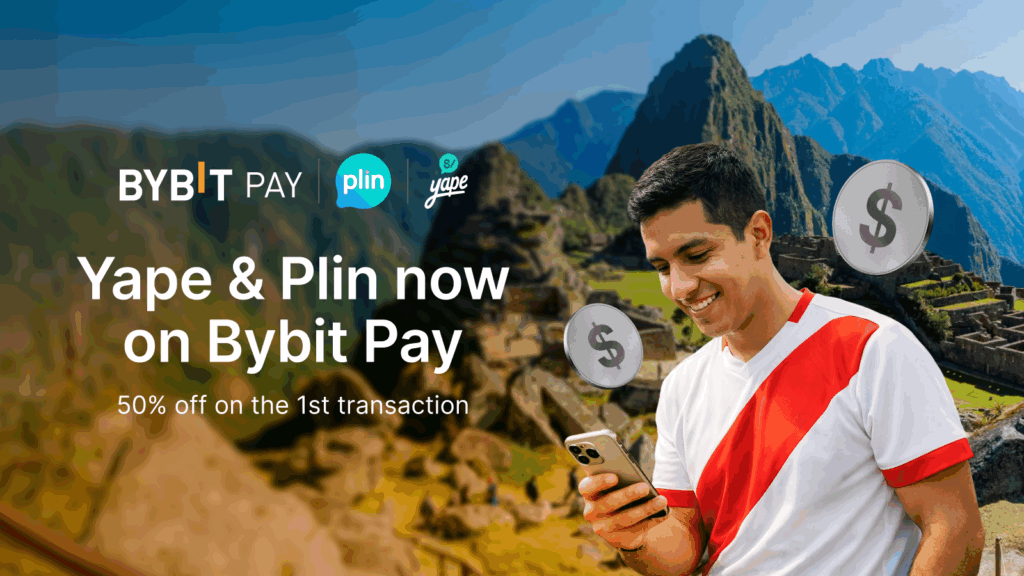
Bybit Pay is providing consumers in Peru with previously unheard-of incentives to commemorate the launch:

  • Exclusive to New Users: New customers who successfully register for Bybit Pay may get a 50% discount voucher on their first phone-number transfer or QR code payment in addition to additional welcome perks.
  • Benefits to Current Users: Current Bybit Pay customers may get 2–10% reward on each payment made via phone number transfer or QR code.

“By integrating with mainstream payment methods Peruvians already know and trust, Bybit Pay is removing barriers to digital asset adoption and making crypto genuinely useful for everyday transactions,” said Patricio Mesri, CEO of Bybit LATAM. “Peru represents one of Latin America’s most dynamic digital payment markets, and we are proud to be building the infrastructure for financial innovation and inclusion together with our partners.”

Through collaborations with top regional organizations and payment infrastructure suppliers from Brazil to Argentina, Bybit Pay has been making progress throughout Central and Latin America. Users may visit How to Make Payment with QR Pay utilizing Bybit Pay to find out more about how to utilize Bybit Pay.

Currently, Bybit Pay provides services to users worldwide who have successfully finished Bybit’s Identity Verification process. At this time, local Bybit entities and users from Service Restricted Countries are not supported. Users may visit the official Bybit Pay site for the most recent information as well as comprehensive terms and conditions.

TagsBybitexchange

Domande pertinenti

QWhat is the significance of Bybit Pay's integration with Yape and Plin in Peru?

AThe integration enables millions of digital wallet users in Peru to make real-world cryptocurrency payments, connecting traditional banking with the Latin American digital economy and placing Bybit Pay at the center of Peru's cashless economy.

QWhich cryptocurrencies are supported by Bybit Pay for transactions in Peru?

AThe platform supports several cryptocurrencies including USDT, USDC, BTC, ETH, and other significant digital assets, which are instantly converted for smooth Peruvian Sol (PEN) transactions.

QWhat specific payment methods can Peruvian users now employ through Bybit Pay's integration?

APeruvian users can make payments using Yape QR codes at participating retailers and conduct safe money transfers using Plin phone number transfers, all backed by their cryptocurrency holdings.

QWhat incentives is Bybit offering to users in Peru to celebrate the launch?

ANew users may receive a 50% discount voucher on their first phone-number transfer or QR code payment, while existing users can get a 2–10% reward on each payment made through these methods.

QHow does Bybit Pay's CEO view the impact of this integration on digital asset adoption in Peru?

ACEO Patricio Mesri stated that by integrating with mainstream payment methods Peruvians already trust, Bybit Pay is removing barriers to digital asset adoption and making crypto genuinely useful for everyday transactions in one of Latin America's most dynamic digital payment markets.

Letture associate

Arthur Hayes' New Article: It's 'No-Trade Zone' Time

Arthur Hayes argues that the current market is in a "no-trade zone," a period of high uncertainty created by two converging forces: the deflationary shock from AI and the inflationary shock from geopolitics. AI agents are rapidly displacing knowledge workers, eroding their incomes and creditworthiness, which will eventually trigger a deflationary financial crisis in consumer credit-dependent Western economies. Simultaneously, the war in the Middle East, particularly the potential disruption to shipping through the Strait of Hormuz, threatens global energy supplies and could force nations to abandon the dollar system. Hayes outlines three main scenarios: 1) A return to normalcy, where the deflationary AI shock remains the primary concern; 2) The "Tehran Toll Booth," where Iran controls the Strait and demands payment in gold or yuan, accelerating the end of dollar hegemony; and 3) "Empire Strikes Back," where the US destroys Iran's capabilities but risks a catastrophic regional war that sends commodity prices soaring. In all but the most extreme scenarios, Hayes posits that the key driver for Bitcoin's price will be the *quantity* of money, not its price (interest rates). He expects that governments, forced to fund wars and stockpile resources, will have to print money, expanding the money supply. This would be bullish for fixed-supply assets like Bitcoin, even if it occurs alongside rising rates. However, he cautions that until this liquidity is explicitly unleashed (e.g., when bond market volatility spikes), the risk/reward for new long positions is poor. His current strategy is to wait for a clear signal of monetary expansion before deploying capital, preferring to hold gold and select crypto assets in the meantime.

marsbit33 min fa

Arthur Hayes' New Article: It's 'No-Trade Zone' Time

marsbit33 min fa

a16z Founder: In the Agent Era, What Truly Matters Has Changed

Marc Andreessen, co-founder of a16z, argues that the current AI boom is not an overnight success but the culmination of 80 years of research, now delivering practical results. He emphasizes that this era is defined by the convergence of four key capabilities: large language models (LLMs), reasoning, coding, and agents capable of recursive self-improvement. Andreessen describes the agent architecture—combining an LLM with a shell, file system, markdown, and cron/loop—as a fundamental shift beyond chatbots. This structure leverages existing software components, allowing agents to maintain state, introspect, and extend their own functionality. He predicts a move away from traditional GUI and browser-based interactions toward an "agent-first" world where software is primarily operated by bots, not humans, with people simply stating their goals. He draws parallels to the 2000 internet bubble but notes key differences: current AI infrastructure investments are led by cash-rich giants and quickly monetized. He highlights that scaling constraints involve not just GPUs but the entire chip ecosystem. Open source and edge inference are crucial for democratizing knowledge and enabling low-latency, cost-effective applications on local hardware. Finally, Andreessen identifies significant non-technical challenges: potential short-term cybersecurity crises, the need for "proof of human" identity solutions, financial infrastructure for agents, and institutional resistance from sectors like education and healthcare. He cautions that societal adoption will be slower than technological change.

marsbit43 min fa

a16z Founder: In the Agent Era, What Truly Matters Has Changed

marsbit43 min fa

Trading

Spot
Futures
活动图片