Buying BTC is Not as Good as Buying Nasdaq, and This Statement Has an Expiration Date

marsbitPubblicato 2026-05-14Pubblicato ultima volta 2026-05-14

Introduzione

The article, titled "Investing in Bitcoin Has an Expiration Date", discusses the recent narrative on social media that investing in U.S. tech stocks (like the Nasdaq 100) has been far superior to investing in Bitcoin. This sentiment is fueled by performance comparisons showing the Nasdaq 100 significantly outperforming Bitcoin over a specific five-year window starting in late 2021. However, the author argues that such comparisons are highly sensitive to the chosen timeframe. By shifting the starting point to other key market moments—like the COVID-19 bottom (March 2020), the FTX collapse bottom (November 2022), or the pre-Bitcoin ETF approval period (January 2024)—Bitcoin's returns often match or dramatically exceed those of the Nasdaq 100. The popular Reddit chart essentially cherry-picks a period that started near a Bitcoin cycle high and just before the massive AI-driven rally in tech stocks. The core difference lies in their asset structures. The Nasdaq 100, backed by corporate earnings, exhibits a steadier long-term upward trend. Bitcoin is a highly cyclical asset with extreme volatility, where returns are drastically different depending on where in its bull/bear cycle an investment is made. The article notes Bitcoin often acts like a leveraged version of the S&P 500, magnifying both gains and losses. Currently, Bitcoin is in a "cyclically undervalued zone," having corrected ~37% from its October 2025 peak while the Nasdaq hits new highs. Historically, peak narratives...

Author: Curry, TechFlow

Respected U.S. stock traders have been living quite comfortably over the past half year.

The S&P 500 and Nasdaq 100 have taken turns hitting record highs, the story of AI capital expenditure keeps getting bigger, and net account values have risen accordingly. In contrast, Bitcoin has retreated from about $126,000 in October last year to around $80,000, a drop of 37%. The feeling for coin holders can probably be summed up in two words:

Agony.

This emotional gap is fermenting into a new narrative on social media: Buying U.S. tech stocks is better than buying Bitcoin, and has been for most of the time.

In today's crypto subreddit, a post even gave this sentiment a concrete form. A user posted a comparison chart showing that over the past 5 years, the Nasdaq 100 rose by 132.8%, while Bitcoin rose by only 43.8%.

It is important to note that this chart uses the European DD/MM/YYYY date format. The actual window is from May 12, 2021, to May 12, 2026, and it is based on Euro-denominated ETFs.

The US dollar has appreciated about 18% against the Euro since 2021, further amplifying the gains of USD assets from a Euro perspective due to exchange rate effects. Converted to USD spot prices, the Nasdaq 100's gain over the same period is about 121%, and Bitcoin's is about 43%. The gap remains significant.
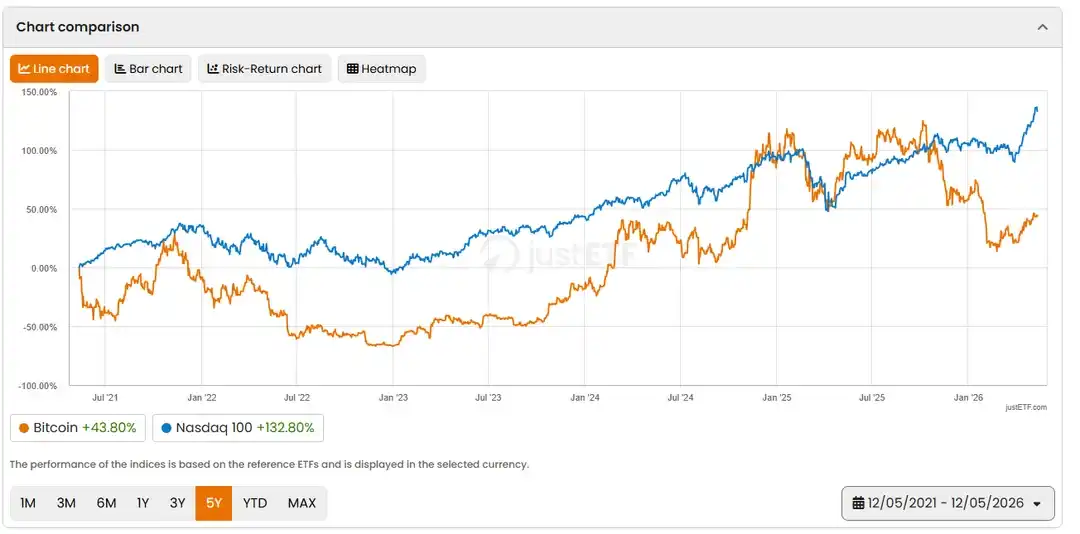
The poster's own summary is even more poignant: "What exactly is going on? I guess the answer is that AI has changed everything."

Bloomberg published a similar report in February this year with an even more merciless title: "Bitcoin's Five-Year Return Lags S&P 500, Nasdaq 100, and Gold."

Investments Have an Expiration Date

The starting point for the 5-year window in the above chart is December 2021.

At that time, Bitcoin had just retreated from its cycle high of $69,000 to around $48,000, while the Nasdaq 100 was around 16,300 points, and the AI narrative had not yet taken off. This means Bitcoin's starting line was set on a high plateau at the end of a bull market, while Nasdaq's starting line was set on the eve of the AI super rally.

Emotionally, it's understandable to promote that U.S. stocks are better than BTC; but is it really the case when looking at longer-term data? If we shift the starting point forward or backward by a few months or years, the winning relationship flips dramatically.

We conducted a simple small analysis. For the following five time windows, with the end point uniformly set as May 2026 (BTC ~$80,000, Nasdaq 100 ~29,000 points), the starting points correspond to five key nodes in crypto and macro markets:
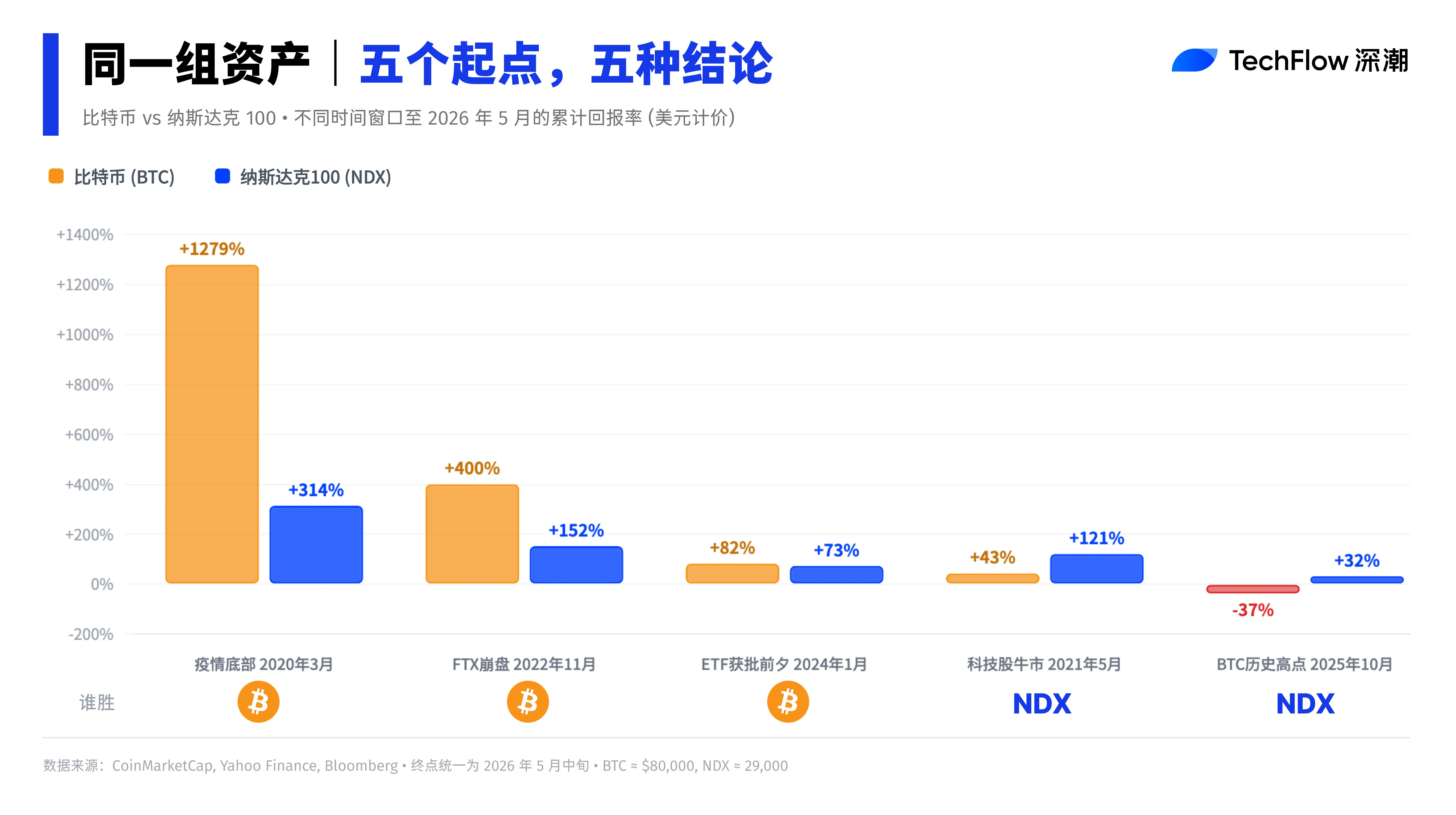
COVID-19 Bottom (March 2020) → Now:

Bitcoin rose from ~$5,800 to $80,000, a gain of ~1,279%. Nasdaq 100 rose from ~7,000 points to 29,000 points, a gain of ~314%. Bitcoin's return was over 4 times that of Nasdaq.

FTX Collapse Bottom (November 2022) → Now:

Bitcoin rose from ~$16,000 to $80,000, a gain of ~400%. Nasdaq 100 rose from ~11,500 points to 29,000 points, a gain of ~152%. Bitcoin's return was still 2.6 times that of Nasdaq.

On the Eve of Bitcoin ETF Approval (January 2024) → Now:

Bitcoin rose from ~$44,000 to $80,000, a gain of ~82%. Nasdaq 100 rose from ~16,800 points to 29,000 points, a gain of ~73%. They were basically tied, with Bitcoin slightly ahead.

This Tech Stock Cycle (May 2021) → Now:

Bitcoin rose from ~$48,000 to $80,000, a gain of ~67%. Nasdaq 100 rose from ~16,300 points to 29,000 points, a gain of ~78%. Nasdaq led.

Bitcoin's All-Time High (October 2025) → Now:

Bitcoin fell from ~$126,000 to $80,000, a loss of ~37%. Nasdaq 100 rose from ~22,000 points to 29,000 points, a gain of ~32%. Nasdaq led significantly, and the directions were completely opposite.

Therefore, the conclusion is: Out of five windows, Bitcoin wins in three, Nasdaq wins in two. The Reddit post happened to select one of the windows where Nasdaq has the biggest advantage.

Cyclical Asset vs. Trend Asset

The difference in sensitivity to the starting point between Bitcoin and the Nasdaq 100 stems from the two assets' fundamentally different volatility structures.

The Nasdaq 100 is composed of 500 large non-financial companies, backed by cash flows and earnings, exhibiting a long-term upward trend. Even after the 33% pullback in 2022, its recovery was relatively steady.

Choosing any non-extreme starting point results in long-term returns falling within a relatively stable range.

Bitcoin is a typical cyclical asset. Historically, in each bull-bear cycle, the drawdown from peak to trough has ranged between 75% and 85% (as seen in 2014, 2018, and 2022). The pullback from October 2025 to early 2026 also reached about 50%.

This intense volatility means that where the starting point falls within the cycle almost determines the final return figure.

A Nasdaq.com analysis put it more bluntly: Bitcoin is essentially a leveraged version of the S&P 500.

In 2024, the S&P rose 24%, Bitcoin rose 135%; in 2023, the S&P rose 26%, Bitcoin rose 147%; in 2022, the S&P fell 19%, Bitcoin fell 65%. Same direction, magnitude amplified 3 to 5 times.

This means that choosing a starting point that coincides exactly with a Bitcoin cycle peak for comparison, and concluding that "stocks completely beat Bitcoin," is almost statistically inevitable. The opposite is also true.

The Current BTC is Possibly in a "Cyclical Undervaluation Zone"

Setting aside the starting point game, the current market structure itself warrants attention.

After peaking in October 2025, Bitcoin underwent a typical cyclical correction. It fell to around $65,000 in February 2026, then rebounded to around $80,000, still down about 37% from its high. Meanwhile, the Nasdaq 100 repeatedly hit new highs driven by continued expansion in AI capital expenditure.

This divergence is not uncommon in history. In 2019, while Bitcoin rallied from $3,000 to $12,000, it was almost decoupled from the S&P 500. In 2022, both plummeted in sync, with correlation once soaring to 0.92. The correlation between the crypto market and U.S. stocks is dynamic and cyclical, not a fixed positive correlation.

Galaxy Digital's Head of Research, Alex Thorn, proposed an interesting perspective in December 2025:

If measured in terms of 2020 US dollar purchasing power, Bitcoin's nominal high of $126,000 never actually broke through $100,000. Cumulative inflation from 2020 to 2025 is about 24%, which introduces a systematic bias in cross-year nominal price comparisons.

At a time when Bitcoin is down 37% from its all-time high while U.S. stock indices are simultaneously hitting record highs, the narrative of "stocks outperforming Bitcoin" naturally dominates social media.

However, in the past, every time this narrative was loudest, it usually coincided with Bitcoin nearing the bottom of its cycle. After the FTX collapse in late 2022, similar "Bitcoin is dead" rhetoric was also rampant, yet Bitcoin subsequently rose from $16,000 to $126,000 over the next 18 months.

Hindsight is easy; placing bets ahead of time is hard. Arguing about which asset has higher returns has little practical meaning at the micro level. Any conclusion based on a single time window that "A is forever superior to B" cannot withstand the test of shifting the starting point.

Each era has its champion. The difficult part across all eras is timing the market and taking profits.


Domande pertinenti

QBased on the article, why does the claim 'Buying Nasdaq is better than buying BTC' have a 'shelf life'?

ABecause the comparison outcome heavily depends on the selected starting point due to Bitcoin's extreme cyclical volatility and Nasdaq's steadier trend. Choosing a starting point near a Bitcoin cycle peak makes Nasdaq look better, while starting near a Bitcoin cycle low makes Bitcoin's returns vastly superior. The conclusion is not universally true across all timeframes.

QHow did Bitcoin's performance compare to Nasdaq 100 from the COVID-19 market bottom in March 2020 to May 2026, according to the article's data?

AFrom March 2020 to May 2026, Bitcoin rose from approximately $5,800 to $80,000, a gain of about 1,279%. The Nasdaq 100 rose from about 7,000 points to 29,000 points, a gain of about 314%. Bitcoin's return was over 4 times that of the Nasdaq 100.

QWhat is the fundamental difference in the 'volatility structure' between Bitcoin and the Nasdaq 100 as explained in the article?

AThe Nasdaq 100, backed by company cash flows and earnings, exhibits a long-term upward trend with relatively stable returns from most non-extreme starting points. Bitcoin is a typical cyclical asset with extreme volatility, experiencing drawdowns of 75-85% in past bear markets. Its final return is almost entirely determined by the cycle phase at the starting point.

QAccording to the article, what is one reason the current narrative of 'stocks outperforming Bitcoin' is so prevalent in mid-2026?

AIn mid-2026, Bitcoin is down about 37% from its October 2025 all-time high of $126,000, trading around $80,000. Meanwhile, the Nasdaq 100 is hitting new all-time highs driven by AI capital expenditure stories. This significant performance divergence makes the 'stocks are better' narrative naturally dominate social media.

QWhat historical pattern does the article suggest often occurs when the 'Bitcoin is dead' or 'stocks outperform Bitcoin' narrative is loudest?

AThe article suggests that in the past, when narratives claiming 'Bitcoin is dead' or that stocks are definitively better than Bitcoin were at their loudest (e.g., after the FTX crash in late 2022), it often coincided with Bitcoin being near a cyclical bottom region. Subsequently, Bitcoin experienced massive rallies, such as rising from $16,000 to $126,000 in the 18 months following the FTX collapse.

Letture associate

No Coding Required: Build Your First AI Agent in 2 Days (Complete Tutorial)

A No-Code Guide to Building Your First AI Agent in a Weekend This article presents a weekend, zero-code tutorial for beginners to build a functional AI Agent using tools like Claude. It clarifies the core difference between a chatbot, which responds to queries, and an Agent, which autonomously plans and executes multi-step tasks using tools to deliver a final result. The process is broken into four stages over two days: 1. **Saturday Morning: Understanding Agents.** Learn that an Agent requires a clear Goal, a Plan, necessary Tools, and an execution Loop. Identify a simple, multi-step task from your own work/life as your first project. 2. **Saturday Afternoon: Building with Claude.** Create a one-page "Agent Blueprint" answering: the Goal, sequential Steps, required Tools, the desired Output format, and error-handling rules. Implement this blueprint in Claude (Desktop Cowork or web Projects) and run the Agent for the first time. 3. **Sunday Morning: Debugging & Optimization.** Review the initial (often 60-70% accurate) output. Identify flaws, trace them back to vague instructions in your blueprint, and refine it with more specific criteria and error handling. Iterate this run-review-refine cycle 3-4 times to reach ~90% reliability. 4. **Sunday Afternoon: Expansion.** Apply the learned workflow to quickly build a second, different Agent (e.g., for research, content repurposing, or meeting prep), experiencing the compounding efficiency gains. The core skill is not writing a perfect blueprint initially, but rapidly iterating based on output. By the end of the weekend, you'll have built two usable Agents, moving beyond just chatting with AI to automating multi-step workflows, fundamentally changing how you approach repetitive tasks.

marsbit6 h fa

No Coding Required: Build Your First AI Agent in 2 Days (Complete Tutorial)

marsbit6 h fa

Trading

Spot
Futures

Articoli Popolari

Cosa è BITCOIN

Comprendere HarryPotterObamaSonic10Inu (ERC-20) e la sua posizione nel mondo delle criptovalute Negli ultimi anni, il mercato delle criptovalute ha assistito a un aumento della popolarità delle meme coin, catturando l'interesse non solo dei trader, ma anche di coloro che cercano coinvolgimento comunitario e valore di intrattenimento. Tra questi token unici c'è HarryPotterObamaSonic10Inu (ERC-20), un progetto intrigante che mescola riferimenti culturali nel tessuto delle criptovalute. Questo articolo esplora gli aspetti chiave di HarryPotterObamaSonic10Inu, analizzando i suoi meccanismi, l'etica guidata dalla comunità e il suo coinvolgimento con il panorama crittografico più ampio. Che cos'è HarryPotterObamaSonic10Inu (ERC-20)? Come suggerisce il suo nome, HarryPotterObamaSonic10Inu è una meme coin costruita sulla blockchain di Ethereum, classificata secondo lo standard ERC-20. A differenza delle criptovalute tradizionali che possono enfatizzare l'utilità pratica o il potenziale investimento, questo token prospera grazie al valore di intrattenimento e alla forza della sua comunità. Il progetto mira a creare un ambiente in cui gli utenti coinvolti possono riunirsi, condividere idee e partecipare ad attività ispirate a diversi fenomeni culturali. Una caratteristica notevole di HarryPotterObamaSonic10Inu è la zero tassa sulle transazioni. Questo elemento allettante tende a incoraggiare il trading e il coinvolgimento della comunità, privo di costi aggiuntivi che possono scoraggiare i trader di piccole dimensioni. L'offerta totale della moneta è fissata a un miliardo di token, un numero che segna la sua intenzione di mantenere una circolazione sostanziale all'interno della comunità. Creatore di HarryPotterObamaSonic10Inu (ERC-20) Le origini di HarryPotterObamaSonic10Inu sono avvolte in un certo mistero; i dettagli sul creatore rimangono sconosciuti. Lo sviluppo di questo token non presenta un team identificabile o un piano esplicito, cosa non rara nel settore delle meme coin. Invece, il progetto è emerso organicamente, con il suo progresso fortemente dipendente dall'entusiasmo e dalla partecipazione della sua comunità. Investitori di HarryPotterObamaSonic10Inu (ERC-20) Per quanto riguarda investimenti esterni e finanziamenti, HarryPotterObamaSonic10Inu rimane ambiguo. Il token non elenca alcuna fondazione di investimento conosciuta o un sostegno organizzativo significativo. Invece, la linfa vitale del progetto è la sua comunità di base, che informa la sua crescita e sostenibilità attraverso azioni collettive e coinvolgimento nello spazio crittografico. Come funziona HarryPotterObamaSonic10Inu (ERC-20)? In quanto meme coin, HarryPotterObamaSonic10Inu opera principalmente al di fuori delle strutture tradizionali che governano spesso il valore degli asset. Ci sono diversi aspetti distintivi che definiscono il funzionamento del progetto: Transazioni senza tasse: Senza costi fiscali sulle transazioni, gli utenti possono comprare e vendere liberamente il token senza preoccuparsi di costi nascosti. Coinvolgimento della comunità: Il progetto prospera sull'interazione della comunità, sfruttando le piattaforme social per creare entusiasmo e facilitare il coinvolgimento. Discussioni, condivisione di contenuti e coinvolgimento sono elementi cruciali che aiutano ad espandere la sua portata e a favorire la lealtà tra i sostenitori. Nessuna utilità pratica: Va notato che HarryPotterObamaSonic10Inu non offre un'utilità concreta all'interno dell'ecosistema finanziario. Piuttosto, è classificato come un token principalmente per attività di intrattenimento e comunitarie. Riferimento culturale: Il token incorpora astutamente elementi della cultura pop per attirare interesse, collegandosi a appassionati di meme e seguaci delle criptovalute. HarryPotterObamaSonic10Inu esemplifica come le meme coin operino in modo diverso rispetto ai progetti di criptovalute più tradizionali, entrando nel mercato come costrutti sociali innovativi piuttosto che come asset utilitari. Cronologia di HarryPotterObamaSonic10Inu (ERC-20) La storia di HarryPotterObamaSonic10Inu è segnata da diversi traguardi notevoli: Creazione: Il token è emerso da un meme virale, catturando l'immaginazione di molti appassionati di criptovalute. Le date di creazione specifiche non sono disponibili, sottolineando la sua crescita organica. Inserimento negli scambi: HarryPotterObamaSonic10Inu ha fatto il suo ingresso in vari scambi, consentendo un accesso e un trading più facili da parte della comunità. Iniziative di coinvolgimento della comunità: Attività in corso volte a migliorare l'interazione della comunità, comprese gare, campagne sui social media e generazione di contenuti da parte di fan e sostenitori. Piani di espansione futura: La tabella di marcia del progetto include il lancio di una collezione NFT, merchandising e un sito di eCommerce relativo ai suoi temi culturali, coinvolgendo ulteriormente la comunità e cercando di aggiungere più dimensioni al suo ecosistema. Punti chiave su HarryPotterObamaSonic10Inu (ERC-20) Natura guidata dalla comunità: Il progetto dà priorità al contributo collettivo e alla creatività, garantendo che il coinvolgimento degli utenti sia al centro del suo sviluppo. Classificazione come meme coin: Rappresenta l'epitome delle criptovalute basate sull'intrattenimento, distinguendosi dai veicoli d'investimento tradizionali. Nessuna affiliazione diretta con Bitcoin: Nonostante la somiglianza nel nome del ticker, HarryPotterObamaSonic10Inu è distintivo e non ha alcuna relazione con Bitcoin o altre criptovalute consolidate. Focus sulla collaborazione: HarryPotterObamaSonic10Inu è progettato per creare uno spazio per la collaborazione e la condivisione di storie tra i suoi detentori, fornendo un canale per la creatività e il legame comunitario. Prospettive future: L'ambizione di espandersi oltre il suo presupposto iniziale verso NFT e merchandising delinea un percorso per il progetto per potenzialmente entrare in strade più mainstream all'interno della cultura digitale. Poiché le meme coin continuano a catturare l'immaginazione della comunità crittografica, HarryPotterObamaSonic10Inu (ERC-20) si distingue per i suoi legami culturali e il suo approccio centrato sulla comunità. Anche se potrebbe non adattarsi al modello tipico di un token orientato all'utilità, la sua essenza risiede nella gioia e nella camaraderia coltivate tra i suoi sostenitori, evidenziando la natura in evoluzione delle criptovalute in un'epoca sempre più digitale. Con la continuazione dello sviluppo del progetto, sarà importante osservare come le dinamiche della comunità influenzano la sua traiettoria nel panorama in continuo cambiamento della tecnologia blockchain.

1.5k Totale visualizzazioniPubblicato il 2024.04.01Aggiornato il 2024.12.03

Cosa è BITCOIN

Come comprare BTC

Benvenuto in HTX.com! Abbiamo reso l'acquisto di Bitcoin (BTC) semplice e conveniente. Segui la nostra guida passo passo per intraprendere il tuo viaggio nel mondo delle criptovalute.Step 1: Crea il tuo Account HTXUsa la tua email o numero di telefono per registrarti il tuo account gratuito su HTX. Vivi un'esperienza facile e sblocca tutte le funzionalità,Crea il mio accountStep 2: Vai in Acquista crypto e seleziona il tuo metodo di pagamentoCarta di credito/debito: utilizza la tua Visa o Mastercard per acquistare immediatamente BitcoinBTC.Bilancio: Usa i fondi dal bilancio del tuo account HTX per fare trading senza problemi.Terze parti: abbiamo aggiunto metodi di pagamento molto utilizzati come Google Pay e Apple Pay per maggiore comodità.P2P: Fai trading direttamente con altri utenti HTX.Over-the-Counter (OTC): Offriamo servizi su misura e tassi di cambio competitivi per i trader.Step 3: Conserva Bitcoin (BTC)Dopo aver acquistato Bitcoin (BTC), conserva nel tuo account HTX. In alternativa, puoi inviare tramite trasferimento blockchain o scambiare per altre criptovalute.Step 4: Scambia Bitcoin (BTC)Scambia facilmente Bitcoin (BTC) nel mercato spot di HTX. Accedi al tuo account, seleziona la tua coppia di trading, esegui le tue operazioni e monitora in tempo reale. Offriamo un'esperienza user-friendly sia per chi ha appena iniziato che per i trader più esperti.

3.8k Totale visualizzazioniPubblicato il 2024.12.12Aggiornato il 2025.03.21

Come comprare BTC

Cosa è $BITCOIN

ORO DIGITALE ($BITCOIN): Un'Analisi Completa Introduzione all'ORO DIGITALE ($BITCOIN) L'ORO DIGITALE ($BITCOIN) è un progetto basato su blockchain che opera sulla rete Solana, con l'obiettivo di combinare le caratteristiche dei metalli preziosi tradizionali con l'innovazione delle tecnologie decentralizzate. Sebbene condivida un nome con Bitcoin, spesso definito “oro digitale” a causa della sua percezione come riserva di valore, l'ORO DIGITALE è un token separato progettato per creare un ecosistema unico all'interno del panorama Web3. Il suo obiettivo è posizionarsi come un asset digitale alternativo valido, anche se i dettagli riguardanti le sue applicazioni e funzionalità sono ancora in fase di sviluppo. Cos'è l'ORO DIGITALE ($BITCOIN)? L'ORO DIGITALE ($BITCOIN) è un token di criptovaluta esplicitamente progettato per l'uso sulla blockchain di Solana. A differenza di Bitcoin, che fornisce un ruolo di stoccaggio di valore ampiamente riconosciuto, questo token sembra concentrarsi su applicazioni e caratteristiche più ampie. Aspetti notevoli includono: Infrastruttura Blockchain: Il token è costruito sulla blockchain di Solana, nota per la sua capacità di gestire transazioni ad alta velocità e a basso costo. Dinamiche di Offerta: L'ORO DIGITALE ha un'offerta massima fissata a 100 quadrilioni di token (100P $BITCOIN), sebbene i dettagli riguardanti la sua offerta circolante siano attualmente non divulgati. Utilità: Sebbene le funzionalità precise non siano esplicitamente delineate, ci sono indicazioni che il token potrebbe essere utilizzato per varie applicazioni, potenzialmente coinvolgendo applicazioni decentralizzate (dApp) o strategie di tokenizzazione degli asset. Chi è il Creatore dell'ORO DIGITALE ($BITCOIN)? Attualmente, l'identità dei creatori e del team di sviluppo dietro l'ORO DIGITALE ($BITCOIN) rimane sconosciuta. Questa situazione è tipica tra molti progetti innovativi nel settore blockchain, in particolare quelli allineati con la finanza decentralizzata e i fenomeni delle meme coin. Sebbene tale anonimato possa favorire una cultura guidata dalla comunità, intensifica le preoccupazioni riguardo alla governance e alla responsabilità. Chi sono gli Investitori dell'ORO DIGITALE ($BITCOIN)? Le informazioni disponibili indicano che l'ORO DIGITALE ($BITCOIN) non ha alcun sostenitore istituzionale noto o investimenti di venture capital prominenti. Il progetto sembra operare su un modello peer-to-peer incentrato sul supporto e sull'adozione della comunità piuttosto che su percorsi di finanziamento tradizionali. La sua attività e liquidità si trovano principalmente su exchange decentralizzati (DEX), come PumpSwap, piuttosto che su piattaforme di trading centralizzate consolidate, evidenziando ulteriormente il suo approccio di base. Come Funziona l'ORO DIGITALE ($BITCOIN) Le meccaniche operative dell'ORO DIGITALE ($BITCOIN) possono essere elaborate in base al suo design blockchain e alle caratteristiche della rete: Meccanismo di Consenso: Sfruttando il proof-of-history (PoH) unico di Solana combinato con un modello di proof-of-stake (PoS), il progetto garantisce una validazione efficiente delle transazioni contribuendo all'alta performance della rete. Tokenomics: Sebbene meccanismi deflazionistici specifici non siano stati dettagliati ampiamente, l'ampia offerta massima di token implica che potrebbe soddisfare microtransazioni o casi d'uso di nicchia che devono ancora essere definiti. Interoperabilità: Esiste il potenziale per l'integrazione con l'ecosistema più ampio di Solana, inclusi vari piattaforme di finanza decentralizzata (DeFi). Tuttavia, i dettagli riguardanti integrazioni specifiche rimangono non specificati. Cronologia degli Eventi Chiave Ecco una cronologia che evidenzia traguardi significativi riguardanti l'ORO DIGITALE ($BITCOIN): 2023: Il dispiegamento iniziale del token avviene sulla blockchain di Solana, contrassegnato dal suo indirizzo di contratto. 2024: L'ORO DIGITALE guadagna visibilità poiché diventa disponibile per il trading su exchange decentralizzati come PumpSwap, consentendo agli utenti di scambiarlo contro SOL. 2025: Il progetto assiste a un'attività di trading sporadica e a un potenziale interesse per impegni guidati dalla comunità, sebbene non siano state documentate partnership significative o avanzamenti tecnici fino ad ora. Analisi Critica Punti di Forza Scalabilità: L'infrastruttura sottostante di Solana supporta alti volumi di transazioni, il che potrebbe migliorare l'utilità di $BITCOIN in vari scenari di transazione. Accessibilità: Il potenziale basso prezzo di trading per token potrebbe attrarre investitori al dettaglio, facilitando una partecipazione più ampia grazie a opportunità di proprietà frazionata. Rischi Mancanza di Trasparenza: L'assenza di sostenitori, sviluppatori o di un processo di audit pubblicamente noti potrebbe generare scetticismo riguardo alla sostenibilità e all'affidabilità del progetto. Volatilità del Mercato: L'attività di trading è fortemente dipendente dal comportamento speculativo, il che può comportare una significativa volatilità dei prezzi e incertezze per gli investitori. Conclusione L'ORO DIGITALE ($BITCOIN) emerge come un progetto intrigante ma ambiguo all'interno dell'evolvente ecosistema di Solana. Sebbene tenti di sfruttare la narrativa dell'“oro digitale”, la sua partenza dal ruolo consolidato di Bitcoin come riserva di valore sottolinea la necessità di una chiara differenziazione della sua utilità e struttura di governance. L'accettazione e l'adozione future dipenderanno probabilmente dall'affrontare l'attuale opacità e dalla definizione più esplicita delle sue strategie operative ed economiche. Nota: Questo rapporto comprende informazioni sintetizzate disponibili a ottobre 2023, e potrebbero essersi verificati sviluppi oltre il periodo di ricerca.

99 Totale visualizzazioniPubblicato il 2025.05.13Aggiornato il 2025.05.13

Cosa è $BITCOIN

Discussioni

Benvenuto nella Community HTX. Qui puoi rimanere informato sugli ultimi sviluppi della piattaforma e accedere ad approfondimenti esperti sul mercato. Le opinioni degli utenti sul prezzo di BTC BTC sono presentate come di seguito.

活动图片