Buybacks and Telegram fuel LIT’s 40% surge, but can the rally extend itself?

ambcryptoPubblicato 2026-04-09Pubblicato ultima volta 2026-04-09

Introduzione

LIT, the native token of Peter Thiel-backed Lighter perpetual DEX, surged 40% in April, driven by an aggressive buyback program and a key Telegram integration. The project has repurchased and locked 10 million LIT (4% of the 250 million circulating supply) and is buying back tokens at a rate of about 1% per month. Meanwhile, Telegram’s integration of Lighter for leveraged trading attracted 40,000 new users. Despite this, open interest saw only a modest increase, though daily revenue rose from $35K to over $100K. A trader cautioned that the rally faces a key resistance level at the 200-EMA, and further gains depend on bulls flipping it into support.

Peter Thiel-backed Lighter perpetual DEX has accelerated the buyback of its native LIT token. On 08 April, the project announced it had bought and locked 10 million LIT. This translated to 4% of the current circulation of 250 million tokens since its debut last December.

A month ago, the buyback program was at 3% of the circulating supply. At its current pace, the project is buying back about 1% of supply or an average of 2.4 million LIT per month. If the trend persists, it would take the DEX about 10 months to lock the entire current circulating supply.

Worth pointing out, however, that LIT’s total supply is capped at 1 billion, and only 250 million LIT tokens were released after the debut. The first wave of unlocks will begin in December 2026.

In the meantime, how is the market responding to the aggressive LIT buyback though?

Telegram spikes Lighter traction

Well, the reception has been very positive and bullish. Since late March, the token has recovered by over 40%, rising from a record low of $0.74 to above $1.13.

LIT’s uptrend momentum was further boosted by a recent Telegram integration. The privacy-focused messenger will use Lighter to power its native trading with up to 50x leverage across crypto and non-crypto assets.

It’s been about a week since the Telegram integration. So, AMBCrypto dug deeper to check whether the partnership is driving meaningful traction for the DEX or not.

According to Lightalytics data, Lighter recorded about 40K new registered users after the Telegram update.
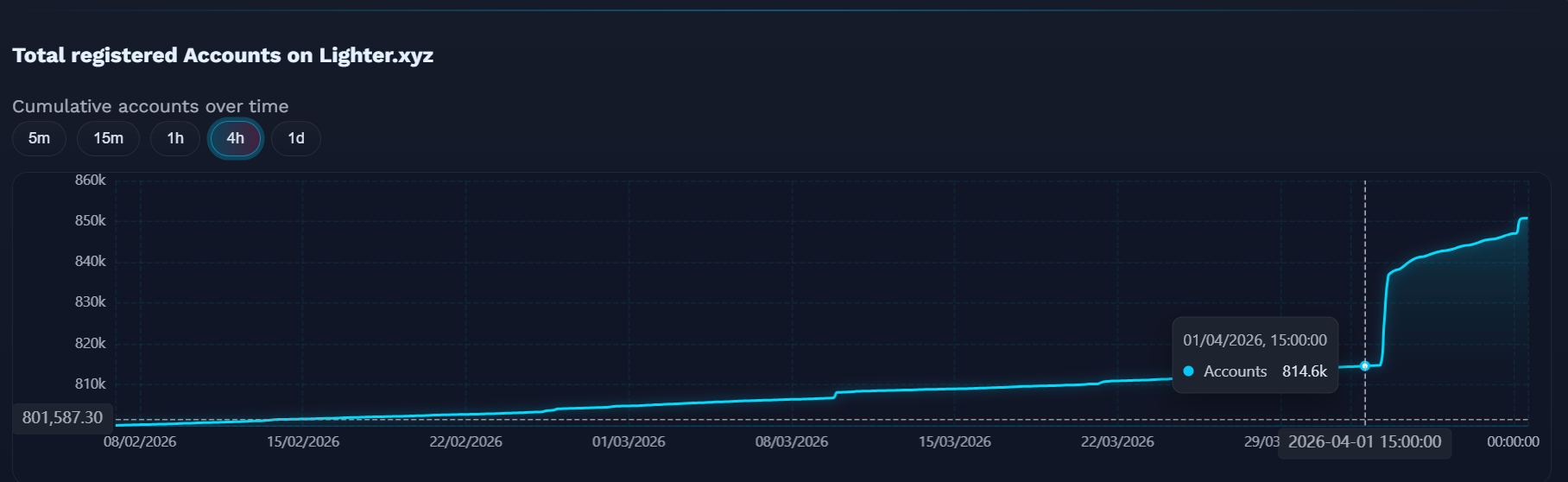
Source: Lightalytics

Will LIT extend the 40% rally?

However, the Open Interest (OI), which tracks users’ opened bets, posted only a slight improvement.

The OI rose by about $40 from $675 million to $717 million. Interestingly, the little traction saw daily revenue rise from $35K to over $100K over the last seven days.
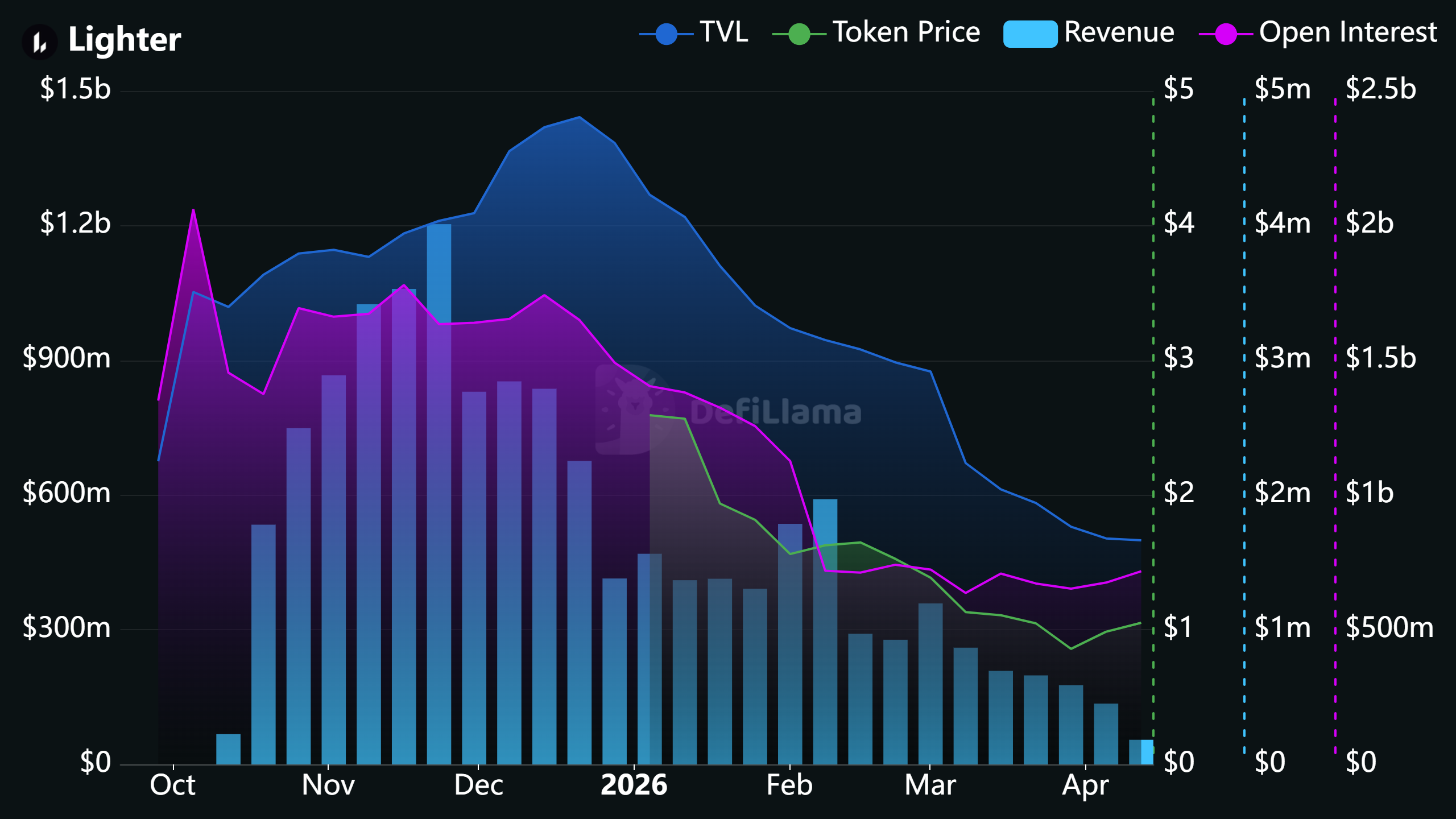
Source: DeFiLlama

Since most of the revenue is being channeled to buybacks, any further improved traction could help bolster LIT’s recovery.

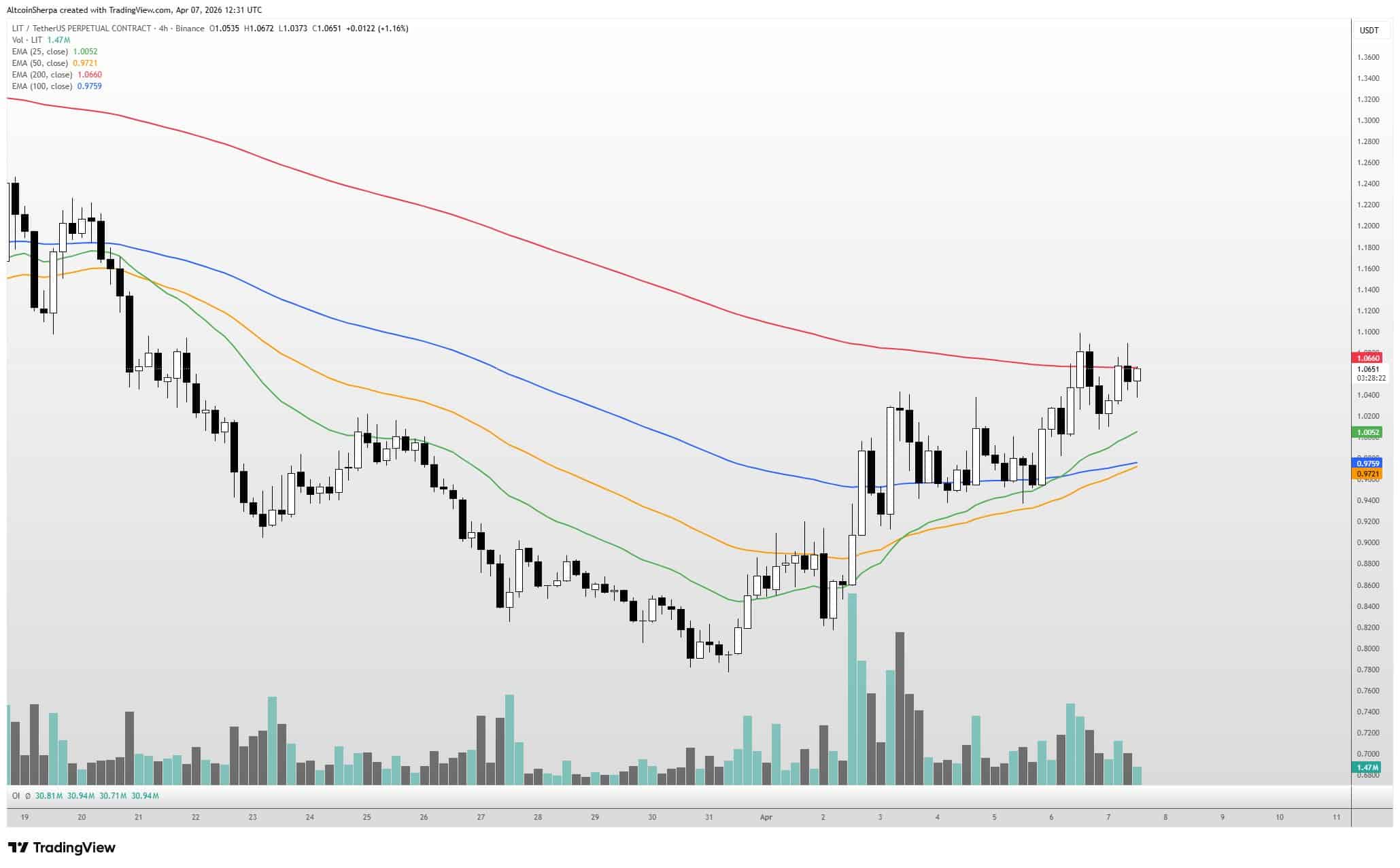
Even so, a trader recently cautioned that the rally had hit the 200-EMA (Exponential Moving Average) – A key dynamic resistance that may derail bulls in the near-term. An extended rally could only be confirmed if bulls flip the 200-EMA into support.
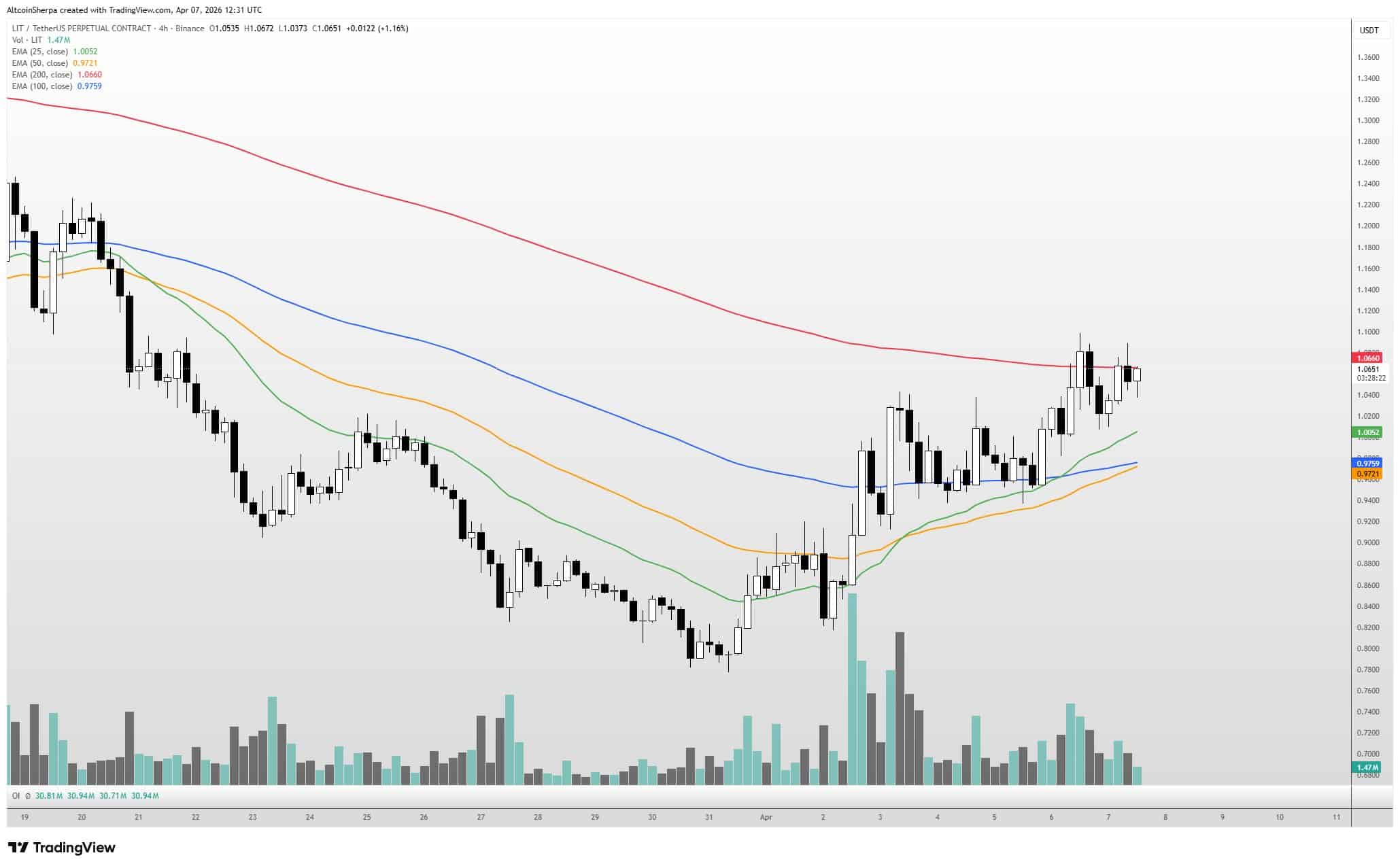
Source: X

Final Summary

  • Lighter’s buyback program has hit 10 million LIT or 4% of the circulating supply of 250 million.
  • Aggressive buyback program and Telegram integration fueled LIT’s 40% rally in April.

Domande pertinenti

QWhat is the current percentage of LIT's circulating supply that has been bought back by the project?

AThe project has bought back 4% of the current circulating supply of 250 million LIT tokens.

QWhat two main factors are credited with fueling LIT's 40% price surge in April?

AThe aggressive buyback program and the integration with Telegram fueled LIT's 40% rally.

QHow many new registered users did Lighter record after the Telegram integration was announced?

ALighter recorded about 40,000 new registered users after the Telegram update.

QWhat key technical resistance level did the rally hit, according to a trader's caution?

AThe rally hit the 200-EMA (Exponential Moving Average), which is a key dynamic resistance that could derail the bulls in the near-term.

QWhen is the first wave of LIT token unlocks scheduled to begin?

AThe first wave of unlocks is scheduled to begin in December 2026.

Letture associate

GitHub, Transfixed by AI

On the night of February 9th, GitHub suffered a major outage caused by a simple configuration change—reducing a cache refresh interval from 12 to 2 hours—that triggered a cascade of failures. This was not an isolated event, but part of a broader pattern. In early 2026, GitHub experienced at least 8 major incidents, failing to meet its promised 99.9% availability. These outages stemmed from structural issues: explosive growth in load, tight service coupling, and insufficient protection against abnormal traffic. This unprecedented load is driven by AI Agents. In 2025, GitHub handled ~1 billion commits. By 2026, weekly commits reached 275 million, projecting to ~14 billion for the year—a 14x increase. AI tools like Claude Code now contribute 4.5% of all public repository commits, with weekly submissions surging 25x in just three months. AI-generated pull requests jumped from 4 million to 17 million per month in half a year. Unlike human developers, AI Agents work continuously, generating commits at a scale that overwhelms infrastructure designed for human rhythms. The surge also shattered GitHub's business model. Copilot's flat-rate pricing, based on assisting human developers, became unsustainable as Agentic AI sessions consumed resources worth hundreds of dollars for a few dollars in fees. In response, GitHub imposed usage limits and, by June 1st, shifted to a pay-per-use "AI Credits" system. Facing this new reality, GitHub realized a 10x scaling plan was insufficient. It announced a need to *redesign* its architecture for 30x current scale—decoupling services, adding fault isolation, and improving change management to prevent cascading failures. Other platforms like Stripe and AWS are facing similar challenges with AI Agents. Fundamentally, GitHub is transitioning from a human collaboration platform to an "exhaust pipe" for automated AI workflows. Its detailed post-mortem reports aim to maintain trust during this turbulent rebuild. The February outage was not just a technical glitch, but a signal of the software industry's entry into a new, AI-driven era.

marsbit31 min fa

GitHub, Transfixed by AI

marsbit31 min fa

Both Suffer Massive Losses Exceeding $90 Billion, Which Is in Greater Peril: Strategy or Bitmine?

Facing massive paper losses exceeding $90 billion each amidst a sharp market downturn, "Digital Asset Treasury" (DAT) giants Strategy and Bitmine find themselves in a precarious position, but with different underlying risks. Strategy, heavily invested in Bitcoin (BTC), faces significant financial strain. Its strategy relies heavily on debt, including convertible notes and preferred stock (STRC) requiring substantial dividend payments. With its cash reserves dwindling and BTC offering no staking yield for cash flow, Strategy's high leverage makes it vulnerable. A continued price decline could force asset sales to meet obligations, potentially creating a negative feedback loop. Its market value has already fallen sharply. In contrast, Bitmine, an Ethereum (ETH) holder, appears on firmer financial ground. It primarily funds its purchases through equity offerings (like ATM programs), avoiding debt pressure. It also generates income by staking a large portion of its ETH holdings. While not immune to market drops and shareholder dilution concerns, Bitmine maintains more flexibility, recently announcing a new preferred share offering to raise further capital. The core divergence lies in their financing: Bitmine uses equity (investor money), while Strategy uses debt (borrowed money). Consequently, Bitmine currently faces less immediate liquidity pressure than Strategy, which must navigate the dual challenge of servicing debt/dividends and a declining core asset (BTC) price.

marsbit38 min fa

Both Suffer Massive Losses Exceeding $90 Billion, Which Is in Greater Peril: Strategy or Bitmine?

marsbit38 min fa

Trading

Spot
Futures

Articoli Popolari

Come comprare TON

Benvenuto in HTX.com! Abbiamo reso l'acquisto di The Open Network (TON) semplice e conveniente. Segui la nostra guida passo passo per intraprendere il tuo viaggio nel mondo delle criptovalute.Step 1: Crea il tuo Account HTXUsa la tua email o numero di telefono per registrarti il tuo account gratuito su HTX. Vivi un'esperienza facile e sblocca tutte le funzionalità,Crea il mio accountStep 2: Vai in Acquista crypto e seleziona il tuo metodo di pagamentoCarta di credito/debito: utilizza la tua Visa o Mastercard per acquistare immediatamente The Open NetworkTON.Bilancio: Usa i fondi dal bilancio del tuo account HTX per fare trading senza problemi.Terze parti: abbiamo aggiunto metodi di pagamento molto utilizzati come Google Pay e Apple Pay per maggiore comodità.P2P: Fai trading direttamente con altri utenti HTX.Over-the-Counter (OTC): Offriamo servizi su misura e tassi di cambio competitivi per i trader.Step 3: Conserva The Open Network (TON)Dopo aver acquistato The Open Network (TON), conserva nel tuo account HTX. In alternativa, puoi inviare tramite trasferimento blockchain o scambiare per altre criptovalute.Step 4: Scambia The Open Network (TON)Scambia facilmente The Open Network (TON) nel mercato spot di HTX. Accedi al tuo account, seleziona la tua coppia di trading, esegui le tue operazioni e monitora in tempo reale. Offriamo un'esperienza user-friendly sia per chi ha appena iniziato che per i trader più esperti.

1.7k Totale visualizzazioniPubblicato il 2024.12.10Aggiornato il 2026.06.02

Come comprare TON

Discussioni

Benvenuto nella Community HTX. Qui puoi rimanere informato sugli ultimi sviluppi della piattaforma e accedere ad approfondimenti esperti sul mercato. Le opinioni degli utenti sul prezzo di TON TON sono presentate come di seguito.

活动图片