BTC Halved, DAT Companies Face Billions in Paper Losses: Who is 'Selling to Stop the Bleeding'?

Odaily星球日报Pubblicato 2026-02-11Pubblicato ultima volta 2026-02-11

Introduzione

BTC's sharp decline from its $120,000 peak in late 2025 to around $60,000 has triggered significant unrealized losses for several Digital Asset Treasury (DAT) companies, forcing some to sell off crypto holdings to manage financial strain. Cango Inc. sold 4,451 BTC (nearly half its holdings) to repay a BTC-collateralized loan, as mining costs exceeded Bitcoin's current price. Empery Digital, which bought BTC near the peak at around $117,000, sold portions of its holdings to fund share buybacks and debt repayment amid a 57% unrealized loss. Bitdeer shifted from a “HODL” strategy to regularly selling mined BTC to prioritize cash flow. Sequans Communications became the first DAT company to sell Bitcoin (970 BTC) to redeem convertible bonds, highlighting debt-driven sell-offs. ETHZilla, an Ethereum-focused DAT, sold over 32,000 ETH to manage leverage and transition toward real-world asset (RWA) tokenization. These moves underscore the vulnerability of highly leveraged DAT firms in a bear market. While large players may hold on, mid-tier and smaller companies face pressure to deleverage, signaling a market shift from narrative-driven expansion to financial survival and operational sustainability.

Original | Odaily Planet Daily (@OdailyChina)

Author | Ding Dang (@XiaMiPP)
The beginning of 2026 delivered a heavy blow to DAT (Digital Asset Treasury) companies.

BTC retreated from the阶段性高点 (stage high) of $120,000 in December 2025 to around $60,000, a drop of nearly 50%. ETH was not spared either, falling below the $2,000 mark, almost erasing all gains since May 2025. That was precisely the time when a group of DAT companies, represented by SharpLink and Bitmine,高调宣布 (loudly announced) their strategic transformations and made large-scale allocations to加密资产 (crypto assets).

What does this mean? It means that those listed companies or institutions that once regarded BTC and ETH as "corporate strategic reserves" are now collectively mired in浮亏 (paper losses), with账面亏损 (book losses) ranging from hundreds of millions to billions of dollars. Top players like Strategy and Bitmine are still gritting their teeth and increasing their holdings, trying to maintain the narrative stability of "long-term believers"; but more small and medium-sized or highly leveraged DAT companies have already begun substantial reductions or even阶段性清仓 (phased liquidation).

Crypto is never short of stories. If 2025 was the year of "writing faith into financial reports," then 2026 is the test of "how faith survives a bear market." When prices retreat, leverage tightens, and the financing environment reverses, can these DAT companies still支撑住 (hold up) their balance sheets?

Odaily Planet Daily will拆解 (break down) several representative cases that have already started "selling to stop the bleeding," looking at how much they sold, why they sold, and what they will do next.

Cango Inc. (NYSE: CANG): The Leverage Limit of the Mining Model

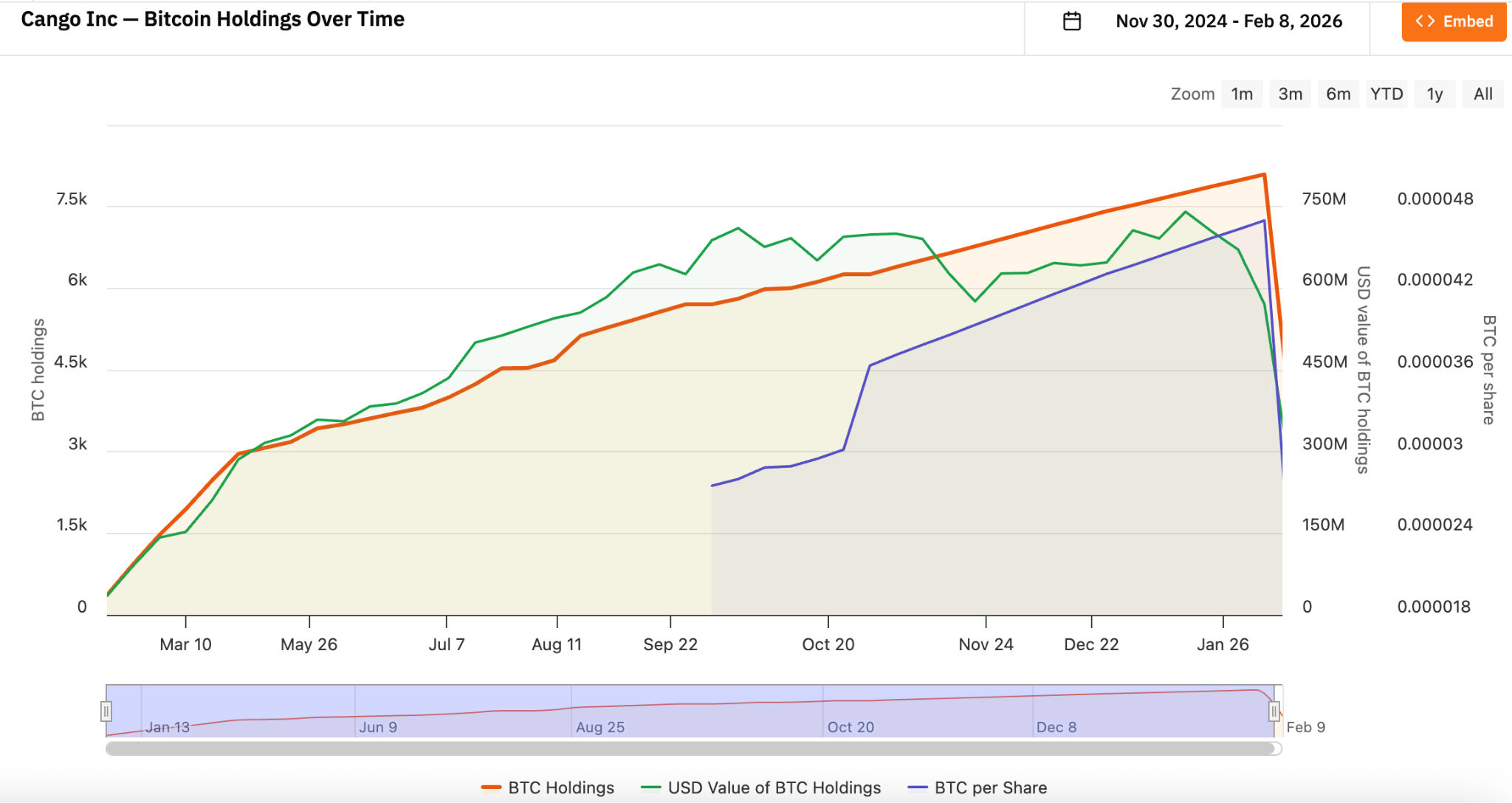
On February 9th, Cango disclosed that it had sold 4,451 bitcoins on the open market, with net proceeds of approximately $305 million, and used all the funds to repay a loan collateralized by BTC. This transaction size was close to half of its previous holdings, leaving only 3,645 BTC on its books after the sale.

Cango was founded in 2010 and is headquartered in China. It was initially a well-known automotive transaction service platform. Starting from November 2024, Cango officially entered the digital asset field, transforming into a Bitcoin mining enterprise through business restructuring and strategic pivoting, and regarding BTC as the core reserve asset of the enterprise. Cango's Bitcoin strategy initially leaned towards HODL + mining accumulation, meaning not selling coins and relying on hash rate to continuously accumulate. This model can be self-reinforcing in a rising price cycle: rising coin prices increase net asset value, increased net asset value enhances financing capability, and financing capability in turn supports hash rate expansion.

Cango began continuously accumulating Bitcoin starting November 2024, and its Bitcoin holdings once ranked as the world's second-largest mining enterprise after MARA Holdings.

Related reading: 《寻找潜力加密美股:灿谷如何从车企一跃成全球第二大比特币矿企?》 (Looking for Potential Crypto Stocks: How Did Cango Leap from an Auto Company to the World's Second Largest Bitcoin Miner?)

But mining is inherently a leveraged industry. Miner purchases, mining farm construction, and power contracts all require upfront capital expenditure, and mining companies often use self-held BTC as collateral to obtain equipment from miner manufacturers with delayed payment, or borrow USD/stablecoins from institutions/platforms to expand mining farms, purchase equipment, and maintain operations. The drawback of this model is that when the BTC price大幅回调 (significantly corrects), the collateral ratio deteriorates rapidly, leverage risk is amplified, and fixed costs like electricity, maintenance, and equipment depreciation do not decrease accordingly, putting extreme pressure on cash flow.

According to Q3 2025 data released in December 2025, Cango's average all-in mining cost (including depreciation) was approximately $99,000 per coin, and the cash cost excluding depreciation was about $81,000 per coin. The Bitcoin price is now far below its shutdown price, forcing it to reduce BTC holdings to "stop the bleeding," improve the balance sheet, and reduce financial leverage.

It is worth noting that Cango has announced it will shift部分资源 (some resources) to artificial intelligence computing infrastructure, seeking business diversification to reduce reliance on a single asset price.
Empery Digital Inc.(NASDAQ: EMPD): The Reverse Pressure of Bull Market Financing Logic

Empery Digital was founded in February 2020 (originally named Frog ePowersports Inc., later renamed Volcon Inc.), headquartered in Texas, USA. It was originally a company focused on all-electric off-road powersports vehicles.

In July 2025, the company announced a Bitcoin treasury strategy. Looking back, this timing恰是 (was exactly) near the high point of this Bitcoin price cycle. The company raised approximately $450-500 million through private placements and credit financing, and陆续增持 (progressively increased holdings of) about 4,000 bitcoins between July and August 2025, with an average cost of approximately $117,000 per coin. Calculated at the current price, the paper loss is close to 57%.

On February 6th, Empery Digital announced the sale of 357.7 BTC at an average price of about $68,000 per coin, obtaining about $24 million, to fund share repurchases and repay部分债务 (part of the debt). It has repurchased over 15.4 million shares so far, at an average price of $6.71, aiming to narrow the NAV discount. Empery now holds approximately 3,724 bitcoins remaining.

The case of Empery Digital actually reflects the typical dilemma of small and medium-sized DATs. They transformed aggressively, their financing relied on the bull market, but when prices corrected, they were forced to "sell coins for buybacks + deleverage." Compared to Cango's mining background, Empery is more like a "pure financial play." Its original main business was unsustainable, so it borrowed heavily to buy BTC at bull market highs, trying to replicate Strategy's path, but the significant correction in BTC exposed its leverage risk and it lacked the space for long-term issuance and capital market operations. If prices continue to fall,持续减持 (continuous reduction) becomes almost inevitable.

Bitdeer Technologies Group(NASDAQ: BTDR): From Price Betting to Cash Flow Priority

Bitdeer was founded in December 2021 by crypto OG Jihan Wu (co-founder of Bitmain), and is one of the world's major Bitcoin mining enterprises alongside MARA and Riot.

Bitdeer provides a full-chain solution through a vertical integration model, from equipment procurement, logistics, data center design/construction, equipment management to daily operations, while expanding into cloud hash rate, hosting services, and proprietary ASIC miner R&D. This has shifted Bitdeer's business from pure mining to diversified high-performance computing, buffering the impact of Bitcoin price fluctuations to some extent.

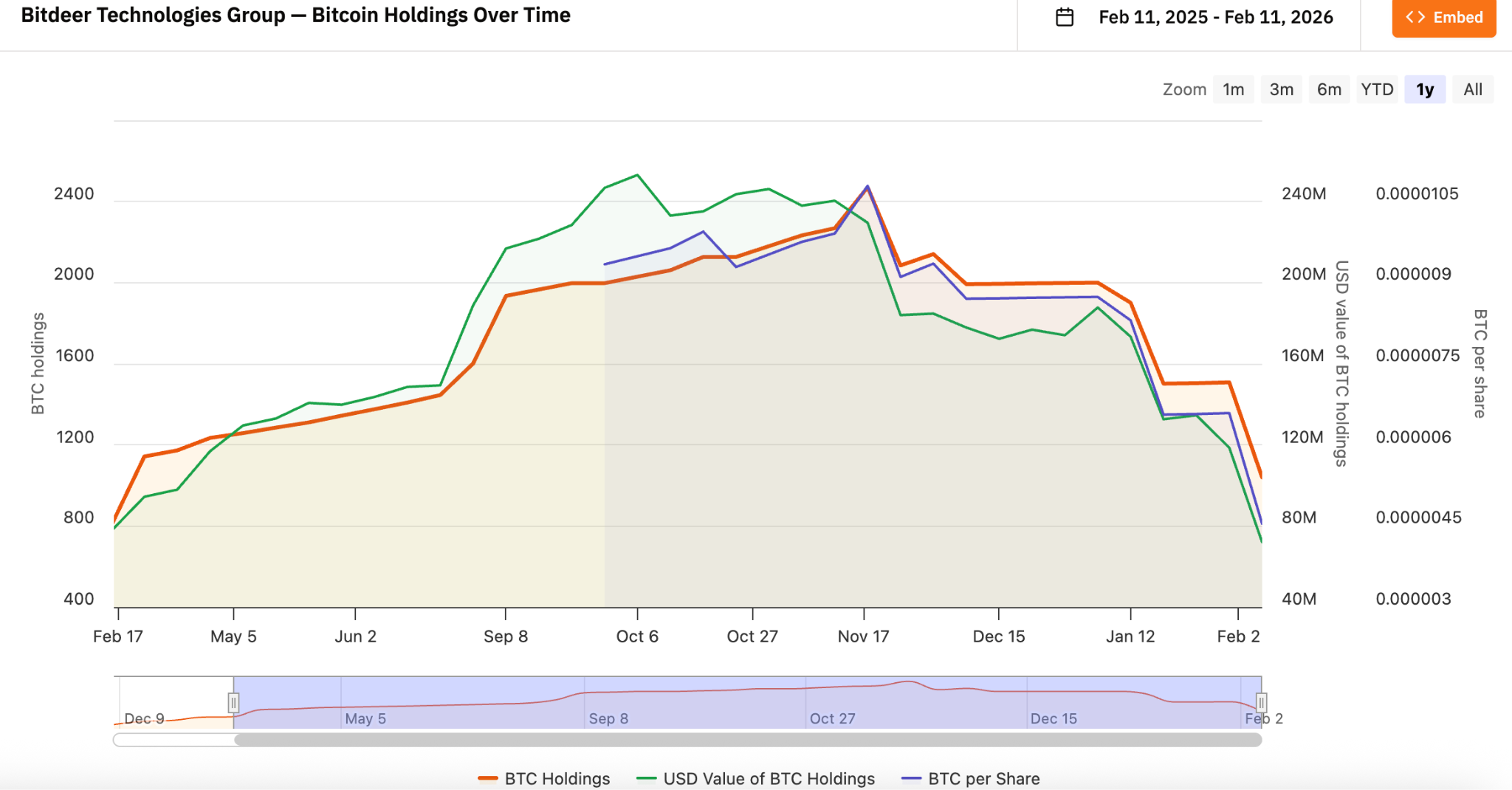
Data from bitcointreasuries.net shows that since November 2025, Bitdeer's BTC strategy has shifted to "mine and sell simultaneously", no longer holding fully (HODL), but maintaining cash flow and operational stability by partially realizing gains. Preserving cash flow takes priority over long-term holding. Is this the industry sensitivity of an OG who has experienced multiple bull and bear cycles?
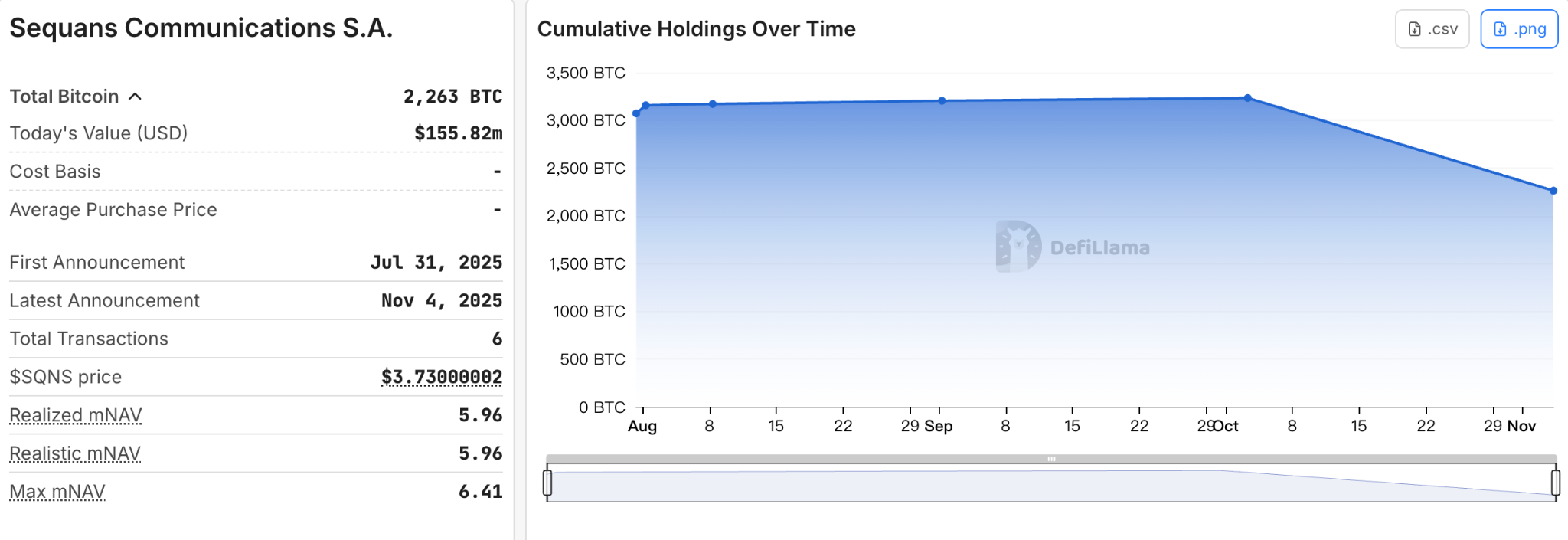
Sequans Communications S.A.(NYSE: SQNS): Selling Coins to Repay Debt Becomes an Industry Turning Point

Sequans was founded in October 2003 and was originally a semiconductor company focused on wireless cellular technology chips and modules. In June 2025, the company raised approximately $380 million through private equity and convertible bonds to accumulate Bitcoin, transforming itself from a pure IoT chipmaker into an "IoT + BTC DAT" hybrid.

Between July and October 2025, Sequans累计增持 (cumulatively increased holdings of) 3,233 bitcoins. Roughly estimated, the average cost was around $116,000.

In November 2025, it executed its first large-scale reduction of 970 BTC, used to redeem about 50% of its convertible bonds, reducing the company's total debt from $189 million to $94.5 million. The company called this a "strategic asset reallocation," not an abandonment of the strategy. But in the market's view, Sequans was the starting point of the "bubble burst" for BTC treasuries—the first DAT company to publicly admit the need to sell coins to repay debt.
ETHZilla Corporation(NASDAQ: ETHZ): A Deleveraging Sample of an ETH Treasury

ETHZilla Corporation was originally a clinical-stage biotech company focused on drug research and treatment development in areas like chronic pain, inflammation, and fibrosis. The company faced issues like cash shortages, poor liquidity, and slow R&D progress, with its stock price remaining low for a long time.

In August 2025, it raised $425-565 million through a private placement, with investors including加密机构 (crypto institutions) like Electric Capital, Polychain Capital, GSR, and Peter Thiel-related entities holding about 7.5%. These funds were directly used to purchase ETH and establish an Ethereum treasury. At its peak, ETHZilla had增持 (increased holdings to) about 102,000 ETH, worth approximately $210 million, with a per-coin entry cost of $3,841.

On November 13, 2025, ETHZilla began its first reduction of 8,293 ETH; on December 25, ETHZilla disclosed it had sold 24,291 ETH, generating proceeds of about $74.5 million. This transaction was part of redeeming outstanding senior secured convertible notes, making it the first sample of ETH treasury reduction. Currently, ETHZilla's ETH holdings are approximately 65,700 coins.
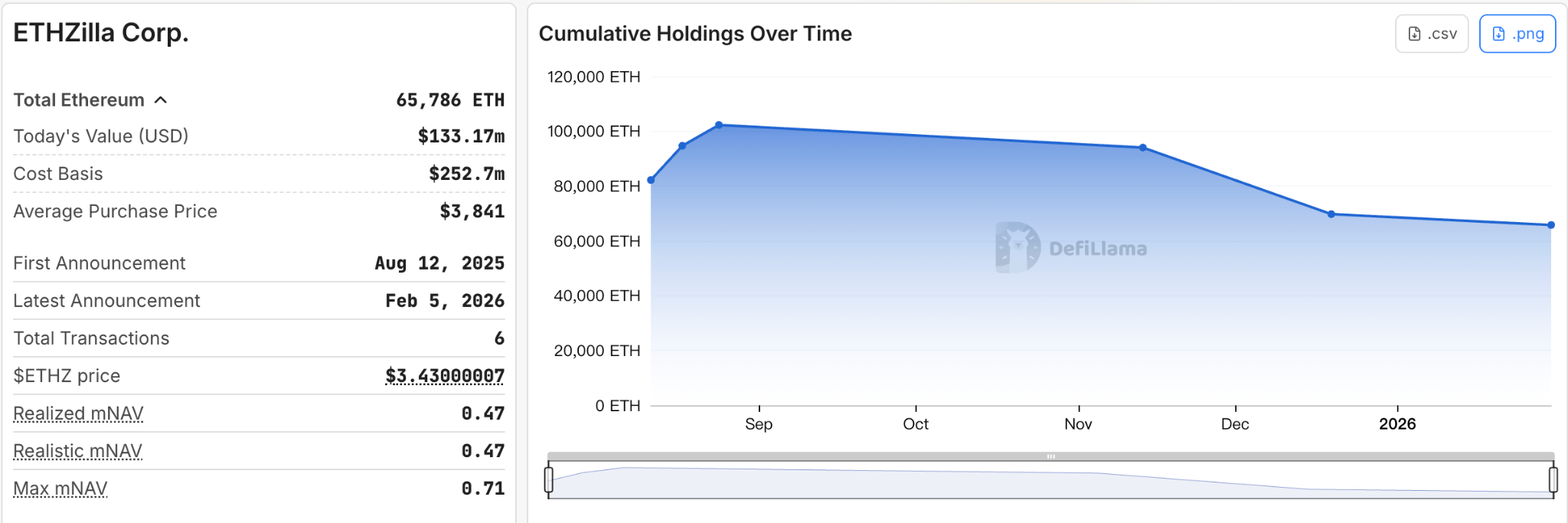
Similar to Empery, ETHZilla also embarked on the path of被迫卖币去杠杆 (forced coin selling for deleveraging). But the company is accelerating its转型 (transformation) towards RWA (Real World Asset tokenization), focusing on auto loans, home loans, land/commercial real estate, etc., with its first RWA token product expected to launch in early 2026, attempting to重塑价值 (reshape value) through business innovation.

Conclusion

The above are just a few representative samples, most of which are in the middle tier of the industry. They neither have the capital market pricing power of a company like Strategy, nor can they exit the stage悄无声息地 (silently) like the smallest companies. Beyond them, some smaller, structurally weaker DAT companies have already悄然消失 (quietly disappeared) in this round of correction;还有一些 (there are also) some companies that originally planned to transform but hadn't真正落地 (truly implemented) a treasury strategy, and have chosen to press the pause button after the financing environment suddenly tightened, even announcing termination before the project even started.

The 2026 correction acts like a mirror, reflecting the fragility and resilience of the DAT model. Those companies that relied purely on "storytelling + leverage" to rise are now paying the price for their aggressive expansion. Crypto faith may still exist, but it must ultimately coexist with the reality of cash flow, leverage management, and business sustainability.

The gap between top players and small and medium-sized companies is being持续拉大 (continuously widened) in this process. Rather than saying this is the end of the DAT model, it is more like the starting point of its stratification phase.


Domande pertinenti

QWhat is the main reason why some DAT companies are selling their Bitcoin holdings in 2026?

AThe main reason is that the price of Bitcoin has plummeted by nearly 50% from its 2025 high, causing these companies to face massive paper losses. Many, especially smaller or highly leveraged ones, are being forced to sell their crypto assets to repay debt, reduce financial leverage, and alleviate cash flow pressure.

QWhich company was the first DAT company to publicly admit to selling Bitcoin to repay debt, according to the article?

ASequans Communications S.A. (NYSE: SQNS) was the first DAT company to publicly acknowledge selling Bitcoin (970 BTC) to redeem a portion of its convertible bonds, marking a turning point for the industry.

QHow did Cango Inc. use the proceeds from its sale of 4,451 Bitcoin?

ACango Inc. used the approximately $305 million in net proceeds from the sale entirely to repay a loan that was collateralized by Bitcoin.

QWhat new business direction is ETHZilla Corporation pursuing after selling part of its ETH holdings?

AFollowing the sale of some of its ETH holdings, ETHZilla Corporation is accelerating its transition into the RWA (Real World Asset tokenization) sector, focusing on areas like auto loans, home loans, and land/commercial real estate.

QHow has Bitdeer Technologies Group's Bitcoin strategy changed in response to market conditions?

ABitdeer Technologies Group has shifted its strategy from a pure 'HODL' approach to 'mine and sell,' opting to partially liquidate its mined Bitcoin to prioritize maintaining cash flow and operational stability over long-term holding.

Letture associate

Trading

Spot
Futures

Articoli Popolari

Cosa è BITCOIN

Comprendere HarryPotterObamaSonic10Inu (ERC-20) e la sua posizione nel mondo delle criptovalute Negli ultimi anni, il mercato delle criptovalute ha assistito a un aumento della popolarità delle meme coin, catturando l'interesse non solo dei trader, ma anche di coloro che cercano coinvolgimento comunitario e valore di intrattenimento. Tra questi token unici c'è HarryPotterObamaSonic10Inu (ERC-20), un progetto intrigante che mescola riferimenti culturali nel tessuto delle criptovalute. Questo articolo esplora gli aspetti chiave di HarryPotterObamaSonic10Inu, analizzando i suoi meccanismi, l'etica guidata dalla comunità e il suo coinvolgimento con il panorama crittografico più ampio. Che cos'è HarryPotterObamaSonic10Inu (ERC-20)? Come suggerisce il suo nome, HarryPotterObamaSonic10Inu è una meme coin costruita sulla blockchain di Ethereum, classificata secondo lo standard ERC-20. A differenza delle criptovalute tradizionali che possono enfatizzare l'utilità pratica o il potenziale investimento, questo token prospera grazie al valore di intrattenimento e alla forza della sua comunità. Il progetto mira a creare un ambiente in cui gli utenti coinvolti possono riunirsi, condividere idee e partecipare ad attività ispirate a diversi fenomeni culturali. Una caratteristica notevole di HarryPotterObamaSonic10Inu è la zero tassa sulle transazioni. Questo elemento allettante tende a incoraggiare il trading e il coinvolgimento della comunità, privo di costi aggiuntivi che possono scoraggiare i trader di piccole dimensioni. L'offerta totale della moneta è fissata a un miliardo di token, un numero che segna la sua intenzione di mantenere una circolazione sostanziale all'interno della comunità. Creatore di HarryPotterObamaSonic10Inu (ERC-20) Le origini di HarryPotterObamaSonic10Inu sono avvolte in un certo mistero; i dettagli sul creatore rimangono sconosciuti. Lo sviluppo di questo token non presenta un team identificabile o un piano esplicito, cosa non rara nel settore delle meme coin. Invece, il progetto è emerso organicamente, con il suo progresso fortemente dipendente dall'entusiasmo e dalla partecipazione della sua comunità. Investitori di HarryPotterObamaSonic10Inu (ERC-20) Per quanto riguarda investimenti esterni e finanziamenti, HarryPotterObamaSonic10Inu rimane ambiguo. Il token non elenca alcuna fondazione di investimento conosciuta o un sostegno organizzativo significativo. Invece, la linfa vitale del progetto è la sua comunità di base, che informa la sua crescita e sostenibilità attraverso azioni collettive e coinvolgimento nello spazio crittografico. Come funziona HarryPotterObamaSonic10Inu (ERC-20)? In quanto meme coin, HarryPotterObamaSonic10Inu opera principalmente al di fuori delle strutture tradizionali che governano spesso il valore degli asset. Ci sono diversi aspetti distintivi che definiscono il funzionamento del progetto: Transazioni senza tasse: Senza costi fiscali sulle transazioni, gli utenti possono comprare e vendere liberamente il token senza preoccuparsi di costi nascosti. Coinvolgimento della comunità: Il progetto prospera sull'interazione della comunità, sfruttando le piattaforme social per creare entusiasmo e facilitare il coinvolgimento. Discussioni, condivisione di contenuti e coinvolgimento sono elementi cruciali che aiutano ad espandere la sua portata e a favorire la lealtà tra i sostenitori. Nessuna utilità pratica: Va notato che HarryPotterObamaSonic10Inu non offre un'utilità concreta all'interno dell'ecosistema finanziario. Piuttosto, è classificato come un token principalmente per attività di intrattenimento e comunitarie. Riferimento culturale: Il token incorpora astutamente elementi della cultura pop per attirare interesse, collegandosi a appassionati di meme e seguaci delle criptovalute. HarryPotterObamaSonic10Inu esemplifica come le meme coin operino in modo diverso rispetto ai progetti di criptovalute più tradizionali, entrando nel mercato come costrutti sociali innovativi piuttosto che come asset utilitari. Cronologia di HarryPotterObamaSonic10Inu (ERC-20) La storia di HarryPotterObamaSonic10Inu è segnata da diversi traguardi notevoli: Creazione: Il token è emerso da un meme virale, catturando l'immaginazione di molti appassionati di criptovalute. Le date di creazione specifiche non sono disponibili, sottolineando la sua crescita organica. Inserimento negli scambi: HarryPotterObamaSonic10Inu ha fatto il suo ingresso in vari scambi, consentendo un accesso e un trading più facili da parte della comunità. Iniziative di coinvolgimento della comunità: Attività in corso volte a migliorare l'interazione della comunità, comprese gare, campagne sui social media e generazione di contenuti da parte di fan e sostenitori. Piani di espansione futura: La tabella di marcia del progetto include il lancio di una collezione NFT, merchandising e un sito di eCommerce relativo ai suoi temi culturali, coinvolgendo ulteriormente la comunità e cercando di aggiungere più dimensioni al suo ecosistema. Punti chiave su HarryPotterObamaSonic10Inu (ERC-20) Natura guidata dalla comunità: Il progetto dà priorità al contributo collettivo e alla creatività, garantendo che il coinvolgimento degli utenti sia al centro del suo sviluppo. Classificazione come meme coin: Rappresenta l'epitome delle criptovalute basate sull'intrattenimento, distinguendosi dai veicoli d'investimento tradizionali. Nessuna affiliazione diretta con Bitcoin: Nonostante la somiglianza nel nome del ticker, HarryPotterObamaSonic10Inu è distintivo e non ha alcuna relazione con Bitcoin o altre criptovalute consolidate. Focus sulla collaborazione: HarryPotterObamaSonic10Inu è progettato per creare uno spazio per la collaborazione e la condivisione di storie tra i suoi detentori, fornendo un canale per la creatività e il legame comunitario. Prospettive future: L'ambizione di espandersi oltre il suo presupposto iniziale verso NFT e merchandising delinea un percorso per il progetto per potenzialmente entrare in strade più mainstream all'interno della cultura digitale. Poiché le meme coin continuano a catturare l'immaginazione della comunità crittografica, HarryPotterObamaSonic10Inu (ERC-20) si distingue per i suoi legami culturali e il suo approccio centrato sulla comunità. Anche se potrebbe non adattarsi al modello tipico di un token orientato all'utilità, la sua essenza risiede nella gioia e nella camaraderia coltivate tra i suoi sostenitori, evidenziando la natura in evoluzione delle criptovalute in un'epoca sempre più digitale. Con la continuazione dello sviluppo del progetto, sarà importante osservare come le dinamiche della comunità influenzano la sua traiettoria nel panorama in continuo cambiamento della tecnologia blockchain.

1.2k Totale visualizzazioniPubblicato il 2024.04.01Aggiornato il 2024.12.03

Cosa è BITCOIN

Come comprare BTC

Benvenuto in HTX.com! Abbiamo reso l'acquisto di Bitcoin (BTC) semplice e conveniente. Segui la nostra guida passo passo per intraprendere il tuo viaggio nel mondo delle criptovalute.Step 1: Crea il tuo Account HTXUsa la tua email o numero di telefono per registrarti il tuo account gratuito su HTX. Vivi un'esperienza facile e sblocca tutte le funzionalità,Crea il mio accountStep 2: Vai in Acquista crypto e seleziona il tuo metodo di pagamentoCarta di credito/debito: utilizza la tua Visa o Mastercard per acquistare immediatamente BitcoinBTC.Bilancio: Usa i fondi dal bilancio del tuo account HTX per fare trading senza problemi.Terze parti: abbiamo aggiunto metodi di pagamento molto utilizzati come Google Pay e Apple Pay per maggiore comodità.P2P: Fai trading direttamente con altri utenti HTX.Over-the-Counter (OTC): Offriamo servizi su misura e tassi di cambio competitivi per i trader.Step 3: Conserva Bitcoin (BTC)Dopo aver acquistato Bitcoin (BTC), conserva nel tuo account HTX. In alternativa, puoi inviare tramite trasferimento blockchain o scambiare per altre criptovalute.Step 4: Scambia Bitcoin (BTC)Scambia facilmente Bitcoin (BTC) nel mercato spot di HTX. Accedi al tuo account, seleziona la tua coppia di trading, esegui le tue operazioni e monitora in tempo reale. Offriamo un'esperienza user-friendly sia per chi ha appena iniziato che per i trader più esperti.

3.6k Totale visualizzazioniPubblicato il 2024.12.12Aggiornato il 2025.03.21

Come comprare BTC

Cosa è $BITCOIN

ORO DIGITALE ($BITCOIN): Un'Analisi Completa Introduzione all'ORO DIGITALE ($BITCOIN) L'ORO DIGITALE ($BITCOIN) è un progetto basato su blockchain che opera sulla rete Solana, con l'obiettivo di combinare le caratteristiche dei metalli preziosi tradizionali con l'innovazione delle tecnologie decentralizzate. Sebbene condivida un nome con Bitcoin, spesso definito “oro digitale” a causa della sua percezione come riserva di valore, l'ORO DIGITALE è un token separato progettato per creare un ecosistema unico all'interno del panorama Web3. Il suo obiettivo è posizionarsi come un asset digitale alternativo valido, anche se i dettagli riguardanti le sue applicazioni e funzionalità sono ancora in fase di sviluppo. Cos'è l'ORO DIGITALE ($BITCOIN)? L'ORO DIGITALE ($BITCOIN) è un token di criptovaluta esplicitamente progettato per l'uso sulla blockchain di Solana. A differenza di Bitcoin, che fornisce un ruolo di stoccaggio di valore ampiamente riconosciuto, questo token sembra concentrarsi su applicazioni e caratteristiche più ampie. Aspetti notevoli includono: Infrastruttura Blockchain: Il token è costruito sulla blockchain di Solana, nota per la sua capacità di gestire transazioni ad alta velocità e a basso costo. Dinamiche di Offerta: L'ORO DIGITALE ha un'offerta massima fissata a 100 quadrilioni di token (100P $BITCOIN), sebbene i dettagli riguardanti la sua offerta circolante siano attualmente non divulgati. Utilità: Sebbene le funzionalità precise non siano esplicitamente delineate, ci sono indicazioni che il token potrebbe essere utilizzato per varie applicazioni, potenzialmente coinvolgendo applicazioni decentralizzate (dApp) o strategie di tokenizzazione degli asset. Chi è il Creatore dell'ORO DIGITALE ($BITCOIN)? Attualmente, l'identità dei creatori e del team di sviluppo dietro l'ORO DIGITALE ($BITCOIN) rimane sconosciuta. Questa situazione è tipica tra molti progetti innovativi nel settore blockchain, in particolare quelli allineati con la finanza decentralizzata e i fenomeni delle meme coin. Sebbene tale anonimato possa favorire una cultura guidata dalla comunità, intensifica le preoccupazioni riguardo alla governance e alla responsabilità. Chi sono gli Investitori dell'ORO DIGITALE ($BITCOIN)? Le informazioni disponibili indicano che l'ORO DIGITALE ($BITCOIN) non ha alcun sostenitore istituzionale noto o investimenti di venture capital prominenti. Il progetto sembra operare su un modello peer-to-peer incentrato sul supporto e sull'adozione della comunità piuttosto che su percorsi di finanziamento tradizionali. La sua attività e liquidità si trovano principalmente su exchange decentralizzati (DEX), come PumpSwap, piuttosto che su piattaforme di trading centralizzate consolidate, evidenziando ulteriormente il suo approccio di base. Come Funziona l'ORO DIGITALE ($BITCOIN) Le meccaniche operative dell'ORO DIGITALE ($BITCOIN) possono essere elaborate in base al suo design blockchain e alle caratteristiche della rete: Meccanismo di Consenso: Sfruttando il proof-of-history (PoH) unico di Solana combinato con un modello di proof-of-stake (PoS), il progetto garantisce una validazione efficiente delle transazioni contribuendo all'alta performance della rete. Tokenomics: Sebbene meccanismi deflazionistici specifici non siano stati dettagliati ampiamente, l'ampia offerta massima di token implica che potrebbe soddisfare microtransazioni o casi d'uso di nicchia che devono ancora essere definiti. Interoperabilità: Esiste il potenziale per l'integrazione con l'ecosistema più ampio di Solana, inclusi vari piattaforme di finanza decentralizzata (DeFi). Tuttavia, i dettagli riguardanti integrazioni specifiche rimangono non specificati. Cronologia degli Eventi Chiave Ecco una cronologia che evidenzia traguardi significativi riguardanti l'ORO DIGITALE ($BITCOIN): 2023: Il dispiegamento iniziale del token avviene sulla blockchain di Solana, contrassegnato dal suo indirizzo di contratto. 2024: L'ORO DIGITALE guadagna visibilità poiché diventa disponibile per il trading su exchange decentralizzati come PumpSwap, consentendo agli utenti di scambiarlo contro SOL. 2025: Il progetto assiste a un'attività di trading sporadica e a un potenziale interesse per impegni guidati dalla comunità, sebbene non siano state documentate partnership significative o avanzamenti tecnici fino ad ora. Analisi Critica Punti di Forza Scalabilità: L'infrastruttura sottostante di Solana supporta alti volumi di transazioni, il che potrebbe migliorare l'utilità di $BITCOIN in vari scenari di transazione. Accessibilità: Il potenziale basso prezzo di trading per token potrebbe attrarre investitori al dettaglio, facilitando una partecipazione più ampia grazie a opportunità di proprietà frazionata. Rischi Mancanza di Trasparenza: L'assenza di sostenitori, sviluppatori o di un processo di audit pubblicamente noti potrebbe generare scetticismo riguardo alla sostenibilità e all'affidabilità del progetto. Volatilità del Mercato: L'attività di trading è fortemente dipendente dal comportamento speculativo, il che può comportare una significativa volatilità dei prezzi e incertezze per gli investitori. Conclusione L'ORO DIGITALE ($BITCOIN) emerge come un progetto intrigante ma ambiguo all'interno dell'evolvente ecosistema di Solana. Sebbene tenti di sfruttare la narrativa dell'“oro digitale”, la sua partenza dal ruolo consolidato di Bitcoin come riserva di valore sottolinea la necessità di una chiara differenziazione della sua utilità e struttura di governance. L'accettazione e l'adozione future dipenderanno probabilmente dall'affrontare l'attuale opacità e dalla definizione più esplicita delle sue strategie operative ed economiche. Nota: Questo rapporto comprende informazioni sintetizzate disponibili a ottobre 2023, e potrebbero essersi verificati sviluppi oltre il periodo di ricerca.

99 Totale visualizzazioniPubblicato il 2025.05.13Aggiornato il 2025.05.13

Cosa è $BITCOIN

Discussioni

Benvenuto nella Community HTX. Qui puoi rimanere informato sugli ultimi sviluppi della piattaforma e accedere ad approfondimenti esperti sul mercato. Le opinioni degli utenti sul prezzo di BTC BTC sono presentate come di seguito.

活动图片