BTC Falls Back to $10,000?! Bloomberg Senior Expert Gives the Most Pessimistic Prediction

比推Pubblicato 2025-12-15Pubblicato ultima volta 2025-12-15

Introduzione

Bitcoin has retreated below $90,000, extending a 30%+ decline from its October all-time high. The broader crypto market is under pressure, with most top assets in the red. Bloomberg Intelligence senior commodity strategist Mike McGlone issued a stark warning, predicting Bitcoin could fall to $10,000 by 2026. He argues that global markets are approaching an inflationary-to-deflationary inflection point, where risk assets like Bitcoin—viewed as highly speculative and dependent on liquidity—could face severe repricing. McGlone cites three factors: extreme wealth reversion to the mean, Bitcoin's high valuation relative to gold, and systemic oversupply of speculative crypto assets. While not all analysts agree, institutions like Standard Chartered have also lowered mid-term Bitcoin price targets. The market's direction is now tied to macro conditions, with key central bank decisions and economic data releases expected to shape the trajectory of risk assets in 2026.

Over the past weekend, the crypto market did not see a sentiment recovery. After several days of narrow-range fluctuations, Bitcoin came under significant pressure from Sunday evening to Monday U.S. stock market hours, falling below the $90,000 mark, with the intraday low once touching around $86,000. ETH dropped 3.4% to $2,980; BNB fell 2.1%; XRP declined 4%; SOL decreased 1.5%, retreating to around $126. Among the top ten cryptocurrencies by market cap, only TRX recorded a slight increase of less than 1%, while the rest were in a correction phase.
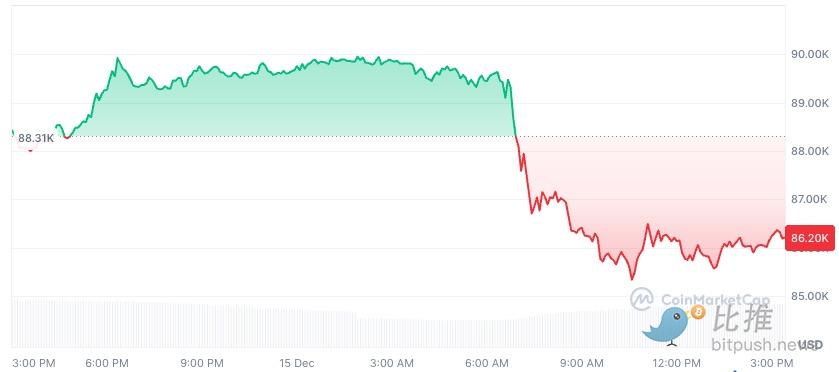
From a time perspective, this is not an isolated adjustment. Since hitting a new all-time high in mid-October, Bitcoin has accumulated a pullback of over 30%, with each rebound appearing brief and hesitant. Although ETF funds have not seen systematic outflows, marginal inflows have significantly slowed, making it difficult to provide the "sentiment foundation" for the market as before. The crypto market is transitioning from one-sided optimism to a more complex and patience-testing phase.

Against this backdrop, Mike McGlone, Senior Commodity Strategist at Bloomberg Intelligence, released a latest report, placing Bitcoin's current trend within a broader macro and cyclical framework and presenting a highly unsettling judgment: Bitcoin is very likely to fall back to $10,000 by 2026. This is not alarmist but a potential outcome under a deflationary cycle.
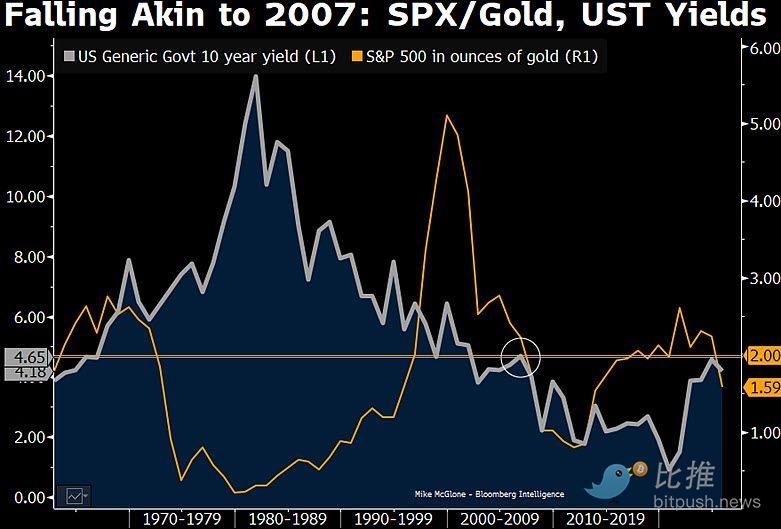
The reason this view has sparked significant controversy is not just because the number itself is "too low," but because McGlone does not treat Bitcoin as an independent crypto asset. Instead, he reexamines it within the long-term coordinate system of "global risk assets—liquidity—wealth regression."

What Comes After Inflation? McGlone Focuses Not on Crypto but on the Cycle Inflection Point

To understand McGlone's judgment, the key is not how he views the crypto industry but how he interprets the next phase of the macro environment.

In his latest views, McGlone repeatedly emphasizes a concept: Inflation/Deflation Inflection. In his view, global markets are near such a critical juncture. As inflation peaks in major economies and growth momentum slows, asset pricing logic is shifting from "fighting inflation" to "coping with deflationary pressures."
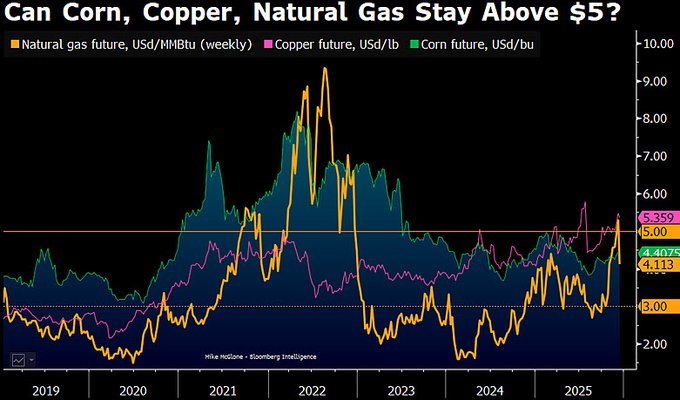
He points out that by around 2026, commodity prices may fluctuate around a key axis—the "inflation-deflation dividing line" for core commodities like natural gas, corn, and copper could settle near $5. Among these, only copper, which has real industrial demand support, might still stand above this axis by the end of 2025.

McGlone notes: When liquidity recedes, the market will重新区分 "real demand" and "financialization premium." In his framework, Bitcoin is not "digital gold" but an asset highly correlated with risk appetite and speculative cycles. When the inflation narrative recedes and macro liquidity tightens, Bitcoin tends to reflect this change earlier and more sharply.

In McGlone's view, his logic is not based on a single technical level but the叠加 of three long-term paths.

First, mean reversion after extreme wealth creation. McGlone has long emphasized that Bitcoin is one of the most extreme wealth amplifiers of the past decade-plus of loose global monetary conditions. When asset price growth long outstrips real economy and cash flow growth, the regression is not gentle but violent. Historically, whether it was the 1929 U.S. stock market or the 2000 tech bubble, the commonality of the top phase was: the market repeatedly sought a "new paradigm" at highs, and the eventual adjustment幅度, in hindsight, often far exceeded the most pessimistic expectations at the time.

Second, the relative pricing relationship between Bitcoin and gold. McGlone特别强调 the Bitcoin/Gold ratio. This ratio was about 10x at the end of 2022, then expanded rapidly driven by the bull market, reaching over 30x at one point in 2025. But this year, the ratio has fallen about 40%, dropping to around 21x. In his view, if deflationary pressures persist and gold remains firm due to safe-haven demand, it is not an激进假设 for the ratio to further return to historical ranges.
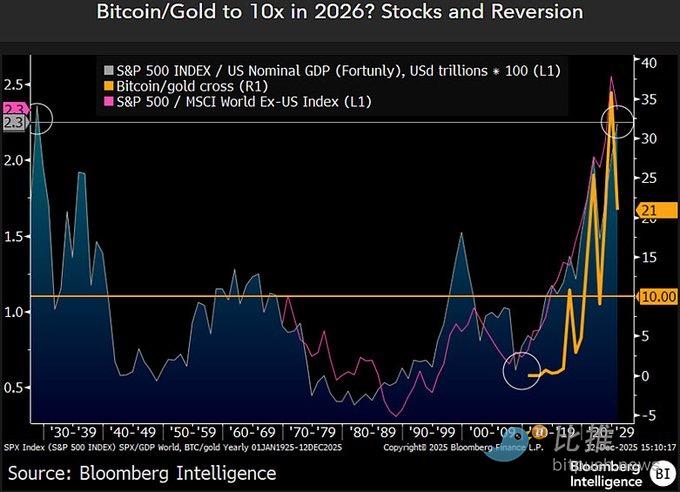
Third, systemic issues in the supply environment of speculative assets. Although Bitcoin itself has a clear total supply cap, McGlone has多次指出 that what the market is truly trading is not Bitcoin's "uniqueness" but the risk premium of the entire crypto ecosystem. When millions of tokens, projects, and narratives compete for the same risk budget, in a deflationary cycle, the entire sector tends to be uniformly discounted, and Bitcoin can hardly完全脱离 this revaluation process.

It should be noted that Mike McGlone is not a bull/bear spokesperson for the crypto market. As a senior commodity strategist at Bloomberg, he has long studied the cyclical relationships between crude oil, precious metals, agricultural products, interest rates, and risk assets. His predictions are not always precisely timed, but their value lies in: he often raises structural contrarian questions when market sentiment is most consensus-driven.

In his latest remarks, he also主动复盘 his "errors," including underestimating the timing of gold breaking through $2,000 and misjudging the节奏 of U.S. Treasury yields and U.S. stocks. But in his view, these deviations反复印证 one point: the market is most prone to illusions about trends before cycle inflection points.

Other Voices: Divergence Is Widening

Of course, McGlone's judgment is not market consensus. In fact, mainstream institutions' attitudes show clear分化.

Traditional financial institutions like Standard Chartered have recently significantly lowered their medium-to-long-term target prices for Bitcoin, reducing the 2025 expectation from $200,000 to about $100,000 and adjusting the 2026 imagination from $300,000 to around $150,000. In other words, institutions no longer assume that ETFs and corporate allocations will provide marginal buying at any price range持续.

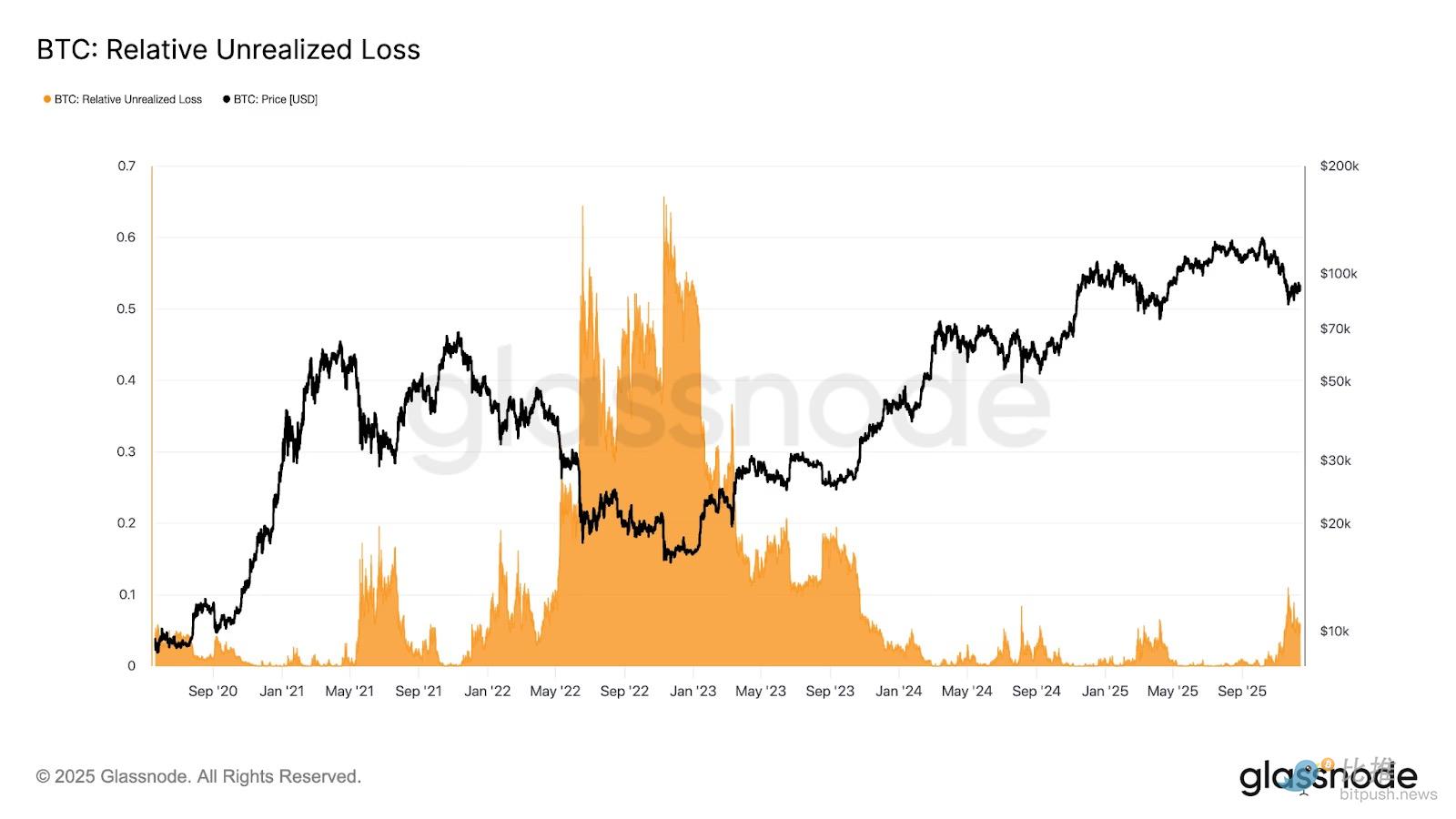
Glassnode's research points out that Bitcoin's current consolidation range between $80,000 and $90,000 has put pressure on the market, with intensity comparable to the end of January 2022. The current market's relative unrealized losses have approached 10% of market cap. Analysts further explain that such market dynamics reflect a state of "liquidity-constrained, sensitive to macro shocks" but not yet reaching the level of a typical bear market彻底抛售 (panic selling).
More quantitative and structure-focused 10x Research gives a more direct conclusion: they believe Bitcoin has entered the early stages of a bear market, with on-chain indicators, fund flows, and market structure all indicating that the downward cycle has not yet reached its end.

From a broader time dimension, the current uncertainty surrounding Bitcoin is no longer just an issue of the crypto market itself but is firmly embedded in the global macro cycle. The coming week is seen by many strategists as the most critical macro window of the year-end—the European Central Bank, Bank of England, and Bank of Japan will相继 announce interest rate decisions, while the U.S. will迎来 a series of delayed employment and inflation data, providing a belated "reality check" for the market.

The Fed's signal at the December 10 FOMC meeting was unusual: not only did it cut rates by 25 basis points, but there were also three dissenting votes, and Powell直言 that job growth in previous months might have been overestimated. This week's密集出炉 macro data will reshape the market's core expectations for 2026—whether the Fed can continue to cut rates or will have to press pause for a longer period. For risk assets, this answer may be more important than any single asset's bull-bear debate.

Author: Seed.eth


Twitter:https://twitter.com/BitpushNewsCN

Bitpush TG Discussion Group:https://t.me/BitPushCommunity

Bitpush TG Subscription: https://t.me/bitpush

Original link:https://www.bitpush.news/articles/7595927

Domande pertinenti

QWhat is the most pessimistic price prediction for Bitcoin in 2026, as mentioned in the article, and who made it?

AThe most pessimistic prediction is that Bitcoin could fall back to $10,000 in 2026, made by Mike McGlone, a senior commodity strategist at Bloomberg Intelligence.

QAccording to Mike McGlone, what major macroeconomic shift is the global market approaching that could impact Bitcoin's price?

AMcGlone believes the global market is approaching an 'Inflation / Deflation Inflection' point, where the pricing logic for assets is shifting from 'fighting inflation' to 'dealing with deflationary pressures'.

QWhat key ratio does McGlone use to analyze Bitcoin's relative pricing, and what was its peak and current value?

AMcGlone uses the Bitcoin/Gold ratio. It peaked at over 30 times in 2025 and has since fallen approximately 40% to around 21 times.

QBesides McGlone prediction, which major financial institution significantly lowered its Bitcoin price target for 2025 and 2026?

AStandard Chartered significantly lowered its Bitcoin price target, reducing its 2025 forecast from $200,000 to around $100,000 and its 2026 forecast from $300,000 to about $150,000.

QWhat did the research firm 10x Research conclude about the current state of the Bitcoin market based on on-chain metrics and market structure?

A10x Research concluded that Bitcoin has entered the early stages of a bear market, with on-chain indicators, fund flows, and market structure all indicating that the downward cycle is not yet over.

Letture associate

Borrowing Money from a Hundred Years Later, Building Incomprehensible AI

Tech giants like Alphabet, Amazon, Meta, and Microsoft are undergoing a radical financial transformation due to AI. Their traditional "light-asset, high-free-cash-flow" model is being dismantled by staggering capital expenditures on AI infrastructure—data centers, GPUs, and power. Combined 2026 guidance exceeds $700 billion, a 4.5x increase from 2022, causing free cash flow to plummet (e.g., Amazon's fell 95%). To fund this, they are borrowing unprecedented sums through long-dated, multi-currency bonds (e.g., Alphabet's 100-year bond). The world's most conservative capital—pensions, insurers—is now funding Silicon Valley's most speculative bet. This shift makes these companies resemble heavy-asset industrials (railroads, utilities) rather than software firms, threatening their premium valuations. Historically, such infrastructure booms (railroads, fiber optics) followed a pattern: genuine technology, overbuilding fueled by competitive frenzy, aggressive debt financing, and a crash triggered by financial conditions—not technology failure. The infrastructure remained, but many original builders and financiers did not survive. The core gamble is a "time arbitrage": using cheap debt today to build scale and lock in customers before AI capabilities commoditize. They are betting that AI revenue will materialize before debt comes due. Their positions vary: Amazon is under immediate cash pressure; Meta's path to monetization is unclear; Alphabet has a robust core business buffer; Microsoft has the shortest path from infrastructure to revenue. The contract is set: the most risk-averse global capital has lent its time to Silicon Valley, awaiting a future that is promised but uncertain.

marsbit27 min fa

Borrowing Money from a Hundred Years Later, Building Incomprehensible AI

marsbit27 min fa

The 'VVV' Concept Soars 9x in Half a Year, The New AI Narrative on Base Chain

"The article explores the 'VVV' concept as the new AI-focused narrative within the Base ecosystem, centered around the token $VVV of the privacy-focused, uncensored generative AI platform Venice, led by crypto veteran Erik Voorhees. Venice has seen significant growth in 2026, with its API users surging, partly attributed to exposure from OpenClaw. The platform now boasts over 2 million total users and 55,000 paid subscribers. Correspondingly, the $VVV token price has risen over 9x this year. Key to its performance are tokenomics designed for value accrual: reduced annual emissions, subscription revenue used for buyback-and-burn, and a unique staking mechanism. Staking $VVV yields $sVVV, which can be used to mint $DIEM tokens. Each staked $DIEM provides a daily $1 credit for using Venice's API services, creating tangible utility. The article also highlights other tokens associated with the 'VVV' narrative. $POD, the token of distributed AI network Dolphin (which co-developed Venice's default AI model), saw a massive price surge. $cyb3rwr3n, a project for a Venice credit auction market, gained attention due to perceived connections to Venice's team despite official denials. Finally, $SR of robotics platform STRIKEROBOT.AI rose after announcing a partnership with Venice for robot vision-language model development. Overall, the 'VVV' ecosystem combines AI platform growth, deflationary tokenomics, and innovative utility mechanisms, driving significant investor interest and price action in related tokens."

marsbit36 min fa

The 'VVV' Concept Soars 9x in Half a Year, The New AI Narrative on Base Chain

marsbit36 min fa

Anthropic and OpenAI Have Single-Handedly Severed the Logic of Pre-IPO Stock Tokenization

The pre-IPO stock token market is experiencing significant turmoil following strong statements from AI giants Anthropic and OpenAI. Both companies have updated their official policies, declaring that any transfer of their company shares—including sales, transfers, or assignments of share interests—without prior board approval is "invalid" and will not be recognized in their corporate records. This means buyers in such unauthorized transactions would not be recognized as shareholders and would have no shareholder rights. A major point of contention is the use of Special Purpose Vehicles (SPVs), which are legal entities commonly used by pre-IPO token platforms to pool investor funds and indirectly acquire shares from employees or early investors. The companies explicitly state they do not permit SPVs to acquire their shares, and any such transfer violates their restrictions. They warn that third parties selling shares through SPVs, direct sales, forward contracts, or stock tokens are likely engaged in fraud or are offering worthless investments due to these transfer limits. This stance directly threatens the core model of many pre-IPO token platforms, which rely on SPV structures. The announcement revealed additional risks within this model, such as complex "SPV-within-SPV" layering that obscures legal transparency, increases management fees, and creates a chain reaction risk of invalidation. Following the news, tokens like ANTHROPIC and OPENAI on platforms like PreStocks fell sharply (over 20%). The market reaction highlights a divergence: while asset-backed pre-IPO tokens plummeted, purely speculative pre-IPO futures contracts, which are bilateral bets on future IPO prices with no claim to actual shares, remained relatively stable as they are unaffected by the transfer restrictions. The industry is split on the implications. Some believe the fundamental logic of pre-IPO token trading is broken if leading companies reject SPV-held shares, potentially causing a domino effect. Others, like Rivet founder Nick Abouzeid, argue that buyers of such unofficial tokens always knowingly accepted the risk of non-recognition by the company. The statements serve as a stark risk warning and a corrective measure for a market where valuations for some AI-related pre-IPO tokens had soared to irrational levels, far exceeding recent funding round valuations.

marsbit1 h fa

Anthropic and OpenAI Have Single-Handedly Severed the Logic of Pre-IPO Stock Tokenization

marsbit1 h fa

Anthropic and OpenAI Personally Sever the Logic of Pre-IPO Crypto-Stocks

The pre-IPO token market has been rocked by strong statements from Anthropic and OpenAI. Both AI giants have updated official warnings, declaring that any sale or transfer of their company shares without explicit board approval is "invalid" and will not be recognized on their corporate records. This directly targets Special Purpose Vehicles (SPVs), the common legal structure used by pre-IPO token platforms. These platforms typically use an SPV to acquire shares from employees or early investors, then issue blockchain-based tokens representing a claim on the SPV's economic benefits. Anthropic and OpenAI's position means that if an SPV's share purchase lacked authorization, the underlying asset could be deemed worthless, nullifying the token's value. Anthropic explicitly warned that any third party selling its shares—via direct sales, forwards, or tokens—is likely fraudulent or offering a valueless investment. The crackdown highlights risks in the popular SPV model, including complex multi-layered "Russian doll" SPV structures that obscure legal ownership, add fees, and concentrate risk. If one layer is invalidated, the entire chain could collapse. Following the announcements, tokens like ANTHROPIC and OPENAI on platforms like PreStocks fell sharply (over 20%). In contrast, purely speculative pre-IPO prediction contracts remained stable, as they involve no actual share ownership. The move is seen as a corrective measure amid a market frenzy where some pre-IPO token valuations (e.g., Anthropic's token hitting a $1.4 trillion implied valuation) far exceeded recent official funding rounds. Opinions are split: some believe this undermines the core logic of pre-IPO token trading if top companies reject SPVs, while others argue buyers always assumed this legal risk when accessing unofficial channels. The statements serve as a stark warning and a potential catalyst for market de-leveraging and clearer boundaries.

Odaily星球日报1 h fa

Anthropic and OpenAI Personally Sever the Logic of Pre-IPO Crypto-Stocks

Odaily星球日报1 h fa

The Waged Worker Driven to Poverty by AI Subscriptions

"AI Membership: The Hidden Cost Pushing Workers Toward 'Poverty'" The widespread corporate push for AI adoption is creating a hidden financial burden for employees. Companies, from giants like Alibaba to small firms, are mandating AI use, often tying token consumption to KPIs, but frequently refuse to cover the costs. Workers are forced to pay for subscriptions out of pocket to stay competitive and avoid being replaced. Front-end developer Long Shen spends up to 2000 RMB monthly on tools like Cursor and ChatGPT Plus, seeing it as a necessary 3% salary investment to handle 90% of his coding tasks. While it boosted his performance and led to promotions, he now faces idle time at work, pretending to be busy. Designer Peng Peng navigates strict company firewalls by using personal devices and accounts for AI image generation tools like Midjourney, spending hundreds monthly without reimbursement, while her boss demands faster, more numerous revisions. The pressure creates workplace anxiety and suspicion. Programmer Li Huahua, after a friend's experience of raised KPIs following AI success, fears being branded a "traitor" for using it yet worries about falling behind if she doesn't. The dynamic allows management to demand results without understanding the tools or covering expenses, treating employees like AI "agents." While some, like entrepreneur Jin Tu, find high value in paid AI, building entire systems and winning competitions, for most, it's a trap. Free tools like Kimi and Doubao are introducing fees, closing off alternatives. The initial efficiency gains individual advantage, but as AI becomes ubiquitous, the personal edge disappears, workloads increase, and a cycle of dependency begins. Workers like Long Shen realize they cannot maintain AI-generated code without AI, making stopping harder than continuing to pay. The tool promising liberation is instead becoming a compulsory, costly chain in the modern workplace.

marsbit2 h fa

The Waged Worker Driven to Poverty by AI Subscriptions

marsbit2 h fa

Trading

Spot
Futures

Articoli Popolari

Cosa è BITCOIN

Comprendere HarryPotterObamaSonic10Inu (ERC-20) e la sua posizione nel mondo delle criptovalute Negli ultimi anni, il mercato delle criptovalute ha assistito a un aumento della popolarità delle meme coin, catturando l'interesse non solo dei trader, ma anche di coloro che cercano coinvolgimento comunitario e valore di intrattenimento. Tra questi token unici c'è HarryPotterObamaSonic10Inu (ERC-20), un progetto intrigante che mescola riferimenti culturali nel tessuto delle criptovalute. Questo articolo esplora gli aspetti chiave di HarryPotterObamaSonic10Inu, analizzando i suoi meccanismi, l'etica guidata dalla comunità e il suo coinvolgimento con il panorama crittografico più ampio. Che cos'è HarryPotterObamaSonic10Inu (ERC-20)? Come suggerisce il suo nome, HarryPotterObamaSonic10Inu è una meme coin costruita sulla blockchain di Ethereum, classificata secondo lo standard ERC-20. A differenza delle criptovalute tradizionali che possono enfatizzare l'utilità pratica o il potenziale investimento, questo token prospera grazie al valore di intrattenimento e alla forza della sua comunità. Il progetto mira a creare un ambiente in cui gli utenti coinvolti possono riunirsi, condividere idee e partecipare ad attività ispirate a diversi fenomeni culturali. Una caratteristica notevole di HarryPotterObamaSonic10Inu è la zero tassa sulle transazioni. Questo elemento allettante tende a incoraggiare il trading e il coinvolgimento della comunità, privo di costi aggiuntivi che possono scoraggiare i trader di piccole dimensioni. L'offerta totale della moneta è fissata a un miliardo di token, un numero che segna la sua intenzione di mantenere una circolazione sostanziale all'interno della comunità. Creatore di HarryPotterObamaSonic10Inu (ERC-20) Le origini di HarryPotterObamaSonic10Inu sono avvolte in un certo mistero; i dettagli sul creatore rimangono sconosciuti. Lo sviluppo di questo token non presenta un team identificabile o un piano esplicito, cosa non rara nel settore delle meme coin. Invece, il progetto è emerso organicamente, con il suo progresso fortemente dipendente dall'entusiasmo e dalla partecipazione della sua comunità. Investitori di HarryPotterObamaSonic10Inu (ERC-20) Per quanto riguarda investimenti esterni e finanziamenti, HarryPotterObamaSonic10Inu rimane ambiguo. Il token non elenca alcuna fondazione di investimento conosciuta o un sostegno organizzativo significativo. Invece, la linfa vitale del progetto è la sua comunità di base, che informa la sua crescita e sostenibilità attraverso azioni collettive e coinvolgimento nello spazio crittografico. Come funziona HarryPotterObamaSonic10Inu (ERC-20)? In quanto meme coin, HarryPotterObamaSonic10Inu opera principalmente al di fuori delle strutture tradizionali che governano spesso il valore degli asset. Ci sono diversi aspetti distintivi che definiscono il funzionamento del progetto: Transazioni senza tasse: Senza costi fiscali sulle transazioni, gli utenti possono comprare e vendere liberamente il token senza preoccuparsi di costi nascosti. Coinvolgimento della comunità: Il progetto prospera sull'interazione della comunità, sfruttando le piattaforme social per creare entusiasmo e facilitare il coinvolgimento. Discussioni, condivisione di contenuti e coinvolgimento sono elementi cruciali che aiutano ad espandere la sua portata e a favorire la lealtà tra i sostenitori. Nessuna utilità pratica: Va notato che HarryPotterObamaSonic10Inu non offre un'utilità concreta all'interno dell'ecosistema finanziario. Piuttosto, è classificato come un token principalmente per attività di intrattenimento e comunitarie. Riferimento culturale: Il token incorpora astutamente elementi della cultura pop per attirare interesse, collegandosi a appassionati di meme e seguaci delle criptovalute. HarryPotterObamaSonic10Inu esemplifica come le meme coin operino in modo diverso rispetto ai progetti di criptovalute più tradizionali, entrando nel mercato come costrutti sociali innovativi piuttosto che come asset utilitari. Cronologia di HarryPotterObamaSonic10Inu (ERC-20) La storia di HarryPotterObamaSonic10Inu è segnata da diversi traguardi notevoli: Creazione: Il token è emerso da un meme virale, catturando l'immaginazione di molti appassionati di criptovalute. Le date di creazione specifiche non sono disponibili, sottolineando la sua crescita organica. Inserimento negli scambi: HarryPotterObamaSonic10Inu ha fatto il suo ingresso in vari scambi, consentendo un accesso e un trading più facili da parte della comunità. Iniziative di coinvolgimento della comunità: Attività in corso volte a migliorare l'interazione della comunità, comprese gare, campagne sui social media e generazione di contenuti da parte di fan e sostenitori. Piani di espansione futura: La tabella di marcia del progetto include il lancio di una collezione NFT, merchandising e un sito di eCommerce relativo ai suoi temi culturali, coinvolgendo ulteriormente la comunità e cercando di aggiungere più dimensioni al suo ecosistema. Punti chiave su HarryPotterObamaSonic10Inu (ERC-20) Natura guidata dalla comunità: Il progetto dà priorità al contributo collettivo e alla creatività, garantendo che il coinvolgimento degli utenti sia al centro del suo sviluppo. Classificazione come meme coin: Rappresenta l'epitome delle criptovalute basate sull'intrattenimento, distinguendosi dai veicoli d'investimento tradizionali. Nessuna affiliazione diretta con Bitcoin: Nonostante la somiglianza nel nome del ticker, HarryPotterObamaSonic10Inu è distintivo e non ha alcuna relazione con Bitcoin o altre criptovalute consolidate. Focus sulla collaborazione: HarryPotterObamaSonic10Inu è progettato per creare uno spazio per la collaborazione e la condivisione di storie tra i suoi detentori, fornendo un canale per la creatività e il legame comunitario. Prospettive future: L'ambizione di espandersi oltre il suo presupposto iniziale verso NFT e merchandising delinea un percorso per il progetto per potenzialmente entrare in strade più mainstream all'interno della cultura digitale. Poiché le meme coin continuano a catturare l'immaginazione della comunità crittografica, HarryPotterObamaSonic10Inu (ERC-20) si distingue per i suoi legami culturali e il suo approccio centrato sulla comunità. Anche se potrebbe non adattarsi al modello tipico di un token orientato all'utilità, la sua essenza risiede nella gioia e nella camaraderia coltivate tra i suoi sostenitori, evidenziando la natura in evoluzione delle criptovalute in un'epoca sempre più digitale. Con la continuazione dello sviluppo del progetto, sarà importante osservare come le dinamiche della comunità influenzano la sua traiettoria nel panorama in continuo cambiamento della tecnologia blockchain.

1.5k Totale visualizzazioniPubblicato il 2024.04.01Aggiornato il 2024.12.03

Cosa è BITCOIN

Come comprare BTC

Benvenuto in HTX.com! Abbiamo reso l'acquisto di Bitcoin (BTC) semplice e conveniente. Segui la nostra guida passo passo per intraprendere il tuo viaggio nel mondo delle criptovalute.Step 1: Crea il tuo Account HTXUsa la tua email o numero di telefono per registrarti il tuo account gratuito su HTX. Vivi un'esperienza facile e sblocca tutte le funzionalità,Crea il mio accountStep 2: Vai in Acquista crypto e seleziona il tuo metodo di pagamentoCarta di credito/debito: utilizza la tua Visa o Mastercard per acquistare immediatamente BitcoinBTC.Bilancio: Usa i fondi dal bilancio del tuo account HTX per fare trading senza problemi.Terze parti: abbiamo aggiunto metodi di pagamento molto utilizzati come Google Pay e Apple Pay per maggiore comodità.P2P: Fai trading direttamente con altri utenti HTX.Over-the-Counter (OTC): Offriamo servizi su misura e tassi di cambio competitivi per i trader.Step 3: Conserva Bitcoin (BTC)Dopo aver acquistato Bitcoin (BTC), conserva nel tuo account HTX. In alternativa, puoi inviare tramite trasferimento blockchain o scambiare per altre criptovalute.Step 4: Scambia Bitcoin (BTC)Scambia facilmente Bitcoin (BTC) nel mercato spot di HTX. Accedi al tuo account, seleziona la tua coppia di trading, esegui le tue operazioni e monitora in tempo reale. Offriamo un'esperienza user-friendly sia per chi ha appena iniziato che per i trader più esperti.

3.8k Totale visualizzazioniPubblicato il 2024.12.12Aggiornato il 2025.03.21

Come comprare BTC

Cosa è $BITCOIN

ORO DIGITALE ($BITCOIN): Un'Analisi Completa Introduzione all'ORO DIGITALE ($BITCOIN) L'ORO DIGITALE ($BITCOIN) è un progetto basato su blockchain che opera sulla rete Solana, con l'obiettivo di combinare le caratteristiche dei metalli preziosi tradizionali con l'innovazione delle tecnologie decentralizzate. Sebbene condivida un nome con Bitcoin, spesso definito “oro digitale” a causa della sua percezione come riserva di valore, l'ORO DIGITALE è un token separato progettato per creare un ecosistema unico all'interno del panorama Web3. Il suo obiettivo è posizionarsi come un asset digitale alternativo valido, anche se i dettagli riguardanti le sue applicazioni e funzionalità sono ancora in fase di sviluppo. Cos'è l'ORO DIGITALE ($BITCOIN)? L'ORO DIGITALE ($BITCOIN) è un token di criptovaluta esplicitamente progettato per l'uso sulla blockchain di Solana. A differenza di Bitcoin, che fornisce un ruolo di stoccaggio di valore ampiamente riconosciuto, questo token sembra concentrarsi su applicazioni e caratteristiche più ampie. Aspetti notevoli includono: Infrastruttura Blockchain: Il token è costruito sulla blockchain di Solana, nota per la sua capacità di gestire transazioni ad alta velocità e a basso costo. Dinamiche di Offerta: L'ORO DIGITALE ha un'offerta massima fissata a 100 quadrilioni di token (100P $BITCOIN), sebbene i dettagli riguardanti la sua offerta circolante siano attualmente non divulgati. Utilità: Sebbene le funzionalità precise non siano esplicitamente delineate, ci sono indicazioni che il token potrebbe essere utilizzato per varie applicazioni, potenzialmente coinvolgendo applicazioni decentralizzate (dApp) o strategie di tokenizzazione degli asset. Chi è il Creatore dell'ORO DIGITALE ($BITCOIN)? Attualmente, l'identità dei creatori e del team di sviluppo dietro l'ORO DIGITALE ($BITCOIN) rimane sconosciuta. Questa situazione è tipica tra molti progetti innovativi nel settore blockchain, in particolare quelli allineati con la finanza decentralizzata e i fenomeni delle meme coin. Sebbene tale anonimato possa favorire una cultura guidata dalla comunità, intensifica le preoccupazioni riguardo alla governance e alla responsabilità. Chi sono gli Investitori dell'ORO DIGITALE ($BITCOIN)? Le informazioni disponibili indicano che l'ORO DIGITALE ($BITCOIN) non ha alcun sostenitore istituzionale noto o investimenti di venture capital prominenti. Il progetto sembra operare su un modello peer-to-peer incentrato sul supporto e sull'adozione della comunità piuttosto che su percorsi di finanziamento tradizionali. La sua attività e liquidità si trovano principalmente su exchange decentralizzati (DEX), come PumpSwap, piuttosto che su piattaforme di trading centralizzate consolidate, evidenziando ulteriormente il suo approccio di base. Come Funziona l'ORO DIGITALE ($BITCOIN) Le meccaniche operative dell'ORO DIGITALE ($BITCOIN) possono essere elaborate in base al suo design blockchain e alle caratteristiche della rete: Meccanismo di Consenso: Sfruttando il proof-of-history (PoH) unico di Solana combinato con un modello di proof-of-stake (PoS), il progetto garantisce una validazione efficiente delle transazioni contribuendo all'alta performance della rete. Tokenomics: Sebbene meccanismi deflazionistici specifici non siano stati dettagliati ampiamente, l'ampia offerta massima di token implica che potrebbe soddisfare microtransazioni o casi d'uso di nicchia che devono ancora essere definiti. Interoperabilità: Esiste il potenziale per l'integrazione con l'ecosistema più ampio di Solana, inclusi vari piattaforme di finanza decentralizzata (DeFi). Tuttavia, i dettagli riguardanti integrazioni specifiche rimangono non specificati. Cronologia degli Eventi Chiave Ecco una cronologia che evidenzia traguardi significativi riguardanti l'ORO DIGITALE ($BITCOIN): 2023: Il dispiegamento iniziale del token avviene sulla blockchain di Solana, contrassegnato dal suo indirizzo di contratto. 2024: L'ORO DIGITALE guadagna visibilità poiché diventa disponibile per il trading su exchange decentralizzati come PumpSwap, consentendo agli utenti di scambiarlo contro SOL. 2025: Il progetto assiste a un'attività di trading sporadica e a un potenziale interesse per impegni guidati dalla comunità, sebbene non siano state documentate partnership significative o avanzamenti tecnici fino ad ora. Analisi Critica Punti di Forza Scalabilità: L'infrastruttura sottostante di Solana supporta alti volumi di transazioni, il che potrebbe migliorare l'utilità di $BITCOIN in vari scenari di transazione. Accessibilità: Il potenziale basso prezzo di trading per token potrebbe attrarre investitori al dettaglio, facilitando una partecipazione più ampia grazie a opportunità di proprietà frazionata. Rischi Mancanza di Trasparenza: L'assenza di sostenitori, sviluppatori o di un processo di audit pubblicamente noti potrebbe generare scetticismo riguardo alla sostenibilità e all'affidabilità del progetto. Volatilità del Mercato: L'attività di trading è fortemente dipendente dal comportamento speculativo, il che può comportare una significativa volatilità dei prezzi e incertezze per gli investitori. Conclusione L'ORO DIGITALE ($BITCOIN) emerge come un progetto intrigante ma ambiguo all'interno dell'evolvente ecosistema di Solana. Sebbene tenti di sfruttare la narrativa dell'“oro digitale”, la sua partenza dal ruolo consolidato di Bitcoin come riserva di valore sottolinea la necessità di una chiara differenziazione della sua utilità e struttura di governance. L'accettazione e l'adozione future dipenderanno probabilmente dall'affrontare l'attuale opacità e dalla definizione più esplicita delle sue strategie operative ed economiche. Nota: Questo rapporto comprende informazioni sintetizzate disponibili a ottobre 2023, e potrebbero essersi verificati sviluppi oltre il periodo di ricerca.

99 Totale visualizzazioniPubblicato il 2025.05.13Aggiornato il 2025.05.13

Cosa è $BITCOIN

Discussioni

Benvenuto nella Community HTX. Qui puoi rimanere informato sugli ultimi sviluppi della piattaforma e accedere ad approfondimenti esperti sul mercato. Le opinioni degli utenti sul prezzo di BTC BTC sono presentate come di seguito.

活动图片