BTC Breaks Through $97,000, Crypto Market Stands at a New Structural Turning Point

Odaily星球日报Pubblicato 2026-01-15Pubblicato ultima volta 2026-01-15

Introduzione

BTC surged past $97,000, reaching a high of $97,924, while ETH and SOL also rose but remained near key resistance levels. The rally triggered significant liquidations, with shorts seeing the largest squeeze since the "1011 crash." Notably, crypto-related stocks outperformed traditional equities. A key shift occurred in BTC ETF flows, with a notable $750 million net inflow after a period of outflows, signaling renewed institutional interest. Price action was strongest during U.S. trading hours, reversing previous weak performance in that session. Macro conditions showed stable but sticky inflation, with the Fed expected to hold rates, though 2026 rate cuts are anticipated. Regulatory attention is on the CLARITY Act, which aims to define U.S. crypto regulation but faces industry division, notably after Coinbase withdrew support. On-chain, Ethereum staking demand remains strong with over 36 million ETH locked. MicroStrategy continued accumulating BTC, now holding 687,410 coins. Market structure may be changing, with the classic "four-year cycle" potentially broken. A sustained rally may require: broader ETF adoption beyond BTC/ETH, strong continued outperformance from major assets to spur altcoin interest, and a return of retail investor attention currently focused on other high-growth sectors like AI.

Original | Odaily Planet Daily (@OdailyChina)

Author | Ding Dang (@XiaMiPP)
Following yesterday's strong breakthrough of the key resistance level at $95,000, BTC continued its upward momentum in the early hours of today, reaching a high of $97,924, currently trading at $96,484; ETH broke through $3,400, currently trading at $3,330; SOL rose to a high of $148, currently trading at $145. Compared to BTC, ETH and SOL are still hovering around key resistance intervals, without forming a clear trend breakthrough.

In derivatives, according to Coinglass data, yesterday's total liquidation across the network reached $680 million, with short positions liquidated at $578 million and long positions at $101 million; Glassnode stated that the market rebound led to short liquidations reaching a new high since the "10/11 crash".

According to msx.com data, while the three major U.S. stock indices closed lower, crypto-related stocks generally rose, with ALTS up over 30.94% and BNC up over 11.81%. This situation is not common. What is driving such a strong rally in the crypto market?

ETF Fund Shift

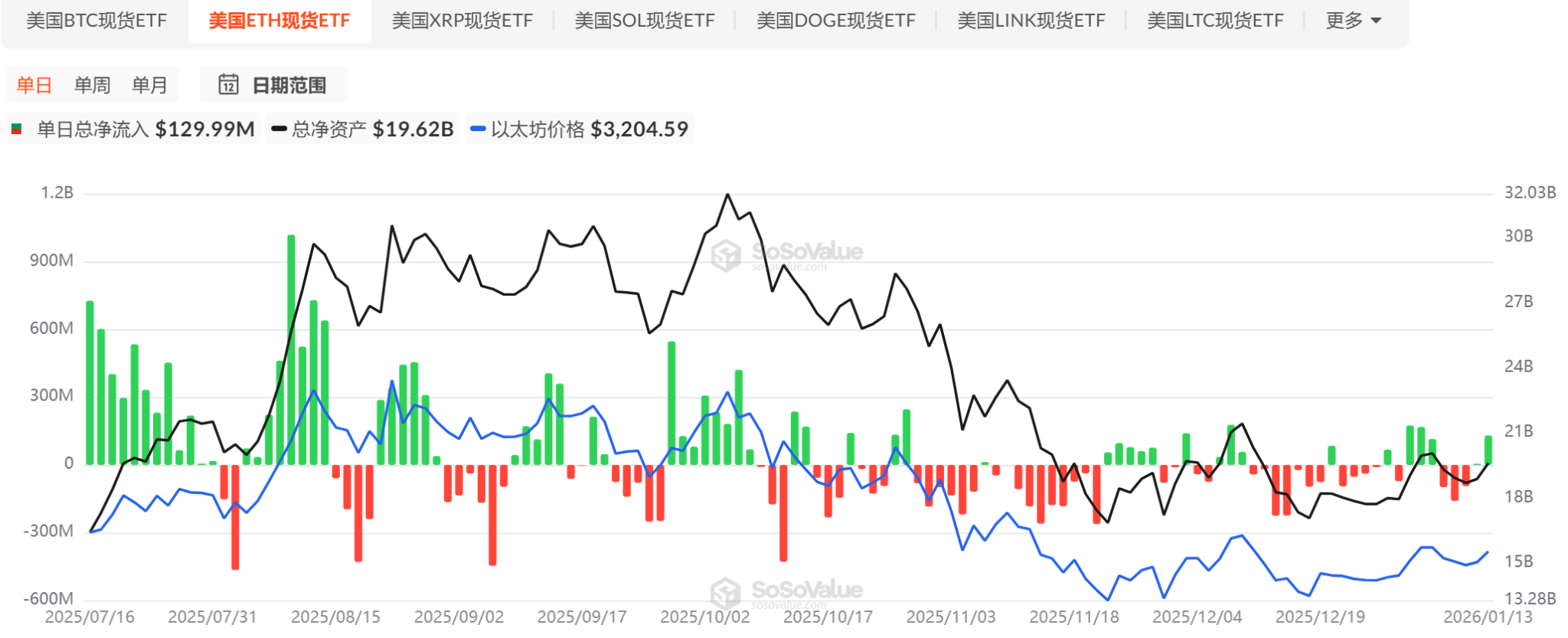
In terms of funds, since mid-October 2025, BTC spot ETFs have been in a state of overall net outflows or small-scale net inflows, indicating a lack of clear incremental fund signals. However, after four consecutive trading days of net outflows last week, BTC spot ETFs turned to two consecutive days of net inflows, with a single-day net inflow of $750 million on January 13, becoming a significant signal for the phase. In contrast, ETH spot ETFs remain weak.
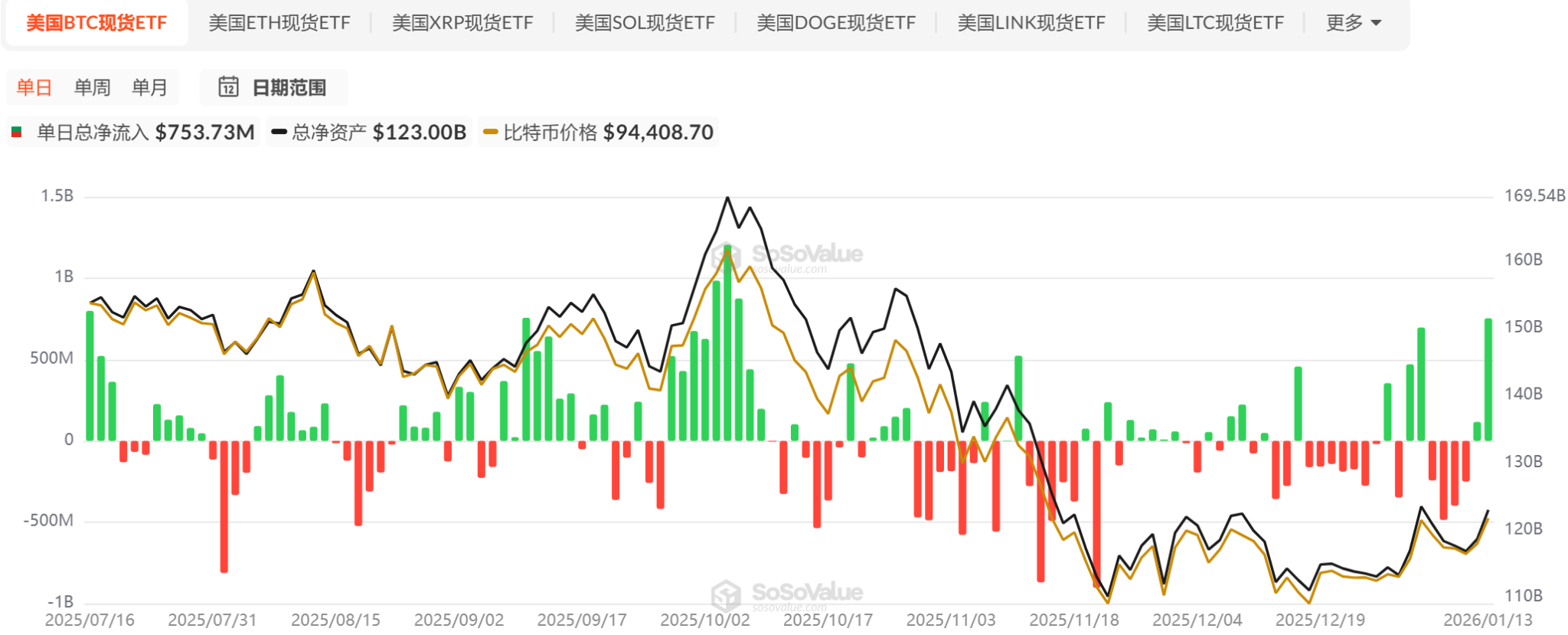
From a price action perspective, a noteworthy change is occurring. Bitcoin's cumulative return during North American trading hours is about 8%, while the European session recorded only a mild gain of about 3%, and the Asian trading session even dragged down the overall performance.

This phenomenon is in stark contrast to the end of 2025. At that time, Bitcoin accumulated a decline of up to 20% during North American hours, with prices once falling back to around $80,000. In the fourth quarter, U.S. market opening hours often came with selling pressure, and spot Bitcoin ETFs faced almost daily outflows.

Now, the strongest returns occur shortly after the U.S. stock market opens, which was precisely Bitcoin's weakest period over the past six months.

Macro Data: No Bad News, But Lacking Easing Catalysts

On the macro level, the December CPI year-on-year remained at 2.7% (unchanged from the previous reading, meeting market expectations), while the core CPI year-on-year slightly rose to 2.7% (previous 2.6%, slightly higher than some expectations), indicating that inflationary pressures still have some stickiness; however, the November PPI year-on-year unexpectedly rose to 3.0% (higher than the expected 2.7%), and retail sales month-on-month also recorded strong growth (exceeding market expectations), showing robust consumer data, which to some extent supports the view that economic growth remains resilient.

Although the December CPI data was generally mild (month-on-month 0.3% met expectations, year-on-year did not accelerate further), inflation has not clearly fallen back to the Fed's comfort zone. Combined with the labor market resilience shown in previous employment reports, the market widely believes that the probability of the Fed maintaining interest rates unchanged at the end-of-January meeting is extremely high, with almost no expectation of a rate cut. This also means that short-term policy easing catalysts are still lacking. According to CME's "FedWatch," the probability of the Fed keeping rates unchanged in January is 95%.

However, rate cut expectations for 2026 are worth anticipating, with Fed Governor Milan reiterating the need for 150 basis points of rate cuts this year.

Regulatory Legislative Progress: CLARITY Act in Focus

Beyond short-term market movements, the most noteworthy mid-to-long-term variable recently is the legislative progress of the CLARITY Act. This bill aims to establish a comprehensive regulatory framework for the U.S. crypto market, with main objectives including:

  • Clarifying the regulatory boundaries between the SEC (security-type assets) and CFTC (commodity-type digital assets);
  • Defining digital asset classifications (securities, commodities, stablecoins, etc.);
  • Introducing stricter disclosure, anti-money laundering, and investor protection requirements, while leaving room for innovation.

With the Senate Banking Committee's revision and vote scheduled for January 15, U.S. crypto legislation has officially entered the "final sprint." Committee Chairman Tim Scott (Republican) released a 278-page revised text on January 13, which followed months of bipartisan closed-door negotiations. It quickly sparked over 70 (some counts say 137) proposed amendments, with disagreements over stablecoin yields and DeFi regulation heating up rapidly. The crypto industry, banking lobby groups, and consumer protection organizations are all involved.

Moreover, the crypto industry itself is not united. On January 14, Coinbase CEO Brian Armstrong publicly withdrew support, stating that after reviewing the text, he believed the bill had "too many issues regarding DeFi bans, stifling stablecoin reward mechanisms, and excessive government surveillance, making it worse than the status quo." He emphasized that Stand With Crypto would score the Thursday revision vote to test whether senators "side with bank profits or consumer/innovation rewards." Industry insiders believe that Coinbase's public opposition is "significant" and could determine the bill's fate.

After Coinbase publicly opposed, several top institutions and associations including a16z, Circle, Kraken, Digital Chamber, Ripple, and Coin Center publicly expressed support for the Senate Republican version, believing that "any clear rules are better than the status quo," which could inject long-term certainty into the market and position the U.S. as the "global crypto hub." (Recommended reading: "CLARITY Deliberation Suddenly Postponed, Why Is the Industry So Divided?")

Other Observations: Strong Ethereum Staking Demand and Strategy Continues to Increase Holdings

Ethereum staking demand remains strong. Currently, the amount of ETH locked in the Beacon Chain has exceeded 36 million, accounting for nearly 30% of the network's circulating supply, with a staking market value exceeding $118 billion, continuously刷新历史新高. The previous highest proportion was 29.54%,出现在 July 2025. The Ethereum network currently has about 900,000 active validators, with about 2.55 million ETH still queued waiting to enter the staking queue. This means that, at least from on-chain behavior, existing stakers' short-term selling意愿 remains limited, and the network overall tends to "lock rather than release."
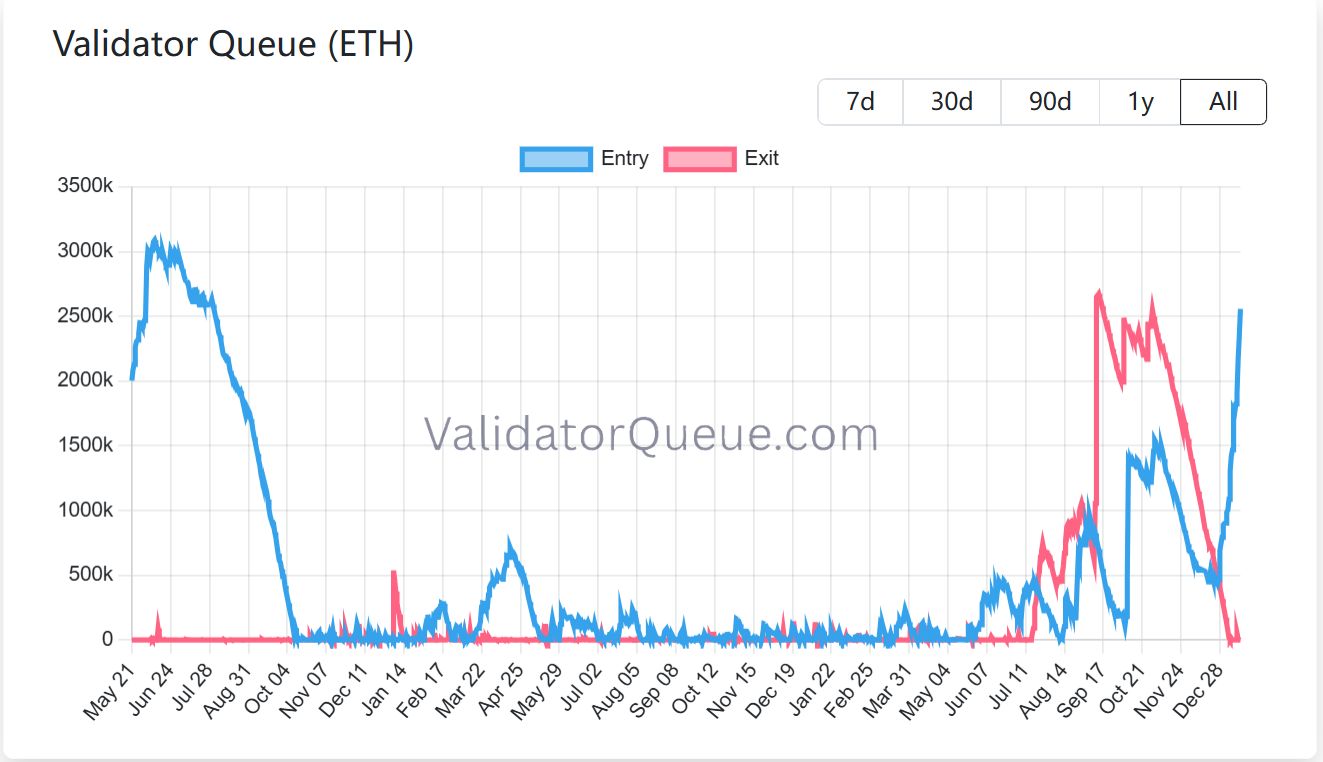
In addition, developer activity and stablecoin transaction volume on Ethereum both hit record highs. Recommended reading: "ETH Staking Data Reversal: Exits Zero VS Entries Surge 1.3 Million, When to Buy the Dip?"

Bitcoin reserve company Strategy (formerly MicroStrategy) continued its long-term accumulation strategy this week, spending approximately $1.25 billion to purchase 13,627 BTC at an average price of about $91,519. Thus, its total Bitcoin holdings have increased to 687,410, worth approximately $65.89 billion, with an overall average cost basis of about $75,353.

Investment bank TD Cowen recently lowered its one-year price target from $500 to $440, citing dilution effects from continuous issuance of common and preferred stock, leading to weaker Bitcoin yield expectations. Analysts expect Strategy to acquire about 155,000 more Bitcoin in fiscal year 2026, higher than previous forecasts, but a higher proportion of equity financing will reduce the growth rate of Bitcoin holdings per share.

TD Cowen also pointed out that although short-term yields are under pressure, related metrics are expected to improve in fiscal year 2027 as Bitcoin prices recover. The report also emphasized that Strategy chose to continue accumulating during the recent Bitcoin price pullback, with most financing proceeds directly used to purchase Bitcoin, showing that its strategic goals remain unchanged. Overall, analysts remain relatively positive about Strategy's long-term value as a "Bitcoin exposure tool" and believe that some of its preferred stock has certain attractiveness in terms of income and capital appreciation. Regarding index inclusion, MSCI has not yet removed Bitcoin reserve companies from the index system, which is seen as a short-term positive, but uncertainty remains in the medium to long term.

Arthur Hayes also stated that his core trading strategy this quarter is to go long on Strategy (MSTR) and Metaplanet (3350), using them as leveraged bets on BTC's return to an upward trend.

Market Outlook: Structural Changes and Rebound Conditions

Overall, the crypto market stands at a critical turning point. Whether the traditional "four-year cycle" still holds will likely be revealed in the coming months.

Crypto market maker Wintermute analyzed in its latest digital asset OTC market review: In 2025, Bitcoin did not exhibit the strong characteristics typical of a four-year cycle, and the altcoin cycle almost disappeared. In their view, this is not a short-term fluctuation or misalignment but a deeper structural change.

Under this premise, Wintermute believes that for a truly strong rebound to occur in 2026, the triggering conditions will be significantly higher than in previous cycles and will no longer rely on a single variable. Specifically, at least one of the following three outcomes needs to be validated.

First, the allocation scope of ETFs and crypto treasury (DAT) companies must expand beyond Bitcoin and Ethereum. Currently, U.S. spot BTC and ETH ETFs objectively concentrate a large amount of new liquidity on a few large-cap assets. While this enhances the stability of top assets, it also significantly compresses market breadth, leading to severe performance divergence. Only when more crypto assets are included in ETF products or corporate balance sheets can the market potentially regain broader participation and a liquidity foundation.

Second, core assets like BTC, ETH, as well as BNB, SOL, etc., need to experience sustained strong rallies again and recreate significant wealth effects. In 2025, the traditional transmission mechanism of "Bitcoin rising - funds spreading to altcoins" basically failed. The average uptrend周期 for altcoins was compressed to about 20 days (compared to about 60 days the previous year), with many tokens weakening under unlock selling pressure. Without sustained拉升 from top assets, funds lack the motivation to溢出 downward, making altcoin行情 difficult to activate.

Third, and most crucially, retail attention needs to truly return to the crypto market. Although retail investors have not completely left, their new funds are currently flowing more into high-growth themes like the S&P 500, AI, robotics, and quantum computing. The extreme drawdowns of 2022-2023, platform bankruptcies, liquidation memories, coupled with the reality of crypto assets underperforming traditional stocks in 2025, have significantly weakened the narrative appeal of "crypto = getting rich quick." Only when retail investors believe again that the crypto market has the potential for超额回报 and return in a scaled manner can the market potentially regain the highly emotional,近乎狂热 upward momentum of the past.

In other words, against the backdrop of structural changes, the future rebound is no longer about "if it will come," but rather "under what conditions and through which path it will be reignited."


Domande pertinenti

QWhat was the key factor that led to the recent surge in Bitcoin's price above $97,000?

AThe shift in BTC spot ETF flows from net outflows to significant net inflows, with a single-day net inflow of $750 million on January 13, provided a strong signal of renewed institutional demand and was a major driver of the price surge.

QHow did the performance of Bitcoin differ across global trading sessions according to the article?

ABitcoin's strongest returns, approximately 8%, occurred during the North American trading session, while European sessions saw a more moderate 3% gain, and Asian sessions actually dragged down the overall performance.

QWhat is the CLARITY Act and why is its legislative progress significant for the crypto market?

AThe CLARITY Act is a proposed US bill aiming to establish a comprehensive regulatory framework for crypto, clarifying the regulatory boundaries between the SEC and CFTC, defining digital asset classifications, and introducing stricter rules. Its progress is significant as it could provide long-term regulatory certainty, positioning the US as a global crypto hub, but it has also sparked intense debate and division within the industry.

QWhat are the three conditions identified by Wintermute for a true强势反弹 (strong rally) in the crypto market in 2026?

AWintermute identified three conditions: 1) ETF and corporate treasury (DAT) allocations must expand beyond just Bitcoin and Ethereum. 2) Core assets like BTC, ETH, BNB, and SOL need to show sustained strong appreciation to recreate significant wealth effect. 3) Retail investor attention must genuinely return to the crypto market, believing it offers superior returns compared to other high-growth themes.

QWhat does the data on Ethereum staking indicate about holder behavior according to the article?

AThe data indicates that Ethereum holders are exhibiting a strong preference for locking their assets rather than selling them. With over 36 million ETH staked (nearly 30% of supply) and a queue of 2.55 million ETH waiting to enter, it suggests limited short-term selling pressure from existing stakers and a network behavior leaning towards 'locking rather than releasing' value.

Letture associate

Trading

Spot
Futures

Articoli Popolari

Cosa è BITCOIN

Comprendere HarryPotterObamaSonic10Inu (ERC-20) e la sua posizione nel mondo delle criptovalute Negli ultimi anni, il mercato delle criptovalute ha assistito a un aumento della popolarità delle meme coin, catturando l'interesse non solo dei trader, ma anche di coloro che cercano coinvolgimento comunitario e valore di intrattenimento. Tra questi token unici c'è HarryPotterObamaSonic10Inu (ERC-20), un progetto intrigante che mescola riferimenti culturali nel tessuto delle criptovalute. Questo articolo esplora gli aspetti chiave di HarryPotterObamaSonic10Inu, analizzando i suoi meccanismi, l'etica guidata dalla comunità e il suo coinvolgimento con il panorama crittografico più ampio. Che cos'è HarryPotterObamaSonic10Inu (ERC-20)? Come suggerisce il suo nome, HarryPotterObamaSonic10Inu è una meme coin costruita sulla blockchain di Ethereum, classificata secondo lo standard ERC-20. A differenza delle criptovalute tradizionali che possono enfatizzare l'utilità pratica o il potenziale investimento, questo token prospera grazie al valore di intrattenimento e alla forza della sua comunità. Il progetto mira a creare un ambiente in cui gli utenti coinvolti possono riunirsi, condividere idee e partecipare ad attività ispirate a diversi fenomeni culturali. Una caratteristica notevole di HarryPotterObamaSonic10Inu è la zero tassa sulle transazioni. Questo elemento allettante tende a incoraggiare il trading e il coinvolgimento della comunità, privo di costi aggiuntivi che possono scoraggiare i trader di piccole dimensioni. L'offerta totale della moneta è fissata a un miliardo di token, un numero che segna la sua intenzione di mantenere una circolazione sostanziale all'interno della comunità. Creatore di HarryPotterObamaSonic10Inu (ERC-20) Le origini di HarryPotterObamaSonic10Inu sono avvolte in un certo mistero; i dettagli sul creatore rimangono sconosciuti. Lo sviluppo di questo token non presenta un team identificabile o un piano esplicito, cosa non rara nel settore delle meme coin. Invece, il progetto è emerso organicamente, con il suo progresso fortemente dipendente dall'entusiasmo e dalla partecipazione della sua comunità. Investitori di HarryPotterObamaSonic10Inu (ERC-20) Per quanto riguarda investimenti esterni e finanziamenti, HarryPotterObamaSonic10Inu rimane ambiguo. Il token non elenca alcuna fondazione di investimento conosciuta o un sostegno organizzativo significativo. Invece, la linfa vitale del progetto è la sua comunità di base, che informa la sua crescita e sostenibilità attraverso azioni collettive e coinvolgimento nello spazio crittografico. Come funziona HarryPotterObamaSonic10Inu (ERC-20)? In quanto meme coin, HarryPotterObamaSonic10Inu opera principalmente al di fuori delle strutture tradizionali che governano spesso il valore degli asset. Ci sono diversi aspetti distintivi che definiscono il funzionamento del progetto: Transazioni senza tasse: Senza costi fiscali sulle transazioni, gli utenti possono comprare e vendere liberamente il token senza preoccuparsi di costi nascosti. Coinvolgimento della comunità: Il progetto prospera sull'interazione della comunità, sfruttando le piattaforme social per creare entusiasmo e facilitare il coinvolgimento. Discussioni, condivisione di contenuti e coinvolgimento sono elementi cruciali che aiutano ad espandere la sua portata e a favorire la lealtà tra i sostenitori. Nessuna utilità pratica: Va notato che HarryPotterObamaSonic10Inu non offre un'utilità concreta all'interno dell'ecosistema finanziario. Piuttosto, è classificato come un token principalmente per attività di intrattenimento e comunitarie. Riferimento culturale: Il token incorpora astutamente elementi della cultura pop per attirare interesse, collegandosi a appassionati di meme e seguaci delle criptovalute. HarryPotterObamaSonic10Inu esemplifica come le meme coin operino in modo diverso rispetto ai progetti di criptovalute più tradizionali, entrando nel mercato come costrutti sociali innovativi piuttosto che come asset utilitari. Cronologia di HarryPotterObamaSonic10Inu (ERC-20) La storia di HarryPotterObamaSonic10Inu è segnata da diversi traguardi notevoli: Creazione: Il token è emerso da un meme virale, catturando l'immaginazione di molti appassionati di criptovalute. Le date di creazione specifiche non sono disponibili, sottolineando la sua crescita organica. Inserimento negli scambi: HarryPotterObamaSonic10Inu ha fatto il suo ingresso in vari scambi, consentendo un accesso e un trading più facili da parte della comunità. Iniziative di coinvolgimento della comunità: Attività in corso volte a migliorare l'interazione della comunità, comprese gare, campagne sui social media e generazione di contenuti da parte di fan e sostenitori. Piani di espansione futura: La tabella di marcia del progetto include il lancio di una collezione NFT, merchandising e un sito di eCommerce relativo ai suoi temi culturali, coinvolgendo ulteriormente la comunità e cercando di aggiungere più dimensioni al suo ecosistema. Punti chiave su HarryPotterObamaSonic10Inu (ERC-20) Natura guidata dalla comunità: Il progetto dà priorità al contributo collettivo e alla creatività, garantendo che il coinvolgimento degli utenti sia al centro del suo sviluppo. Classificazione come meme coin: Rappresenta l'epitome delle criptovalute basate sull'intrattenimento, distinguendosi dai veicoli d'investimento tradizionali. Nessuna affiliazione diretta con Bitcoin: Nonostante la somiglianza nel nome del ticker, HarryPotterObamaSonic10Inu è distintivo e non ha alcuna relazione con Bitcoin o altre criptovalute consolidate. Focus sulla collaborazione: HarryPotterObamaSonic10Inu è progettato per creare uno spazio per la collaborazione e la condivisione di storie tra i suoi detentori, fornendo un canale per la creatività e il legame comunitario. Prospettive future: L'ambizione di espandersi oltre il suo presupposto iniziale verso NFT e merchandising delinea un percorso per il progetto per potenzialmente entrare in strade più mainstream all'interno della cultura digitale. Poiché le meme coin continuano a catturare l'immaginazione della comunità crittografica, HarryPotterObamaSonic10Inu (ERC-20) si distingue per i suoi legami culturali e il suo approccio centrato sulla comunità. Anche se potrebbe non adattarsi al modello tipico di un token orientato all'utilità, la sua essenza risiede nella gioia e nella camaraderia coltivate tra i suoi sostenitori, evidenziando la natura in evoluzione delle criptovalute in un'epoca sempre più digitale. Con la continuazione dello sviluppo del progetto, sarà importante osservare come le dinamiche della comunità influenzano la sua traiettoria nel panorama in continuo cambiamento della tecnologia blockchain.

1.2k Totale visualizzazioniPubblicato il 2024.04.01Aggiornato il 2024.12.03

Cosa è BITCOIN

Come comprare BTC

Benvenuto in HTX.com! Abbiamo reso l'acquisto di Bitcoin (BTC) semplice e conveniente. Segui la nostra guida passo passo per intraprendere il tuo viaggio nel mondo delle criptovalute.Step 1: Crea il tuo Account HTXUsa la tua email o numero di telefono per registrarti il tuo account gratuito su HTX. Vivi un'esperienza facile e sblocca tutte le funzionalità,Crea il mio accountStep 2: Vai in Acquista crypto e seleziona il tuo metodo di pagamentoCarta di credito/debito: utilizza la tua Visa o Mastercard per acquistare immediatamente BitcoinBTC.Bilancio: Usa i fondi dal bilancio del tuo account HTX per fare trading senza problemi.Terze parti: abbiamo aggiunto metodi di pagamento molto utilizzati come Google Pay e Apple Pay per maggiore comodità.P2P: Fai trading direttamente con altri utenti HTX.Over-the-Counter (OTC): Offriamo servizi su misura e tassi di cambio competitivi per i trader.Step 3: Conserva Bitcoin (BTC)Dopo aver acquistato Bitcoin (BTC), conserva nel tuo account HTX. In alternativa, puoi inviare tramite trasferimento blockchain o scambiare per altre criptovalute.Step 4: Scambia Bitcoin (BTC)Scambia facilmente Bitcoin (BTC) nel mercato spot di HTX. Accedi al tuo account, seleziona la tua coppia di trading, esegui le tue operazioni e monitora in tempo reale. Offriamo un'esperienza user-friendly sia per chi ha appena iniziato che per i trader più esperti.

3.6k Totale visualizzazioniPubblicato il 2024.12.12Aggiornato il 2025.03.21

Come comprare BTC

Cosa è $BITCOIN

ORO DIGITALE ($BITCOIN): Un'Analisi Completa Introduzione all'ORO DIGITALE ($BITCOIN) L'ORO DIGITALE ($BITCOIN) è un progetto basato su blockchain che opera sulla rete Solana, con l'obiettivo di combinare le caratteristiche dei metalli preziosi tradizionali con l'innovazione delle tecnologie decentralizzate. Sebbene condivida un nome con Bitcoin, spesso definito “oro digitale” a causa della sua percezione come riserva di valore, l'ORO DIGITALE è un token separato progettato per creare un ecosistema unico all'interno del panorama Web3. Il suo obiettivo è posizionarsi come un asset digitale alternativo valido, anche se i dettagli riguardanti le sue applicazioni e funzionalità sono ancora in fase di sviluppo. Cos'è l'ORO DIGITALE ($BITCOIN)? L'ORO DIGITALE ($BITCOIN) è un token di criptovaluta esplicitamente progettato per l'uso sulla blockchain di Solana. A differenza di Bitcoin, che fornisce un ruolo di stoccaggio di valore ampiamente riconosciuto, questo token sembra concentrarsi su applicazioni e caratteristiche più ampie. Aspetti notevoli includono: Infrastruttura Blockchain: Il token è costruito sulla blockchain di Solana, nota per la sua capacità di gestire transazioni ad alta velocità e a basso costo. Dinamiche di Offerta: L'ORO DIGITALE ha un'offerta massima fissata a 100 quadrilioni di token (100P $BITCOIN), sebbene i dettagli riguardanti la sua offerta circolante siano attualmente non divulgati. Utilità: Sebbene le funzionalità precise non siano esplicitamente delineate, ci sono indicazioni che il token potrebbe essere utilizzato per varie applicazioni, potenzialmente coinvolgendo applicazioni decentralizzate (dApp) o strategie di tokenizzazione degli asset. Chi è il Creatore dell'ORO DIGITALE ($BITCOIN)? Attualmente, l'identità dei creatori e del team di sviluppo dietro l'ORO DIGITALE ($BITCOIN) rimane sconosciuta. Questa situazione è tipica tra molti progetti innovativi nel settore blockchain, in particolare quelli allineati con la finanza decentralizzata e i fenomeni delle meme coin. Sebbene tale anonimato possa favorire una cultura guidata dalla comunità, intensifica le preoccupazioni riguardo alla governance e alla responsabilità. Chi sono gli Investitori dell'ORO DIGITALE ($BITCOIN)? Le informazioni disponibili indicano che l'ORO DIGITALE ($BITCOIN) non ha alcun sostenitore istituzionale noto o investimenti di venture capital prominenti. Il progetto sembra operare su un modello peer-to-peer incentrato sul supporto e sull'adozione della comunità piuttosto che su percorsi di finanziamento tradizionali. La sua attività e liquidità si trovano principalmente su exchange decentralizzati (DEX), come PumpSwap, piuttosto che su piattaforme di trading centralizzate consolidate, evidenziando ulteriormente il suo approccio di base. Come Funziona l'ORO DIGITALE ($BITCOIN) Le meccaniche operative dell'ORO DIGITALE ($BITCOIN) possono essere elaborate in base al suo design blockchain e alle caratteristiche della rete: Meccanismo di Consenso: Sfruttando il proof-of-history (PoH) unico di Solana combinato con un modello di proof-of-stake (PoS), il progetto garantisce una validazione efficiente delle transazioni contribuendo all'alta performance della rete. Tokenomics: Sebbene meccanismi deflazionistici specifici non siano stati dettagliati ampiamente, l'ampia offerta massima di token implica che potrebbe soddisfare microtransazioni o casi d'uso di nicchia che devono ancora essere definiti. Interoperabilità: Esiste il potenziale per l'integrazione con l'ecosistema più ampio di Solana, inclusi vari piattaforme di finanza decentralizzata (DeFi). Tuttavia, i dettagli riguardanti integrazioni specifiche rimangono non specificati. Cronologia degli Eventi Chiave Ecco una cronologia che evidenzia traguardi significativi riguardanti l'ORO DIGITALE ($BITCOIN): 2023: Il dispiegamento iniziale del token avviene sulla blockchain di Solana, contrassegnato dal suo indirizzo di contratto. 2024: L'ORO DIGITALE guadagna visibilità poiché diventa disponibile per il trading su exchange decentralizzati come PumpSwap, consentendo agli utenti di scambiarlo contro SOL. 2025: Il progetto assiste a un'attività di trading sporadica e a un potenziale interesse per impegni guidati dalla comunità, sebbene non siano state documentate partnership significative o avanzamenti tecnici fino ad ora. Analisi Critica Punti di Forza Scalabilità: L'infrastruttura sottostante di Solana supporta alti volumi di transazioni, il che potrebbe migliorare l'utilità di $BITCOIN in vari scenari di transazione. Accessibilità: Il potenziale basso prezzo di trading per token potrebbe attrarre investitori al dettaglio, facilitando una partecipazione più ampia grazie a opportunità di proprietà frazionata. Rischi Mancanza di Trasparenza: L'assenza di sostenitori, sviluppatori o di un processo di audit pubblicamente noti potrebbe generare scetticismo riguardo alla sostenibilità e all'affidabilità del progetto. Volatilità del Mercato: L'attività di trading è fortemente dipendente dal comportamento speculativo, il che può comportare una significativa volatilità dei prezzi e incertezze per gli investitori. Conclusione L'ORO DIGITALE ($BITCOIN) emerge come un progetto intrigante ma ambiguo all'interno dell'evolvente ecosistema di Solana. Sebbene tenti di sfruttare la narrativa dell'“oro digitale”, la sua partenza dal ruolo consolidato di Bitcoin come riserva di valore sottolinea la necessità di una chiara differenziazione della sua utilità e struttura di governance. L'accettazione e l'adozione future dipenderanno probabilmente dall'affrontare l'attuale opacità e dalla definizione più esplicita delle sue strategie operative ed economiche. Nota: Questo rapporto comprende informazioni sintetizzate disponibili a ottobre 2023, e potrebbero essersi verificati sviluppi oltre il periodo di ricerca.

99 Totale visualizzazioniPubblicato il 2025.05.13Aggiornato il 2025.05.13

Cosa è $BITCOIN

Discussioni

Benvenuto nella Community HTX. Qui puoi rimanere informato sugli ultimi sviluppi della piattaforma e accedere ad approfondimenti esperti sul mercato. Le opinioni degli utenti sul prezzo di BTC BTC sono presentate come di seguito.

活动图片













