Cryptocurrency mining in an ordinary apartment, private garage, or utility room usually gives away several noticeable signs:
- Constant humming.
- Overheating of the air.
- Power grid disruptions.
- Noise at night.
- Regular flickering of lights.
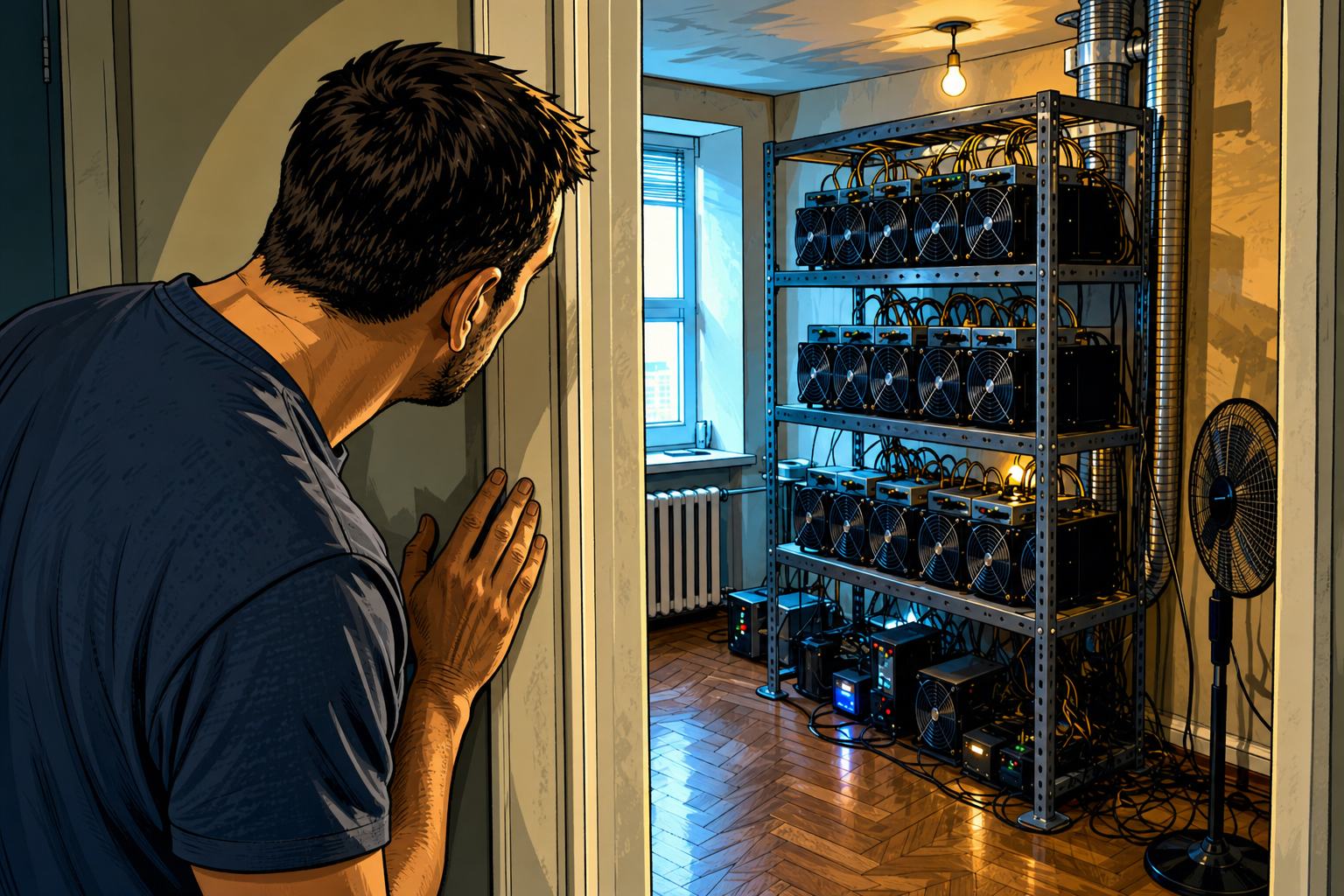
Residents of the Bryansk region were told what to pay attention to if a home crypto farm might be operating nearby. Investment advisor from the Bank of Russia registry, Rufat Abyasov, noted that such equipment is usually difficult to hide from neighbors if it runs 24/7.
Main Sign: Monotonous Hum Without Interruptions
The most obvious signal is a steady low-frequency noise. When a farm runs constantly, the sound from fans and cooling can be heard from an apartment, garage, or other premises even late at night.
Ordinary household noise usually changes: appliances turn on and off, people move around, the building quiets down. With mining equipment it's different: if the process doesn't stop, the hum remains at almost the same level for hours.
Heat, Smell of Electronics, and Power Issues
Another characteristic sign is noticeable heat emission. This can be indicated by:
- Warm air in the stairwell, hallway, or near the room where the equipment is located.
- A specific smell of overheated electronics.
Special attention should be paid to the power grid. High load from equipment for mining digital coins can manifest as:
- Circuit breakers tripping.
- Voltage spikes.
- Neighbors' lights flickering.
Older housing stock may be particularly vulnerable. In Soviet-era buildings, electrical wiring is often designed for much more modest consumption than required by modern powerful devices operating non-stop.
What is Mining in Simple Words
Cryptocurrency mining is the work of computers and special equipment that help the network verify transactions and add new records to the blockchain. For such work, a network participant can receive a cryptocurrency reward.
In short: the equipment constantly solves complex computational problems, consumes electricity, heats up, and requires cooling. This is precisely why a home farm is often betrayed by noise, heat, and load on the power grid.
What Equipment is Used for Mining
Different devices and components may be needed for mining:
- ASIC — a specialized device for mining specific cryptocurrencies.
- Graphics cards — used in farms where computations are performed by a graphics processor.
- Power supplies — ensure stable operation of equipment under high load.
- Cooling system — removes heat and helps prevent equipment from overheating.
- Mining software — connects the equipment to the network or a mining pool.
A mining pool is an association of participants who combine their computing power and share rewards according to contribution. For beginners, this option is usually more understandable than trying to mine coins alone.
They start by choosing a cryptocurrency and equipment, then install software, connect to a pool, and set up a wallet to receive payouts. An ordinary computer can also be used, but its efficiency is lower, and a smartphone is almost unsuitable for serious mining: power is low, while wear and heating quickly become a problem.
Profitability, Timelines, and Risks of Mining
The mining speed depends on equipment power, network difficulty, electricity price, pool fees, and the cryptocurrency exchange rate. Therefore, the timeframe for obtaining 1 Bitcoin is not simply calculated by the calendar: a solo farm may not receive a whole coin for a long time, while in a pool a participant more often receives small payouts proportional to their computing power.
Monthly farm income is calculated after expenses: the cost of mined coins minus electricity bills, fees, maintenance, and possible repairs. If electricity is expensive or the exchange rate drops, profits can quickly decrease.
The main risks include high load on wiring, equipment overheating, breakdowns, noise for neighbors, financial losses due to exchange rate changes, and possible claims if safety requirements or rules for using the power grid are violated. The prospects of mining depend on equipment development, energy costs, and regulations that will be applied to market participants.
Why Mining Puts Such a Strain on an Apartment
Mining is associated with the constant operation of equipment and software performing calculations for blockchain networks. Such systems use cryptography, consensus algorithms, and proof-of-work, and data verification relies on cryptographic hash functions.
For residents, the technical side is less important than the practical result: the higher the computer's computational power, the greater the strain on power supply and cooling. At different times, central processors, graphics cards, or application-specific integrated circuits could be used for mining coins. Even with good energy efficiency, such equipment emits heat and requires stable power supply.
The equipment can be used for various digital assets, including Bitcoin and Litecoin. A mobile app for a crypto wallet itself does not create such domestic signs: it is the operating farm with constant energy consumption that raises suspicion.
One should not confuse a home farm with a situation where a computer virus secretly launches mining on someone else's device. In the case of a neighbor's premises, it is usually about noticeable equipment betrayed by noise, heat, and load on the grid.
What the Law Says About Cryptocurrency
Buying, storing, selling, and exchanging cryptocurrencies remain legal in Russia. From September 1st, digital currency will be legally recognized as property.
Mining itself does not make the equipment owner a violator, but the conditions under which the farm operates are important. If the equipment overloads the power grid, creates a fire hazard, disturbs neighbors, or is used without complying with mandatory requirements, claims may arise from the management company, the energy supply company, or regulatory authorities.
From the same date, residents of the Bryansk region will be able to transfer cryptocurrency abroad. Digital assets will be allowed to be sent to one's own foreign wallets as well as to non-residents for payment for goods and services.
Such an opportunity is provided for both qualified and non-qualified investors, subject to established requirements. Transactions must be carried out in compliance with currency control and anti-money laundering legislation.
end-content