Brother Sun and CZ Jointly Endorse, New Stablecoin United Stables (U) Emerges

marsbitPubblicato 2026-01-13Pubblicato ultima volta 2026-01-13

Introduzione

New stablecoin United Stables (U) has been launched on multiple exchanges including Binance, Gate, and BitMart, with HTX listing it earlier on December 18 alongside a 20% APY earnings campaign. Positioned as a next-generation stablecoin for trading, payments, wealth management, and AI-native ecosystems, U aggregates liquidity across different chains and assets. It is currently issued on BNB Chain and Ethereum, with a total supply of 409 million tokens. The project gained significant attention due to public support from two major industry figures: CZ (Binance founder) and Justin Sun. Both followed United Stables’ official X account, and CZ referred to U as a “second-generation stablecoin” during an AMA. Sun promoted U through a livestream and offered financial incentives via HTX. United Stables is backed 1:1 by a mix of USD and major audited stablecoins like USDT, USDC, and USD1. It features real-time Proof of Reserves (PoR) and monthly audits. The token is fully integrated into the BSC ecosystem, supported by DeFi protocols such as PancakeSwap and wallets like Trust Wallet and SafePal. The coin is also linked to Athena Y, a co-founder who previously served as Executive Director of the Binance Charity Foundation.

Author|Golem(@web 3_golem)

Today, multiple cryptocurrency exchanges including Binance, Gate, and BitMart have successively announced the listing of the stablecoin United Stables (U). Previously, Huobi HTX had already taken the lead in listing U on December 18, simultaneously launching a wealth management activity with an annualized rate of up to 20%.

United Stables (U) positions itself as a next-generation stablecoin designed for trading, payments, wealth management, and an AI-native ecosystem. It aims to reintegrate liquidity scattered across different chains and assets. Currently, it has been launched on BNB Chain and Ethereum, with a cumulative issuance of 409 million tokens.

In the current competitive stablecoin market, United Stables quickly attracted community attention, primarily because it has gained the endorsement of two top influencers in the crypto circle—CZ and Sun Yuchen. After BNB Chain previewed the launch of the new stablecoin on December 16, the community noticed that CZ and Sun Yuchen successively followed the official United Stables X account, rapidly boosting its popularity.
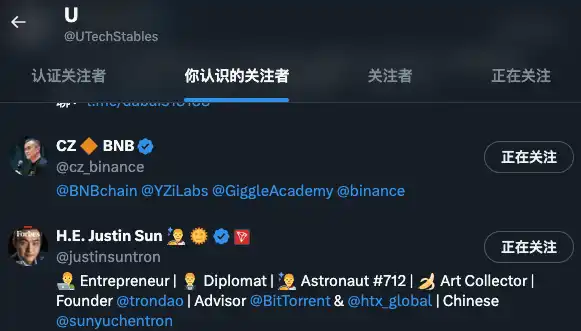
CZ and Sun Yuchen follow the United Stables (U) X account

On December 18, crypto blogger Australian Big Lion Brother posted that CZ extensively mentioned stablecoins in that day's AMA and hinted that United Stables (U) is a second-generation stablecoin. These signs have led the market to speculate that CZ may be deeply involved with the United Stables project.

Interestingly, United Stables' co-founder Athena Y also has a "Binance background." According to Athena Y's personal account introduction, she is the co-founder of the United Nations Development Programme's "Made in Africa" initiative and the co-founder of the stablecoin payment project Wello (supported by BNB Chain); the community uncovered another undisclosed identity: Athena Y previously served as the Executive Director of the Binance Charity Foundation (BCF), conducting multiple charity activities in Africa.

If CZ's support for United Stables (U) remains at the "verbal" level, Sun Yuchen is providing subsidies with real money. On the day United Stables (U) was listed, Huobi launched an Earn product with an annualized rate of 20%. On December 19, Sun Yuchen personally livestreamed with multiple KOLs to promote the stablecoin U, with the cover featuring an animated image of him and CZ holding "U."

The images of the two are exactly what they wore during government activities in Pakistan on December 11-12. That day, CZ and Sun Yuchen took photos together with regulatory authorities; CZ was appointed as a strategic advisor to the Pakistan Crypto Committee, while Huobi received a license from local regulators. Afterwards, the two were also photographed riding in a car together.

(In the picture, Sun Yuchen wears a golden vest, CZ wears a suit, tie, and white shirt)

The Stablecoin of Stablecoins

What makes United Stables (U), favored by CZ and Sun Yuchen, so unique?

United Stables (U) can be called the stablecoin of stablecoins. According to official introduction, U is fully collateralized 1:1 by the US dollar and major audited stablecoins (such as USDT, USDC, and USD1). Additionally, U features real-time on-chain Proof of Reserves (PoR) and monthly audits. This structure not only enhances liquidity and reduces collateral asset volatility but also ensures users can always redeem quickly and transparently.

The total issuance of United Stables (U) is 409 million tokens, all of which are currently in circulation. According to DeFiLama data, although United Stables (U) supports both BSC and Ethereum, its entire supply is currently issued on BSC.
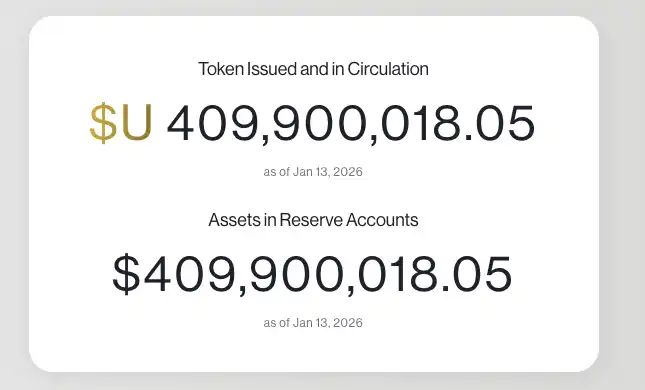
In terms of ecosystem integration, U has integrated with the vast majority of BSC ecosystem applications, including mainstream DeFi protocols such as PancakeSwap, Aster, Four.meme, and ListaDAO. Users can directly trade, stake, borrow, and provide liquidity on-chain. For wallet support, Binance Wallet, Trust Wallet, and SafePal have simultaneously listed U.

United Stables has stated that "U is born for the AI era," but no specific project developments have been disclosed yet.

Crypto di tendenza

Domande pertinenti

QWhat is the name of the new stablecoin promoted by CZ and Justin Sun?

AThe new stablecoin is called United Stables, with the ticker symbol U.

QOn which blockchain networks has United Stables (U) been launched?

AUnited Stables (U) has been launched on both BNB Chain and Ethereum.

QWhat is the claimed annual percentage yield (APY) for the earning product launched by HTX alongside U?

AHTX launched an earning product with the stablecoin U offering an annualized yield of up to 20%.

QHow is the United Stables (U) stablecoin collateralized according to its official introduction?

AUnited Stables (U) is fully collateralized 1:1 by the US dollar and major, audited stablecoins such as USDT, USDC, and USD1.

QWhat is the background of Athena Y, a co-founder of United Stables, as mentioned in the article?

AAthena Y is a 'Binance alumni' who previously served as the Executive Director of the Binance Charity Foundation (BCF) and is a co-founder of the Wello stablecoin payment project supported by BNB Chain.

Letture associate

DRAM ETF Issuer: Samsung, SK Hynix, Micron All Surpass $1 Trillion, the AI Era of Memory Chips Has Only Just Begun

Authors: Dave Mazza, Thomas DiFazio | Source: Deep Tide TechFlow The article, written by Roundhill Investments (issuer of the DRAM ETF), responds to Morningstar's caution about investing in memory chip stocks. Morningstar warns of the sector's history of boom-bust cycles, a lack of economic moats, and potential momentum-driven overvaluation. Roundhill argues the current situation is structurally different due to AI. Key points in Roundhill's rebuttal include: * **Changed Demand & Supply Dynamics:** AI infrastructure, not consumer electronics, is now the primary growth driver for memory demand. New, strict long-term supply agreements with hyperscalers reflect the high capital intensity of advanced manufacturing. * **Existence of a Moat:** High-Bandwidth Memory (HBM), essential for AI, has extremely high manufacturing barriers. The market is dominated by Samsung, SK Hynix, and Micron, with new entrants blocked by technological complexity and long lead times for equipment like ASML's EUV machines. * **Strong Fundamental Outlook:** Analyst consensus projects the three companies will rank among the world's most profitable by 2027, with combined profits of $704 billion on over $1 trillion in revenue. Their operating margins have already reached record highs. * **Valuation Re-rating:** Despite significant stock price gains, memory stocks trade at attractive valuations (e.g., a median NTM P/E of 8.37x for the DRAM ETF) relative to projected explosive EPS growth. Roundhill suggests historical valuation frameworks may no longer apply given the new profitability paradigm. Conclusion: Roundhill contends the rally is justified by fundamentals, marking a structural shift for the memory industry into a new era of sustained, AI-driven demand against constrained supply, rather than a repeat of past cycles.

marsbit13 min fa

DRAM ETF Issuer: Samsung, SK Hynix, Micron All Surpass $1 Trillion, the AI Era of Memory Chips Has Only Just Begun

marsbit13 min fa

EF's Epic Reorganization: 20% Layoffs, Budget Halved, Is Ethereum Gearing Up for a Leaner Future?

The Ethereum Foundation (EF) has announced a major organizational restructuring, involving a 20% staff reduction (approx. 54 employees) and a division into functional clusters like Protocol, Access, User, Community, and Institutional layers. Co-founder Vitalik Buterin further revealed plans to cut the EF's budget by around 40% over the coming years, aiming to reduce its annual spending rate from about 15% to roughly 5% by 2030, transitioning to an endowment-driven model. This overhaul is seen as a long-overdue correction to the EF's ambiguous role. As Ethereum grew, the foundation faced persistent criticism over ETH sales, perceived lack of execution, and unclear strategy, often becoming a focal point for community frustration amid ETH's price stagnation. The reform aims to redefine the EF's boundaries, narrowing its focus to core protocol research, public goods funding, and ecosystem coordination, while offloading more applied development work to the broader market. Concurrently, ecosystem forces like the newly formed Ethlabs (founded by ex-EF researchers) and other independent groups are stepping in to fill the space, signaling a shift from a centralized model to a more distributed, collaborative ecosystem structure. The move was notably praised by Solana co-founder toly, who viewed a "leaner" EF as potentially more decisive and agile.

Odaily星球日报54 min fa

EF's Epic Reorganization: 20% Layoffs, Budget Halved, Is Ethereum Gearing Up for a Leaner Future?

Odaily星球日报54 min fa

Dragonfly Partner Haseeb: The Fastest-Growing Companies of the Future May All Get Stuck at 149 Employees

Dragonfly partner Haseeb explores the distorted economics of AI model pricing, drawing parallels to tax policy. He notes that startups and small teams (under 150 users) enjoy heavily subsidized, fixed-price AI subscriptions (like Claude Code), where the marginal cost of an additional token is effectively zero. This creates a powerful incentive for them to maximize token usage ("token-maxxing") and innovate aggressively with AI automation. In contrast, large enterprises (over 150 users) are forced onto "Enterprise" plans, paying per-token API fees with high (~75%) markups. This acts like a steep "tax" on AI-powered labor, disincentivizing marginal automation and experimental use, and encouraging them to retain more human workers. Haseeb argues this pricing creates a "150-person cliff," a regulatory notch similar to labor laws in France that discourage firms from growing past 50 employees. He predicts the fastest-growing future companies may deliberately cap their headcount at 149 to avoid the punitive enterprise pricing. This would foster an "AI-first" management philosophy obsessed with automation and outsourcing to stay lean. While not intentionally designed, this bifurcated pricing could become one of the most influential de facto tax policies, shaping how AI replaces labor—not through mass layoffs at big firms, but through agile, AI-native startups outcompeting them.

marsbit1 h fa

Dragonfly Partner Haseeb: The Fastest-Growing Companies of the Future May All Get Stuck at 149 Employees

marsbit1 h fa

How xBubble Breaks Through in the VC-Heavily-Backed OPC Economy

xBubble: Addressing the Structural Gap in the VC-Backed OPC Economy The concept of OPC (One Person Company) is evolving from a buzzword to a significant AI-driven market. While AI coding tools like Replit and Lovable have validated demand from non-technical users wanting to build applications, a key gap remains: the leap from creating a demo to running a stable, evolving business. These tools still require users to manage the development process, including technical judgments for integrations, modifications, and deployments—a major hurdle for OPCs. xBubble, by DAPPOS, tackles this by shifting from "Prompt-to-Code" to "SOP-to-Business." Instead of generating code from instructions, its core is a system of pre-organized SOPs (Standard Operating Procedures) that translate business goals—like "sell World Cup merchandise"—into complete, executable workflows. This includes generating cohesive assets, pages, payment systems, and backend logic. The platform is augmented by a network of third-party service providers who handle infrastructure (hosting, domains, payment setup), acting like "on-site service engineers." Users can pay for these services directly with xBubble credits, simplifying onboarding. This ecosystem aims to deliver not just an app, but a complete, modifiable business launch path. xBubble targets a clear OPC segment: small commercial nodes (e.g., creators, merchants) with existing products, customers, or channels, but for whom a full tech team is unjustifiable. Its potential lies in SOPs accumulating expertise from real cases, improving reliability and reducing delivery costs over time. Additionally, its native support for crypto payments caters to global or digital-native OPCs. In summary, as AI democratizes software creation, xBubble's opportunity is to prove that "SOP-to-Business" provides more immediate value for launching a real, operational business than a powerful but unstructured AI coding tool.

链捕手1 h fa

How xBubble Breaks Through in the VC-Heavily-Backed OPC Economy

链捕手1 h fa

Trading

Spot
Futures

Articoli Popolari

Come comprare SUN

Benvenuto in HTX.com! Abbiamo reso l'acquisto di SUN (SUN) semplice e conveniente. Segui la nostra guida passo passo per intraprendere il tuo viaggio nel mondo delle criptovalute.Step 1: Crea il tuo Account HTXUsa la tua email o numero di telefono per registrarti il tuo account gratuito su HTX. Vivi un'esperienza facile e sblocca tutte le funzionalità,Crea il mio accountStep 2: Vai in Acquista crypto e seleziona il tuo metodo di pagamentoCarta di credito/debito: utilizza la tua Visa o Mastercard per acquistare immediatamente SUNSUN.Bilancio: Usa i fondi dal bilancio del tuo account HTX per fare trading senza problemi.Terze parti: abbiamo aggiunto metodi di pagamento molto utilizzati come Google Pay e Apple Pay per maggiore comodità.P2P: Fai trading direttamente con altri utenti HTX.Over-the-Counter (OTC): Offriamo servizi su misura e tassi di cambio competitivi per i trader.Step 3: Conserva SUN (SUN)Dopo aver acquistato SUN (SUN), conserva nel tuo account HTX. In alternativa, puoi inviare tramite trasferimento blockchain o scambiare per altre criptovalute.Step 4: Scambia SUN (SUN)Scambia facilmente SUN (SUN) nel mercato spot di HTX. Accedi al tuo account, seleziona la tua coppia di trading, esegui le tue operazioni e monitora in tempo reale. Offriamo un'esperienza user-friendly sia per chi ha appena iniziato che per i trader più esperti.

868 Totale visualizzazioniPubblicato il 2024.12.12Aggiornato il 2025.03.21

Come comprare SUN

Discussioni

Benvenuto nella Community HTX. Qui puoi rimanere informato sugli ultimi sviluppi della piattaforma e accedere ad approfondimenti esperti sul mercato. Le opinioni degli utenti sul prezzo di SUN SUN sono presentate come di seguito.

活动图片