Brokerage Giant Charles Schwab Rolls Out Spot Crypto Trading To Retail Investors

bitcoinistPubblicato 2026-05-14Pubblicato ultima volta 2026-05-14

Introduzione

Charles Schwab has officially launched its spot crypto trading platform, Schwab Crypto, to a select group of retail investors in the US, excluding New York and Louisiana. The service allows direct trading of Bitcoin (BTC) and Ethereum (ETH) with a 75-basis-point fee, linked to clients' brokerage accounts. Schwab Premier Bank will serve as custodian, with Paxos handling trade execution. The firm plans to add more assets and transfer capabilities. This move expands Schwab's offerings beyond indirect crypto investment products. It follows a trend of major institutions entering the space, as Morgan Stanley also recently launched a crypto trading pilot on its E*Trade platform with a 50-basis-point fee, aiming for wider rollout later this year.

Brokerage and banking firm Charles Schwab officially began rolling out its crypto trading platform to retail clients in the US, joining the list of traditional financial institutions expanding their digital asset offering.

Schwab Launches Spot Trading For BTC, ETH

On Tuesday, the $11.7 trillion brokerage giant Charles Schwab revealed that it officially launched its spot digital asset trading platform, Schwab Crypto, to a select group of retail customers.

According to the X announcement, the first group of clients can trade Bitcoin (BTC) and Ethereum (ETH) directly on its platform alongside their other digital asset-related investment products.

The crypto trading platform is available in all US states, excluding New York and Louisiana, and will charge a 75-basis-point fee on the dollar value of each trade, which is among the lowest in the industry.

Last month, the firm revealed the platform would be introduced in phases, starting with an internal employee pilot, moving to a client waitlist, and then opening to eligible customers throughout the rest of 2026.

As reported by Bitcoinist, the company explained that Schwab clients will maintain separate accounts under the new platform, which will be linked directly to their brokerage accounts.

Notably, Charles Schwab Premier Bank (CSPB) will serve as the custodian for customers’ assets, handling safekeeping and record-keeping. Meanwhile, blockchain infrastructure provider Paxos will handle trade execution and sub-custody, using a federally overseen trust model and enterprise-grade technology

The brokerage giant also revealed plans to add additional digital assets to the platform and introduce transfer capabilities for both deposits and withdrawals, allowing clients with existing digital asset investments to bring them to Schwab alongside their other accounts.

Jonathan Craig, Head of Retail Investing at Charles Schwab, previously noted that with Schwab Crypto, the firm seeks to allow clients who want direct access to the asset class to benefit from the service, educational resources, and research tools they expect from the company.

Traditional Institutions Expand Crypto Offerings

This move marks a major expansion from Schwab’s previous digital asset-related offerings, which included indirect exposure to investments through spot crypto Exchange-traded products (ETPs), futures, options on spot crypto ETPs, crypto-related ETFs, and mutual funds that invest in the broader digital asset ecosystem. Schwab clients hold approximately 20% of spot crypto ETPs, the firm noted.

Moreover, the launch comes as major banks and brokerages race to add digital‐asset products and integrate crypto into mainstream investing, with several firms expanding retail digital asset offerings in recent years.

Last week, Wall Street behemoth Morgan Stanley also launched a crypto trading pilot on its E*Trade platform to a limited number of users, seeking to challenge major players, including Schwab, with competitive pricing.

The banking giant is charging E*Trade users a 50-basis-point fee on the transaction value, placing its prices below Robinhood’s 95 basis points, Coinbase’s 60 basis points, and Schwab’s 75 basis points.

While the pilot is currently available only to a limited group, Morgan Stanley expects to expand access to all of E*Trade’s 8.6 million clients later this year. The bank’s executives are reportedly preparing an offering to directly convert digital assets into shares of ETPs without selling the assets, and planning to add the ability to trade tokenized equities in the second half of 2026.

Jed Finn, Morgan Stanley’s head of wealth management, affirmed that the launch is “much bigger than trading crypto at a cheaper rate,” explaining that their strategy is “disintermediating the disintermediators.”
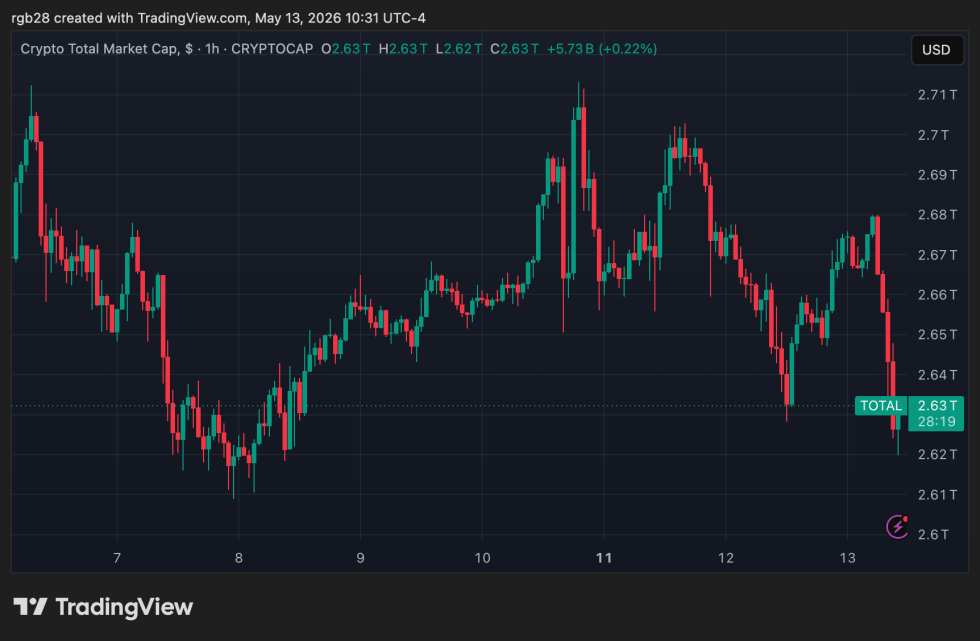
The total crypto market capitalization is at $2.63 trillion in the one-week chart. Source: TOTAL on TradingView


Domande pertinenti

QWhat is the name of the new crypto trading platform launched by Charles Schwab and which two major cryptocurrencies can users trade on it?

AThe new platform is called Schwab Crypto. Users can trade Bitcoin (BTC) and Ethereum (ETH) directly on the platform.

QWhat is the trading fee charged by Charles Schwab on its Schwab Crypto platform, and how does it compare to competitors like Coinbase and Morgan Stanley?

ACharles Schwab charges a 75-basis-point (0.75%) fee on the dollar value of each trade on Schwab Crypto. This is higher than Morgan Stanley's 50 basis points but lower than Coinbase's 60 basis points for its users.

QWhat two US states are currently excluded from accessing the Schwab Crypto platform?

AThe Schwab Crypto platform is available in all US states, excluding New York and Louisiana.

QWhat are the roles of Charles Schwab Premier Bank (CSPB) and Paxos in the operation of the Schwab Crypto platform?

ACharles Schwab Premier Bank (CSPB) serves as the custodian for customers' assets, handling safekeeping and record-keeping. Blockchain infrastructure provider Paxos handles trade execution and sub-custody.

QWhat is the stated strategic goal of Morgan Stanley's crypto launch on E*Trade, according to Jed Finn, its head of wealth management?

AJed Finn stated that the launch is 'much bigger than trading crypto at a cheaper rate,' explaining that their strategy is 'disintermediating the disintermediators.'

Letture associate

Codex Goal Mode Usage Guide: How to Make AI Continuously Pursue a Specific Objective

"Codex Goal Mode: How to Make AI Work Continuously Toward a Specific Goal" OpenAI's Codex "goal mode" (/goal) transforms the AI from a reactive code assistant into a proactive execution agent capable of working autonomously for hours or even days to achieve a defined objective. To maximize its effectiveness, follow these key principles: 1. **Define Clear, Verifiable Exit Criteria:** The goal prompt should be a concise, measurable success condition, not a lengthy specification. Use quantifiable metrics like "reduce build time by 30%" or "achieve 100% test parity." 2. **Provide Initial Guidance and Tools:** Direct Codex toward likely problem areas and specify available tools (e.g., browsers, testing environments) to prevent it from exploring unproductive paths. 3. **Enable Progress Measurement:** Equip Codex with ways to track advancement, such as creating comparison tools for visual tasks or evaluation sets, ensuring it can gauge its own progress. 4. **Use a Realistic Execution Environment:** For tasks like performance optimization, provide access to environments that closely mimic production (e.g., similar configs, databases) to yield valid results. 5. **Be Cautious with Visual Goals:** Avoid vague "pixel-perfect" instructions. Instead, supplement visual references with functional checklists or design system specifications to prevent Codex from obsessing over minor details. 6. **Implement Progress Tracking:** For long-running tasks, have Codex commit code to draft PRs, update progress documents, or send Slack updates to maintain visibility into its work. 7. **Review and Consolidate Results:** Once the goal is met, instruct Codex to review its work, clean up ineffective experimental code, and reflect on what strategies succeeded or failed. Ultimately, using goal mode shifts the developer's role from writing prompts to managing a persistent engineering agent—defining objectives, establishing metrics, configuring environments, and conducting final reviews.

marsbit37 min fa

Codex Goal Mode Usage Guide: How to Make AI Continuously Pursue a Specific Objective

marsbit37 min fa

From Ethereum to AI's 'CROPS': What Exactly Is This 'Slow Variable' That Vitalik Has Repeatedly Emphasized?

Recently, Vitalik Buterin has frequently emphasized the concept of "CROPS," first outlined in the Ethereum Foundation's March mandate as core principles guiding its focus: Censorship Resistance, Capture Resistance, Open Source, Privacy, and Security. CROPS represents Ethereum's commitment to providing foundational capabilities for user sovereignty—enabling asset ownership, identity expression, and coordination without reliance on centralized platforms or surrendering ultimate control. This framework is gaining new urgency with the rise of AI, particularly AI agents managing digital assets and automating transactions. While AI offers convenience, it risks centralizing user data, intent, and control if dependent on opaque, centralized services. Vitalik argues for "CROPS AI"—AI that is open, privacy-preserving, secure, and capable of local execution to maintain user agency. He highlights convergence between "CROPS Ethereum access layers" and "CROPS AI," such as using zero-knowledge proofs for private remote LLM calls and Ethereum RPC reads, ensuring users can access services without exposing sensitive information. Ultimately, CROPS is not just an abstract ideal but a practical guide for Ethereum's development and AI integration. It addresses the critical long-term question: as digital systems grow more powerful, how can users retain control over their privacy, assets, and autonomy? In an AI-driven era, these principles may define Ethereum's enduring value—prioritizing verifiable, secure, and user-centric design over short-term optimizations like speed and cost alone.

marsbit42 min fa

From Ethereum to AI's 'CROPS': What Exactly Is This 'Slow Variable' That Vitalik Has Repeatedly Emphasized?

marsbit42 min fa

Trading

Spot
Futures
活动图片




